
Pluperfect in a Sentence
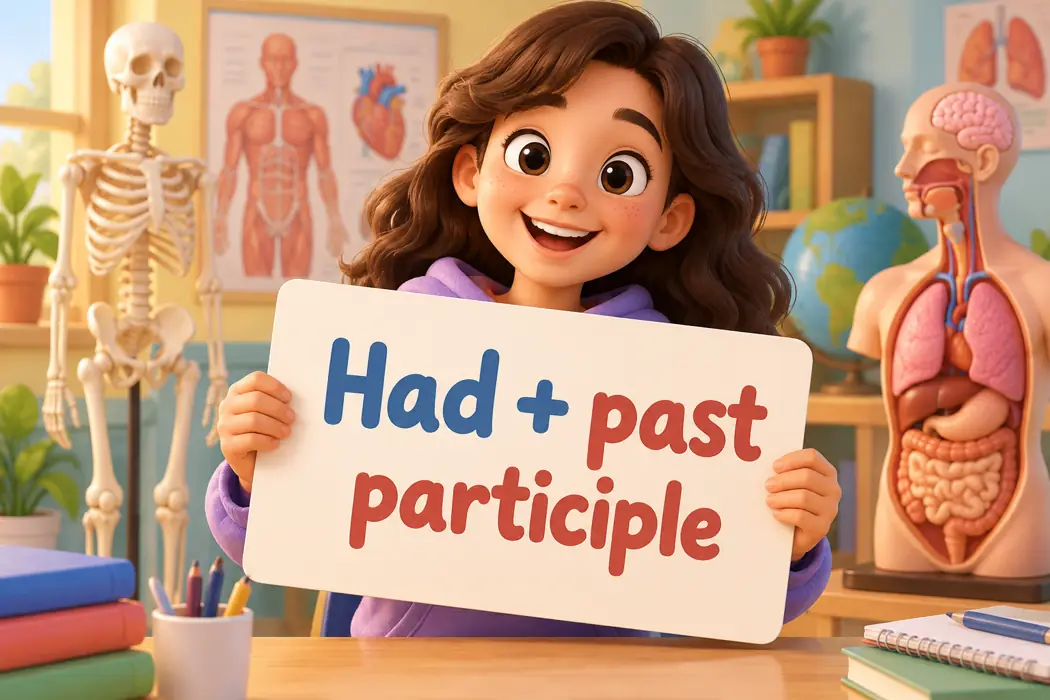
The pluperfect, often called the past perfect in English lessons, uses had + the past participle. It places one event before a particular point or event in the past.


- “By the time the doors opened, the guests had already lined up.”
- “I had not saved the file before the laptop shut down.”
- “Had the team checked the map before it left?”
In each example, a second past event gives a reference point for the earlier action. The tense can also add useful background or show why a later event happened. It is not necessary to use the past perfect every time one event comes first: when words such as before or after make the order clear, the simple past may be enough for the meaning and focus of the sentence.
Build the tense one part at a time
For a positive statement, use a subject, had, and a past participle: “Maya had finished the drawing.” Had remains the same with I, you, he, she, it, we, and they. The main verb supplies the participle. Regular verbs often use the same form as the simple past, such as worked and opened; irregular verbs require forms such as written, eaten, gone, and seen.
To make the statement negative, add not after had: “Maya had not finished the drawing.” The contraction hadn’t is common in conversation. For a question, move had before the subject: “Had Maya finished the drawing?” A short answer can be “Yes, she had” or “No, she hadn’t.” You do not need did alongside had in this construction.
Use a past reference point
A useful way to understand the tense is to imagine two points on a timeline. In “We had packed our bags before the taxi arrived,” packing is earlier and the taxi’s arrival is later. Both belong to the past. The past perfect makes the earlier action easy to identify, especially if the writer mentions the later event first.
“When I reached the station, the train had left” tells us that the departure happened before my arrival. Compare “When I reached the station, the train left.” The second sentence puts the departure at or around that later moment instead. The tense changes the relationship between the events, even though both examples use the same basic vocabulary.
Examples that use the word pluperfect itself
If your assignment asks for pluperfect in a sentence, you can discuss the tense directly. “Our teacher used the pluperfect to describe an earlier action.” “The phrase had forgotten is an example of the pluperfect.” “The editor changed the verb to the pluperfect to clarify the sequence.” In these examples, pluperfect names the grammatical form; it is not the auxiliary verb that creates it.
You can also use pluperfect before another grammar noun: “The exercise contains three pluperfect forms.” In a lesson on English, past perfect is the more familiar term for this construction. Other languages form and use their equivalent tenses differently, so a rule about English had does not automatically describe every language’s pluperfect.
Common errors to avoid
Write “had gone,” rather than “had went,” and “had seen,” rather than “had saw.” The form after had must be the past participle, which may differ from the simple past. A useful revision habit is to check each irregular verb in a dictionary rather than assuming that adding had to any past-tense form will work.
Do not confuse past perfect with present perfect. “I have finished the report” connects a completed action to the present. “I had finished the report when the meeting began” places completion before a past reference point. Have or has signals the present perfect; had signals the past perfect. The participle can stay the same while the time relationship changes.
A sentence with had is not always pluperfect. In “I had a blue bicycle,” had is the simple past of have and describes possession. In “I had repaired the bicycle,” had helps form the past perfect because it is followed by repaired. Look at the whole verb phrase before naming the tense.
Short practice with answers
Complete these examples: “She ___ already written the letter before lunch.” “We had ___ the keys at home.” “___ they checked the timetable?” Suitable answers are had, left, and Had. Now identify the earlier event in “The shop had closed before we arrived.” Closing comes first; arriving supplies the later past reference point.
For a writing exercise, describe two events from yesterday in reverse order. Start with the later event, then explain what had happened earlier: “The room was quiet because everyone had gone outside.” Next, check whether the past perfect clarifies the sequence or adds useful background. Its purpose is to make the relationship clear, rather than to make every past sentence more complicated.
The British Council’s past perfect lesson explains the basic form and its connection to a point in the past. The examples and practice sentences here are original illustrations of that pattern.
Have you ever heard of the pluperfect tense in grammar? This verb form expresses an action that was completed before another past action.
In English, the pluperfect is formed by using the past perfect tense of the auxiliary verb “have” or “had” followed by the past participle of the main verb.
7 Examples Of Pluperfect Used In a Sentence For Kids
- Pluperfect shows an action that happened before another action.
- I had played with my toys before eating dinner.
- She had finished her homework before going to bed.
- They had read a story before going to sleep.
- He had brushed his teeth before watching TV.
- We had cleaned our room before playing outside.
- The cat had slept in the sun before waking up.
14 Sentences with Pluperfect Examples
- During the exam, she had already finished studying the entire syllabus.
- By the time the professor arrived, the students had already submitted their assignments.
- Before the lecture started, we had already discussed the topic in our study group.
- The library was closed because I had forgotten to return the books on time.
- By the time I realized there was a quiz, I had already missed the deadline to register.
- He had already completed the project before the deadline, impressing the professor.
- By the time the meeting began, we had already reviewed the presentation multiple times.
- She had already booked her tickets for the college event before anyone else.
- By the time I reached the bookstore, the textbooks I needed had already been sold out.
- The professor was pleased to see that the class had already started the assigned reading.
- I was disappointed to find out that the seminar had already ended when I arrived late.
- By the time the workshop started, the students had already formed study groups.
- She was relieved that the exam had already been rescheduled as she needed more time to prepare.
- By the time I checked the college website, the scholarship deadline had already passed.
How To Use Pluperfect in Sentences?
Using the Pluperfect tense in a sentence is a great way to talk about an action that was completed before another action in the past. To form the Pluperfect tense, you need the verb “to have” in the past tense (had) and the past participle of the main verb. For example, “I had eaten” or “She had finished.”
Here’s a simple guide to using the Pluperfect in a sentence:
- Identify the two actions in the past you want to talk about.
- Use “had” as the auxiliary verb, followed by the past participle of the main verb.
- Place “had” before the subject of the sentence.
For example:
– Incorrect: “She finished her homework before she had eaten dinner.”
– Correct: “She had finished her homework before she ate dinner.”
Remember, the Pluperfect is often used to show that one action had already been completed before another past action occurred.
In summary, by using the Pluperfect tense, you can clearly indicate the sequence of events that happened in the past. Keep practicing to become more comfortable with using this tense in your writing and conversations.
Conclusion
In summary, sentences with the pluperfect tense convey actions that had already been completed before another past action took place. By using the auxiliary verb “had” followed by the past participle, these sentences help to establish a clear chronological sequence of events in the past. For example, “She had already finished her homework before her friends arrived” demonstrates this tense by showing that the completion of the homework happened before the arrival of her friends.
Overall, mastering the pluperfect tense in writing and speaking allows for more precise expression of past events and their relationships in time. It adds depth and clarity to narratives by specifying the order of actions in the past, helping to paint a more detailed picture of events that have occurred before a certain point in time.