How to use pointing in a sentence
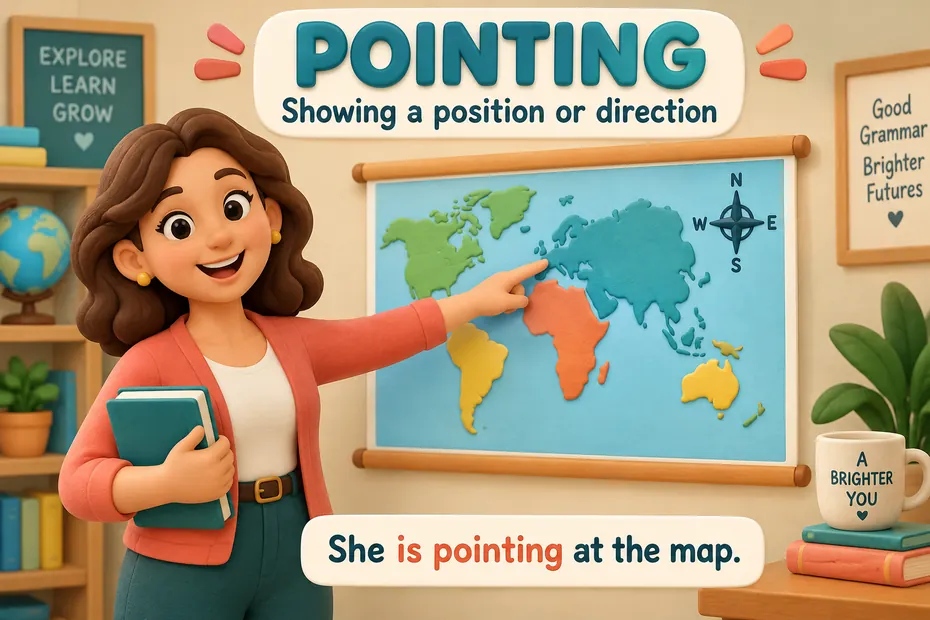
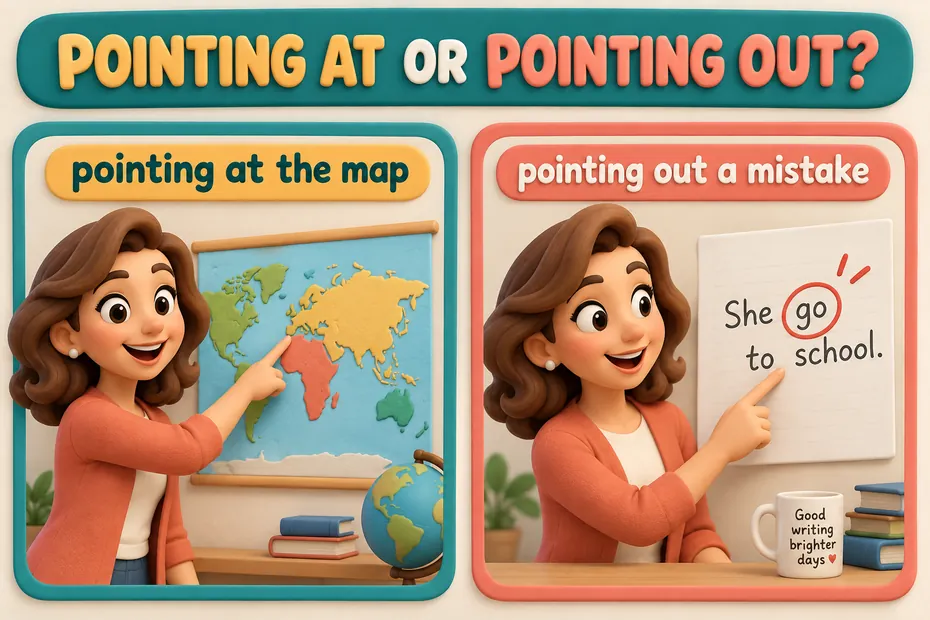
Pointing is the -ing form of the verb point. In everyday use, it can describe showing a position or direction: “She is pointing at the map.” It also appears in phrases such as pointing out a mistake, which means drawing attention to something rather than necessarily making a physical gesture.
The Merriam-Webster entry for point distinguishes indicating a position, directing attention, and facing in a direction. This guide focuses on those common meanings so you can choose a natural construction and make it clear who or what is pointing.
Pointing at, pointing to, and pointing out
| Construction | Example | Meaning |
|---|---|---|
| Pointing at | Maya is pointing at the clock. | Her gesture identifies the clock. |
| Pointing to | The arrow is pointing to the exit. | The arrow indicates a direction or location. |
| Pointing toward | The sign is pointing toward the station. | The sign indicates the station’s direction. |
| Pointing out | The editor is pointing out a missing word. | The editor is bringing the omission to attention. |
| Pointing to evidence | The report is pointing to a change in demand. | The report indicates or supports a conclusion. |
At and to overlap when describing a gesture, so context matters more than a rigid rule. “Pointing at the picture” clearly identifies a target. “Pointing to the doorway” may identify a place or suggest a route. Add detail if readers need to know whether someone is indicating an object or showing where to go.
Point out means to draw attention to something. “She is pointing out the difference between the charts” can describe an explanation in speech or writing. It does not require her to use a finger or pointer.
Use the correct verb form
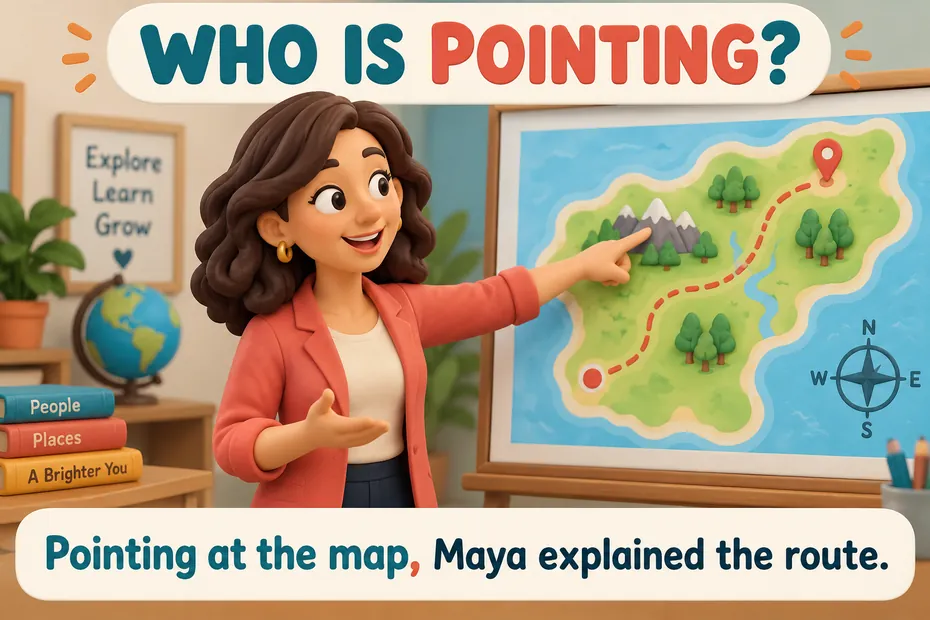
Write points for a simple present action with a singular subject: “The sign points toward the library.” Write pointed for a past action: “The guide pointed at the drawing.” Use is pointing or was pointing when the sentence describes an ongoing action.
“She pointing at the map” is incomplete as an ordinary full sentence. Add the helping verb: “She is pointing at the map.” With a plural subject, write “They are pointing at the map.” Keep the helping verb consistent with the subject and the time of the action.
Pointing can also name an activity: “Pointing at the diagram helped explain the route.” Here the entire phrase is the subject of helped. The sentence does not need an extra is because it already has its main verb.
Make introductory phrases clear
A sentence can begin with an -ing phrase: “Pointing at the map, Maya explained the route.” The person immediately after the comma is Maya, who performs both actions. This gives the opening phrase a clear connection to the main sentence.
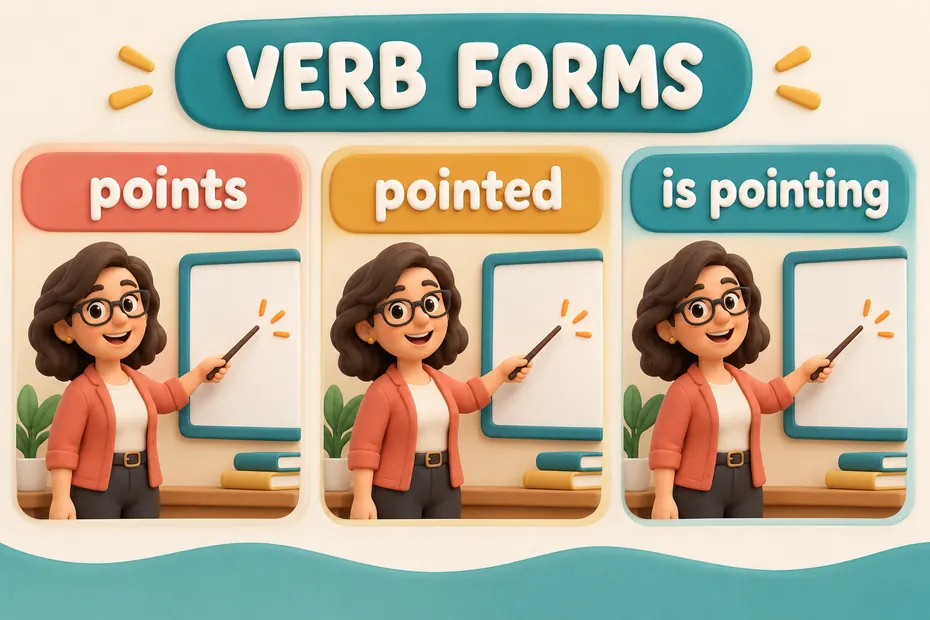
Avoid “Pointing at the map, the route became clear.” The route cannot make the gesture. Revise it to “As Maya pointed at the map, the route became clear” or “Pointing at the map, Maya explained the route.” The revision names the actor and prevents a dangling modifier.
You can keep the same idea without an introductory phrase: “Maya explained the route while pointing at the map.” Choose the order that makes the action easiest to follow rather than using the opening phrase only to make the sentence sound elaborate.
Literal gestures and figurative indications
“The teacher is pointing at the diagram” describes a physical action. “The evidence is pointing to a different explanation” describes what the evidence suggests. The second sentence does not personify the evidence as a hand; it uses a familiar figurative meaning of point.
The older introduction below presents pointing as a general writing concept. For a sentence exercise, it is clearer to begin with the ordinary verb and its constructions. Demonstratives such as this and that can refer to things in writing, but that topic does not define every use of pointing.
Also, pointing toward a speaker is not a requirement for active listening. A better example identifies the purpose of the gesture: “The student was pointing at the diagram while asking a question.” Match the action to the situation instead of treating a gesture as proof of attention.
Natural examples to adapt
- The teacher is pointing at the first word on the board.
- The arrow is pointing toward the entrance.
- Maya was pointing to the place where the path divides.
- The editor is pointing out a repeated sentence.
- Pointing at the photograph, Sam identified the bridge.
- The guide answered our question while pointing to the map.
- The signs are pointing in opposite directions.
- The report is pointing to a need for clearer instructions.
- Pointing out the missing label helped us understand the chart.
- The clock’s minute hand was pointing straight upward.
These examples vary the actor: a person, a sign, an arrow, a report, and a clock hand. Before using one, check whether your subject can perform the literal action or whether the sentence clearly uses a figurative sense.
A quick editing check
Identify the subject, the complete verb, and the target or direction. Then ask whether out is needed. “Pointing at a mistake” can describe physically indicating it; “pointing out a mistake” focuses on making someone notice it. Finally check any opening phrase to make sure the following subject is the person doing the pointing.
Frequently asked questions
Is pointing a verb?
It is an -ing form of point and can be part of a verb phrase, as in “She is pointing.” An -ing phrase can also name an activity, as in “Pointing helped.”
What is a simple example for children?
“Maya is pointing at the moon.” It has a clear subject, complete verb phrase, and target.
Does pointing out require a gesture?
No. It can mean mentioning or explaining something so another person notices it. “He is pointing out a difference” can describe spoken feedback.
Can a sentence begin with pointing?
Yes. “Pointing at the map, Maya explained the route” is clear because Maya performs the action in the introductory phrase.
Have you ever wanted to emphasize a specific detail or direct someone’s attention to a particular spot in a sentence? This is where the concept of “pointing” comes into play. Pointing refers to the act of highlighting a specific element or drawing focus to a particular aspect of a sentence.
In writing, pointing can be achieved through the use of various language tools, such as pronouns, demonstratives, or adverbs. By effectively pointing in your writing, you can guide your readers’ understanding and ensure that the intended message is clear and impactful. Let’s explore how pointing can enhance the clarity and precision of your writing.
7 Examples Of Pointing Used In a Sentence For Kids
- Pointing at the sky, I saw a beautiful rainbow.
- The little girl was pointing at the colorful flowers in the garden.
- Pointing to his favorite toy, the boy asked his mom to play with him.
- She was pointing at the cute puppy wagging its tail.
- Pointing towards the playground, the teacher led the children outside.
- The bird was pointing its beak towards the juicy fruits on the tree.
- Pointing to the letter “A,” the teacher asked the students to repeat after her.
14 Sentences with Pointing Examples
- Pointing out key information during a lecture is essential for taking effective notes.
- When pointing out a mistake in your friend’s assignment, be sure to provide constructive feedback.
- It’s important to practice active listening by pointing towards the speaker during group discussions.
- Use your index finger for pointing at important equations on the blackboard during a math class.
- When pointing out sources in your research paper, make sure to follow the citation guidelines.
- Pointing out the main themes in a literature text can help you analyze it more effectively.
- During a debate, pointing out logical fallacies in arguments can strengthen your own position.
- As a student leader, pointing out the benefits of joining a club can attract new members.
- Pointing towards the library can help lost students find their way around the campus.
- When pointing out a potential study group partner, consider their strengths and weaknesses.
- Pointing out relevant examples in your presentation can make your points more convincing.
- Pointing out opportunities for professional development can help students enhance their skills.
- Always be respectful when pointing out differences of opinion in a classroom discussion.
- In group projects, pointing out each member’s responsibilities can prevent misunderstandings.
How To Use Pointing in Sentences?
Pointing is a way to draw attention or indicate a specific subject in a sentence. To use pointing effectively, follow these steps:
- Identify the subject you want to emphasize or clarify in your sentence.
- Choose an appropriate pointing word to use, such as “this,” “that,” “these,” or “those.”
- Place the pointing word directly before the subject you are referring to. For example, “I love this book.” or “She wants to buy those shoes.”
- Make sure the pointing word agrees in number and gender with the subject it is pointing to. For singular subjects, use “this” or “that.” For plural subjects, use “these” or “those.”
- Use pointing words to avoid repetition within a sentence. Instead of repeating the subject, you can use a pointing word to refer back to it.
By following these steps, you can effectively use pointing in your sentences to make your writing clearer and more concise. Practice using pointing words in sentences to become more comfortable with incorporating them into your writing. Remember that pointing is a useful tool for directing your reader’s attention and adding variety to your sentences.
Conclusion
In writing, sentences with pointing, such as “She indicated the correct path,” help readers understand specific directions or locations. By using verbs like ‘pointed’ or ‘indicated’, writers can guide readers to key information or emphasize important details within a text. These pointed sentences serve as signposts for readers, directing attention to crucial elements and guiding comprehension through a clear and precise communication style.
Whether in a story, report, or instructional guide, sentences with pointing play a crucial role in conveying information effectively. By indicating key points or directions, writers can ensure their audience grasps the main message while maintaining clarity and coherence in their writing.