Pristine describes something so clean or untouched that it looks brand new. To use pristine in a sentence, place it before the noun or after a linking verb: a pristine beach, or the room was pristine. The word implies original condition, not merely tidiness.
Pristine at a glance
- Pristine is an adjective; its rare adverb is pristinely and it has no common verb form.
- It describes conditions, surfaces, copies, ecosystems and anything kept free of marks.
- It sits before a noun or follows a linking verb such as was, looks or remained.
- Pristine implies original, unspoiled condition rather than simple neatness.
- The commonest error is using pristine for an object whose wear contradicts the claim.
What does pristine mean?
Pristine is an adjective meaning spotlessly clean or in original, unspoiled condition. The Cambridge entry for pristine and the Merriam-Webster entry for pristine both record the clean sense and the untouched sense, and the second is the older, stricter one. Three shades of meaning appear in practice.
| Sense | Plain meaning | Example sentence |
|---|---|---|
| Spotlessly clean | Free of any dirt or mark | The kitchen looked spotless after the cleaners left. |
| In original condition | Unworn, as good as when new | The manuscript survived in pristine condition. |
| Untouched by people | Unspoiled, especially of nature | The unspoiled coastline has no roads for miles. |
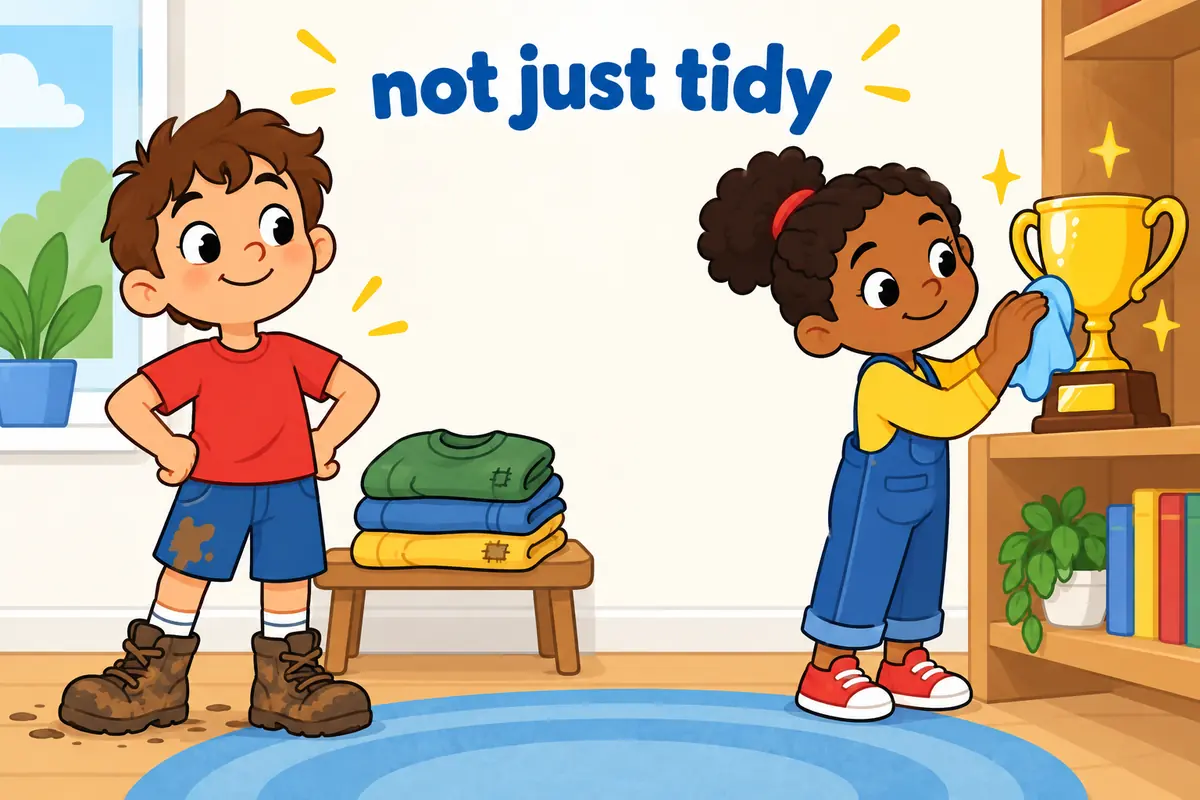
One limitation deserves stating plainly. Pristine is a strong word, and writers sometimes stretch it to mean merely tidy. A desk with neat piles is organised, not pristine, because pristine insists on a finish without marks or wear. The adjective also resists anything that shows use: scuffed boots, a faded cover and a chipped cup all contradict it. Where you mean untouched by people, untouched is the plainer choice.
How do you use pristine in a sentence?
Pristine works as an attributive adjective before a noun or as a predicative adjective after a linking verb, and the fixed phrase in pristine condition is the commonest frame of all.
| Pattern | Example | What it signals |
|---|---|---|
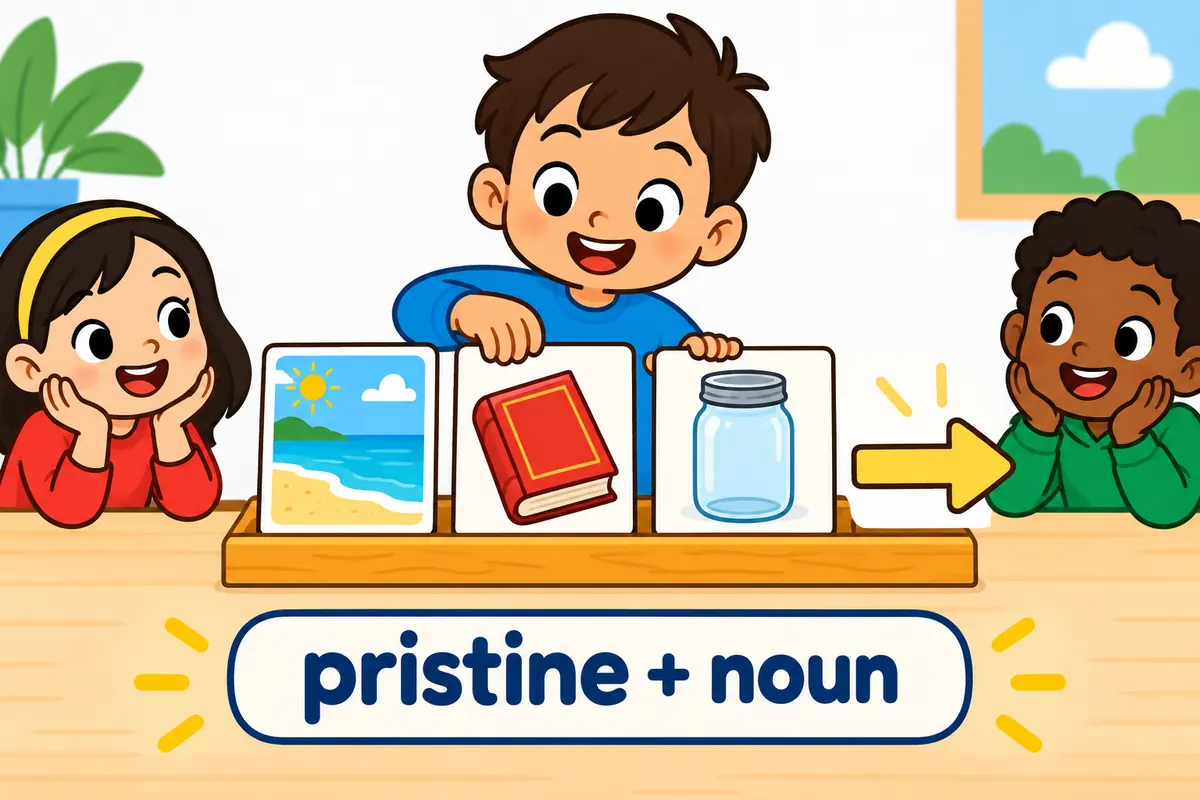
| pristine + noun | a pristine copy of the first edition | Names the thing that is unmarked and new. |
| linking verb + pristine | The snow was pristine at dawn. | Judges the condition without naming a cause. |
| in pristine condition | The violins arrived in pristine condition. | States the condition as a fixed phrase. |
| pristine + environment noun | a pristine rainforest | Carries the untouched-by-people sense. |
| remain or stay + pristine | The path stays pristine in winter. | Emphasises that no damage has occurred. |
The adjective rarely takes a direct object or a preposition. Naming what a thing is pristine of sounds foreign, so writers keep the word close to the noun it describes.
Pristine in a sentence: examples across contexts
Each sentence below keeps the same adjective while the setting changes, and every one names the surface or space being judged.
| Context | Example sentence | Why this works |
|---|---|---|
| Classroom | The new textbooks arrived in pristine condition. | An unmarked object makes the condition visible. |
| Workplace email | Please return the borrowed equipment in pristine condition. | Uses the fixed phrase as a clear instruction. |
| News report | Campaigners want the pristine wetland protected from drainage. | Applies the untouched-nature sense. |
| Travel writing | At sunrise the bay was pristine and utterly silent. | Pairs the adjective with a quiet scene. |
| Academic writing | The archive kept the letters in pristine order. | Extends the word to an unbroken sequence. |
| Real estate | The flat is small but pristine throughout. | Names no single room, so the adjective stands alone. |
| Food writing | The chef insists on pristine ingredients. | Moves the word from surfaces to freshness. |
| Conversation | Her white trainers somehow stayed pristine all term. | The mild surprise makes the word do real work. |
| Environmental science | A pristine sample must not touch the air. | Uses the technical sense of uncontaminated. |
Pristine vs immaculate
Pristine and immaculate both praise condition, but they praise different things. Pristine stresses original, unspoiled state; immaculate stresses perfect cleanliness and freedom from fault.
| Attribute | pristine | immaculate |
|---|---|---|
| Core quality | Original and unspoiled | Perfectly clean |
| Implied history | Little or no use | Cleaned to a high standard |
| Typical subject | Copies, nature, surfaces, samples | Rooms, clothes, records, behaviour |
| What it stresses | Freshness and lack of wear | Spotlessness and order |
| Register | Neutral to formal | Formal |
| Common pairing | pristine condition | immaculate appearance |
Verdict: choose pristine for something that looks untouched and new, and immaculate for something kept perfectly clean.
Word forms and grammar of pristine
Pristine has few forms, which is why learners invent ones that do not exist. The table separates the real forms from the non-standard.
| Form | Part of speech | Example |
|---|---|---|
| pristine | adjective, attributive | a pristine page |
| pristine | adjective, predicative | The page was pristine. |
| more pristine | comparative | The second copy was more pristine than the first. |
| pristinely | adverb, rare | The hall was pristinely kept. |
| pristineness | noun, rare | The pristineness of the sample mattered. |
| pristiner | non-standard | Write more pristine instead. |
| pristined | non-standard | The adjective has no past form. |
Common mistakes with pristine
- Incorrect:
His notes were pristine and piled in neat rows.Correct: His notes were neat and piled in tidy rows. Rule: Pristine means spotless or untouched, not merely organised. - Incorrect:
The worn boots were still pristine.Correct: The worn boots were still sturdy. Rule: Visible wear contradicts pristine. - Incorrect:
The room was very pristine.Correct: The room was absolutely pristine. Rule: Pristine resists the softer degree adverb very. - Incorrect:
a pristine and clean kitchenCorrect: a pristine kitchen. Rule: Clean repeats a meaning the adjective already carries. - Incorrect:
The pristiner copy sold first.Correct: The more pristine copy sold first. Rule: Long adjectives take more, not -er.
Practice using pristine
Work through the six items, then compare your reasoning with the answers rather than only the keys.
- Fill the gap: The snow on the highest field was still ______ at noon.
- Choose the better word: The hospital corridor was (pristine / neat) after the deep clean.
- Correct the error: The faded map was in pristine condition.
- Build a sentence: use in pristine condition about a borrowed library book.
- Spot the register: which belongs in a scientific report, a pristine sample or a super clean sample?
- Rewrite with a linking verb: the newly painted fence.
Answers
- pristine — the untouched snow shows original, unmarked condition.
- pristine — a deep clean produces spotlessness, which is the stronger claim.
- The faded map was fragile and worn — fading contradicts pristine.
- Model answer: The library book came back in pristine condition, with no folded corners.
- A pristine sample — technical writing prefers the precise adjective.
- The newly painted fence was pristine — the linking verb carries the judgement.
The bottom line
Use pristine in a sentence for something spotlessly clean or in original, unspoiled condition, and keep visible wear out of the picture. Two nuances decide most sentences: pristine insists on an unmarked finish rather than neatness, and the fixed phrase in pristine condition carries the strictest sense. For untouched nature, flawless and unblemished are close cousins worth keeping in mind.
Frequently asked questions about pristine
Does pristine always mean spotless?
No. Spotless is only one sense. Pristine more strictly means in original, unspoiled condition, so a rare book can be pristine because it is unworn, even if it has never been washed. When the point is cleanliness rather than newness, spotless or immaculate is the sharper choice.
Can pristine describe a place or a landscape?
Yes. Pristine describes an environment untouched by people, as in a pristine forest or a pristine coastline. This sense is common in travel writing and conservation, where it signals that no road, building or pollution has altered the place. It is a strong claim, so writers use it with care.
How is pristine different from clean?
Clean means free of dirt, which is a modest claim. Pristine means not just clean but in unmarked, original condition, so it adds freshness and lack of wear. A wiped table is clean; a table so untouched that it still gleams is pristine. The two words sit on different levels of intensity.
Can pristine describe a person?
Only loosely. Pristine normally describes objects, surfaces and places, not people. A writer might say her record was pristine, meaning unblemished, but calling a person pristine sounds odd. For people, spotless reputation or clean record is the more natural phrase.
Pristine describes something that is fresh and clean as if new, or a place left in its original, unspoiled condition. For example, “The museum displayed the vase in pristine condition” emphasizes its excellent state; “The hikers reached a pristine cove” suggests a clean, unspoiled environment.
- Object sense: clean and undamaged, as if new.
- Place sense: not developed or changed; unspoiled.
- Common phrase: in pristine condition.
- Precision: pristine does not necessarily prove that an object is unused or that a place has never been visited.
What does pristine mean in a sentence?
Oxford Learner’s Dictionaries defines pristine as fresh and clean as if new, or as not developed or changed from an original condition. The noun it describes reveals which meaning the writer intends.
| Use | Meaning | Example sentence |
|---|---|---|
| Pristine condition | Clean, intact, and nearly new in appearance. | The secondhand camera arrived in pristine condition. |
| Pristine fabric | Fresh-looking and unmarked. | She folded the pristine tablecloth for the celebration. |
| Pristine landscape | Apparently unspoiled or little changed by development. | The guide led us to a pristine stretch of coastline. |
| Pristine record | Unblemished or without a recorded failure, where context supports this figurative use. | The pilot had a pristine safety record. |
How do you use pristine correctly?
Use pristine for a strikingly clean, well-preserved, or unspoiled state, often in the phrase pristine condition. Place it before a noun or after a linking verb: “a pristine room” and “The room remained pristine.”
- Name the object or place being described.
- Choose the intended sense: clean and intact, or unspoiled and unchanged.
- Use a more exact adjective if you mean only one feature, such as spotless for cleanliness or undamaged for condition.
“The whiteboard was spotless” is more specific if the only point is that it has no marks. “The whiteboard was pristine” suggests a broader clean, new-looking condition.

How is pristine different from perfect?
Pristine usually describes condition or an unspoiled state; perfect means having no fault or meeting a standard completely. A pristine object may look new but still have a feature that is not ideal, while a perfect score describes correctness rather than cleanliness.
- Use pristine for a clean, intact collection, surface, or environment.
- Use perfect for an exact result, ideal match, or error-free performance.
- Use untouched only when the point is that something has not been handled or altered.
For nature writing, pristine is often an impression rather than proof of a place’s full history. If a claim about human impact matters, say what was measured or observed instead of treating “pristine” as a technical ecological classification.

Frequently asked questions about pristine
What is a simple sentence with pristine?
“The antique book remained in pristine condition.” The adjective says that the book is remarkably clean and well-preserved, almost as if it were new, without requiring the sentence to claim that the book has never been used.
Is pristine positive or negative?
Pristine is usually positive when it praises an item’s condition or a place’s cleanliness. In environmental writing, it can also imply little human impact, so use it carefully if that implication is not supported by the facts.
What is a synonym for pristine?
Immaculate fits a spotless object or room; unspoiled fits a landscape or setting that has not been developed or damaged. Undamaged is narrower and should be used when cleanliness is not part of the meaning.
Can pristine describe a used object?
Yes. A used item can still be in pristine condition if it remains exceptionally clean and well-preserved. The adjective describes its current state, not necessarily its ownership or use history.
Choose pristine for condition or an unspoiled state
A useful pristine sentence makes clear whether the subject is clean and as-new in condition or apparently unspoiled in its setting. When that meaning is too broad, select a narrower word such as spotless, intact, or undamaged.
Have you ever struggled to find the perfect word to describe something untouched, pure, and unspoiled? Look no further, as the word “pristine” encapsulates just that.
Pristine, an adjective often used to paint a vivid picture of something in its original state, untouched by damage or imperfections. Whether referring to a sparkling clean environment, an untouched natural landscape, or a flawless piece of art, the word “pristine” evokes a sense of beauty and perfection.
7 Examples Of Pristine Used In a Sentence For Kids
- The pristine lake was shimmering in the sunlight.
- The pristine white snow covered the mountains.
- My mother’s pristine saree was very beautiful.
- The pristine garden was filled with colorful flowers.
- The pristine blue sky had fluffy white clouds.
- I love to draw on pristine sheets of paper.
- The pristine beach had golden sand and clear water.
14 Sentences with Pristine Examples
- The college library is known for its collection of pristine books.
- Students are encouraged to maintain the pristine condition of the campus premises.
- He was determined to achieve a pristine score on his final exams.
- The professor emphasized the importance of presenting a pristine project report.
- The campus garden was a pristine spot for students to relax and unwind.
- She found a pristine study spot in the quiet corner of the college campus.
- The college canteen served meals in pristine condition to ensure student health.
- The college auditorium was a pristine venue for hosting cultural events.
- They organized a pristine cleanliness drive on the college campus.
- Students were inspired to pursue careers that would keep the environment pristine.
- The college hostel rooms were kept in pristine condition by the diligent housekeeping staff.
- The college pond was a pristine habitat for various species of aquatic life.
- She always carried a pristine notebook and pen for taking notes in lectures.
- The college gym provided students with the latest equipment in pristine condition for their workouts.
How To Use Pristine in Sentences?
To use the word Pristine in a sentence, you can describe something that is in its original, undamaged, or unspoiled condition. For example, you could say, “The hiker found a pristine waterfall deep in the forest.” This sentence means that the waterfall the hiker discovered was clean, untouched, and in perfect condition.
Another way to use Pristine is in the context of cleanliness or quality. For instance, you might say, “The chef insisted on using only pristine ingredients in her recipes.” In this sentence, the word pristine implies that the chef used only the finest, freshest, and highest quality ingredients.
You can also use Pristine to describe something that is immaculate or spotless. A sentence like, “The car sparkled with a pristine shine after being washed and waxed,” indicates that the car looked extremely clean and polished.
In essence, when incorporating Pristine into a sentence, remember its definition of being pure, clean, or unspoiled. This will help you convey a sense of something being in perfect or impeccable condition. Experiment with different contexts and situations to fully grasp how to effectively use the word Pristine in your writing or speech.
Conclusion
In conclusion, sentences with the keyword “pristine” often describe something clean, unspoiled, and in its original state. These sentences convey a sense of purity and perfection, used to paint vivid pictures of untouched landscapes, flawless environments, or immaculate conditions. The word “pristine” is commonly employed to evoke images of clarity, freshness, and beauty in writing.
By using sentences with “pristine,” authors can create a powerful visual impact on readers, transporting them to scenes of untouched serenity and natural beauty. Whether describing a crystal-clear lake, a newly minted snowfall, or a perfectly preserved artifact, sentences with the word “pristine” invite readers to imagine a world of unblemished splendor and harmonious perfection.