
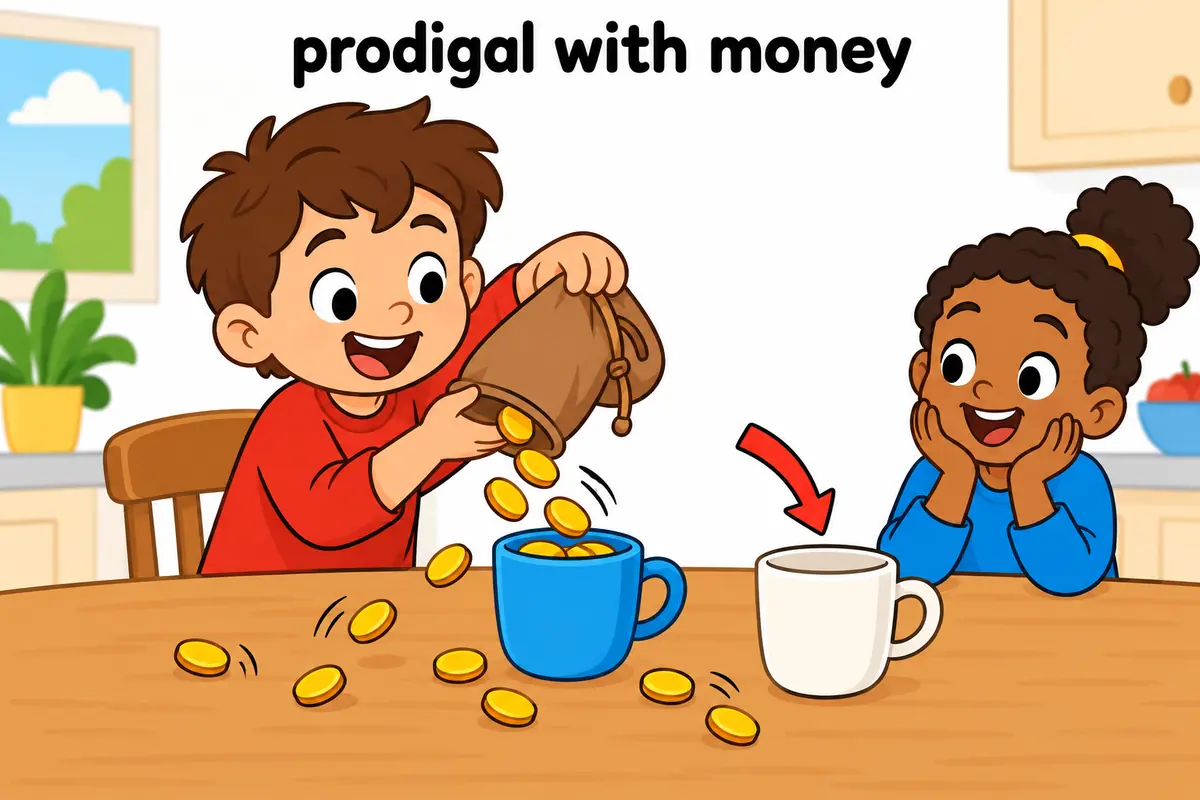
Prodigal is an adjective meaning recklessly wasteful with money, and it describes the spendthrift rather than the homecoming: a prodigal son is one who squandered his share. To use prodigal in a sentence, name what was wasted, because the word always implies loss through excess.
Prodigal at a glance
- Prodigal is chiefly an adjective meaning recklessly wasteful; it also works as a noun.
- Its related forms are prodigally and the noun prodigality.
- It usually appears with spending, lifestyle, son or the phrase prodigal with money.
- Prodigal carries a moral tone, so it belongs to commentary, sermons and literary writing.
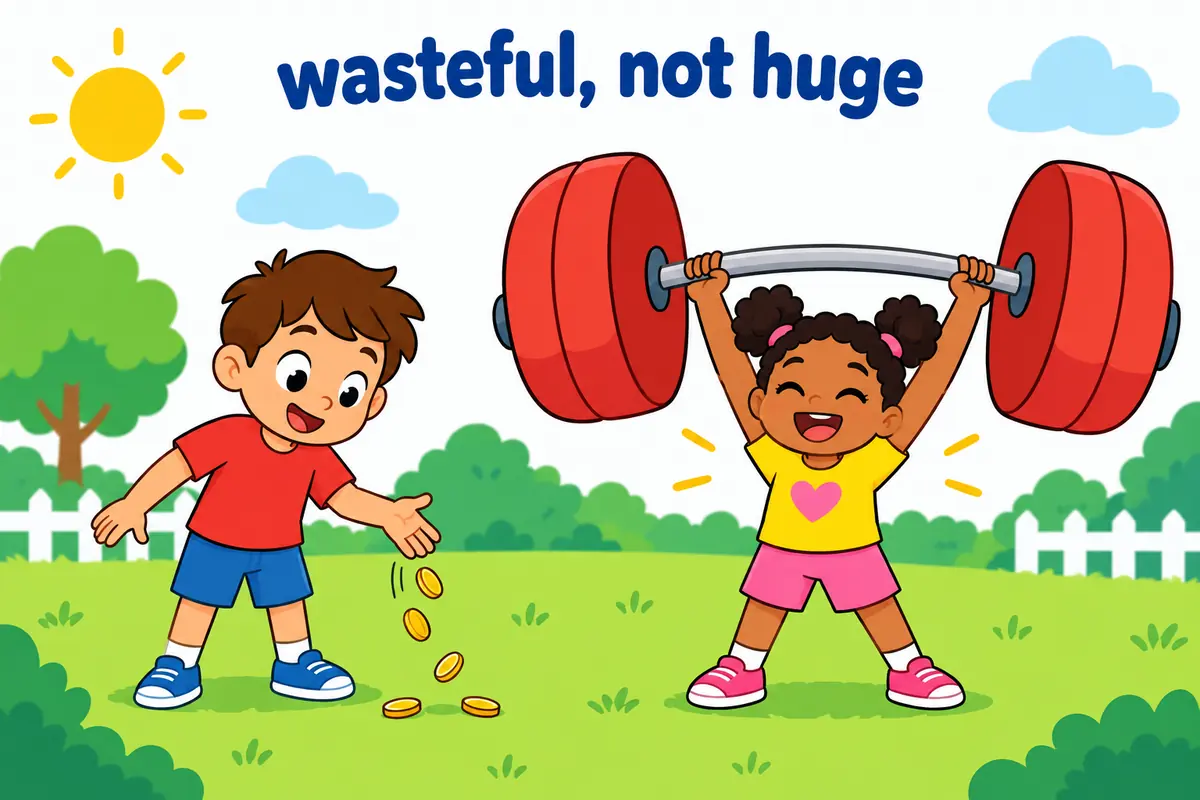
- The commonest error is reading it as a synonym for prodigious, which means huge.
What does prodigal mean?
Prodigal is an adjective meaning recklessly wasteful or extravagant, especially with money. The Cambridge entry for prodigal keeps the idea of careless spending, and the famous parable of the prodigal son turns on exactly that waste before any return. A second, literary sense means lavishly generous.
| Sense | Plain meaning | Example sentence |
|---|---|---|
| Wasteful with money | Spending carelessly and losing what is spent | His prodigal habits emptied the account in a year. |
| Lavishly giving | Giving far more than is needed | She was prodigal with her praise of the young team. |
| Noun: a spendthrift | A person who wastes money | The prodigal returned with nothing but stories. |
One limitation matters. Prodigal does not mean wandering, lost or returning; the son in the parable comes home, but the adjective describes the earlier waste. Where you only mean wasteful, a profligate spender or extravagant is often clearer and carries less baggage.
How do you use prodigal in a sentence?
As an adjective, prodigal sits before a noun or after a linking verb, and it usually takes with to name the resource being wasted. As a noun, it takes an article.
| Pattern | Example | What it signals |
|---|---|---|
| prodigal + noun | Their prodigal spending worried the bank. | The commonest attributive use. |
| be + prodigal + with + noun | He was prodigal with his first salary. | Names what is squandered. |
| the prodigal + verb | The prodigal finally came home. | Noun use, echoing the parable. |
| prodigal + of + noun | The host was prodigal of both food and time. | Literary sense of giving freely. |
Prodigal in a sentence: examples across contexts
The word keeps its moral edge in every register, from a fable to a finance column. A plainer near-synonym such as an extravagant purchase could replace it in the middle rows.
| Context | Example sentence | Why this works |
|---|---|---|
| Fable | The prodigal son left with a fortune and returned without it. | Uses the fixed phrase that carries the whole story. |
| Workplace email | The audit flagged a prodigal use of the training budget. | Formal tone suits a written warning. |
| News report | Critics called the stadium a prodigal use of public money. | Attributes the judgement to named critics. |
| Finance writing | A prodigal quarter left the firm short of cash. | Applies the adjective to a period of spending. |
| Literary essay | The novel pairs a prodigal hero with a frugal sister. | Sets the word against its natural opposite. |
| Sermon | Even the prodigal is welcomed home in the story. | Noun use with a moral frame. |
| Conversation | Calling him prodigal was polite; everyone knew he was reckless. | Shows the word as a gentle rebuke. |
| History essay | The court’s prodigal patronage drained the treasury. | Extends waste from money to favour. |
| Review | The film is a prodigal feast of colour and noise. | Uses the lavish sense without a moral point. |
Only the review row drops the disapproval, which shows how firmly the moral sense anchors the word.
Prodigal vs prodigious
Prodigal and prodigious share a Latin root and sound alike, so they are constantly confused. A prodigious effort is a huge or remarkable one; a prodigal one is wasteful. The first measures size, and the second judges conduct.
| Attribute | prodigal | prodigious |
|---|---|---|
| Core meaning | Recklessly wasteful | Enormous or extraordinary |
| What it judges | How money or resources are used | How large or impressive something is |
| Typical collocates | spending, habits, son | effort, talent, appetite |
| Emotional tone | Disapproving or pitying | Admiring or neutral |
| Register | Moral, literary and financial | General and formal |
Verdict: use prodigal for careless waste and prodigious for sheer size, and never swap them in the phrase prodigal son.
Word forms and grammar of prodigal
The adjective has a regular adverb and a formal noun, plus one fixed phrase that keeps the word alive in modern English.
| Form | Part of speech | Example |
|---|---|---|
| prodigal | adjective | His prodigal habits cost him the house. |
| prodigal | noun | The prodigal was welcomed at the gate. |
| prodigally | adverb | He spent prodigally for two years. |
| prodigality | noun, formal | Her prodigality became a family legend. |
| prodigal son | fixed phrase | The story of the prodigal son ends in forgiveness. |
| prodigious | adjective, different meaning | She has a prodigious memory for names. |
The related page on a young prodigy shows the same root used for talent rather than waste, which is another reason the forms must be kept apart.
Common mistakes with prodigal
- Incorrect:
The prodigal traveler wandered for years.Correct: The wasteful traveler squandered his savings for years. Rule: Prodigal means wasteful, not wandering. - Incorrect:
She prodigalled her whole allowance.Correct: She squandered her whole allowance. Rule: Prodigal is not a verb, so it cannot be inflected. - Incorrect:
His prodigious spending alarmed the family.Correct: His prodigal spending alarmed the family. Rule: Prodigious means huge; prodigal means wasteful. - Incorrect:
They wasted a prodigal amount of fuel.Correct: They wasted a prodigious amount of fuel. Rule: For pure quantity, prodigious is the adjective. - Incorrect:
He was prodigal for his money.Correct: He was prodigal with his money. Rule: The adjective takes with, not for, before the resource.
Practice using prodigal
- Fill the gap: The young heir’s ______ spending soon attracted the bank’s attention.
- Choose the better word: The explorer made a (prodigal / prodigious) journey across the ice.
- Correct the error: She prodigalled every penny of the inheritance.
- Build a sentence: use be prodigal with about a first wage.
- Spot the register: which suits a serious editorial — a prodigal use of public funds, or a totally wasteful splurge?
- Rewrite with the noun: He was prodigal and lost everything.
Answers
- prodigal — the adjective marks spending as careless before the noun.
- prodigious — the journey was remarkably large, not wasteful.
- She squandered every penny of the inheritance — prodigal is an adjective, not a verb.
- Model answer: He was prodigal with his very first wage and had nothing left by Friday.
- A prodigal use of public funds — the formal adjective fits the editorial tone.
- His prodigality cost him everything — the formal noun names the wasteful habit.
The bottom line
Use prodigal in a sentence for reckless waste, especially of money, and name the resource with with. Two nuances decide most sentences: the word judges conduct rather than size, so it is not a synonym for prodigious, and it does not mean wandering or lost. The fixed phrase prodigal son carries its own story, where a spendthrift squanders an inheritance and comes home.
Frequently asked questions about prodigal
Does prodigal mean lost or returning?
No. Prodigal means recklessly wasteful, and the returning son of the famous parable is only one famous example of a spendthrift. The story supplies the setting, but the adjective itself describes the waste. People often mistake the word for wandering or lost because the son travels far from home.
Is prodigal a noun or an adjective?
Prodigal works as both. The adjective describes wasteful spending, as in prodigal habits. The noun names a wasteful person, usually with an article, as in the prodigal returned. The adverb is prodigally, and the formal noun for the habit is prodigality, which appears mostly in older and literary prose.
What is the difference between prodigal and prodigious?
Prodigal means wasteful, and prodigious means enormous or extraordinary. They share a root and sound alike, which causes most of the confusion. A prodigal budget is spent carelessly, while a prodigious budget is simply very large. When you mean size, reach for prodigious; when you mean waste, use prodigal.
Can prodigal be used positively?
Rarely, and only in the literary sense of giving lavishly, as in prodigal with praise. Even there the word suggests excess rather than wise generosity. In ordinary modern writing, prodigal carries disapproval, so a positive sentence about thrift or careful giving needs a different adjective such as generous.
Have you ever heard of the term “prodigal”? This adjective is often used to describe someone who is reckless and extravagant in spending money or resources.
Prodigal behavior often leads to financial difficulties and wastefulness. It signifies a pattern of lavishness and extravagance that can have negative consequences in the long run.
7 Examples Of Prodigal Used In a Sentence For Kids
- Prodigal means someone who spends a lot of money.
- The prodigal son in the story wasted all his money.
- The prodigal peacock had beautiful feathers.
- The farmer was happy when his prodigal cow returned home.
- The tree bore fruits in a prodigal amount.
- The prodigal rabbit had many carrots to eat.
- The king was known for his prodigal generosity.
14 Sentences with Prodigal Examples
- Prodigal spending on unnecessary items can lead to financial problems for college students.
- It is important for college students to avoid prodigal behavior and stick to a budget.
- Some college students may indulge in prodigal shopping sprees during festivals or sales.
- Attending multiple parties every weekend can result in a prodigal lifestyle for some college students.
- The temptation to be prodigal with food delivery orders can be hard to resist for college students.
- It’s essential for college students to avoid prodigal habits in order to save money for future endeavors.
- Developing a prodigal reputation can be detrimental for college students seeking financial support.
- Striking a balance between socializing and avoiding prodigal spending can be challenging for college students.
- Some college students may feel pressured to keep up with their peers’ prodigal spending habits.
- Prodigal use of credit cards can lead college students into debt traps.
- Avoiding prodigal use of resources can help college students contribute to sustainability efforts.
- Splurging on luxury items may lead to a prodigal lifestyle for some college students.
- It’s important for college students to practice financial discipline and avoid prodigal behavior.
- Being mindful of prodigal tendencies can help college students make responsible financial decisions.
How To Use Prodigal in Sentences?
To use Prodigal in a sentence, begin by identifying a context where you want to convey the meaning of extravagance or wastefulness. For example, you can use it to describe someone who spends money recklessly on unnecessary things.
Here is an example sentence using Prodigal:
“Despite living on a tight budget, Sarah’s prodigal spending habits often left her with little savings at the end of each month.”
Another way to use Prodigal is to describe someone who is very generous or lavish in their giving. For instance:
“The millionaire was known for his prodigal donations to various charities, helping countless people in need.”
It’s important to note that Prodigal can have both negative and positive connotations, so make sure your sentence reflects the appropriate context. Take a moment to consider whether you want to highlight wastefulness or generosity when using this word.
Incorporating Prodigal into your vocabulary can help you express a range of ideas related to extravagance, generosity, or excess. Practice using it in different sentences to become more comfortable with its usage and to enhance your communication skills.
Conclusion
In conclusion, the use of prodigal in sentences amplifies the theme of wastefulness and extravagance. From descriptions of prodigal spending habits to tales of prodigal sons returning home, this word conveys a sense of excess and recklessness. Whether used in a positive or negative context, sentences with prodigal highlight the consequences of living beyond one’s means and the importance of responsible behavior. Overall, the word prodigal serves as a potent reminder of the perils of squandering resources and the significance of prudence in decision-making.


