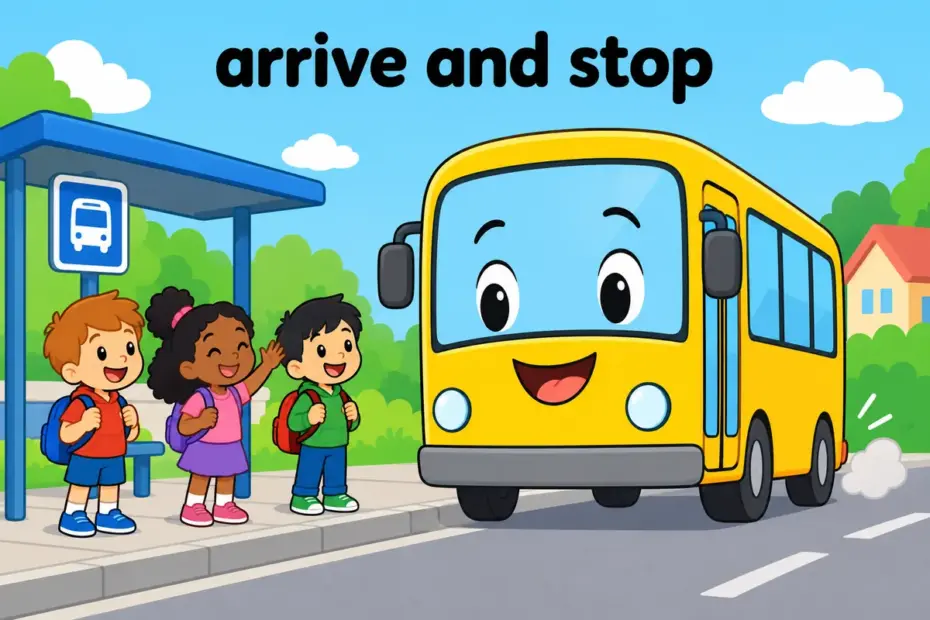
Pull in means to arrive and stop, for a bus or train, and it also means to attract or earn money, an audience or support. To use pull in in a sentence, name the vehicle or the thing attracted: “The bus pulled in at nine.” In the earning sense the object may sit between the verb and particle.
Pull in at a glance
- Pull in is a phrasal verb with three common senses: arrive, attract or earn, and restrain.
- The travel sense is intransitive, as in the train pulled in on time.
- The attract sense is transitive, as in the film pulled in huge crowds.
- The particle can move in the transitive senses: pull the crowds in.
- The commonest error is using pull in where pull over or pull into is needed.
What does pull in mean?
Pull in is a phrasal verb meaning to arrive and stop, or to attract and earn, or to draw someone into an activity. The Cambridge entry for pull in records the arrival sense first, and the examples below keep the different subjects apart, because a train and a film do not behave in the same way.
| Sense | Plain meaning | Example sentence |
|---|---|---|
| Arrive and stop | A vehicle reaches a place and halts | The last train pulled in just before midnight. |
| Attract or earn | Bring in people, money or support | The concert pulled in a record crowd. |
| Draw in or involve | Persuade someone to join | They pulled in two local firms as sponsors. |
| Restrain | Tighten control over a horse or team | The rider pulled in the reins on the final bend. |
One limitation is worth stating. Pull in is not a synonym for every kind of stopping. A driver who leaves the road stops, but the phrasal verb for that is pull over, and a vehicle that turns into a driveway pulls into a place. Where the sentence only needs a general stop, stopped is the safer word.
How do you use pull in in a sentence?
The verb is intransitive when a vehicle arrives and transitive when something is attracted or restrained. In the transitive senses it is separable, so a pronoun object must sit between the two parts: pull them in, never pull in them. The table marks where the particle may move.
| Pattern | Example | What it signals |
|---|---|---|
| subject + pull in | The ferry pulled in at dawn. | Intransitive arrival; no object is possible. |
| pull in + object | The festival pulled in thousands. | Attract or earn; object after the particle. |
| pull + object + in | The festival pulled thousands in. | Same meaning; required when the object is a pronoun. |
| pull in + amount | The film pulled in forty million. | Earnings sense with a figure. |
| pull in + reins | She pulled in the reins. | Restrain sense, fixed with a horse or team. |
When a vehicle reaches a platform, arrive on time is the neutral alternative, and it removes the small ambiguity about stopping that pull in carries.
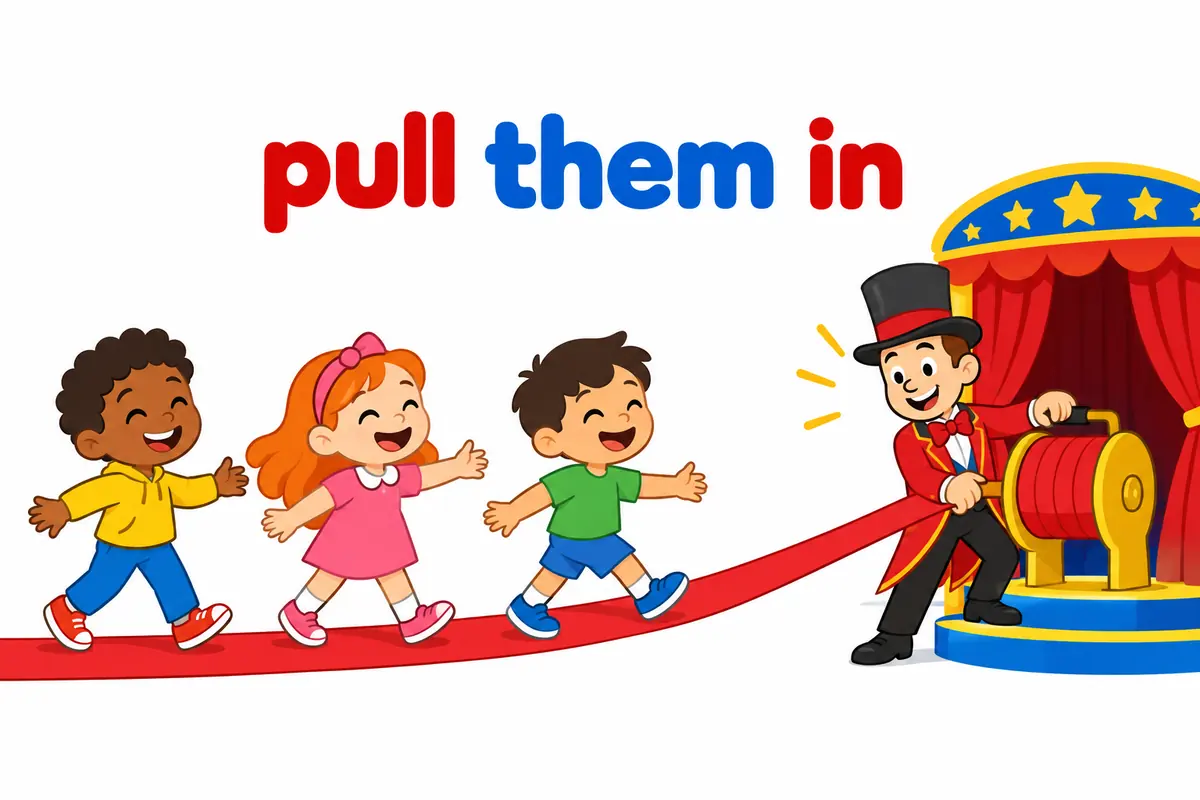
Pull in in a sentence: examples across contexts
Pull in reads as travel writing in one sentence and as business writing in the next. Each example below signals its sense through the subject, which is the detail a reader needs to choose the right meaning.
| Context | Example sentence | Why this works |
|---|---|---|
| Travel writing | Our sleeper pulled in at a station lit by one lamp. | A train as subject makes the arrival sense clear. |
| News report | The blockbuster pulled in a record opening weekend. | Money as the object fixes the earning sense. |
| Business email | The campaign pulled in twice the leads we forecast. | Names the resource that was attracted. |
| Sports report | The captain pulled in the reins after the early goal. | Uses the restrain sense for a team. |
| Conversation | We pulled in just as the rain started. | First person travel use, natural in speech. |
| Marketing note | The pop-up stall pulled in curious passers-by. | People as object show the attracting force. |
| Charity appeal | The concert pulled in enough to fund a new van. | Links the amount to its purpose. |
| Diary entry | The coach pulled in beside a field of sheep. | Keeps the arrival sense concrete. |
Two of these sentences are intransitive and the rest take an object, and the difference is always the subject rather than the particle. The verb also shares its base with pull out of a station, its natural opposite.
Pull in vs pull over
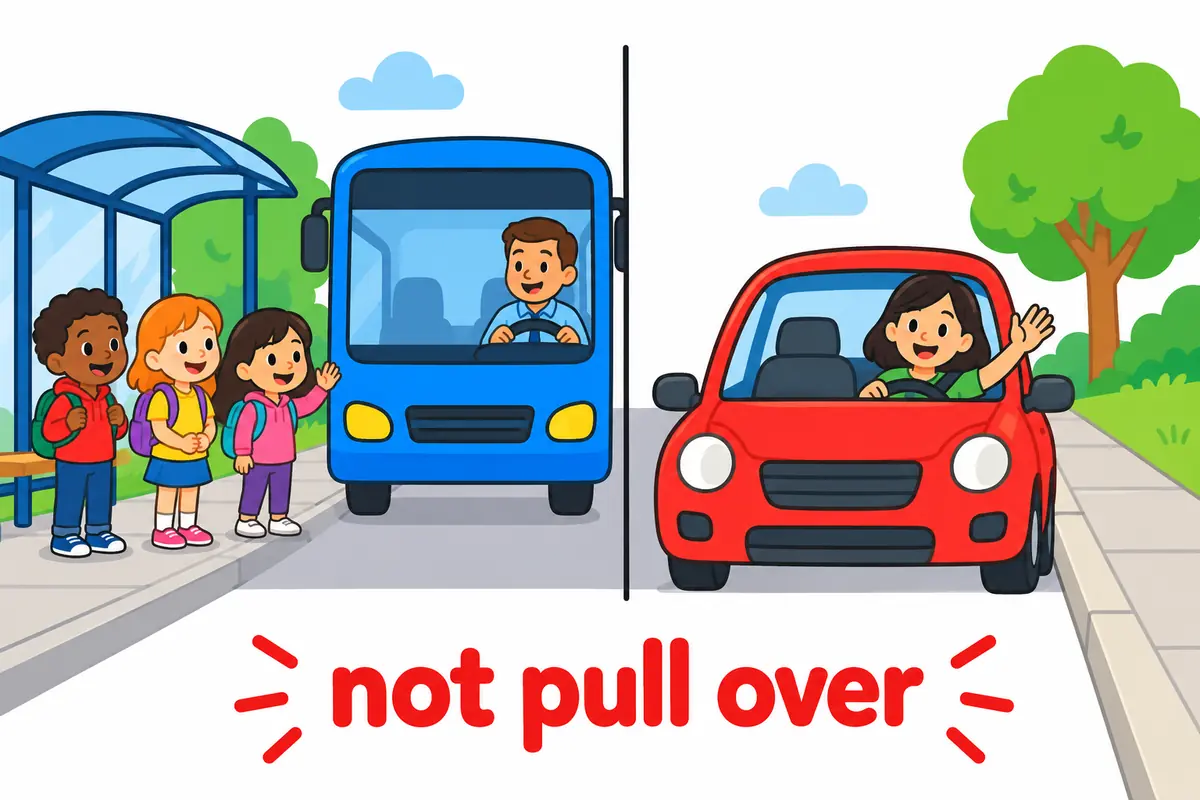
Learners often reach for pull in when they mean pull over, and the two describe different manoeuvres. Pull in is what a scheduled vehicle does at a stop, while pull over is what any driver does at the side of the road. Park the car is the third choice, for leaving the vehicle for a while.
| Attribute | pull in | pull over |
|---|---|---|
| Core action | Arrive and stop at a place | Move to the side and stop |
| Typical subject | Bus, train, ferry at a stop | Car, taxi, driver |
| Implied place | A named stop or terminal | The kerb or hard shoulder |
| Is it scheduled | Often, for public transport | No, usually sudden |
| Register | Neutral, common in reports | Neutral, common in instructions |
Verdict: use pull in for a bus or train reaching its stop, pull over for a car leaving the traffic, and park when the vehicle will wait.
Word forms and grammar of pull in
Pull in inflects regularly, and the hyphenated noun names a roadside stopping place rather than an arrival. The table lists the verb forms alongside the particles that change the meaning completely.
| Form | Part of speech | Example |
|---|---|---|
| pull in | phrasal verb, base | Buses pull in every ten minutes. |
| pulls in | verb, third person | The show pulls in a young crowd. |
| pulled in | verb, past and participle | The train pulled in an hour late. |
| pulling in | verb, present participle | The ferry is pulling in now. |
| pull-in | noun, hyphenated | We waited in a pull-in beside the road. |
| pull off | phrasal verb, different meaning | She pulled off a surprise win. |
Only the base verb is shared across the family. Pull off a win means to succeed at something difficult, and it has nothing to do with transport.
Common mistakes with pull in
- Incorrect:
The car pulled in to the kerb to let the ambulance pass.Correct: The car pulled over to the kerb to let the ambulance pass. Rule: Leaving traffic for the side is pull over; pull in is for arriving at a stop. - Incorrect:
The bus pulled in the station.Correct: The bus pulled into the station. Rule: The arrival sense takes into before the destination, not a bare object. - Incorrect:
The film pulled in them.Correct: The film pulled them in. Rule: A pronoun object must sit between pull and in. - Incorrect:
The show pulled in.Correct: The show pulled in a huge crowd. Rule: The attract sense is transitive, so it needs an object. - Incorrect:
We pulled in the reins on the car.Correct: We pulled in the reins on the horse. Rule: The restrain sense belongs to a horse or team, not a car.
Practice using pull in
Work through the six items, then read the reasons rather than only the keys.
- Fill the gap: The night train ______ at six and emptied onto the platform.
- Choose the better word: The car (pulled in / pulled over) to let the fire engine pass.
- Correct the error: The festival pulled in them from three counties.
- Build a sentence: use pull in + amount about a charity concert.
- Spot the register: which belongs in a transport timetable note — the ferry pulls in at seven, or the ferry turns up around seven?
- Rewrite with arrive: The coach pulled in an hour late. Use arrive instead.
Answers
- pulled in — the train is the subject of the intransitive arrival sense.
- pulled over — a car leaves traffic for the side, which is pull over.
- The festival pulled them in from three counties — a pronoun object sits between pull and in.
- Model answer: The charity concert pulled in over ten thousand pounds.
- The ferry pulls in at seven — a timetable prefers the scheduled verb.
- The coach arrived an hour late — arrive drops the idea of stopping at a specific place.
The bottom line
Use pull in in a sentence when a vehicle arrives and stops, or when something attracts money, a crowd or support. Two details decide most sentences: the arrival sense is intransitive and takes into before a destination, while the attract sense is transitive and separable, so a pronoun object sits in the middle. For a car leaving traffic, pull over is the correct verb.
Frequently asked questions about pull in
Is pull in one word or two?
The phrasal verb is two words, pull in, as in the bus pulled in late. A hyphenated noun, pull-in, names a small stopping place beside a road. Keep the spellings apart, because only the two-word form works as a verb in a sentence.
What is the difference between pull in and pull over?
Pull in means a vehicle arrives and stops at a place such as a station or stop. Pull over means a driver moves to the side of the road and stops, often because of a problem or an emergency vehicle. A bus pulls in on schedule, while a car pulls over suddenly.
Can pull in be separated?
Yes, but only in the transitive senses such as attracting or earning. You can say the show pulled the crowds in or the show pulled in the crowds. When a pronoun is the object, separation is required, so the film pulled them in is correct and the film pulled in them is not.
Can pull in be used about money?
Yes. Pull in commonly means to earn or attract money, as in the film pulled in forty million. The subject is usually an event, a product or a person, and the amount follows the verb. Use earn when you want a plainer tone and no suggestion of drawing people in.
Do you ever find yourself struggling to gain someone’s interest or attention in a conversation? This is where the phrase “pull in” comes into play.
When we “pull someone in” during a discussion or interaction, we engage them effectively, capturing their focus and drawing them closer to the topic at hand. This expression is commonly used to describe the act of captivating someone’s attention or interest in a compelling manner.
7 Examples Of Pull In Used In a Sentence For Kids
- Pull in the rope to open the curtains.
- Let’s pull in the kite from the sky.
- Can you help me pull in the chair closer?
- We need to pull in the laundry from the clothesline.
- It’s time to pull in all the toys from the floor.
- Please pull in the bike before it rains.
- Don’t forget to pull in your stomach during this exercise.
14 Sentences with Pull In Examples
- Pull in all the information from different sources to create a comprehensive research paper.
- Before the exam, make sure to pull in all the essential study materials to ace your tests.
- It is crucial to pull in your focus during lectures to grasp complex concepts easily.
- Don’t forget to pull in your classmates for group study sessions to improve understanding of difficult subjects.
- To succeed in your college projects, you need to pull in your creativity and critical thinking skills.
- When preparing for presentations, it’s important to pull in relevant facts and statistics to support your arguments.
- To stand out in campus activities, you have to pull in your organizational skills to manage events effectively.
- Pull in your friends to form study groups and share knowledge for better academic performance.
- In preparation for internships, it’s essential to pull in your networking skills to connect with industry professionals.
- To excel in extracurricular activities, you should pull in your time management skills to balance academics and participation.
- When working on projects, it’s necessary to pull in your team members to collaborate efficiently and achieve common goals.
- Pull in your creativity to develop innovative solutions during college hackathons and competitions.
- To enhance your resume, you need to pull in relevant internships and volunteer experiences to showcase your skills.
- Pull in your perseverance and determination to overcome challenges and hurdles during your college journey.
How To Use Pull In in Sentences?
To use Pull In in a sentence, consider the following example: “I need to pull in the deadline for our project to ensure everything is completed on time.”
In this sentence, Pull In is used to indicate the action of bringing something closer or earlier than planned. It can also refer to gathering or attracting something towards a specific direction or time.
When using Pull In in a sentence, ensure that it is followed by a clear object or subject to indicate what is being brought closer or earlier. This will help in conveying the intended meaning accurately.
Remember that Pull In can be used in various contexts such as scheduling, logistics, or even attracting attention. Make sure to understand the context in which you are using the phrase to ensure it is being used correctly.
To further enhance your sentence construction skills, practice using Pull In in different scenarios to become more familiar with its usage and nuances. This will help you communicate effectively and convey your message distinctly when using this phrase.
Conclusion
In conclusion, the examples of sentences with the keyword “pull in” demonstrate its versatility in conveying different meanings. Whether used to describe the action of drawing something closer physically or metaphorically, such as pulling in customers or pulling in a crowd, this phrase captures a broad range of contexts. The sentences illustrated how “pull in” can be used in various scenarios to describe attracting or engaging individuals or objects towards a particular point or direction.
Overall, the collection of sentences provided showcases the flexibility and effectiveness of the phrase “pull in” in communication. From describing physical movements to explaining the act of drawing attention or interest, this keyword proves to be a useful tool for expressing the concept of bringing something closer or attracting it towards a specific target.


