Pull up means to stop a vehicle, to lift something, or to bring something closer. To use pull up in a sentence, decide which sense you need: “The taxi pulled up at the kerb,” or “Pull up a chair.” The particle often moves, so pull your socks up and pull up your socks are both correct.
Pull up at a glance
- Pull up is a phrasal verb; its forms are pulls up, pulled up and pulling up.
- The vehicle sense is intransitive, and the lift, chair and file senses are transitive.
- With a pronoun object the particle must come after the pronoun: pull it up, never pull up it.
- The British sense to pull someone up means to reprimand them for a fault.
- The commonest error is using pull up where pull over is meant, or the reverse.
What does pull up mean?
Pull up is a phrasal verb with several distinct senses, and the grammar changes with each one. The most common is a vehicle stopping, which needs no object. The others involve raising or bringing something, which do need one. The Cambridge entry for pull up separates the stop sense from the lift sense, and keeping them apart prevents most errors.
| Sense | Plain meaning | Example sentence |
|---|---|---|
| Stop a vehicle | Arrive somewhere and come to a halt | The bus pulled up outside the library. |
| Lift or raise | Move something upward | She pulled up her hood against the rain. |
| Move closer | Bring a chair nearer and sit down | Pull up a chair and join us. |
| Reprimand (British) | Tell someone they have done wrong | The coach pulled him up for missing training. |
| Bring onto a screen | Open a file or record to read | Pull up last month’s accounts. |
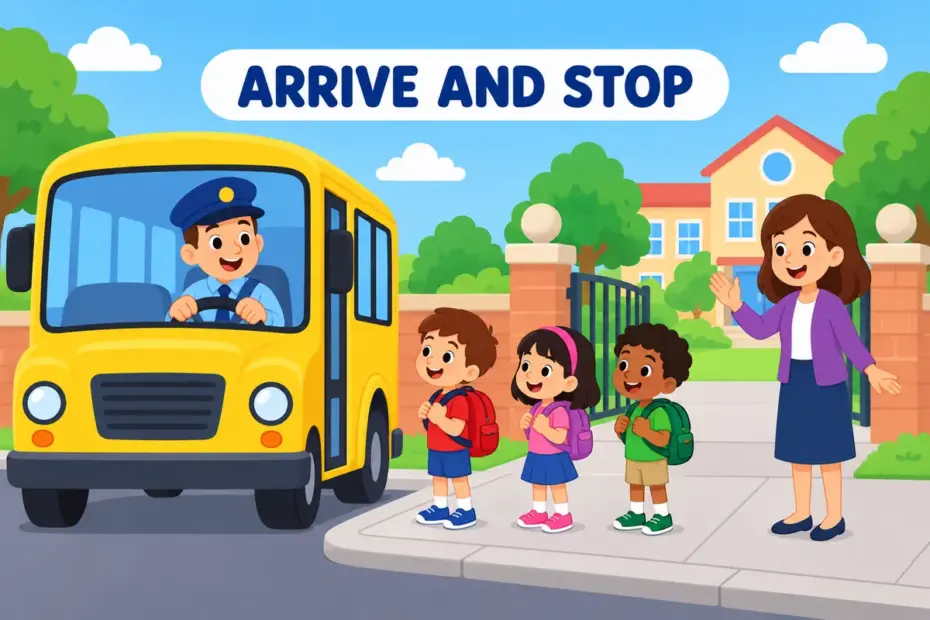
The intransitive stop sense is the one that pairs naturally with arrive at the gate: both describe a vehicle reaching a place, but pull up adds that it stopped there. That extra halt is the whole point of the verb.
One limitation is worth stating. Pull up is informal, so a formal report prefers stop or halt, and the reprimand sense is chiefly British. It also does not mean the same as pull over, which specifically means moving to the side of the road.
How do you use pull up in a sentence?
The grammar depends on the sense. The vehicle sense has no object and keeps the particle glued on; the lift, chair and file senses are transitive and separable, so the object may sit between the verb and the particle. Five patterns cover the common cases.
| Pattern | Example | What it signals |
|---|---|---|
| vehicle + pull up (+ place) | The van pulled up at the gate. | Intransitive; the particle cannot move. |
| pull up + object | Pull up your hood. | Transitive and separable: pull your hood up. |
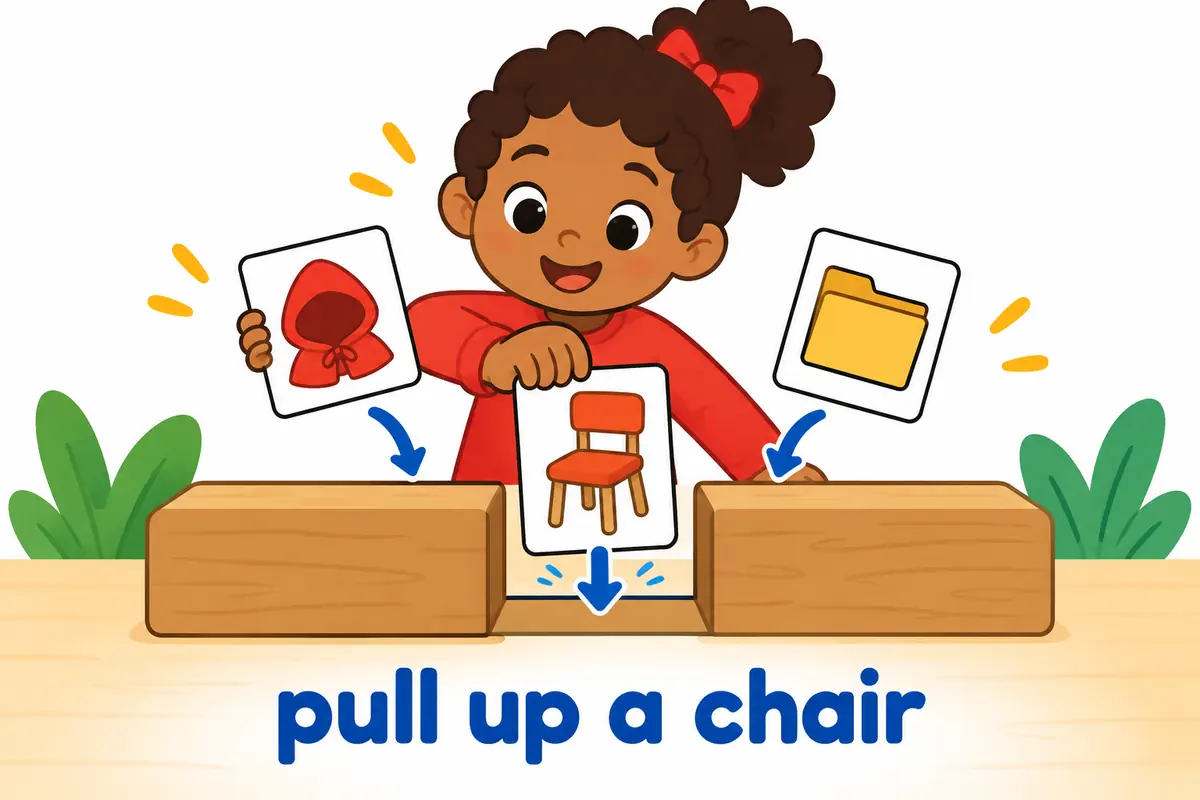
| pull up + a chair | Pull up a chair. | A fixed invitation meaning come and sit. |
| pull + someone + up (on / for) | The boss pulled her up on the error. | A pronoun object must precede the particle. |
| pull + object + up (file / record) | Pull the report up on screen. | Separable; the computing sense. |
The related phrasal verb pull in to the bay also describes a vehicle stopping, but pull in usually implies leaving the road for a bay or lay-by, while pull up simply means stopping wherever you are.
Pull up in a sentence: examples across contexts
Pull up changes meaning and grammar with context. The nine sentences below keep the same phrasal verb while moving from a school gate to a computer screen, and each one shows whether an object is present.
| Context | Example sentence | Why this works |
|---|---|---|
| Classroom | The coach pulled the team up for arriving late. | The British reprimand sense with a pronoun before up. |
| School gate | A yellow bus pulled up just as the bell rang. | Intransitive vehicle sense, no object needed. |
| Workplace email | Please pull up the sales figures before the meeting. | The computing sense, separable in a formal request. |
| News report | The car pulled up outside the court at noon. | A place phrase rather than an object. |
| Driving lesson | Pull the car up beside the kerb, then switch off. | Separable object between pull and up. |
| Home conversation | Pull up a chair and tell me about it. | The fixed idiom for moving closer to sit. |
| Sports commentary | The rider pulled up her horse short of the fence. | The transitive stop sense with an animal. |
| Office chat | She pulled up her sleeve and got to work. | The literal lift sense, physical and clear. |
| IT helpdesk | The technician pulled up the log and read the error aloud. | The computing sense with a definite object. |
Only the vehicle sentences lack an object. That single grammar fact explains most of the confusion learners feel about this verb.
Pull up vs pull over
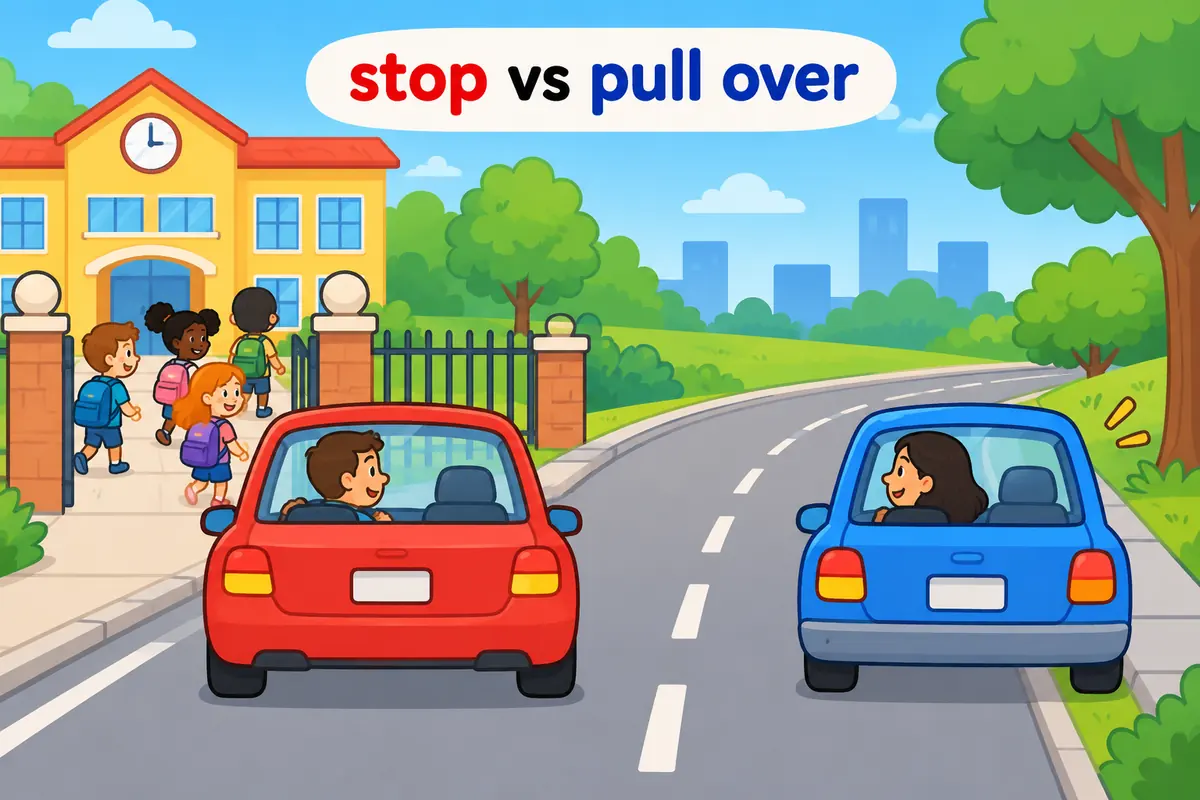
Pull up and pull over both describe a vehicle stopping, and the difference is where it stops. Pull up means to stop where you are, often at a destination. To pull over for the police means to leave the road and stop at the side, usually because you were told to.
| Attribute | pull up | pull over |
|---|---|---|
| Core meaning | Stop a vehicle at a place | Steer to the side and stop |
| Where | At a destination or kerb | At the roadside or hard shoulder |
| Reason | You have arrived | You are told to stop or must stop |
| Verb type | Intransitive in this sense | Intransitive |
| Formality | Neutral to informal | Neutral, common in driving |
Verdict: choose pull up when the car reaches its destination and stops, and pull over when it leaves the traffic lane to stop at the side. A taxi pulls up at your door; a driver pulls over for an ambulance.
Word forms and grammar of pull up
As a phrasal verb, pull up inflects on the verb and keeps the particle fixed in form. The separable senses allow the object to move, which is the single most important rule for learners. The table also shows the hyphenated noun, which is a different word class.
| Form | Part of speech | Example |
|---|---|---|
| pull up | phrasal verb, base form | The cars pull up in a neat line. |
| pulls up | phrasal verb, third person singular | The bus pulls up every ten minutes. |
| pulled up | phrasal verb, past and past participle | She pulled the blind up. |
| pulling up | phrasal verb, present participle | The van is pulling up now. |
| pull-up | noun (hyphenated) | He did ten pull-ups on the bar. |
| pull back | phrasal verb, different particle | Troops pulled back from the ridge. |
The particle can strand in the passive, as in the chair was pulled up to the table. In contrast, pull back uses the same base verb but signals retreat, so the particle rather than the verb carries the meaning.
Common mistakes with pull up
- Incorrect:
He pulled up it from the folder.Correct: He pulled it up from the folder. Rule: A pronoun object always goes between the verb and the particle. - Incorrect:
The train pulled up the platform.Correct: The train pulled up at the platform. Rule: The intransitive stop sense takes a place phrase with at. - Incorrect:
The teacher pulled up him for talking.Correct: The teacher pulled him up for talking. Rule: The reprimand sense puts the person before up. - Incorrect:
The ambulance pulled up to the side to let us pass.Correct: The ambulance pulled over to let us pass. Rule: Leaving the lane is pull over, not pull up. - Incorrect:
Pull up it your hood.Correct: Pull your hood up. Rule: The object follows pull and precedes up; never double the object.
Practice using pull up
Work through the six items, then check the reasoning rather than only the answer.
- Fill the gap: The car ______ outside the school and the children ran to it.
- Choose the better word: The fire engine had to (pull up / pull over) to let the traffic clear.
- Correct the error: Please pull up them on the screen.
- Build a sentence: use pull someone up on about a friend who keeps interrupting.
- Spot the register: which belongs in a driving manual – pull over at the next lay-by, or pull up at some point, whatever?
- Rewrite with a pronoun: Pull up the window. Use it instead of the window.
Answers
- pulled up – the vehicle stops at the destination, with no object.
- pull over – the engine leaves the road to the side, so the other particle is needed.
- Please pull them up on the screen – the pronoun goes before the particle.
- Model answer: I had to pull Sam up on interrupting the speaker.
- Pull over at the next lay-by – a manual is precise and uses the correct particle.
- Pull it up – the pronoun sits between pull and up.
The bottom line
Use pull up in a sentence when a vehicle stops at a place, or when something is lifted or brought closer. The two nuances that decide most sentences are these: the vehicle sense has no object and keeps the particle fixed, while the lift and file senses let the object sit between pull and up. To draw up outside is the closest formal phrase, and it keeps the same stopped-at-a-place meaning.
Frequently asked questions about pull up
Is pull up one word or two?
As a verb it is always two words: pull up. The single hyphenated form pull-up is a noun for the arm exercise, as in ten pull-ups. Keeping the verb two words and the noun hyphenated is the rule that careful editors apply, and it prevents confusion between stopping and exercising.
What is the difference between pull up and pull over?
Pull up means a vehicle stops at a place, often a destination. Pull over means it leaves the traffic lane and stops at the side, usually because the driver was told to. A taxi pulls up at your door, while a driver pulls over for a police car.
Where does the object go in pull up?
In the separable senses the object goes between pull and up: pull the blind up. A pronoun object must go there, so pull it up is correct and pull up it is wrong. The vehicle sense has no object at all, which is why the particle cannot move in that use.
Is pull someone up a British phrase?
The reprimand sense, meaning to tell someone they have done wrong, is chiefly British. Americans usually say call someone out or tell someone off. The grammar is the same either way: the person goes before the particle, as in pulled him up on his lateness.
Have you ever found yourself struggling to properly explain or understand the phrase “pull up” in English? “Pull up” is a common phrasal verb that can have various meanings depending on the context in which it is used. It often involves physically moving something towards oneself or lifting something up.
In casual conversation, “pull up” can refer to activities like retrieving information on a computer or arriving at a destination in a vehicle. Learning how to use “pull up” in different situations can help you communicate more effectively in English.
7 Examples Of Pull Up Used In a Sentence For Kids
- Pull up the zipper on your jacket.
- Pull up your socks before going out to play.
- Pull up the weeds in the garden.
- Pull up the curtains to let in some sunlight.
- Pull up a chair and join us for storytime.
- Pull up your sleeves before helping with the cooking.
- Pull up a seat and let’s have a chat.
14 Sentences with Pull Up Examples
- When you pull up the notes from the last lecture, make sure to review them thoroughly before the next class.
- You can pull up the study material online if you need to refer to it while preparing for exams.
- Remember to pull up the syllabus for each subject at the beginning of the semester to stay organized.
- Before starting your assignment, you should pull up the guidelines to avoid any mistakes.
- Make sure to pull up the timetable for upcoming exams so you can plan your study schedule accordingly.
- It’s a good idea to pull up past question papers to practice for your exams.
- You can pull up educational videos online to help you understand complex topics better.
- Don’t forget to pull up your attendance record to check if you need to improve your attendance in any subject.
- You should pull up your course registration details to ensure you are enrolled in the right classes.
- Before a group study session, it’s beneficial to pull up the shared document to see what topics will be discussed.
- Pull up the campus map to find the location of your next lecture hall or meeting spot.
- Are you able to pull up the assignment template from your email so we can start working on it?
- Let’s pull up the presentation slides so we can practice our presentation before the final submission.
- Make sure to pull up the research articles you saved for your project to incorporate them into your work.
How To Use Pull Up in Sentences?
Pull Up can be used as a phrasal verb in a sentence to describe the action of lifting oneself upward using one’s arms. For beginners, here is a helpful guide on how to use Pull Up in a sentence:
-
Begin by selecting the subject of the sentence, which is the person who will be performing the action of pulling up.
-
Next, identify the object of the sentence, which is usually the specific object or place the person is pulling themselves up to.
-
Use Pull Up in the sentence by placing the subject at the beginning, followed by the verb Pull Up, and then the object. For example: “She decided to pull up on the strong branch to get a better view of the beautiful sunset.”
-
Remember to adjust the tense of the verb Pull Up based on the subject and the time frame of the action. For example, “He will need to pull up with all his strength to complete the pull-up challenge.”
-
Practice using Pull Up in different sentences to become more comfortable with incorporating it into your everyday language.
In conclusion, understanding how to use Pull Up in a sentence is essential for clear communication. By following this guide, beginners can confidently use Pull Up to describe the action of lifting oneself upward using one’s arms in various contexts.
Conclusion
In summary, sentences with “pull up” often refer to physically lifting something towards oneself, like pulling up a zipper or pulling up a chair. Metaphorically, “pull up” can also mean to bring something forward or to improve a situation. These sentences can be used in various contexts, from describing everyday actions to discussing personal growth or progress.
Whether it’s about a simple action of pulling up a sleeve or a deeper reflection on bettering oneself, sentences with “pull up” convey a sense of movement, improvement, and initiative. By understanding the different ways this phrase can be used, we can appreciate the versatility and richness it adds to our language and expressions.


