Pull back means to move away from a place or position, and it also means to withdraw from a plan, a claim or a fight. The verb is intransitive when troops pull back and transitive when you pull something back. Here is the pattern in one line: “The climbers pulled back from the ridge.”
Pull back at a glance
- Pull back is a phrasal verb; it behaves as one unit but keeps a separable object.
- Without an object it means retreat; with a pronoun the pronoun goes between pull and back.
- The verb is neutral in register, at home in news, sport, business and speech.
- The fixed prepositions are from for withdrawal and on for reducing effort.
- The commonest error is writing pull back the border when to or from is required.
What does pull back mean?
Pull back is a phrasal verb meaning to move backwards or away from a position, and, figuratively, to withdraw from a commitment or opinion. The Cambridge entry for pull back lists both the physical and the figurative senses, and the split matters: a retreat is something a group does, while pulling back from a deal is something a decision-maker does. Where the withdrawal is formal, withdraw a statement and its relatives sound more official than the plain phrasal verb.
| Sense | Plain meaning | Example sentence |
|---|---|---|
| Physical retreat | Move back from a place or an edge | The soldiers pulled back to the river. |
| Withdraw from a plan | Step away from a commitment or claim | The company pulled back from the merger. |
| Move something backwards | Draw an object towards you | She pulled back the curtain. |
| Reduce an effort | Become less aggressive or less involved | The editor pulled back on the criticism. |
One limitation is worth naming. Pull back says nothing about distance, cause or authority, so it can leave a reader unsure who ordered the retreat and how far it went. In a legal filing or a shareholder notice, withdraw is the safer word because it names a formal act rather than a movement.
How do you use pull back in a sentence?
Pull back is separable, and that single fact explains most of its grammar. The particle back may follow the object or precede it, but a pronoun object must sit between the two parts, so you pull it back and never pull back it. Without an object the verb is intransitive and the two words are locked together.
| Pattern | Example | What it signals |
|---|---|---|
| pull back (no object) | The crowd pulled back when the gate opened. | Intransitive retreat; the two words stay together. |
| pull + object + back | He pulled the branch back to let her pass. | Separable; the object sits in the middle. |
| pull back + object | He pulled back the branch to let her pass. | Same meaning; a full noun may follow the particle. |
| pull it back | She pulled it back from the fire. | A pronoun must go between verb and particle. |
| pull back from + noun | The team pulled back from the agreement. | Withdrawal from a commitment. |
| pull back on + noun | The bank pulled back on new lending. | Reducing effort, spending or pressure. |
Two other pull verbs use the same base in quite different ways, which is why learners mix them up. To pull out of a market means to leave it completely, while to pull off a rescue means to succeed at something difficult.
Pull back in a sentence: examples across contexts
Pull back keeps one shape while its subject moves from soldiers to shoppers. The nine sentences below show how little the words change and how much the setting does.
| Context | Example sentence | Why this works |
|---|---|---|
| News report | Government forces pulled back from the northern border overnight. | Names the direction with from, which readers expect in reporting. |
| Business email | We pulled back from the second round of talks. | The figurative sense fits a decision to pause talks. |
| Sports commentary | The defence pulled back to protect a one-goal lead. | A tactical retreat that the object-less form handles neatly. |
| Everyday speech | Pull the blind back so the sun comes in. | The pronoun rule does not apply to a full noun object. |
| Classroom | The class pulled back from the wasps and waited by the door. | A concrete reason makes the retreat easy to picture. |
| Finance report | Funds pulled back on property lending last quarter. | On marks reduced exposure rather than a change of place. |
| Political speech | The minister refused to pull back from the promise. | From keeps the withdrawal tied to a stated commitment. |
| Photography | She pulled back the lens to widen the frame. | A technical object shows the motion sense clearly. |
| Personal decision | He bounced back quickly after pulling back from the race. | Pairs the retreat with the recovery that followed. |
Only the last row places the narrator in the sentence, and it still keeps the verb object-less. That is the safest default for a learner to copy.
Pull back vs withdraw
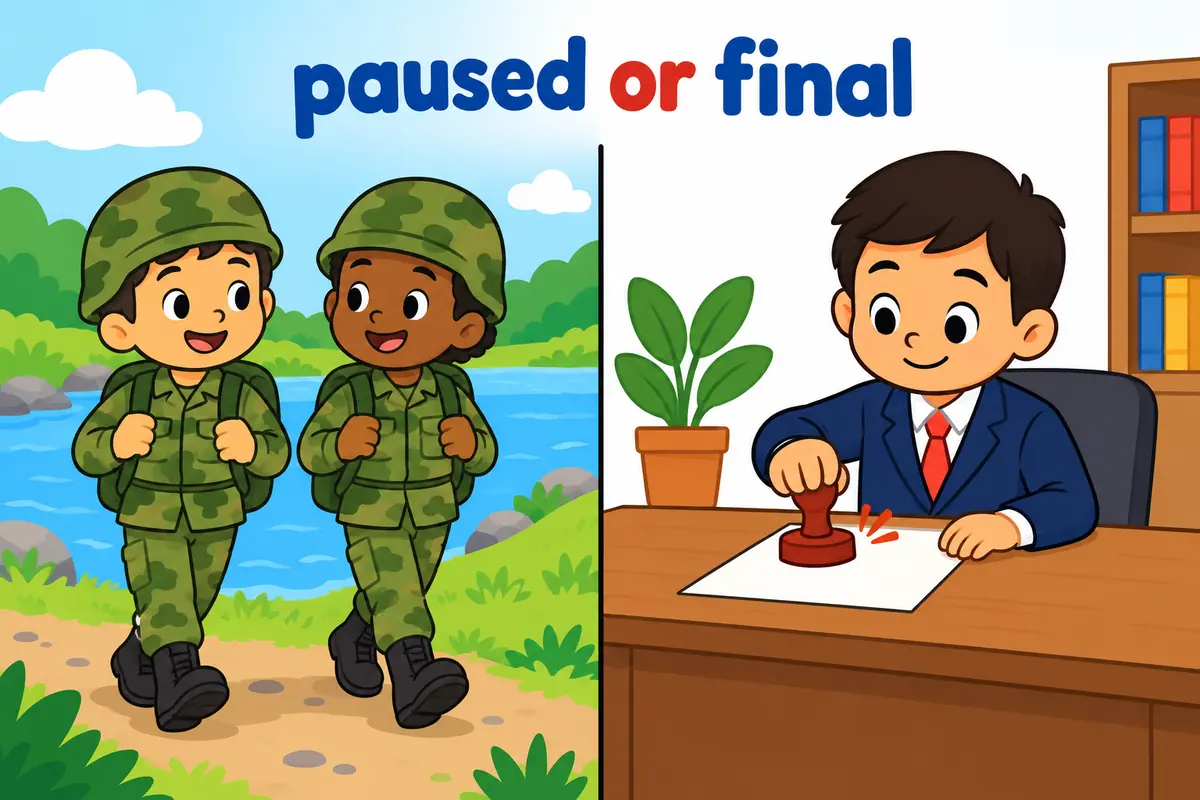
Pull back and withdraw describe the same movement at different levels of formality. A full retreat by an army and a quiet pullback by a shop both fit the phrasal verb, but a formal notice to a court needs withdraw.
| Attribute | pull back | withdraw |
|---|---|---|
| Core meaning | Move away, physically or in a decision | Remove oneself or something, formally |
| Register | Neutral, spoken and journalistic | Formal, legal and official |
| Transitivity | Can be intransitive or separable | Usually transitive, takes a clear object |
| Typical subject | Troops, teams, firms, crowds | An individual, a party, a bidder |
| What it implies | Gradual or cautious movement | A completed, declared act |
Verdict: use pull back for movement that can still change, and withdraw when a person or body makes a formal, finished decision.
Word forms and grammar of pull back
The parts of pull back do not change, but the derived nouns do, and they are written differently. Keep the two-word verb apart from the one-word back off from a threat, which means to stop pressuring someone rather than to move.
| Form | Part of speech | Example |
|---|---|---|
| pull back | phrasal verb, base form | They pull back every winter. |
| pulled back | verb, past and past participle | The unit pulled back at noon. |
| pulling back | verb, present participle | The firm is pulling back on hiring. |
| pullback | noun, one word | Analysts expected a sharp pullback. |
| pull-back | attributive adjective, hyphenated | They ordered a pull-back of troops. |
| pull back | non-standard noun, two words | Marked as wrong; use pullback. |
Common mistakes with pull back
- Incorrect:
The army pulled back the border.Correct: The army pulled back to the border. Rule: Pull back is not prepositional, so use to or from before a place. - Incorrect:
She pulled back it.Correct: She pulled it back. Rule: A pronoun object goes between the verb and its particle. - Incorrect:
The firm pulled back of the deal.Correct: The firm pulled back from the deal. Rule: Withdrawal takes from, never of. - Incorrect:
They announced a pull back of the offer.Correct: They announced a pullback of the offer. Rule: The noun is written as one word, pullback. - Incorrect:
The government pulled back in its pledge.Correct: The government pulled back from its pledge. Rule: From links the verb to the commitment it leaves.
Practice using pull back
Work through the six items, then read the reasons rather than only the answers.
- Fill the gap: The firefighters ______ from the wall as the roof began to sag.
- Choose the better word: The witness decided to (pull back / withdraw) her statement before the hearing.
- Correct the error: He pulled back it before the wave broke.
- Build a sentence: use pull back + from about a company leaving a sponsorship.
- Spot the register: which belongs in a court filing — the claimant pulled back from the claim, or the claimant withdrew the claim?
- Rewrite with a pronoun: The guard pulled back the gate. Use it instead of the gate.
Answers
- pulled back — no object is present, so the two words stay together.
- withdraw — a statement before a hearing is a formal act, which favours the more official verb.
- He pulled it back before the wave broke — the pronoun must sit between pull and back.
- Model answer: The company pulled back from the sponsorship after the first season.
- The claimant withdrew the claim — a filing needs the formal verb and its completed sense.
- Model answer: The guard pulled it back to let the cart through.
The bottom line
Use pull back in a sentence for a retreat you can still reverse, whether the subject is a crowd, a team or a firm. The two details that decide most sentences are separability, which forces a pronoun between pull and back, and the prepositions: from marks withdrawal from a commitment, while on marks reduced effort. For a finished, formal act, withdraw remains the stronger choice.
Frequently asked questions about pull back
Is pull back one word or two?
As a verb it is always two words, pull back, as in the troops pull back. The noun is a single word, pullback, and the attributive adjective is hyphenated, pull-back. Mixing these up is the most common written error, so check whether the word is doing a verb job or a noun job.
Can you say pull back it?
No. A pronoun object must sit between the verb and the particle, so you say pull it back, not pull back it. A full noun is more flexible: you may write pull back the curtain or pull the curtain back, and both sound natural. Only the pronoun is fixed in place.
What does pull back on mean?
Pull back on means to reduce effort, spending or pressure rather than to move anywhere. A bank pulls back on lending when it writes fewer loans, and an editor pulls back on criticism when the tone softens. Use from instead when somebody withdraws altogether from a commitment.
Is pull back formal enough for business writing?
Pull back works in ordinary business email and news writing, but it can sound too casual in contracts and filings. Where a formal decision is being recorded, choose withdraw, which names a declared act. Keep pull back for plans that may still change, such as talks or spending.
“Pull back” is a common phrasal verb that is used in various contexts to describe the action of physically moving something backwards or retracting. It can also be used metaphorically to indicate reducing or scaling down an activity, plan, or commitment.
In everyday language, the term “pull back” can be employed to depict situations where something is being withdrawn, retreated, or minimized. Whether it’s about physically pulling something back or metaphorically scaling back on a decision or project, understanding how to use this versatile phrase can enhance your communication skills.
7 Examples Of Pull Back Used In a Sentence For Kids
- Pull back the string to make the kite fly high.
- Please pull back the toy car to make it go forward.
- Let’s pull back the curtain and look outside.
- We need to pull back our sleeves before washing our hands.
- Can you pull back the hair tie to make a ponytail?
- Remember to pull back your chair before standing up.
- It’s important to pull back the bowstring before shooting the arrow.
14 Sentences with Pull Back Examples
- After a long semester, sometimes it’s important to **pull back** and take a break before diving into studies again.
- If you’re feeling overwhelmed with assignments, it’s okay to **pull back** and reassess your priorities.
- Before exams, it can be helpful to **pull back** from social activities and focus on studying.
- Instead of burning out, it’s better to recognize when you need to **pull back** and give yourself time to relax.
- When faced with a difficult decision, it’s wise to **pull back** and carefully consider all options.
- Feeling drained from extracurricular activities? It might be time to **pull back** and give yourself a breather.
- If you find yourself struggling in a particular subject, it’s okay to **pull back** and seek help from a tutor.
- Sometimes it’s better to **pull back** from group projects if you feel like you’re taking on too much.
- In the midst of campus drama, it’s important to **pull back** and prioritize your mental well-being.
- Before committing to new responsibilities, make sure you’re not overextending yourself and know when to **pull back**.
- When facing burnout, remember it’s okay to **pull back** and focus on self-care.
- If social pressures are affecting your mental health, it’s crucial to **pull back** and establish boundaries.
- When academic stress becomes overwhelming, it’s time to **pull back** and regroup before tackling the challenges.
- Amidst the chaos of college life, make sure to **pull back** and take time for self-reflection and growth.
How To Use Pull Back in Sentences?
Pull back can be used when you want to indicate moving something backward. For example, pull back the curtain to let in some light. In this case, you are physically moving the curtain backward to allow light to come through. Another example could be, “As the car approached the intersection, the driver decided to pull back and wait for the pedestrians to cross.”
Pull back can also be used metaphorically to mean retracting or withdrawing from a situation. For instance, “The company decided to pull back its investment in that project due to financial concerns.” In this context, pull back implies the company’s decision to reduce or withdraw its involvement in the project.
Remember that when using pull back in a sentence, it is crucial to consider the context in which it is being used. Are you physically moving something backward, or are you metaphorically retracting or reducing something? Being clear in your communication will help ensure that your message is understood correctly.
In summary, to use pull back in a sentence, identify whether you are referring to a physical movement backward or a metaphorical withdrawal from a situation. Always provide context to clarify your intended meaning for effective communication.
Conclusion
In conclusion, the concept of “pull back” in various sentences indicates a movement or action of retracting, slowing down, or reconsidering. This term can be used in a physical sense, like pulling back a chair, or in a more abstract manner, such as pulling back from making a decision. The versatility of “pull back” allows it to convey different meanings depending on the context in which it is used.
Throughout the examples provided, we see how “pull back” is employed to signify a wide range of actions and scenarios. Whether describing a physical action or a metaphorical one, the term “pull back” effectively conveys the idea of pausing, retreating, or reflecting. Its simple yet versatile usage makes it a valuable term in expressing various situations and behaviors.


