Settle in means to become comfortable and familiar in a new place, job or routine. To use settle in in a sentence, keep it intransitive and add a prepositional phrase for the place: “It took Maya a week to settle in at school.” The phrase describes a gradual process and never takes a direct object.
Settle in at a glance
- Settle in is an intransitive phrasal verb that never takes a direct object.
- Its forms are settle in, settles in, settled in and settling in.
- A prepositional phrase names the place: settle in at school, settle into a new flat.
- The usual subjects are people, families and new employees, not decisions or debts.
- The commonest learner error is adding a direct object, as in settle in the new house.
What does settle in mean?
Settle in is an intransitive phrasal verb meaning to become comfortable and familiar in a new place or situation. The Cambridge entry for settle in records that core sense and shows how the phrase behaves. Two shades of meaning appear in real writing, and the second one is easy to miss.
| Sense | Plain meaning | Example sentence |
|---|---|---|
| Adjust to a new place | Become at ease where you have moved | The twins settled in at their new nursery within a week. |
| Get comfortable and stay | Arrange yourself to relax for a while | We settled in for the night with hot chocolate and a film. |
One limitation is worth stating plainly. Settle in does not mean to solve, decide or pay for anything; a committee settles a dispute and a customer settles a bill without either person settling in. The phrase also differs from acclimate to a new climate, which names the physical adjustment itself.
How do you use settle in in a sentence?
Settle in is intransitive and inseparable, so the particle in cannot move and nothing can sit between settle and in. When a sentence needs to name the new place, add a prepositional phrase after the verb rather than a direct object. The five patterns below cover almost every real use.
| Pattern | Example | What it signals |
|---|---|---|
| settle in + at or in + place | She settled in at the office by Friday. | Names where the comfort happens. |
| settle into + noun | The family settled into a new routine. | Names the routine or role being adopted. |
| take + time + to settle in | It took him a month to settle in. | Frames settling in as a gradual process. |
| be or get + settled in | By October she was settled in. | Describes the finished state rather than the process. |
| settle in for + noun | We settled in for a long film. | Means get comfortable and stay for a while. |
If the point is getting used to a new set of conditions rather than a new place, adjust to the change is the more precise verb. Settle in also rarely appears in the passive voice, because the person who settles in is the one doing the acting.
Settle in in a sentence: examples across contexts
The sentence stays intransitive in every register, but the surrounding words change the story. The eight examples below move from a classroom to a news report, and each one pairs settle in with a time frame or a place.
| Context | Example sentence | Why this works |
|---|---|---|
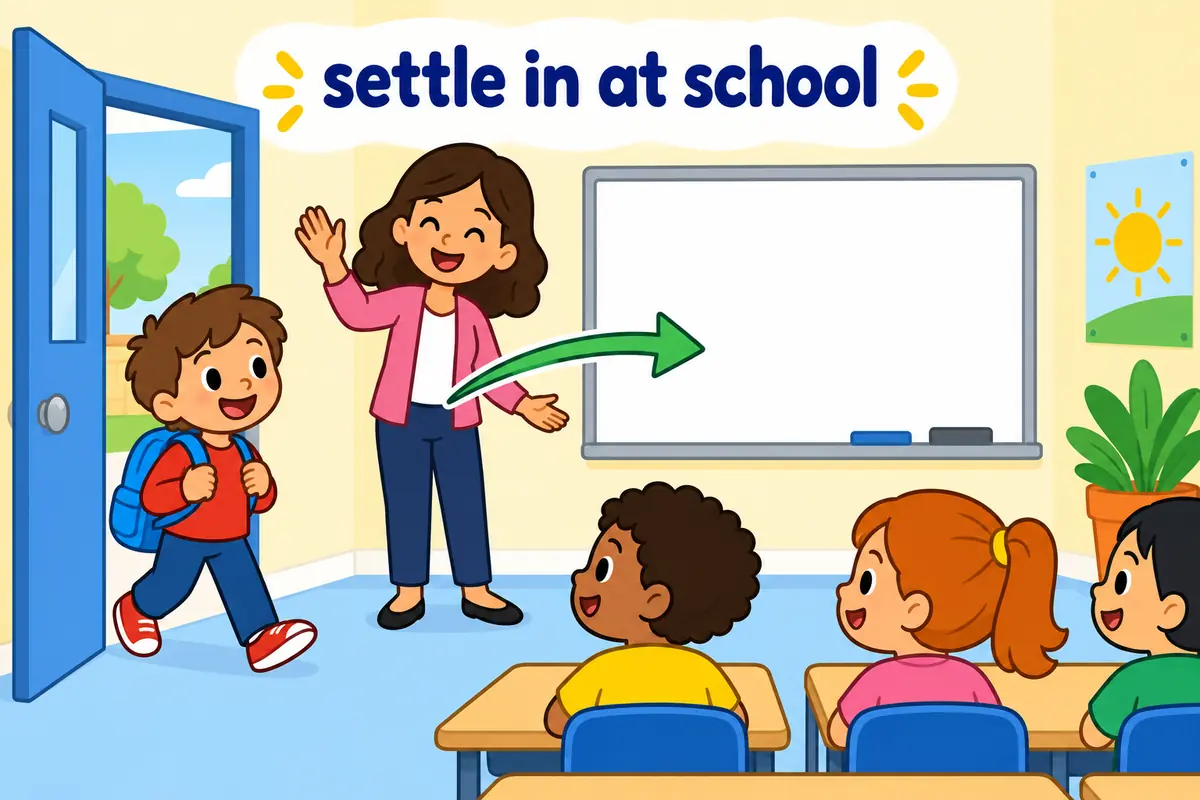
| Classroom | The new pupil settled in quickly once she found a reading partner. | A concrete detail shows comfort growing. |
| Workplace email | Our new analyst has settled in well and already leads two projects. | The present perfect signals a process just completed. |
| News report | Hundreds of families are still settling in after the autumn floods. | The continuous form conveys an unfinished process. |
| Conversation | Give it a few weeks and you will settle in. | The future tense offers reassurance, which suits speech. |
| Personal letter | We have finally settled in and hung the pictures on the walls. | A small domestic action marks the end of the move. |
| Workplace notice | New starters usually settle in within their first month. | A neutral general statement avoids any single person. |
| Travel writing | By dusk the campers had settled in around the fire. | The past perfect places the action before a later moment. |
| Migration history | Families settled in near the docks and opened small shops. | The simple past describes a lasting community. |
None of these sentences names an object directly after settle. The place always arrives inside at, in, into or around, which is the grammatical fingerprint of this phrase. The forced move in the opposite direction is usually described by uproot a family.
Settle in vs settle up
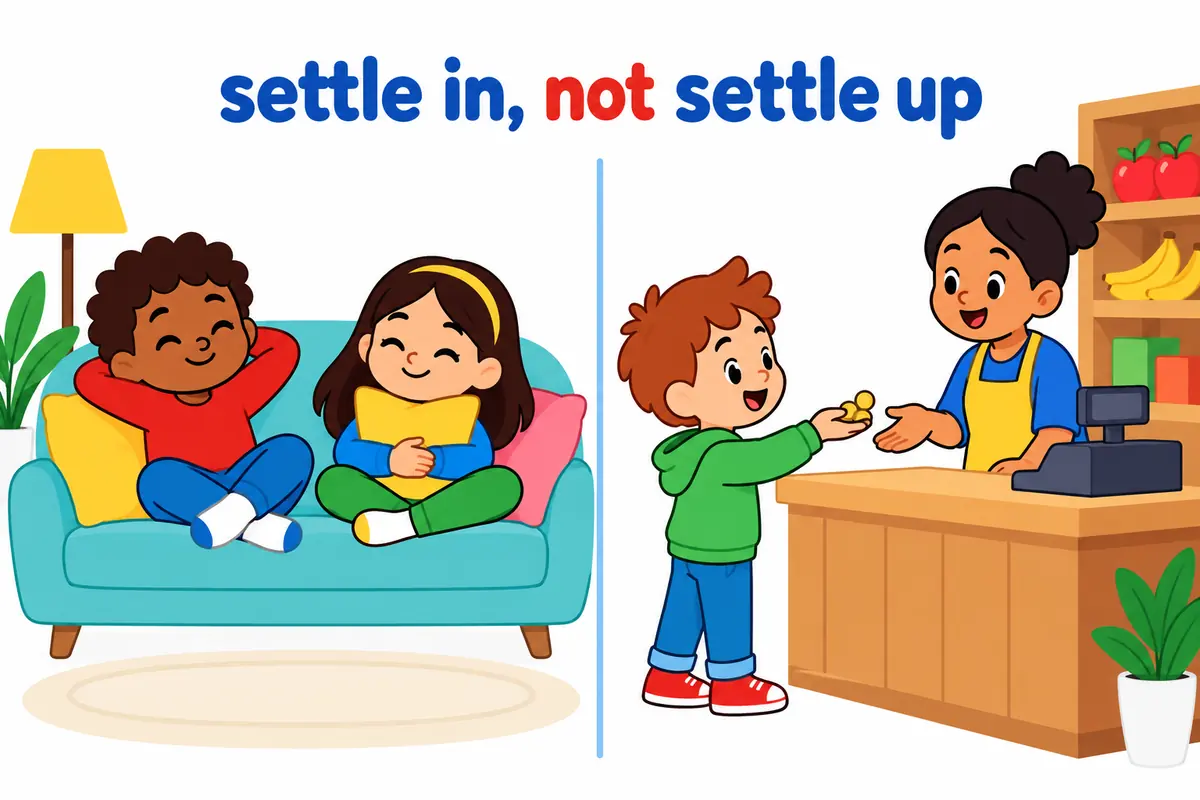
Settle in and settle up share the verb settle but split on meaning. Settle in is about comfort in a place; settle up is about paying what you owe. The table sets out the differences that matter in a sentence.
| Attribute | settle in | settle up |
|---|---|---|
| Core meaning | Become comfortable in a new place | Pay a debt or a shared bill |
| Needs a place | Yes, as a prepositional phrase | No |
| Typical subject | A person, family or new employee | A customer, friend or debtor |
| Register | Neutral, spoken and written | Informal, business and everyday |
| Takes an object | Never | Not usually: we settled up at the till |
| Opposite | Move away or uproot | Run a tab or leave it unpaid |
Verdict: use settle in for the slow business of feeling at home, and settle up for the moment money changes hands.
Word forms and grammar of settle in
Settle in changes its ending with the subject and the tense, and two lookalikes appear in ordinary writing. The table lists the forms you will actually meet.
| Form | Part of speech | Example |
|---|---|---|
| settle in | phrasal verb, base form | New staff settle in within weeks. |
| settles in | third person singular | She settles in fast in a noisy office. |
| settled in | past and past participle | They settled in last spring. |
| settling in | present participle and gerund | Settling in takes patience. |
| settle into | verb plus preposition | He settled into the role by summer. |
| settle | base verb, different meaning | We settled the account on Friday. |
| settle down | phrasal verb, different meaning | The children settled down to sleep. |
The noun settlement belongs to the paying sense of settle, not to settle in, which has no noun of its own. Do not confuse settle in with break in, another verb that takes the particle in but means to wear something new or to enter by force.
Common mistakes with settle in
- Incorrect:
It took a while to settle in the new house.Correct: It took a while to settle into the new house. Rule: Settle in takes no direct object; put into before the noun. - Incorrect:
We settled in the bill before leaving.Correct: We settled up before leaving. Rule: Settle in means get comfortable; paying what you owe is settle up. - Incorrect:
The manager settled in the dispute.Correct: The manager settled the dispute. Rule: Resolving a disagreement uses settle alone, never settle in. - Incorrect:
He settled in to the new job quickly.Correct: He settled into the new job quickly. Rule: The preposition is into, not the two-word sequence in to. - Incorrect:
Please settle in your seats.Correct: Please settle into your seats. Rule: A noun after settle requires into, because in cannot stand before an object here.
Practice using settle in
Work through the six items, then compare your reasoning with the answers rather than only the keys.
- Fill the gap: It took the exchange student a month to settle ______ at her host family’s home.
- Choose the better word: The roommates (settled in / settled up) their shared electricity bill on Sunday.
- Correct the error: We settled in the new apartment last week.
- Build a sentence: use settle into about a child starting a new routine.
- Spot the register: which belongs in a notice to new employees, New staff usually settle in within a month, or We totally settled in, it is great?
- Rewrite with a time frame: They settled in. Use took.
Answers
- in: the particle completes the phrase and no object follows.
- settled up: money is involved, and settle in never means to pay.
- We settled into the new apartment last week: settle in cannot take a direct object.
- Model answer: Ravi settled into his new morning routine after a week.
- New staff usually settle in within a month: a notice avoids totally and the first person.
- It took them a while to settle in: the time frame shows the process rather than the moment.
The bottom line
Use settle in when a person gradually becomes comfortable in a new place, and keep the phrase intransitive by adding a prepositional phrase such as at school or into the job. Two details decide most sentences: settle in never takes a direct object, and it is not the same as settle up, which means to pay. Adapt to a new situation is the better choice when the change is practical rather than emotional.
Frequently asked questions about settle in
Is settle in one word or two?
Settle in is written as two words, because it is a phrasal verb made of the verb settle and the particle in. Only a few verbs fuse their parts into a single noun, and settle in has no such noun form. Write the two words separately in every sentence.
Can settle in take an object?
No. Settle in is intransitive, so it cannot take a direct object. If a sentence needs to name the place or routine, use a prepositional phrase instead: settle in at the office, settle into a new routine. Adding a bare noun after settle, as in settle in the house, is always an error.
What is the difference between settle in and settle down?
Settle in means to become comfortable in a new place over time. Settle down means to become calm or to live permanently in one place, and it can also describe two people starting a long-term life together. A new pupil settles in at school, while an excitable child settles down at bedtime.
What does settle in for the night mean?
The phrase settle in for the night means to get comfortable and prepare to stay somewhere until morning. It does not require a new home; campers, guests and readers can all settle in for the night. The pattern is settle in for plus a time period or event, as in we settled in for the evening.
Have you ever heard the phrase “settle in” and wondered what it means? To settle in is to make oneself comfortable or establish oneself in a new place or situation.
This can include getting accustomed to a new home, job, routine, or environment. The process of settling in often involves relaxing, becoming familiar with your surroundings, and feeling at ease in a specific place or circumstance.
7 Examples Of Settle In Used In a Sentence For Kids
- Settle in with your favorite book and enjoy reading.
- It’s time to settle in for a cozy nap.
- Let’s settle in and listen to a fun story.
- Make sure to settle in for a delicious snack time.
- Before we start our lesson, let’s all settle in quietly.
- Get comfortable and settle in for some drawing time.
- Take a deep breath and settle in for a calming meditation session.
14 Sentences with Settle In Examples
- Settle in to your new dorm room by unpacking your belongings and personalizing your space.
- Settle in to the library for a productive study session before your upcoming exams.
- Settle in at the campus cafe to catch up with friends over a cup of coffee.
- Don’t worry if you feel overwhelmed at first, it takes time to settle in to the college routine.
- Settle in to your new class schedule and create a routine that works for you.
- Make new friends and settle in to the social scene on campus by attending events and joining clubs.
- Settle in to your first job or internship to gain valuable experience in your field of study.
- Settle in to your study abroad program and embrace the new culture and experiences.
- Take time to explore the city and settle in to your new surroundings outside of campus.
- Don’t forget to settle in to a healthy lifestyle by finding time for exercise and eating balanced meals.
- Settle in to your volunteer work and make a positive impact in the community.
- Settle in to your research project by dedicating time and effort to make it successful.
- Settle in to your online classes by creating a comfortable and distraction-free study space.
- After a long day of classes and studying, it’s important to settle in for a good night’s sleep.
How To Use Settle In in Sentences?
To use Settle In in a sentence, first, think of the word or phrase you want to get help with. Then, go to the Settle In website or app and type or paste the word into the search bar. Press the “Settle In” button to see suggested sentences for the word you entered.
Next, browse through the suggested sentences provided for inspiration on how to properly use the word in a sentence. Click on a sentence to see a breakdown of the different parts of speech used and how they contribute to the overall meaning.
Once you have found a sentence that fits your context, try incorporating it into your own writing or conversation. Make sure to pay attention to the sentence structure, grammar, and punctuation to fully understand how the word is used correctly.
If you are still unsure about how to use the word in a sentence, you can explore more sentences on Settle In or ask for additional help from the community of users. By practicing using the suggested sentences and gaining feedback, you will improve your vocabulary and language skills over time.
In summary, Settle In is a valuable tool for discovering how to correctly use words in sentences and enhancing your language proficiency through practical examples and explanations.
Conclusion
In conclusion, sentences with the word “settle in” commonly refer to getting comfortable or establishing oneself in a new environment, whether physical or emotional. This phrase is often used to describe the process of adjusting to a new place or situation, taking the time to feel at ease, and making oneself at home. For example, “After moving to the new city, it took me a while to settle in and get used to my surroundings.”
“Settle in” can also signify accepting or coming to terms with a decision, resolve, or an issue at hand. It often indicates moving past initial uncertainty or doubt and reaching a state of calm or contentment. For instance, “Once she made her decision, she felt a sense of relief and was able to settle in with her choice.”