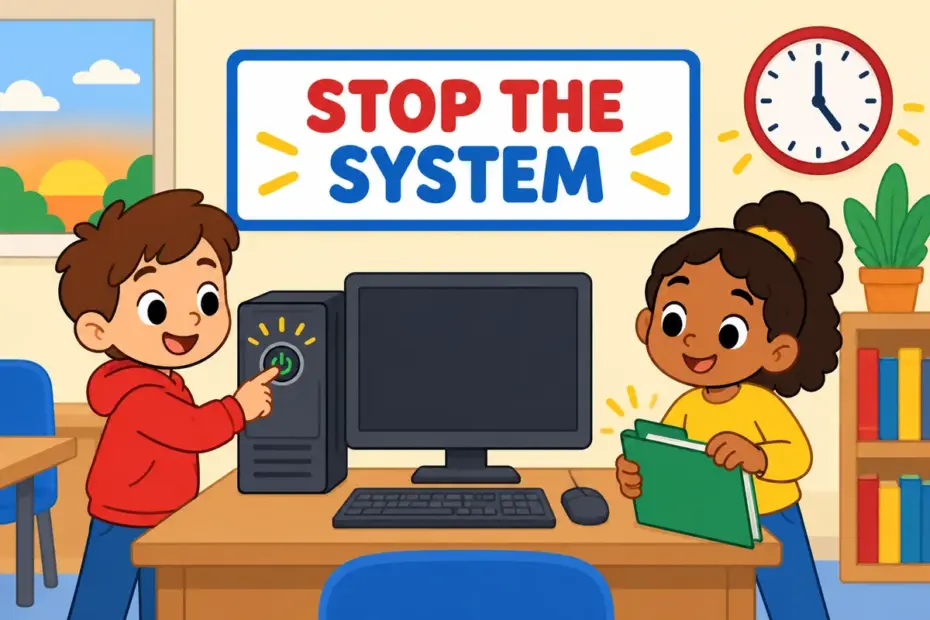
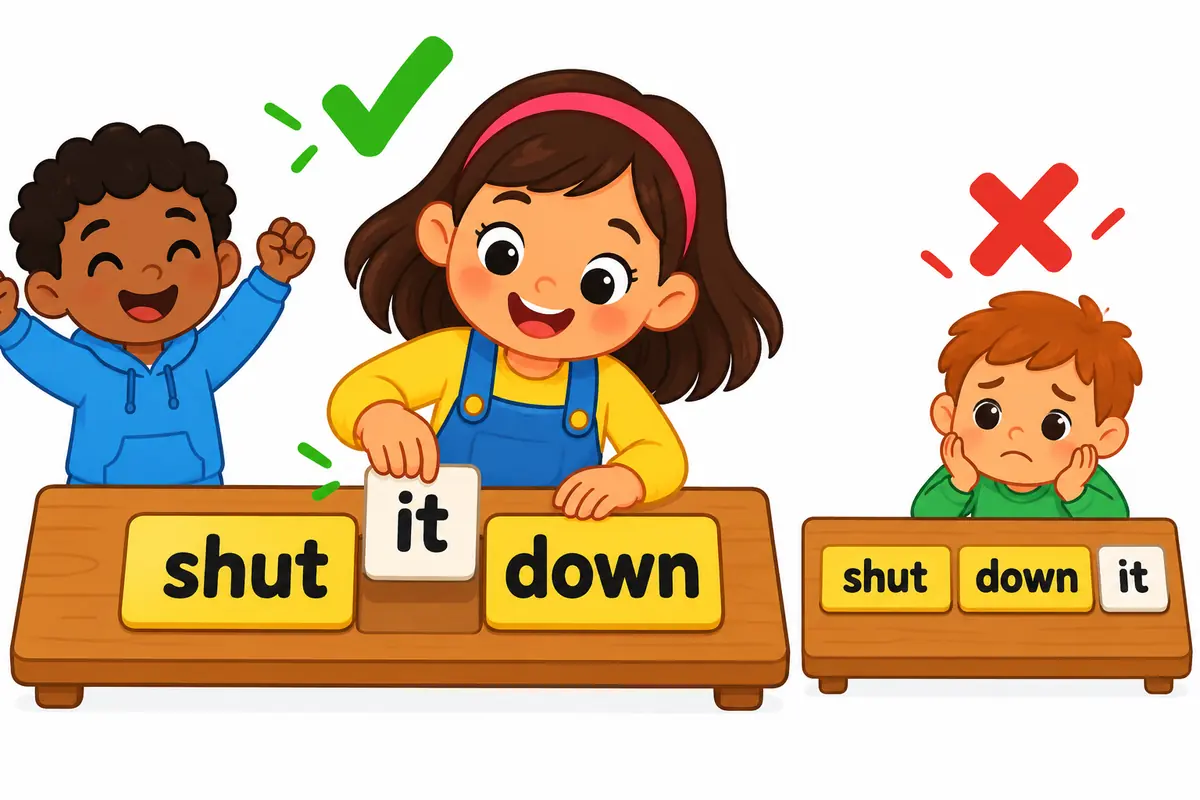
Shut down means to stop a machine, system or business from operating, and it also describes a person closing off emotionally. To use shut down in a sentence, put the object after or between the two words: “Shut down the laptop” or “Shut it down.” The phrasal verb is separable, so a pronoun must sit in the middle.
Shut down at a glance
- Shut down is a separable phrasal verb built from shut + down.
- Its forms are shuts down, shut down and shutting down; the past tense does not change.
- It stops a machine or system, or closes a business and its operations.
- A separate sense describes a person withdrawing and refusing to respond.
- The commonest error is confusing the verb shut down with the noun shutdown.
What does shut down mean?
Shut down is a phrasal verb meaning to stop a machine, system or business from working, or to suppress something, and it can also describe a person who stops responding. The Cambridge entry for shut down records the machine sense and the closing-a-business sense, and the context usually decides which one is meant. Where the point is a temporary pause rather than a full stop, halt a process is more precise, because shut down suggests that something has been taken out of service.
| Sense | Plain meaning | Example sentence |
|---|---|---|
| Stop a machine or system | Turn equipment off so it stops running | Please shut down the printer before you leave. |
| Close a business | End operations, often permanently | The mill shut down after sixty years. |
| Withdraw emotionally | Stop responding and close off | He shut down when the questions turned personal. |
| Suppress or reject | Stop something from continuing | The chair shut down the argument quickly. |
One limitation is worth stating plainly. Shut down is not a synonym for pause, and it does not always mean permanent closure: a laptop shuts down every night, while a factory may shut down for good. The emotional sense is informal and slightly clinical, so in a formal report it reads better as withdrew from the discussion.
How do you use shut down in a sentence?
Shut down is separable, so the object may follow the particle or sit between shut and down. Four patterns cover almost every real sentence, and the pronoun rule is the one that decides the word order.
| Pattern | Example | What it signals |
|---|---|---|
| shut down + object | They shut down the server at midnight. | The most common neutral order. |
| shut + object + down | They shut the server down at midnight. | Same meaning, with the object pulled forward. |
| shut + pronoun + down | They shut it down at midnight. | The only correct spot for a pronoun. |
| shut down, no object | The old factory shut down in May. | An intransitive use meaning the business closed. |
Notice that a pronoun never follows the whole verb: shut down it is wrong, and shut it down is the only standard form. When the subject is a power source, writers often power a system instead, which names the supply rather than the stopping.
Shut down in a sentence: examples across contexts
Shut down keeps its meaning while the register shifts. The nine sentences below move from a home office to a business report, and each shows what has actually been stopped.
| Context | Example sentence | Why this works |
|---|---|---|
| Home | Shut down the computer before you go to bed. | A daily routine shows the ordinary machine sense. |
| Workplace email | We will shut down the booking system for an hour. | A short stoppage makes the temporary sense clear. |
| News report | The airline shut down three regional routes. | A named service shows the business sense. |
| Business report | The plant shut down after falling orders. | Intransitive use with a stated cause. |
| Technical writing | Shut the reactor down slowly to avoid stress. | Separable order with the object pulled forward. |
| Everyday conversation | My phone shut down in the cold. | An intransitive use with no agent. |
| Interview write-up | He shut down whenever the past came up. | Shows the emotional withdrawal sense. |
| Meeting notes | The chair shut down the debate after ten minutes. | The suppression sense in a formal setting. |
| Engineering report | When the fans fail, the unit shuts itself down. | A reflexive use that shows an automatic stop. |
Notice that three sentences have no object at all. The intransitive use is common with machines, services and businesses, because the thing that stops is also the subject of the sentence.
Shut down vs shut off
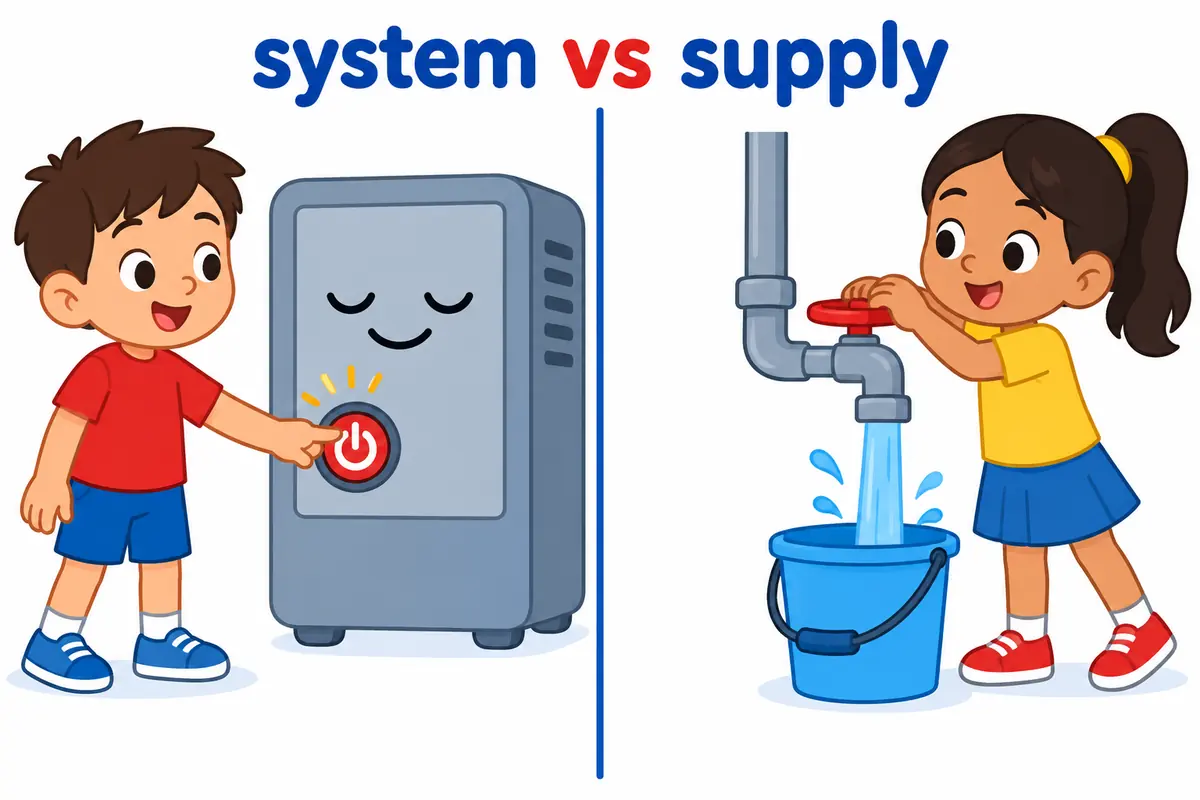
Shut down and shut off both stop something, and they are not interchangeable. Shut down stops a process or a whole system in an orderly way, while shut off cuts a supply such as water, gas or electricity.
| Attribute | shut down | shut off |
|---|---|---|
| Core meaning | Stop a system or process operating | Cut off a flow or supply |
| Typical object | A computer, a factory, a service | A tap, a valve, the water |
| Manner | Usually orderly and complete | Often sudden, and only part of a system |
| Intransitive use | Common: the factory shut down | Rare: the supply shut off |
| Example | Shut down the server before the update. | Shut off the water before the repair. |
| Reversible | Often restarted later | Restored by opening the supply again |
Verdict: choose shut down for a system that stops working, and choose shut off when you are cutting a supply of water, gas or power. A related verb, break down, describes a system stopping by itself through failure, which is the opposite of an orderly shutdown.
Word forms and grammar of shut down
Shut down changes only in the third person and the participle; the past tense keeps the same shape. The table lists the forms, including the one-word noun that learners often confuse with the verb.
| Form | Part of speech | Example |
|---|---|---|
| shut down | base phrasal verb | They shut down the line at noon. |
| shuts down | third person singular | The app shuts down without warning. |
| shut down | past tense | The shop shut down last year. |
| shutting down | present participle | The system is shutting down now. |
| shutdown | noun, one word | The shutdown lasted two days. |
The verb is always two words and the noun is always one, so the shutdown was sudden takes the noun while they shut down the plant takes the verb. Keep shut up out of this group in meaning, because it tells somebody to stop talking rather than to stop a machine.
Common mistakes with shut down
- Incorrect:
Shut down it before midnight.Correct: Shut it down before midnight. Rule: A pronoun must sit between shut and down, never after the whole verb. - Incorrect:
The shutdown of the machine happened at noon.Correct: The machine was shut down at noon. Rule: Shutdown is a noun, so use the two-word verb when you are describing the action. - Incorrect:
Please shut down off the computer.Correct: Please shut down the computer. Rule: Use either shut down or shut off, never both; they already carry the same idea of stopping. - Incorrect:
The factory shut down it in May.Correct: The factory shut down in May. Rule: The intransitive sense takes no object at all, because the factory is the thing that stopped. - Incorrect:
The manager shut down on the workers.Correct: The manager shut down the discussion. Rule: Shut down is not used with on for people; name the thing being stopped instead.
Practice using shut down
Work through the six items, then check the reasoning rather than only the answer.
- Fill the gap: Remember to ______ the projector after the talk.
- Choose the better word: The plumber will (shut down / shut off) the water before the repair.
- Correct the error: Please shut down it before the storm.
- Build a sentence: use shut down about a factory closing after falling orders.
- Spot the register: which belongs in an engineering report – the reactor was shut down slowly, or we just switched it off?
- Rewrite as a noun: They shut down the mine in 1998. Use shutdown instead.
Answers
- shut down – the projector is the object, and it may follow or precede down.
- shut off – water is a supply, so shut off is the precise verb.
- Please shut it down before the storm – a pronoun belongs between shut and down.
- Model answer: The factory shut down after orders fell for a third year.
- The reactor was shut down slowly – a report keeps a formal, passive register.
- Model answer: The mine closed in 1998 after a lengthy shutdown – the noun takes the article.
The bottom line
Use shut down in a sentence when a machine, system or business stops operating, or when a person withdraws and refuses to respond. Two nuances decide most sentences: the verb is separable, so a pronoun must sit between shut and down, and the intransitive sense needs no object at all. Where the meaning is cutting a supply, shut off is the better verb, and a failed system may instead terminate a process.
Frequently asked questions about shut down
Is shut down one word or two?
The verb is always two words, as in they shut down the factory, and the noun is one word, as in the shutdown lasted a week. Mixing them is a common error, so check the job the word is doing in the sentence. If it names an action, keep the space; if it names a thing, close it up.
Can shut down mean to stop a person from talking?
It can, in the sense of suppressing someone, as in the chair shut down the heckler. This use is a little informal and can sound harsh, because it treats the person like a faulty system. In a formal report, choose silenced, stopped or ruled out of order instead.
What is the past tense of shut down?
The past tense is shut down, with no change in spelling, so the factory shut down last year and the factory shuts down daily sit side by side. Only the third person singular adds an s, and the present participle adds ing. English keeps shut unchanged because it is an irregular verb.
Does shut down always mean permanently?
No. A computer shuts down every night and restarts the next morning, so the verb often describes a routine stop. Permanence comes from context, such as for good or after sixty years. When a business is named and no restart is mentioned, readers usually assume the closure is lasting.
If a business or service ceases operation temporarily or permanently, it is said to have been “shut down.” This can happen due to various reasons such as financial difficulties, maintenance issues, or external factors.
During a shutdown, the regular operations of the entity are halted, impacting employees, customers, and suppliers. The process of shutting down involves a series of steps to ensure a smooth transition and minimize disruption.
7 Examples Of Shut Down Used In a Sentence For Kids
- Shut down the computer before leaving the classroom.
- Don’t forget to shut down the lights when you leave the room.
- It’s time to shut down our tablets and put them away.
- Let’s all sing a song before we shut down for the day.
- Remember to shut down your toys and keep them tidy.
- The teacher asked us to shut down our voices during story time.
- After playing outside, it’s important to shut down the garden hose tightly.
14 Sentences with Shut Down Examples
- Shut down your laptop after completing your online classes.
- Make sure to shut down all the lights before leaving the common room.
- It’s important to shut down the computer properly to avoid any data loss.
- The college canteen will shut down early today due to maintenance work.
- Remember to shut down all unnecessary tabs on your browser to save battery life.
- The library will shut down for the day in 10 minutes, please plan accordingly.
- Don’t forget to shut down the music system in the common area before leaving.
- The college administration announced that all classes will be shut down for the week due to unforeseen circumstances.
- It’s advisable to shut down all unnecessary apps on your phone to conserve battery power.
- The college gym will shut down for renovations starting next week.
- Please ensure to shut down all the equipment in the science lab after completing your experiments.
- The college website will shut down temporarily for maintenance this weekend.
- The event organizer announced the party will shut down by midnight, so plan your time accordingly.
- The college bus services will shut down early today due to a festival celebration on campus.
How To Use Shut Down in Sentences?
To properly use the main word Shut Down in a sentence, you first need to understand its meaning and context. Shut Down is a phrasal verb that means to close something, typically a machine, system, or business temporarily or permanently.
Here is a simple guide on how to use Shut Down in a sentence:
- Begin your sentence with a subject, which is the person or thing performing the action.
- Follow the subject with the verb “Shut Down,” which is the main action of closing something.
- Add an object, which is the thing being shut down. This could be a computer, a factory, a store, or any other entity that can be closed.
Here are a few examples of sentences using Shut Down:
- The company decided to shut down its manufacturing plant due to financial difficulties.
- Please remember to shut down your computer before leaving the office.
- The government had to shut down the internet temporarily for maintenance purposes.
- The teacher instructed the students to shut down their laptops after finishing the assignment.
- Due to the storm, the airport had to shut down all flights for the day.
By following this guide and incorporating the main word Shut Down correctly in your sentences, you can effectively communicate the action of closing something either temporarily or permanently.
Conclusion
In conclusion, the term “shut down” refers to the act of closing or stopping operations of a system, organization, or device. It can be used in various contexts, such as shutting down a computer, a business, or even a debate. For example, “The company decided to shut down its manufacturing plant due to financial losses.” “The computer automatically shut down after completing the software update.” “The government’s decision to shut down the controversial program sparked public debate.”
Understanding the implications of a shutdown is crucial in navigating different situations effectively. Whether it involves a temporary closure for maintenance or a permanent cessation of activities, the term “shut down” carries significant weight in decision-making processes across different sectors, impacting outcomes and stakeholders involved.


