
Sift through means to examine a large amount of material carefully in order to find something useful. To use sift through in a sentence, name the mass being examined: “She sifted through the reports until she found the invoice.” The phrasal verb is transitive, so the thing being searched is its object, and the particle through always stays in place.
Sift through at a glance
- Sift through is a transitive phrasal verb meaning to search a mass of material.
- Its forms are sift through, sifts through, sifted through and sifting through.
- The object is the pile, list, archive or evidence being examined.
- Sift through suits research, journalism and everyday searching.
- The commonest error is separating the verb from the particle, as in sift the files through.
What does sift through mean?
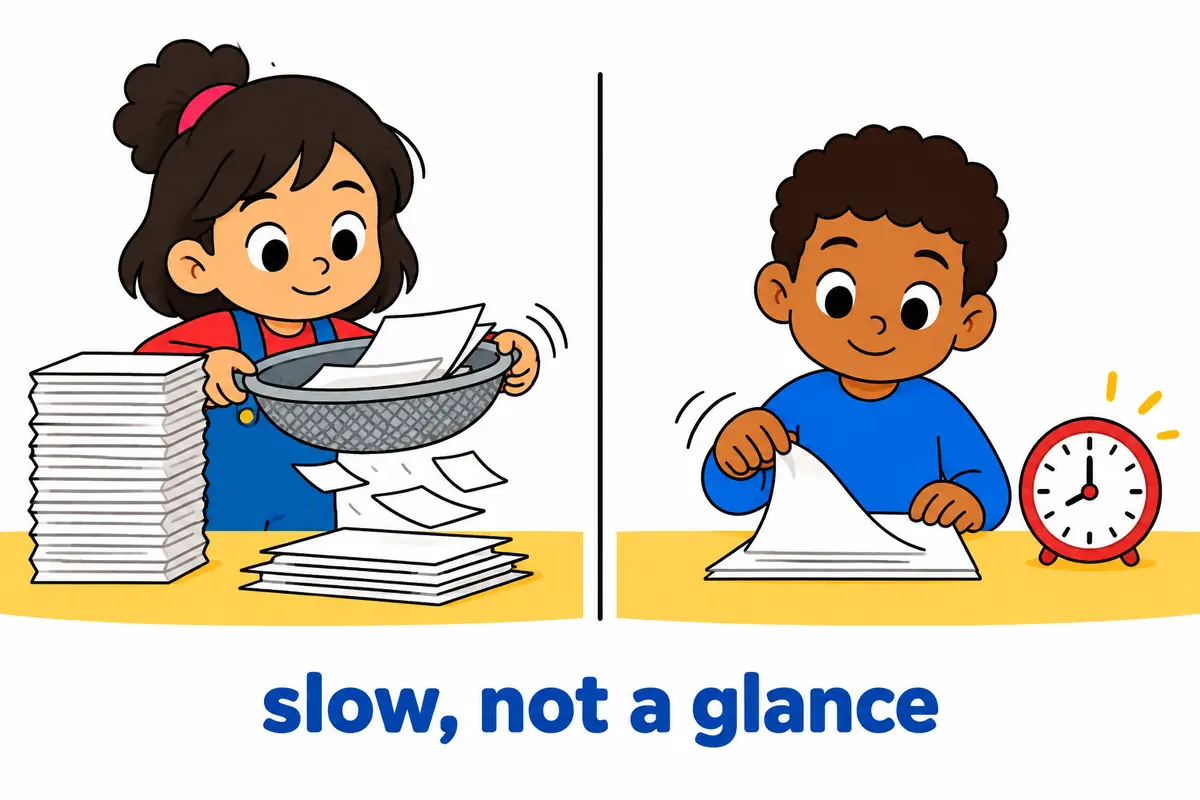
Sift through is a transitive phrasal verb meaning to examine a large quantity of information or objects patiently in order to find what matters. The Cambridge entry for sift through ties it to a careful search, and the image is of a sieve: the useful part stays and the rest falls away. Where the reading is quick rather than careful, skim through a report is the closer phrase, because sift through implies real effort.
| Sense | Plain meaning | Example sentence |
|---|---|---|
| Search a mass | Look through many items for one | He sifted through the box for his passport. |
| Evaluate evidence | Weigh many facts to reach a view | The panel sifted through the witness statements. |
| Filter what matters | Separate useful from useless | She sifted through the offers and kept two. |
One limitation is worth stating plainly. Sift through does not mean to read everything, and it does not promise a result. A person can sift through an archive for a week and find nothing, because the phrase describes the search, not its success.
How do you use sift through in a sentence?
The verb is transitive, so the object follows the particle and the two words stay together. Four patterns cover most real examples, and the object is always the mass being searched rather than the thing hoped for.
| Pattern | Example | What it signals |
|---|---|---|
| sift through + mass | We sifted through the emails. | The standard transitive use with the pile as object. |
| sift through + mass + for + target | She sifted through the box for a receipt. | Names what the search hopes to find. |
| sift through + mass + to + verb | They sifted through the data to find a pattern. | States the purpose of the search. |
| be + sifting through | He is sifting through the applications. | An ongoing action, often in the present. |

Sift through in a sentence: examples across contexts
Sift through keeps its careful, patient sense while the setting changes, and each sentence below names the mass being examined. The object is the clue that the search is real work.
| Context | Example sentence | Why this works |
|---|---|---|
| Classroom | The class sifted through old newspapers for a report on the flood. | A concrete pile makes the search visible. |
| Workplace email | I sifted through the inbox and flagged three messages. | A decision follows the search, which suits work. |
| News report | Reporters sifted through thousands of pages for a single name. | A large number stresses the effort. |
| Legal writing | The team sifted through the records for evidence of a payment. | A formal purpose clause raises the register. |
| Science writing | Researchers sifted through the readings to isolate a signal. | The purpose clause names the aim of the search. |
| Archival research | She sifted through the letters until she found the date. | The until clause marks the end of the search. |
| Recruitment | Managers sifted through the applications before shortlisting. | A second action follows the search. |
| Everyday conversation | I sifted through the drawer for a spare key. | The target phrase makes the search personal. |
| Data work | We are sifting through the results to remove duplicates. | The progressive shows an ongoing task. |
Writers who want to describe a complete read choose go through the files, and those who want a quick look choose skim through a report. Sift through sits between them, implying a slow and selective search rather than a full read or a glance.
Sift through vs go through and skim through
The three phrases all take an object and all involve looking, but they differ in care and speed. Sift through is the slowest and most selective of the three.
| Attribute | sift through | go through | skim through |
|---|---|---|---|
| Core meaning | Search a mass selectively | Read or examine fully | Read quickly for the gist |
| Speed | Slow and patient | Thorough, not rushed | Fast and light |
| Goal | Find or filter something | Cover all of it | Get the general sense |
| Typical object | A pile with many items | A document or list | A report or article |
| Register | Neutral to formal | Neutral | Informal to neutral |
Verdict: choose sift through when the pile is large and the goal is to find or filter, go through the files when every part must be covered, and skim through a report when speed matters more than care. Only sift through carries the image of separating what is useful from what is not.
Word forms and grammar of sift through
Sift through inflects on the base verb only, and the particle never changes. The table also lists the related phrases that share the word through.
| Form | Part of speech | Example |
|---|---|---|
| sift through | phrasal verb, base form | They sift through the archive each spring. |
| sifts through | third person singular | She sifts through the entries every morning. |
| sifted through | past and past participle | We sifted through the records for hours. |
| sifting through | present participle | He is sifting through the applications. |
| sift | verb, without the particle | She sifted the flour into a bowl. |
| throughout | preposition, related form | The rule applied throughout the year. |
Keep the particle in place: sift through the papers is correct, while sift the papers through is not English. Without the particle, sift has a different, physical sense, as in sifting flour. Other phrases share the word through, as in run through a list and follow through on a promise, but their meanings are separate.
Common mistakes with sift through
- Incorrect:
He sifted the box through for a photo.Correct: He sifted through the box for a photo. Rule: the particle through stays with the verb, and the object follows it. - Incorrect:
We sifted through for the missing form.Correct: We sifted through the folders for the missing form. Rule: the verb is transitive, so it needs the mass being searched as its object. - Incorrect:
The panel sifted through that the figures matched.Correct: The panel sifted through the figures and found they matched. Rule: the phrase takes a noun object, never a that-clause. - Incorrect:
She sifted through the flour for lumps.Correct: She sifted the flour for lumps. Rule: the physical cooking sense drops the particle; sift through is the searching sense. Where the reading is quick, pull through a crisis and skim are different ideas again.
Practice using sift through
Work through the six items, then check the reasoning rather than only the answer.
- Fill the gap: The researchers ______ the data until a pattern appeared.
- Choose the better word: Before the meeting, I (sifted through / skimmed through) sixty pages for the one figure I needed.
- Correct the error: She sifted the drawer through for a stamp.
- Build a sentence: use sift through about a box of old photographs.
- Spot the register: which belongs in an academic report, the team sifted through the records for a trend, or the team had a nose through the records?
- Rewrite with a purpose clause: They sifted through the emails. Add to find the order.
Answers
- sifted through. The data is the mass being searched, and the verb is past tense.
- sifted through. The search was slow and selective, so the careful phrase fits better than skimmed.
- She sifted through the drawer for a stamp. The particle must follow the verb.
- Model answer: We sifted through the box of photographs for a picture of the old school.
- The team sifted through the records for a trend. A report keeps the formal phrase and purpose.
- They sifted through the emails to find the order. The clause states the aim of the search.
The bottom line
Use sift through in a sentence when someone searches a large mass of material carefully to find or filter something, and keep the mass as the object. The two facts that decide most sentences are that the verb is transitive and that the particle never separates from sift. When the whole document must be covered, go through the files is the better phrase, and when the reading is quick, skim through is closer to the truth.
Frequently asked questions about sift through
Is sift through a phrasal verb?
Yes. Sift through is a transitive phrasal verb made of the verb sift and the particle through. The two parts work as one unit, so the object follows the particle and the particle never separates. You sift through the records, and you never sift the records through, because that would break the phrase.
What is the difference between sift through and search?
Sift through suggests a large mass and a patient, selective search, often with an image of separating what matters from what does not. Search is the plainer, broader verb and can describe any attempt to find something, from a room to a website. Sift through implies more material and more effort.
Can sift through be used without an object?
No. Sift through is transitive, so it always needs the mass being examined as its object. A sentence such as we sifted through for an hour is incomplete and sounds wrong. Add the material, as in we sifted through the files for an hour, and the sentence becomes natural and clear.
What is the difference between sift through and go through?
Sift through means to search a large mass selectively in order to find or filter something. Go through means to read or examine a document or list completely. Sift through is slower and more selective, while go through stresses full coverage. A pile of emails is sifted through; a single contract is gone through.
When you have a lot of information that needs careful examination, you may find yourself needing to sift through it. To sift through something means to carefully sort through and evaluate the contents to find what is important or relevant.
Whether you are going through a stack of papers, sorting through data on a computer, or examining evidence in a case, the process of sifting through requires attention to detail and focus. By meticulously sifting through information, you can identify key details, gain a deeper understanding, and make informed decisions based on what you have discovered.
7 Examples Of Sift Through Used In a Sentence For Kids
- Sift through the sand to find different colored shells.
- Let’s sift through these books to find the one with the red cover.
- Can you sift through the toy box to find the blue car?
- We need to sift through the puzzle pieces to find the corner ones.
- Sift through the papers to find the drawing you made yesterday.
- It’s fun to sift through the leaves to find the shiny rocks.
- Remember to sift through the crayons to find your favorite color.
14 Sentences with Sift Through Examples
- Sift through various scholarship opportunities to find the best ones that suit your qualifications and interests.
- Make sure to sift through multiple sources when conducting research for your assignments to gather accurate information.
- As a college student, you may need to sift through different internship listings to find one that matches your career goals.
- It is essential to sift through different textbooks and study materials to prepare for your exams effectively.
- Before choosing elective courses, take the time to sift through the course descriptions to select the ones that align with your academic interests.
- As a college student, you will need to sift through job postings to find part-time work that fits your schedule.
- When planning a group project, collaborate with your classmates to sift through ideas and select the most suitable topic.
- To stay organized, create a system to sift through your emails efficiently and prioritize tasks accordingly.
- As a college student, it’s important to sift through different extracurricular activities to find ones that you are passionate about.
- Before referencing sources in your research paper, make sure to sift through the information provided to confirm its credibility.
- Sift through old notes and textbooks to refresh your memory before preparing for final exams.
- To find relevant articles for your academic papers, you will need to sift through online databases and journals.
- As a college student, it’s essential to sift through feedback from professors to improve your academic performance.
- Before choosing a study abroad program, take the time to sift through the options available and select the one that best suits your goals.
How To Use Sift Through in Sentences?
To use “Sift Through” in a sentence, you can follow these steps as a beginner:
-
Identify the need to search or sort through a large amount of information, items, or data.
-
Begin by introducing the topic or the items that need to be examined. For example, “I need to sift through all the emails in my inbox to find the important ones.”
-
Insert the phrase “Sift Through” after the subject of the sentence. Remember that “sift through” means to examine or search through something carefully.
-
Follow it with the specific information, items, or data that you are exploring. For instance, “I need to sift through the documents on my desk to find the right one.”
-
Complete the sentence with the purpose or goal of the sifting process. This can help clarify why you are looking through the items. For example, “I need to sift through the research papers to find relevant information for my report.”
By following these steps, you can effectively incorporate the phrase “Sift Through” into your sentences. Practice using it to refine your search or sorting actions. Over time, you’ll become more comfortable including this phrase in various contexts, helping you communicate your exploration or examination tasks clearly.
Conclusion
To effectively process information and find what is relevant, one must carefully sift through the given data. Phrases and keywords can help streamline this process, guiding individuals to the most important details. When sifting through information, it is crucial to remain focused and methodical, ensuring that nothing significant is overlooked. By using specific criteria and keywords, one can quickly locate key points and make informed decisions based on the information at hand.
In situations where there is a large amount of information to analyze, employing techniques such as sifting through sentences with specific keywords can expedite the process. Through this methodical approach, individuals can efficiently extract relevant information, leading to a more effective and productive decision-making process. By mastering the skill of sifting through data, individuals can discern important details from the noise, enabling them to make well-informed choices.


