Simmer down is a phrasal verb meaning to become calm after being angry or excited. To use simmer down in a sentence, make the person or the situation the subject and keep the particle straight after the verb: “the crowd finally simmered down”. The verb is intransitive, so it never takes a direct object.
Simmer down at a glance
- Simmer down is an intransitive phrasal verb; its forms are simmers down, simmered down and simmering down.
- It means to grow calm, quieter or less intense after strong feeling.
- The particle down stays with the verb and is never separated by an object.
- Register is informal, so calm down or quiet down often suits formal writing better.
- The commonest error is adding a direct object: standard English does not simmer somebody down.
What does simmer down mean?
Simmer down is a phrasal verb meaning to become calm or quiet after anger, excitement or noise. The Cambridge entry for simmer down records the calm-down sense and shows that it describes the person, not an action done to them. A dispute that subsides and a room that grows quiet both fit the same idea of intensity falling away.
| Sense | Plain meaning | Example sentence |
|---|---|---|
| Become calm | Stop being angry or agitated | It took twenty minutes for the passengers to simmer down. |
| Grow quieter | Become less noisy or busy | The party simmered down once the music stopped. |
| Lose intensity | Of a dispute, become less fierce | The row over the fence simmered down after the council wrote. |
One limitation is worth stating plainly. Simmer down is not a transitive verb, so you cannot simmer down a person, and it is not formal enough for a tribunal report. Where a measured tone is needed, calm down or quiet down does the same work.
How do you use simmer down in a sentence?
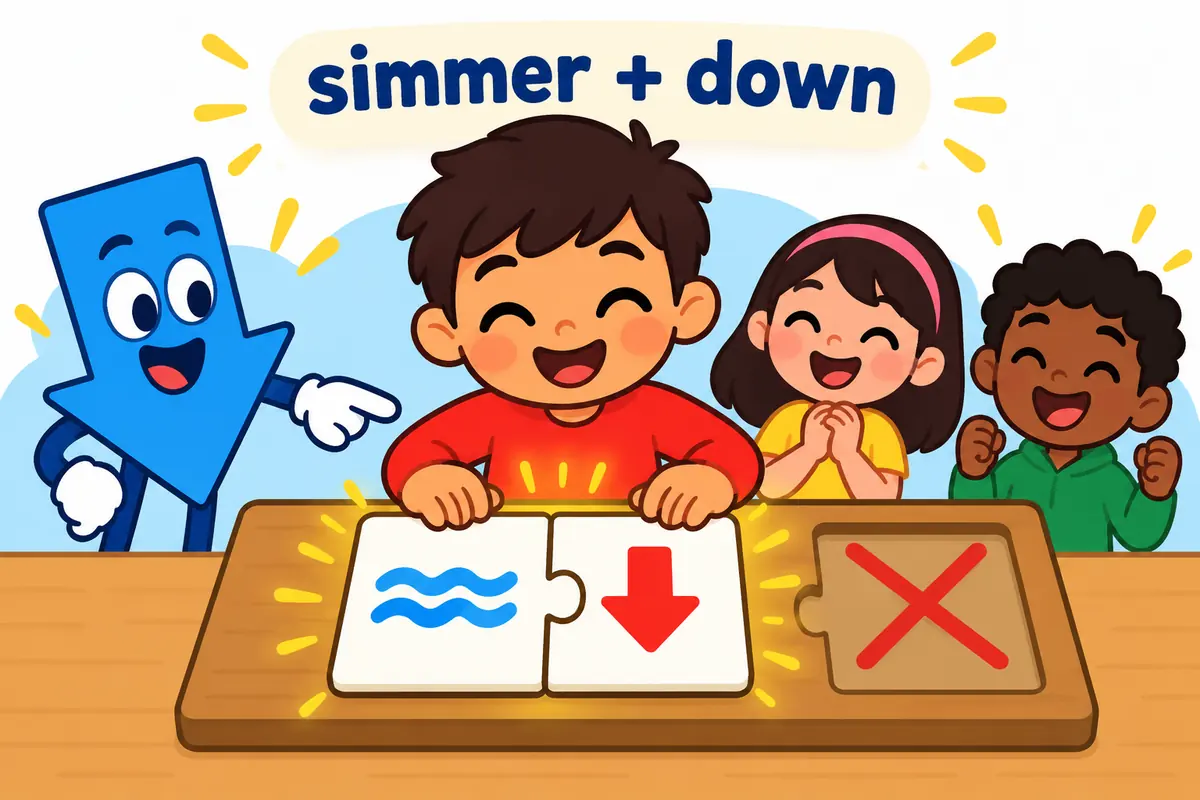
The phrasal verb is intransitive and inseparable: nothing can sit between simmer and down, so there is no object to split it and no particle to strand. To name a person who needs to calm, put a transitive verb first, as in get the children to simmer down.
| Pattern | Example | What it signals |
|---|---|---|
| subject + simmer down | The players simmered down after the whistle. | Intransitive: the subject calms itself. |
| get or tell + person + to simmer down | The coach told the bench to simmer down. | The only standard way to name a person. |
| simmer down + time phrase | He simmered down eventually. | The particle stays attached, so adjuncts follow it. |
| imperative: simmer down | Simmer down, both of you. | A direct instruction, informal and a little sharp. |
| simmering down | Tempers are simmering down at last. | Shows a gradual process, common in news writing. |
Because the verb takes no object, a sentence such as simmer it down is non-standard, and the fix is either get it to simmer down or cool it down.
Simmer down in a sentence: examples across contexts
Simmer down moves easily from a playground to a news report, and each sentence below keeps the verb intransitive. Notice how often the subject is a group rather than one person.
| Context | Example sentence | Why this works |
|---|---|---|
| Classroom | The noisy class simmered down when the teacher raised a hand. | A group subject shows the subject calming itself. |
| Workplace email | Tempers simmered down once the figures were circulated. | Keeps a factual tone with no object after the verb. |
| News report | The demonstration simmered down after the minister’s statement. | Uses the intensity sense for a public event. |
| Sports writing | The visiting bench simmered down after a warning from the referee. | Names the group and the event that prompted calm. |
| Conversation | Give him a minute and he will simmer down. | Everyday register, with a future promise of calm. |
| Parenting | The twins simmered down as soon as the story started. | Shows a concrete trigger, which makes the sentence vivid. |
| When someone concedes | The union late backed down and the room simmered down. | Contrasts a decision to yield with the mood that follows. |
| Negotiation | Talks simmered down to a steady exchange of drafts. | The intensity sense replaces noise with procedure. |
| Markets | Prices simmered down after the early surge. | Extends the verb to activity that cools. |
In every row the person or thing calms itself, which is why none of the sentences adds an object after the verb. When the calming is permanent, settles is the more final verb.
Simmer down vs calm down
Simmer down and calm down share a meaning but not a grammar. The first is intransitive and colloquial; the second works with or without an object and appears in every register.
| Attribute | simmer down | calm down |
|---|---|---|
| Meaning | Grow calm after anger or excitement | Become calm |
| Transitivity | Intransitive only | Intransitive and transitive |
| Typical subject | A person, group or situation | Usually a person |
| What it implies | Emotion was already running high | Any kind of agitation |
| Register | Informal and conversational | Neutral, safe in formal writing |
| Example | The crowd simmered down by dusk. | The nurse calmed the child down. |
Verdict: choose simmer down for informal talk about anger cooling, and calm down when you need a transitive verb or a tone that fits a report.
Word forms and grammar of simmer down
Simmer down inflects through its verb, and the base verb simmer survives in a separate cooking sense. The table also lists a transitive verb that often replaces it.
| Form | Part of speech | Example |
|---|---|---|
| simmer down | phrasal verb, base | Let the argument simmer down. |
| simmers down | phrasal verb, third person singular | He simmers down within a minute. |
| simmered down | phrasal verb, past and participle | The room simmered down after the bell. |
| simmering down | phrasal verb, present participle | Tempers are slowly simmering down. |
| simmer | verb, cooking sense | Let the sauce simmer for ten minutes. |
| soothe | transitive verb | A soft voice soothed the baby. |
Keep the cooking verb simmer separate from the phrasal verb: a sauce simmers, but only people and situations simmer down.
Common mistakes with simmer down
- Incorrect:
The teacher simmered down the class.Correct: The teacher waited for the class to simmer down. Rule: Simmer down is intransitive and cannot take a direct object. - Incorrect:
Simmer down it.Correct: Tell it to simmer down. Rule: The particle down stays beside the verb, so nothing separates them. - Incorrect:
Please simmer down yourself before the meeting.Correct: Please calm yourself down before the meeting. Rule: Simmer down takes no reflexive object; a reflexive needs a transitive verb. - Incorrect:
The sauce simmered down for ten minutes.Correct: The sauce simmered for ten minutes. Rule: The cooking verb is simmer alone; simmer down concerns people and feelings.
Practice using simmer down
Work through the six items, then read the reasoning rather than only the answer.
- Fill the gap: The crowd ______ when the singer finally appeared on stage.
- Choose the better word: The waiter asked the argument to (simmer down / settle down) so other guests could eat.
- Correct the error: The coach simmered down the angry players.
- Build a sentence: use simmer down about a noisy household after a power cut.
- Spot the register: which belongs in a police report, the crowd simmered down at midnight, or everyone finally simmered down, thank goodness?
- Rewrite with an object: The mother calmed her son. Keep the meaning but use the phrasal verb pattern.
Answers
- simmered down — the crowd calms itself, and the past tense matches appeared.
- simmer down — the argument had flared, and the verb names emotion cooling with no object.
- The coach waited for the angry players to simmer down — a direct object is not allowed.
- Model answer: The house simmered down once the candles were lit and the board games came out.
- The crowd simmered down at midnight — a report keeps a neutral tone and drops the exclamation.
- The mother got her son to simmer down — a transitive verb carries the person first.
The bottom line
Use simmer down in a sentence when a person, group or situation grows calm after strong feeling, and keep the verb intransitive with the particle attached. Two details decide most sentences: nothing can separate simmer from down, and a person can only be named through a pattern such as get someone to simmer down. For formal writing or a transitive verb, calm down is the safer choice.
Frequently asked questions about simmer down
Is simmer down formal enough for writing?
Simmer down sits in informal and conversational English. A news report would use calm down or the situation eased instead, and a formal report would say tempers cooled. Fiction and dialogue carry the phrasal verb comfortably, which is where it sounds most natural to a reader.
Can you tell someone to simmer down?
Yes. The imperative simmer down is a direct, slightly sharp way to ask for calm, as in simmer down, both of you. It works between people who know each other, and it can sound rude from a stranger. A softer request is please calm down.
Is simmer down one word or two?
Simmer down is written as two words and functions as a single phrasal verb. It is never hyphenated in verb use, so the correct form is the team simmered down. A noun made from it, as in a simmer-down, is rare and informal.
What is the past tense of simmer down?
The past tense is simmered down, and the past participle is identical. You would write the audience simmered down after the speech. The present participle is simmering down, as in tempers are simmering down, which stresses the gradual nature of the change.
Are you familiar with the phrase “simmer down”? This common expression is often used to encourage someone to calm down, relax, or reduce their anger or excitement.
When someone tells you to “simmer down,” they are advising you to take a step back, lower your emotional intensity, and regain composure. It’s a gentle way of asking you to relax and approach the situation with a calmer mindset.
7 Examples Of Simmer Down Used In a Sentence For Kids
- Let’s simmer down and take a deep breath.
- When we feel upset, we can simmer down by counting to three.
- It’s important to simmer down and listen to others when they are talking.
- You can simmer down by hugging your favorite stuffed animal.
- Before we react, let’s simmer down and think about our actions.
- It’s okay to feel angry, but we need to simmer down before we speak.
- Remember to simmer down when things don’t go our way.
14 Sentences with Simmer Down Examples
- Simmer down and focus on your studies, the exams are just a week away.
- Let’s simmer down and have a peaceful discussion about the upcoming college event.
- Please simmer down, we need to come up with a solution for the group project.
- Simmer down and take a deep breath, the presentation will go smoothly.
- Can you please simmer down and listen to what the professor is explaining?
- It’s important to simmer down and relax after a long day of lectures and assignments.
- Let’s simmer down and plan our study schedule for the upcoming semester.
- Before approaching the college authorities, it’s essential to simmer down and gather all the necessary information.
- Simmer down and avoid getting into unnecessary arguments with your classmates.
- Remember to simmer down and think rationally before making any impulsive decisions.
- It’s okay to feel overwhelmed, but it’s important to simmer down and seek help if needed.
- Take a moment to simmer down and reflect on your goals for the academic year.
- When facing challenges, it’s crucial to simmer down and approach them with a positive mindset.
- Before finalizing your career choices, it’s advisable to simmer down and explore all available options.
How To Use Simmer Down in Sentences?
Simmer Down means to calm down or relax after being angry or excited. When using this expression in a sentence, it is important to remember the following:
-
Usage: You can use “Simmer Down” when someone is feeling angry, upset, or overly excited, and you want them to calm down or relax.
-
Tone: This phrase is often used in a light-hearted or joking manner, so it is best to use it with friends, family, or in casual settings.
-
Example Sentence: “Hey, simmer down! There’s no need to get so worked up about it.”
-
Body Language: You can accompany the phrase with a calming gesture like placing a hand on someone’s shoulder or using a soothing tone of voice.
-
Timing: It is best to use “Simmer Down” when the person is visibly agitated or overly excited. Choose a moment when they are receptive to calming down.
-
Effectiveness: This phrase can be effective in de-escalating a tense situation or helping someone regain their composure.
Remember, using “Simmer Down” in conversations can help diffuse emotions and promote a more positive and relaxed atmosphere. Practice using this phrase in different situations to become more comfortable with incorporating it into your daily interactions.
Conclusion
In conclusion, when tensions are running high, it’s important to remember to take a deep breath and simmer down before responding. By keeping a level head and approaching situations with a calm demeanor, conflicts can be resolved more effectively and peacefully. By practicing patience and understanding, individuals can navigate heated exchanges with grace and maturity, ultimately fostering better communication and healthier relationships.
Remember, it’s natural to feel emotional in challenging situations, but learning to simmer down and respond thoughtfully can lead to more positive outcomes. Embracing a mindset of calmness and composure not only benefits personal well-being but also promotes a harmonious environment where conflicts can be addressed constructively.