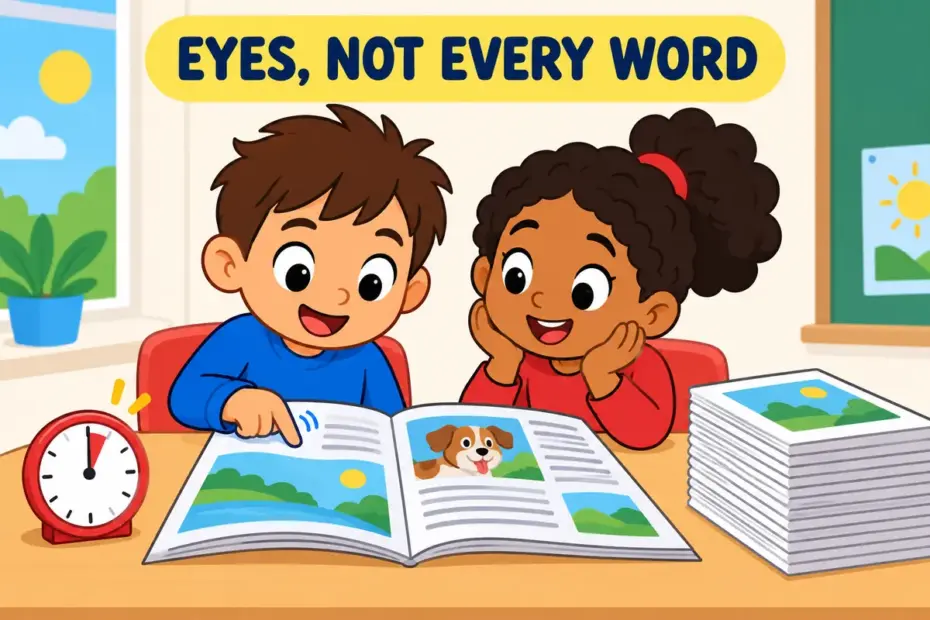
To skim through is to read something quickly for its main points without studying every word. In a sentence the phrase takes the text as its object right after it: “She skimmed through the report on the train.” Unlike many phrasal verbs, skim through never splits, so a pronoun follows through rather than landing in the middle.
Skim through at a glance
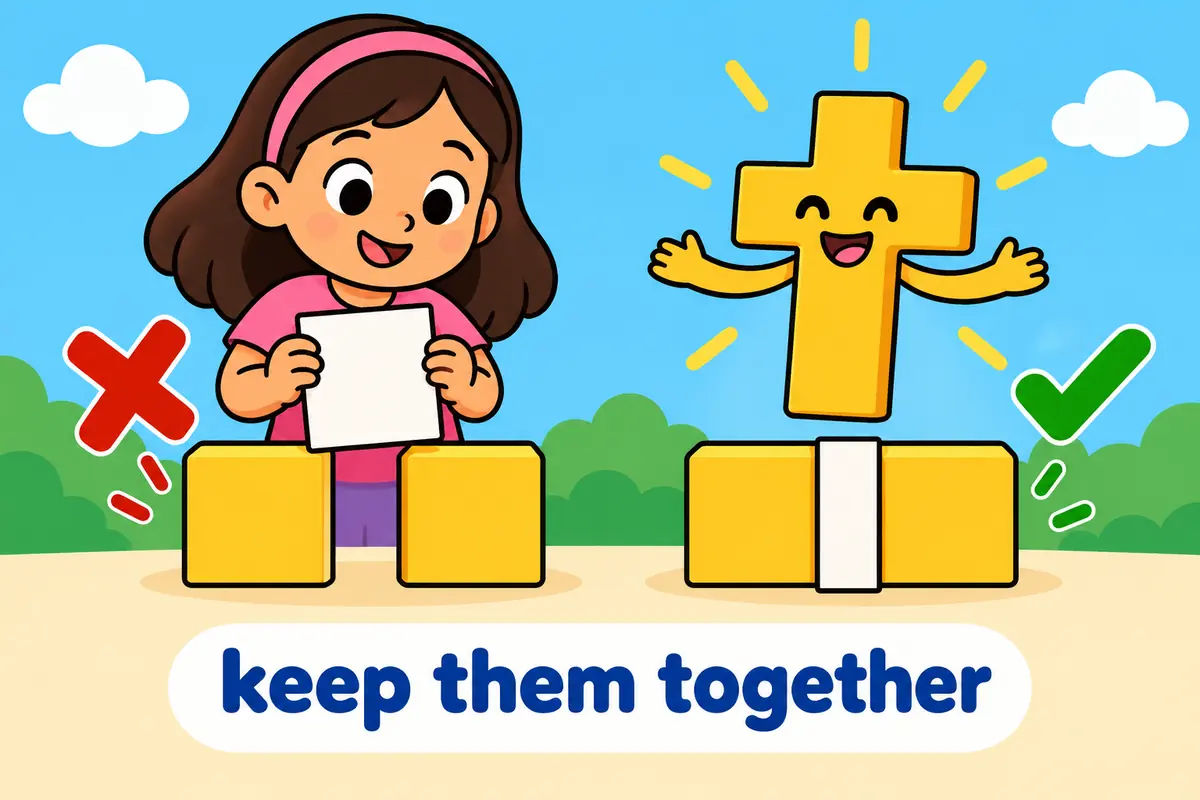
- Skim through is an inseparable phrasal verb; its forms are skims, skimmed and skimming through.
- The structure is skim through + the text or set of items, with nothing in between.
- It means reading or looking rapidly for the gist, deliberately skipping detail.
- The usual objects are reports, emails, notes, minutes, applications and long articles.
- The commonest error is splitting the verb, as in skim it through, which is not standard.
What does skim through mean?
Skim through is a phrasal verb meaning to read or look over something quickly in order to grasp its main points, not to absorb every word. The Cambridge entry for skim through records the reading sense, and the emphasis falls on speed with purpose. Where a reader goes slowly through the whole text, go through the whole report names that opposite act, and the two verbs make a useful pair for describing a study routine.
| Use | Plain meaning | Example sentence |
|---|---|---|
| Get the gist | Read fast enough to grasp the main points | She skimmed through the minutes before the meeting. |
| Review a batch | Look quickly over a set of items to check them | He skimmed through the applications in ten minutes. |
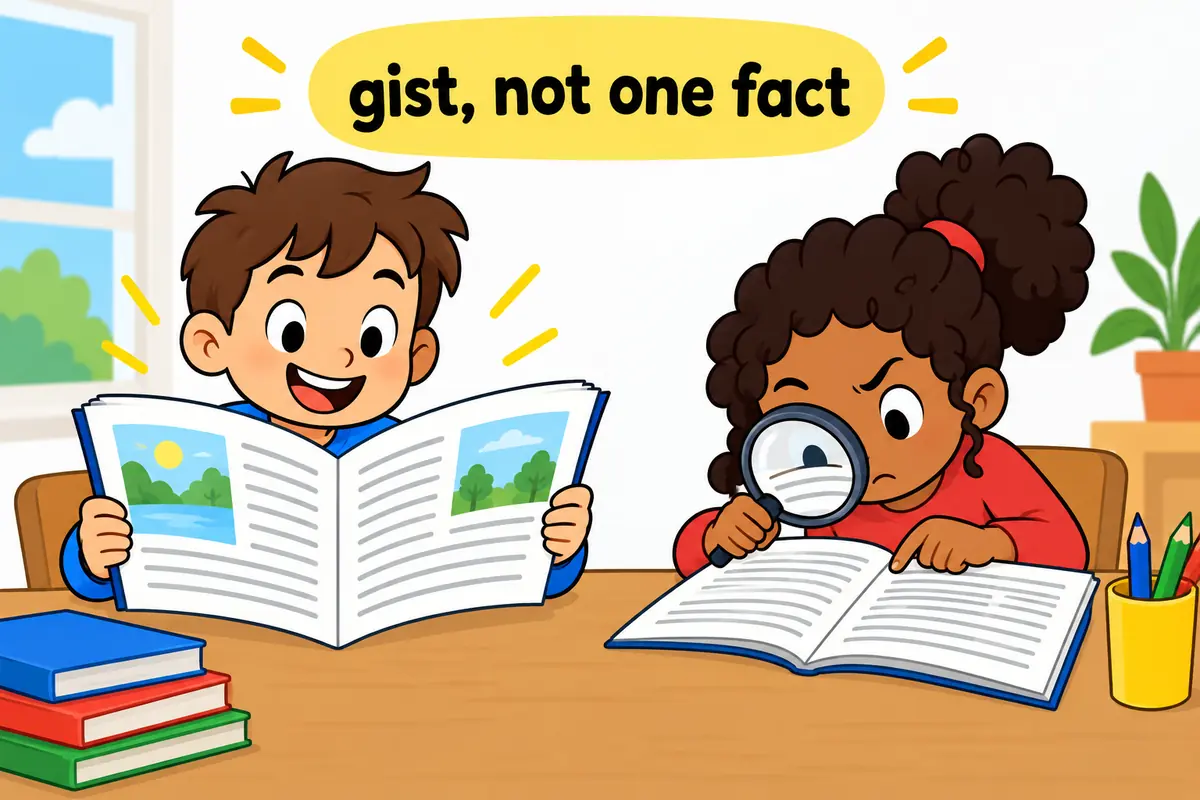
One limitation belongs here. Skim through is not the same as scan, and it is not careful reading. Scanning hunts for one fact; skimming takes in the shape of the whole text. When accuracy matters, as with a contract or an exam paper, skim through is the wrong verb entirely because it admits that detail was skipped.
How do you use skim through in a sentence?
Put the text immediately after through and never separate the two words. Because the particle behaves like a preposition here, the object cannot move, and a pronoun cannot be squeezed between skim and through either. A quick run through of the notes uses the same idea as a noun, which is useful when you want to name the act rather than perform it.
| Pattern | Example | What it signals |
|---|---|---|
| skim through + text | I skimmed through the email before replying. | The object follows through; the standard order. |
| skim through + batch | We skimmed through the photos after the trip. | A set of items rather than continuous prose. |
| skim through + it | She skimmed through it in five minutes. | The pronoun follows through; the verb stays whole. |
| skim through + to + verb | He skimmed through to find the figures. | Names the goal of the quick read. |
| adverb + skim through | I just skimmed through the headlines. | An adverb may precede the whole verb but not split it. |
The near-miss form, skim it through, sounds plausible because other phrasal verbs do split, yet English fixes through to skim here. Treat the pair as one word that happens to be written with a space.
Skim through in a sentence: examples across contexts
Skim through keeps one meaning as it moves between registers. The nine sentences below shift from a classroom to a news desk, and each names what was skipped and why the speed was enough.
| Context | Example sentence | Why this works |
|---|---|---|
| Classroom | Ravi skimmed through the chapter headings before the quiz. | Headings show the shape of a chapter without full reading. |
| Workplace email | Please skim through the thread before you add a reply. | A courteous way to ask for context without demanding detail. |
| Study routine | I skim through each article once, then read it closely. | Pairs the verb with the careful reading that follows. |
| Newsroom | The editor skimmed through the wire copy for a lead. | Speed is the job, so the verb fits the deadline. |
| Recruitment | She skimmed through the applications to build a shortlist. | A batch of items rather than one continuous text. |
| Travel | He skimmed through the guidebook during the flight. | The setting explains why a quick pass was enough. |
| Research | We skimmed through the abstracts before choosing papers. | Abstracts exist to be skimmed, so the object is precise. |
| Conversation | I only skimmed through the terms, so I missed that clause. | Shows the cost of skimming when detail mattered. |
| Academic prose | Students who skimmed through the sources cited them loosely. | Links the verb to a consequence in formal writing. |
Only the conversation example admits a cost, which is why it is the most useful of the nine: it shows that skim through describes a deliberate trade of detail for speed, not a failure to read.
Skim through vs scan
Skim through and scan both describe fast reading, and they answer different questions. Skimming asks what is this about; scanning asks where is this one thing. To sift through the applications is closer to scanning a batch slowly, while skim through keeps the emphasis on overall speed.
| Attribute | skim through | scan |
|---|---|---|
| Goal | Grasp the overall gist | Locate one specific fact |
| What you skip | Most detail, keeping the shape | Everything except the target |
| Typical object | A report, email or set of items | A page, list or timetable |
| Result if hurried | A rough impression of the whole | A found fact with no context |
| Register | Neutral, common in study advice | Neutral, common in instructions |
Verdict: choose skim through when you want the main idea of a whole text, and scan when you are hunting a single name, date or figure inside it.
Word forms and grammar of skim through
Skim through inflects through the base verb and stays whole in every form. The related pages on follow through on a promise, on pull through an illness and on throughout the year show how far the through family spreads beyond reading.
| Form | Part of speech | Example |
|---|---|---|
| skim through | phrasal verb, base form | I skim through the news each morning. |
| skims through | phrasal verb, third person singular | She skims through her notes on the bus. |
| skimmed through | phrasal verb, past and past participle | He skimmed through the draft before lunch. |
| skimming through | phrasal verb, present participle | They are skimming through the survey results. |
| skim | verb, without through | Skim the page, then read the summary. |
| skim it through | non-standard word order | Correct order: skim through it. |
The bare verb skim is fine when the object is obvious, but once you add through the object must follow the particle. That is the one grammatical fact worth memorising about this phrase.
Common mistakes with skim through
- Incorrect:
She skimmed it through during the break.Correct: She skimmed through it during the break. Rule: Skim through is inseparable, so the pronoun follows through. - Incorrect:
He skimmed through over the notes.Correct: He skimmed through the notes. Rule: Through is already the particle, so over is redundant. - Incorrect:
I skimmed through every clause of the contract before signing.Correct: I read every clause of the contract before signing. Rule: Skimming skips detail, so it cannot describe a full careful read. - Incorrect:
She skimmed through looking for one date to confirm.Correct: She scanned the page looking for one date. Rule: Hunting a single fact is scanning, not skimming. - Incorrect:
Please skim through the details carefully.Correct: Please read the details carefully. Rule: Carefully contradicts the speed the verb implies.
Practice using skim through
Work through the six items, then read the reasoning rather than only the answer, because the reason is the part that transfers to your own writing.
- Fill the gap: Before the seminar I ______ the reading list to check the topics.
- Choose the better word: The auditor (skimmed through / scanned) the ledger for the missing entry.
- Correct the error: She skimmed it through on the way to class.
- Build a sentence: use skim through about an editor checking a long email thread.
- Spot the register: which fits a study guide — Skim through the chapter first, or Just give the chapter a quick skim-through?
- Rewrite as a noun: They skimmed through the proposal. Use a run through instead.
Answers
- skimmed through — the reading list follows through, and the past tense matches the whole sentence.
- scanned — the auditor is hunting one specific entry, which is scanning rather than skimming.
- She skimmed through it on the way to class. — the pronoun must follow through.
- Model answer: The editor skimmed through the long thread before writing a one-line reply. The object follows through.
- Skim through the chapter first — a study guide keeps a complete instruction and avoids the slangy noun phrase.
- They gave the proposal a quick run through. — the noun run through names the same act and needs an article.
The bottom line
Use skim through in a sentence when you mean reading or reviewing something quickly for its main points, and keep the two words together every time. The two details that decide most sentences are inseparability and purpose: the object always follows through, and the meaning is always gist rather than detail. Where you need one specific fact, scan is the right verb instead.
Frequently asked questions about skim through
Is skim through one word or two?
It is always written as two words, skim through, even though the two words act as a single verb. No accepted one-word spelling exists in standard English, so skimthrough is a misspelling. The same rule applies to every form, including skimmed through and skimming through.
Does skim through mean reading every word?
No. Skim through means reading quickly for the main points while deliberately skipping detail. If you read every word, you read or read carefully instead. That is why skim through suits a report you need to understand broadly but not a contract you must follow precisely.
Can you skim through a book?
Yes. Skim through takes any text or set of items, so a book, a chapter, a report, a thread or a pile of applications all work as the object. In each case the reader moves fast, skips detail and comes away with the general shape rather than the fine print.
Is skim through formal or informal?
Skim through sits in the neutral middle range. Study guides, teachers and editors use it freely, and it fits a workplace email as well as conversation. In a formal report, a phrase such as reviewed briefly or read quickly may sound slightly more restrained than the phrasal verb.
Have you ever quickly glanced through a book, magazine, or article just to get a general idea of its contents? This browsing technique is known as “skimming through.” Skimming allows readers to quickly move through a text, identifying main points, key words, and overall structure without delving deeply into every detail.
When you skim through a document, you are essentially looking for specific information while bypassing less important sections. This method is commonly used to save time, gather a general overview of written material, or decide whether a piece of text is worth reading more thoroughly.
7 Examples Of Skim Through Used In a Sentence For Kids
- Skim through the pictures in this book.
- Let’s all skim through the story together.
- Can you skim through the pages and find the answer?
- We will skim through the alphabet in class today.
- Don’t forget to skim through your homework before submitting it.
- Take your time to skim through the colorful flashcards.
- It’s fun to skim through a comic book and look at the pictures.
14 Sentences with Skim Through Examples
- Skim through the chapter before the lecture to have a better understanding of the topic.
- Don’t forget to skim through the previous year’s question papers to get an idea of the exam pattern.
- It’s important to skim through the research articles cited in your assignment for better references.
- Make sure to skim through the course syllabus to plan your study schedule accordingly.
- Before starting your group project, take some time to skim through the key points in your team’s discussion.
- Remember to skim through the study material provided by your professor for important concepts.
- Before the exam, skim through your notes to revise the main points at a glance.
- It’s helpful to skim through the index of your textbook to find specific information quickly.
- When preparing for a presentation, skim through the slides to familiarize yourself with the content.
- For a quick review, skim through your class notes to refresh your memory.
- Before submitting your assignment, make sure to skim through it for any errors or typos.
- Skim through the library catalog to find relevant books for your research project.
- In order to save time, skim through the lengthy readings and focus on key information.
- As exams approach, it’s important to skim through your class handouts for important notes.
How To Use Skim Through in Sentences?
Skim Through is a phrasal verb that means to quickly look through or browse something without going into great detail. It’s commonly used in casual conversations and informal writing to indicate a swift or cursory examination of a text, document, or any other type of content.
When Skim Through is used in a sentence, it typically follows this structure: subject + Skim Through + object. For example, “I need to Skim Through this report before the meeting” or “She decided to Skim Through the book to find the main points.”
To use Skim Through effectively, it’s important to keep in mind that it implies a superficial understanding of the material rather than a thorough examination. It’s usually done when you want to get a general sense of the content quickly, such as when you’re looking for specific information or trying to decide if something is worth a closer look.
Some additional tips for using Skim Through in a sentence include:
- Use it when you want to get an overview of a document, article, or book.
- Avoid using it when you need to fully understand or analyze the details of the material.
- Remember that Skim Through suggests a quick and casual review, not an in-depth study.
By following these guidelines, you can effectively incorporate Skim Through into your everyday language to convey the idea of quickly scanning or browsing through something.
Conclusion
In conclusion, when skimming through a document, it is essential to focus on key points by quickly glancing over the material rather than reading it in depth. Skimming through text allows for a rapid understanding of the main ideas and concepts, which can be useful when looking for specific information or trying to grasp the overall content of a document. While skimming through text, one can quickly identify keywords, headings, and main ideas without getting bogged down by the details. This method is especially helpful for quickly processing large amounts of information or when time is limited.
By skimming through text efficiently, individuals can save time and quickly extract the most important information. Skimming through documents can be a valuable skill in a variety of situations, such as when conducting research, reviewing study materials, or looking for specific information in a text. Mastering the ability to skim through text effectively can improve productivity and enhance information retention, making it an invaluable skill in our fast-paced world.


