Sort out is a phrasal verb meaning to put untidy things in order, resolve a problem, or deal with a task or person. To use sort out in a sentence, name the thing being fixed right after the verb: “She sorted out the invoices.” The verb is separable, so a pronoun slides between its two parts.
Sort out at a glance
- Sort out is a separable phrasal verb; its forms are sorts out, sorted out and sorting out.
- The two core senses are organizing something untidy and resolving a problem.
- Typical objects are paperwork, a mess, a dispute, a schedule or a person.
- Sort out suits everyday and business writing; the sense “reprimand a person” is informal British.
- The commonest error is putting a pronoun after the particle, as in sort out it.
What does sort out mean?
Sort out is a phrasal verb meaning to put untidy things into order or to find a solution to a problem. The Cambridge entry for sort out records both the arranging and the solving senses, and context decides which one a reader hears. Where the goal is only to understand something confusing, clarify the details is the sharper verb, because sort out implies that action follows.
| Sense | Plain meaning | Example sentence |
|---|---|---|
| Organize | Put mixed or untidy things into proper order | He sorted out the box of old photographs. |
| Resolve | Find an answer to a problem or dispute | The manager sorted out the rota clash. |
| Deal with | Handle a task or obligation | We sorted out the insurance before the trip. |
| Reprimand | Tell someone off, in informal British use | The coach sorted out the two players who argued. |
One limitation is worth stating plainly. Sort out is informal when the object is a person; in a formal report, write reprimanded instead, because readers may hear a threat. The verb also never describes the untidiness itself, only the fixing of it.
How do you use sort out in a sentence?
Sort out is transitive and separable: the object may follow the particle or sit between the verb and out. The one fixed rule is that a pronoun must go in the middle, so write sort it out and never sort out it. In the informal sense the object is a person rather than a thing.
| Pattern | Example | What it signals |
|---|---|---|
| sort out + noun | She sorted out the paperwork. | Standard order; the object is a thing or a task. |
| sort + noun + out | She sorted the paperwork out. | Particle stranded after a full noun phrase; equally correct. |
| sort + pronoun + out | She sorted it out. | A pronoun must sit between the verb and its particle. |
| sort out + person | The coach sorted out the troublemakers. | Informal British sense of dealing firmly with someone. |
| get + noun + sorted out | We must get this mess sorted out. | Emphasises completing a job that is already under way. |
The pronoun rule is the single test that separates fluent use from a translated sentence.
Sort out in a sentence: examples across contexts
Sort out keeps its meaning while the register shifts from a home note to a business email. The nine sentences below each name the thing being fixed, which is what makes the verb sound native.
| Context | Example sentence | Why this works |
|---|---|---|
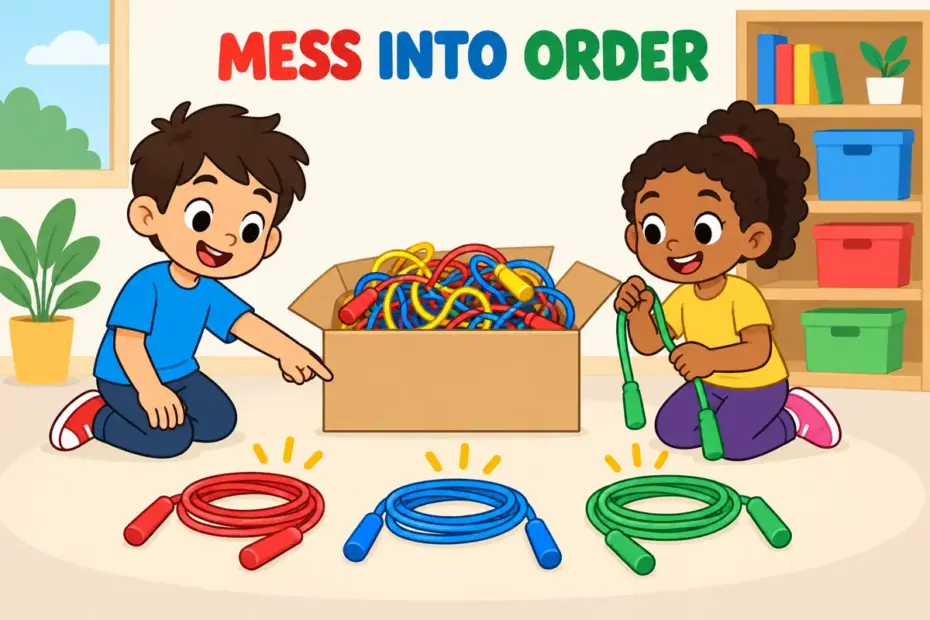
| Classroom | The teacher asked the class to sort out the tangled box of skipping ropes. | A concrete object gives the arranging sense a clear picture. |
| Home note | I sorted out the recycling before the lorry arrived. | Everyday subject and a deadline make the sentence natural. |
| Workplace email | Could you sort out the venue booking today? | The polite request is the commonest office use of the verb. |
| Customer service | We will sort out the refund as soon as the return arrives. | Names the outcome being resolved, which reassures the reader. |
| Sports report | The captain sorted out the defensive mix-up at half time. | Ties the verb to a specific problem and a moment of fixing it. |
| News report | Ministers pledged to sort out the backlog of passport applications. | Formal subject with a public problem; the verb stays neutral. |
| Project planning | The team sorted out who would contact each supplier. | The object is a decision, showing the resolving sense at work. |
| Conversation | Don’t worry, I’ll sort it out with him. | The pronoun between verb and particle marks fluent speech. |
The pronoun pattern in the conversational row marks where separability sounds most natural.
Sort out vs resolve and organize
Sort out overlaps with two verbs and replaces neither. Resolve a dispute is the formal choice for settling a conflict on the record; organize a schedule describes arranging items systematically without any problem to fix.
| Attribute | sort out | resolve | organize |
|---|---|---|---|
| Core job | Fix a mess or a problem informally | Settle a conflict or question formally | Arrange items into a system |
| Typical object | Paperwork, a mess, a dispute, a person | A dispute, a crisis, a question | Files, a schedule, a cupboard |
| Register | Neutral to informal | Formal | Neutral |
| Implies a problem | Yes, most of the time | Yes, always | No, only untidiness |
| Separable | Yes: sort it out | No: resolve it | No: organize it |
Verdict: choose resolve when a conflict is settled on the record, organize when nothing is broken and only order is missing, and sort out when everyday effort clears a practical problem.
Word forms and grammar of sort out
Sort out inflects as a unit, and its spelling rarely changes. The table also lists two lookalikes that learners mix into the same slot: the plain verb sort, which only classifies, and the different phrasal verb sort through, which merely examines a collection.
| Form | Part of speech | Example |
|---|---|---|
| sort out | phrasal verb, base form | Please sort out the recycling. |
| sorts out | phrasal verb, third person singular | The new clerk sorts out the post each morning. |
| sorted out | phrasal verb, past and past participle | We sorted out the booking yesterday. |
| sorting out | phrasal verb, present participle | She is sorting out the seating plan. |
| sort | verb, different meaning | Sort the cards by colour. |
| sort-out | noun, informal British | A quick sort-out of the cupboard took an hour. |
| sort through | phrasal verb, different meaning | He sorted through the letters for the bill. |
Particles combine freely: a partner can back out of a deal, and sort out follows the same grammar. The noun sort-out is hyphenated and countable, so it takes an article.
Common mistakes with sort out
- Incorrect:
Can you sort out it before lunch?Correct: Can you sort it out before lunch? Rule: A pronoun object must sit between the verb and the particle. - Incorrect:
She sorted out that the keys were missing.Correct: She worked out that the keys were missing. Rule: Sort out takes a noun phrase, never a that-clause; use work out or discover before a clause. - Incorrect:
We must sort the problem.Correct: We must sort out the problem. Rule: Sort alone means classify; the particle out is what adds the sense of resolving. - Incorrect:
The supervisor sorted out the apprentice.in a formal letter. Correct: The supervisor reprimanded the apprentice. Rule: The person-as-object sense is informal and can read as a threat, so formal writing needs a neutral verb.
Practice using sort out
Work through the six items, then check the reasoning rather than only the answer.
- Fill the gap: Could you ______ the printer, which keeps jamming before meetings?
- Choose the better word: After months of argument, the two families finally (sorted out / sorted) the boundary.
- Correct the error: I will sort out it as soon as I get home.
- Build a sentence: use sort out about a muddled box of school reports.
- Spot the register: which belongs in an email to a head teacher — we sorted out the timetable clash, or we sorted them out?
- Rewrite with the pair split: The team settled the payment issue. Use sort out and put the object before the particle.
Answers
- sort out — the printer is a thing to fix, so the full particle order is correct.
- sorted out — the family fixed a dispute, so the particle is required; sorted alone would mean arranged.
- I will sort it out as soon as I get home — the pronoun must sit between sort and out.
- Model answer: We sorted out the box of school reports before parents’ evening.
- We sorted out the timetable clash — the other version means reprimanded and is too informal.
- The team sorted the payment issue out — a full noun phrase may sit before the particle.
The bottom line
Use sort out in a sentence when everyday effort turns a mess or a muddle into order, and name the thing being fixed. The two details that decide most sentences are these: the verb is separable, so sort it out is right and sort out it is wrong, and the person-as-object sense is informal, which keeps it out of formal reports. Where a conflict is settled on the record, a jumble of competing claims needs the more formal resolve.
Frequently asked questions about sort out
Is sort out one word or two?
Sort out is always two words when it works as a verb. The hyphenated form sort-out is a noun, as in a quick sort-out of the cupboard. A learner who writes sortout as a single verb has invented a spelling that no dictionary lists, and a spell-checker will either correct it or query it.
Can you separate sort and out in a sentence?
Yes. Sort out is a separable phrasal verb, so the object may follow the particle or sit between the two parts. Write sort out the keys or sort the keys out, and both are correct. The one restriction is a pronoun, which must always go in the middle: sort it out, never sort out it.
What does sort out mean in British English?
Beyond organizing and resolving, British speakers use sort out for dealing firmly with a person, as in the coach sorted him out. That sense carries a hint of discipline or even threat, so it suits conversation and sports talk but not a formal letter. The organizing and solving senses are shared with American English.
What is the difference between sort out and sort through?
Sort out means to fix or organize something, so the mess is gone afterwards. Sort through means only to examine a collection item by item, as in sorting through old letters. You can sort through a pile without changing it, but once you sort it out, the pile has been dealt with.
Are you struggling to understand the concept of “sort out” in English language? In simple terms, “sort out” means to organize or resolve a problem.
When you “sort out” something, you are taking steps to make things more orderly or to find a solution to an issue. This phrasal verb is commonly used in daily conversations and is an essential part of fluent communication. Let’s dive deeper into how to effectively use “sort out” in different contexts and sentences.
7 Examples Of Sort Out Used In a Sentence For Kids
- Let’s sort out all the different colored blocks.
- Can you help me sort out the pictures of animals?
- We need to sort out the toys before we can play.
- Let’s sort out the books by their colors.
- Can you help me sort out the fruits into different groups?
- It’s time to sort out the shapes into the right bins.
- Let’s work together to sort out the numbers in order.
14 Sentences with Sort Out Examples
- Sort out your class schedule to avoid any time conflicts with your extracurricular activities.
- Make sure to sort out your study materials before starting your revision for the exam.
- Don’t forget to sort out your group project roles and responsibilities before the deadline.
- It’s important to sort out your budget for the semester to manage your expenses wisely.
- Sort out your lecture notes and organize them properly for easy reference.
- Make a list of tasks to sort out before the end of the semester to stay on track with your academic goals.
- Sort out your study space to create a conducive environment for focused learning.
- Don’t procrastinate; sort out your assignments as soon as you receive them to avoid last-minute stress.
- Take the time to sort out your career goals and plan your academic path accordingly.
- With multiple deadlines approaching, it’s crucial to sort out your priorities and tackle them one by one.
- Identify any unanswered questions or doubts in your coursework and make a plan to sort out these issues with your professors.
- Sort out your course requirements and make sure you are on track to graduate on time.
- Utilize campus resources such as counseling services to sort out any personal challenges affecting your academic performance.
- Join study groups to sort out difficult concepts and enhance your understanding of the material.
How To Use Sort Out in Sentences?
To use Sort Out in a sentence, first identify a situation or problem that needs to be resolved. For example, “I need to sort out my closet because it’s too cluttered.”
Next, determine the action or solution you will take to address the issue. In the case of organizing a closet, you could say, “I will sort out my clothes by separating them into different piles based on type.”
Then, carry out the action or solution you have planned. This could involve physically moving items around, categorizing them, or making decisions about what to keep or discard. For instance, “I will sort out the items in my closet by sorting through them one by one and deciding what to donate or keep.”
Finally, reflect on the outcome of your efforts and the impact it has had on the initial problem. In this case, you could say, “After spending a few hours sorting out my closet, I now have a more organized space and can easily find items when I need them.”
In conclusion, using Sort Out in a sentence involves identifying a problem, deciding on a course of action, carrying out that action, and reflecting on the results. By following these steps, you can effectively Sort Out various situations and improve your organization and problem-solving skills.
Conclusion
In conclusion, the importance of sorting out various aspects of our lives cannot be overstated. By addressing problems, organizing tasks, and resolving conflicts, we can lead a more efficient and balanced lifestyle. The act of sorting out allows us to effectively manage our time, emotions, and responsibilities, leading to a sense of clarity and peace of mind.
Whether it involves decluttering our living space, tidying up our schedules, or resolving personal conflicts, taking the time to sort out issues can greatly improve our overall well-being and productivity. By actively engaging in sorting out tasks, we can create a harmonious environment for ourselves and those around us, ultimately leading to a more fulfilling and satisfying life.


