
Spill over means to flow past the edge of a container, or for effects, emotions or crowds to pass beyond their usual limits into somewhere else. To use spill over in a sentence, name what overflows and add into plus the new place: “The argument spilled over into the meeting.” The verb is intransitive.
Spill over at a glance
- Spill over is an intransitive phrasal verb, so it never takes a direct object.
- It usually pairs with into, onto or from to name the boundary crossed.
- Its literal sense is liquid passing a rim; its figurative sense is effects or crowds spreading.
- Its common partners are anger, dispute, conflict, crowd and cost.
- The noun spillover is one word and means a secondary consequence.
What does spill over mean?
Spill over is a phrasal verb meaning to flow past a boundary, either literally as liquid or figuratively as an effect that reaches a new area. The Cambridge entry for spill over records both the liquid sense and the spreading sense, and the examples show how often the figurative use carries the meaning.
| Sense | Plain meaning | Example sentence |
|---|---|---|
| Overflow a container | Liquid passes the rim | The milk spilled over onto the table. |
| Spread beyond limits | An effect reaches a new area | The dispute spilled over into trade talks. |
| Fill and crowd out | People move past capacity | Fans spilled over into the car park. |
One limitation is worth stating. Spill over does not mean a slow leak, and it does not name the container. A tap that drips does not spill over; a full bath does. Where nothing crosses a boundary, contain the damage and hold are the more accurate verbs.
How do you use spill over in a sentence?
Because the verb is intransitive, the thing that overflows is the subject and never an object. The preposition then carries the whole direction of the movement, so into, onto and from each mark a different relationship.
| Pattern | Example | What it signals |
|---|---|---|
| subject + spill over | The bath spilled over. | Intransitive; the container overflows. |
| spill over + into | Anger spilled over into the next day. | Names the new place or time. |
| spill over + onto | The paint spilled over onto the floor. | Names the surface below. |
| spill over + from | Trouble spilled over from the coast. | Names where the overflow started. |
| spill over + to | Costs spilled over to consumers. | Shows who receives the effect. |
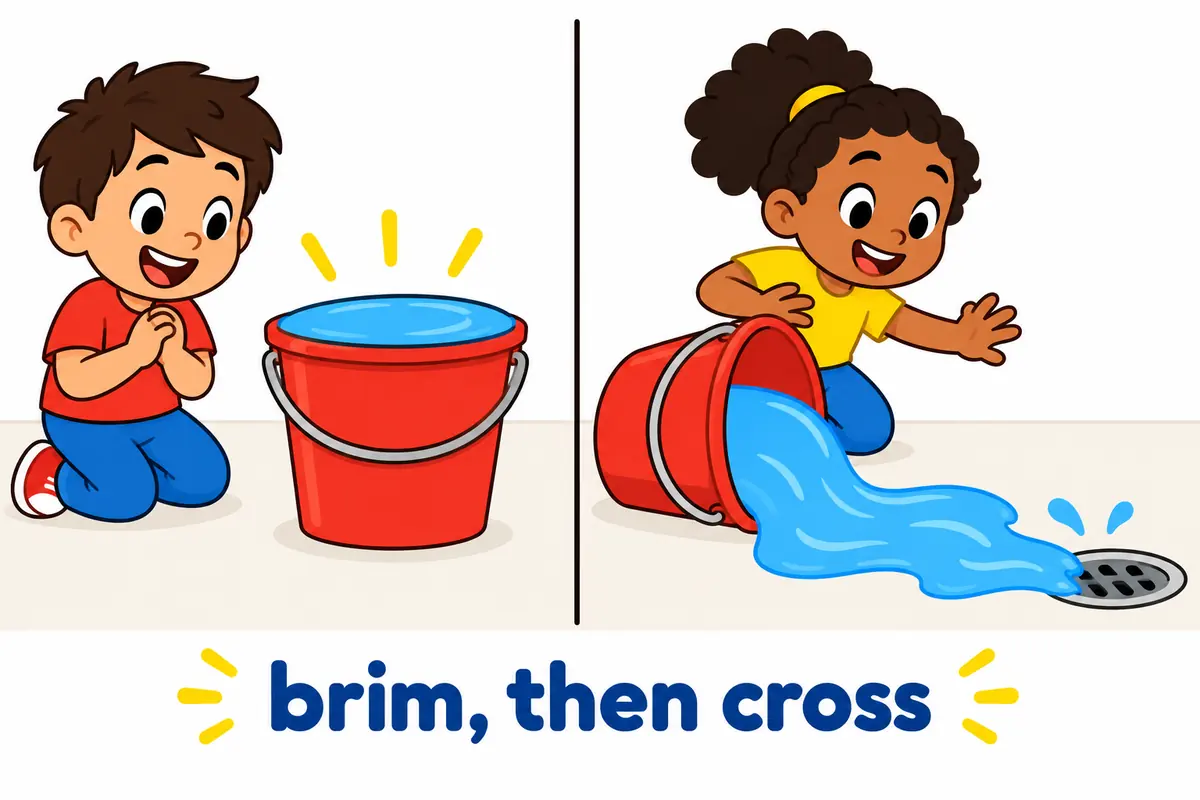
Where the image is a container filled to the top, brim with excitement describes fullness without any crossing, so it suits a scene that has not yet overflowed.

Spill over in a sentence: examples across contexts
Spill over moves easily between a kitchen and a diplomatic report, and the boundary crossed is always the point of the sentence. Each example below names what overflowed and where it went.
| Context | Example sentence | Why this works |
|---|---|---|
| Classroom | Excitement spilled over into the last lesson of term. | An emotion crosses a time boundary. |
| News report | The border dispute spilled over into a wider conflict. | Shows a crisis crossing a national boundary. |
| Workplace email | Let us stop the disagreement spilling over into the client call. | Names the meeting the effect must not reach. |
| Science writing | Nutrients spilled over from the field into the stream. | Keeps the literal liquid sense in formal prose. |
| Sports report | Celebrations spilled over onto the pitch. | Crowd movement past a physical edge. |
| Conversation | Our argument spilled over into the next morning. | Everyday emotion crossing into a new day. |
| Economics note | Higher fuel costs spilled over to food prices. | An economic effect spreading to another sector. |
| Travel diary | The festival crowd spilled over into every side street. | People filling space beyond the venue. |
| History essay | Unrest in the capital spilled over into the provinces. | A political effect reaching a wider region. |
The literal and figurative senses share one grammar but not one register: nutrients and milk sound neutral, while trouble and excitement carry a mild metaphor that formal writing still accepts.
Spill over vs overflow
The two verbs look interchangeable until the sentence asks what crossed. Overflow stresses a container that can take no more, while spill over stresses the movement across a boundary. A glass can overflow without spilling anywhere, and a crowd can spill over without any container at all.
| Attribute | spill over | overflow |
|---|---|---|
| Core image | Movement past an edge | A container past its limit |
| Needs a boundary | Usually, named with into or onto | No, the limit is internal |
| Figurative use | Very common; effects and crowds | Also common; emotion and abundance |
| Typical subject | Water, anger, crowds, costs | River, bath, bin, feeling |
| Register | Neutral to journalistic | Neutral to literary |
Verdict: choose overflow when the container is the point, and spill over when the crossing into a new place or time is the point.
Word forms and grammar of spill over
Spill over inflects regularly, and its noun is written as one word. The table also sets out the phrasal verbs that share the base verb but carry very different meanings.
| Form | Part of speech | Example |
|---|---|---|
| spill over | phrasal verb, base | Meltwater can spill over the banks in spring. |
| spills over | verb, third person | Anger about pay spills over into other talks. |
| spilled over | verb, past and participle | The row spilled over onto the front page. |
| spilling over | verb, present participle | Crowds are spilling over into the side streets. |
| spillover | noun, one word | A spillover of the strike reached the ports. |
| spill out | phrasal verb, different meaning | The children spilled out of the bus. |
The base verb appears in spill the milk, which is transitive and takes a direct object, so it behaves quite unlike spill over. Spill out into the street is the nearest relative and uses a different particle.
Common mistakes with spill over
- Incorrect:
The child spilled over the juice.Correct: The child spilled the juice, which spilled over the rim. Rule: Spill over is intransitive and cannot take a direct object. - Incorrect:
The argument spilled over the meeting.Correct: The argument spilled over into the meeting. Rule: The figurative sense needs into or onto before the new place. - Incorrect:
Anger spilled over in the next day.Correct: Anger spilled over into the next day. Rule: A time boundary takes into, not in. - Incorrect:
The bath spilled over of water.Correct: The bath spilled over. Rule: The container is the subject, so no of phrase is needed. - Incorrect:
Costs spilled over consumers.Correct: Costs spilled over to consumers. Rule: The receiver of the effect takes to.
Practice using spill over
Work through the six items, then read the reasons rather than only the keys.
- Fill the gap: The celebration ______ into the quiet street outside.
- Choose the better word: The river (overflowed / spilled over) its banks after the storm.
- Correct the error: The dispute spilled over the trade talks.
- Build a sentence: use spill over into about a playground game.
- Spot the register: which belongs in a science report — nutrients spilled over into the stream, or the nutrients went everywhere?
- Rewrite with the noun: The strike spilled over into other industries. Use spillover instead.
Answers
- spilled over — the celebration is the subject of the intransitive verb.
- overflowed — the river and its banks are a container past its limit.
- The dispute spilled over into the trade talks — the new place needs into.
- Model answer: The lunchtime game spilled over into the afternoon lesson.
- Nutrients spilled over into the stream — a report keeps the precise preposition.
- A spillover from the strike reached other industries — the noun takes an article and of.
The bottom line
Use spill over in a sentence when something flows or spreads past a boundary into a new place or time. Two details decide most sentences: the verb is intransitive, so the overflowing thing is the subject, and it almost always takes into, onto, from or to to name the boundary. When the container at its limit is the real point, overflow is the sharper verb.
Frequently asked questions about spill over
Is spill over one word or two?
The phrasal verb is two words, spill over, as in the bath spilled over. The related noun is one word, spillover, and means a secondary effect, as in a spillover of the conflict. Keep the two spellings apart, because only the two-word form works as a verb.
Can emotions spill over?
Yes, and this figurative use is now more common than the literal one. Anger, excitement and grief all spill over when they can no longer be contained, usually into a time or place named with into. The pattern treats the feeling as if it were a liquid passing a rim.
What is a spillover effect?
A spillover effect is a consequence that spreads from one situation into another, often unexpectedly. A factory strike can have a spillover effect on deliveries in a different city. The noun keeps the same idea of crossing a boundary, but it names the result rather than the action itself.
Is spill over transitive or intransitive?
Spill over is intransitive, so it never takes a direct object. You say the water spilled over, not the child spilled over the water; in the second sentence the transitive verb spill is doing the work. Adding into or onto after the verb does not change this, because those are prepositions.
Spill over refers to the unintentional or unexpected spread or overflow of something, often from one area or situation to another. This term is commonly used to describe the transfer of effects or consequences beyond their original boundaries.
In various contexts, spill over can occur in different forms and have varied impacts, affecting diverse aspects of life such as economics, health, and the environment. Whether it involves the dispersion of contaminants into surrounding areas or the diffusion of emotions from one individual to a group, understanding spill over is crucial in managing and mitigating its potential repercussions.
7 Examples Of Spill Over Used In a Sentence For Kids
- Be careful with your glass, you might spill over the water.
- If you fill the cup too much, it will spill over.
- Don’t run too fast with your bowl of soup or it might spill over.
- The milk can spill over if you tilt the bottle too much.
- Make sure to balance the bucket so it doesn’t spill over.
- The fountain can spill over if there is too much water.
- Watch out for the paint can, it might spill over if it’s not closed properly.
14 Sentences with Spill Over Examples
- Don’t worry about missing the first lecture, you can always catch up on the spill over videos online.
- The cafeteria was so crowded that my plate almost had a spill over of food.
- I need to make sure I have extra notes in case there is a spill over of information during the seminar.
- The library hours were extended to accommodate the spill over of students studying for exams.
- I left my coffee too close to the edge of the table and it started to spill over.
- The department store had a spill over sale on textbooks, so I stocked up for the semester.
- We had planned to finish the project in one session, but there was a spill over of work that needed to be completed the next day.
- I couldn’t fit all of my clothes in my suitcase, so I had to pack the spill over in a second bag.
- The professor ended the lecture with a spill over of extra credit opportunities for students.
- The party was so lively that it spill over into the early hours of the morning.
- I had so many thoughts running through my mind that they started to spill over onto the pages of my notebook.
- The student council meeting had a lot of topics to discuss, so it ended up spill over into the next meeting.
- The library was so full during exam week that some students had to find spill over study spaces in the cafeteria.
- The guest speaker had so much valuable information to share that the lecture had a spill over question and answer session.
How To Use Spill Over in Sentences?
Spill Over may be used in a sentence in various ways. It refers to the act of expanding or flowing into an area beyond its intended boundaries.
When using Spill Over in a sentence, it is important to consider the context in which the term is being used. For example, “The excitement from the concert spilled over into the streets, creating a lively atmosphere throughout the city.”
To effectively incorporate Spill Over into your sentences, ensure that you are describing a situation where something is extending or reaching beyond its usual limits or borders. For instance, “The positive energy from the team meeting spilled over into the following week, leading to increased productivity among the staff.”
Remember to use Spill Over in a way that clearly conveys the idea of overflow or extension. By doing so, you can accurately express the concept of something spreading beyond its original confines in your writing.
In summary, when using Spill Over in a sentence, focus on describing the overflow or extension of a particular influence, energy, emotion, or action. Consider the context and ensure that your sentence clearly communicates the idea of something expanding or flowing into an area beyond its intended boundaries.
Conclusion
In conclusion, “spill over” refers to the transfer or diffusion of something from one area to another. Whether it’s an overflow of emotions spilling over into everyday interactions, the spread of a disease from one community to another, or the positive effects of an initiative benefiting more than its intended recipients, the concept of spill over underscores the interconnectedness and interdependence of different aspects of life. Recognizing and understanding the potential for spill over effects can help individuals and organizations anticipate and manage the repercussions of their actions, both positive and negative, in a more holistic manner.
Whether it’s the unintended consequences of a policy decision, the unexpected benefits of a new technology, or the ripple effects of a cultural movement, acknowledging the existence of spill over can lead to more informed decision-making and a greater awareness of the intricate web of connections that shape our world. By considering how actions in one area might spill over into others, we can strive for more comprehensive and sustainable outcomes that take into account the broader impact on individuals, communities, and society as a whole.


