
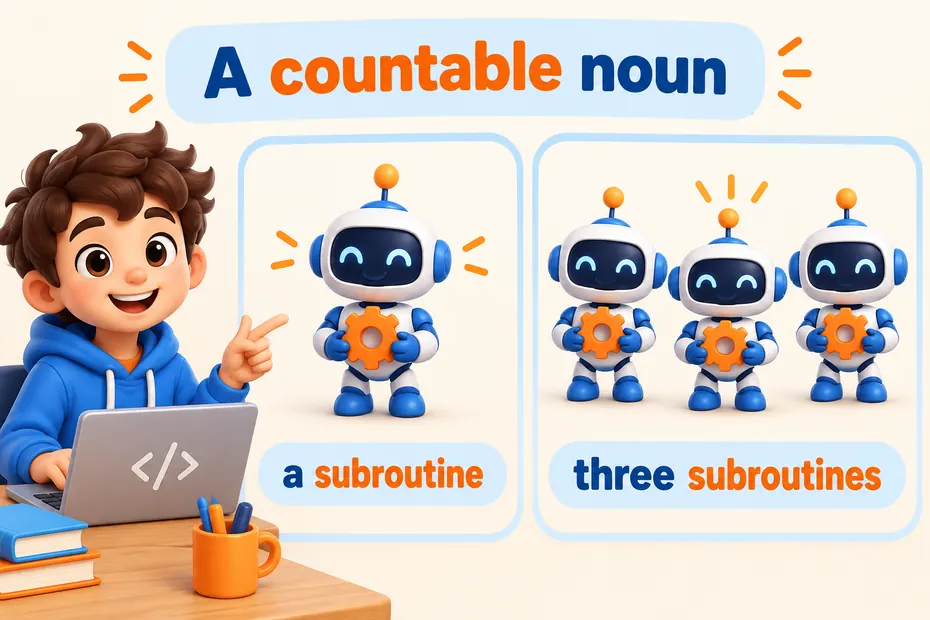
A subroutine is a reusable sequence of program instructions for a particular task. Use the word as a countable noun: “The program calls a subroutine to format the date.” Its plural is subroutines. In ordinary prose, describe the subroutine and its purpose; you do not execute code by writing a sentence.
What does subroutine mean?
Merriam-Webster’s subroutine entry identifies the word as a noun for repeatable instructions performing a specified task. A subroutine belongs to a program’s organization; it need not be a separate standalone application. Think of a named helper that the larger program can call when its particular job is needed.
The original explanation below calls a subroutine a “small independent program.” That description can be misleading if “independent” suggests it must run on its own. A more precise beginner sentence is “A subroutine performs one task within a larger program.” Whether the helper depends on inputs, shared data, or other routines is a separate technical question.
How do you use subroutine in a sentence?
Because subroutine is a singular countable noun, it normally needs a determiner such as a, the, this, or our. Write “A subroutine checks the input,” not “Subroutine checks the input.” When speaking generally, the plural works without an article: “Subroutines can organize repeated tasks.”
| Pattern | Original example | Purpose |
|---|---|---|
| a subroutine | We wrote a subroutine to format the heading. | Introduces a helper |
| the subroutine | The subroutine returns a formatted heading. | Refers to the known helper |
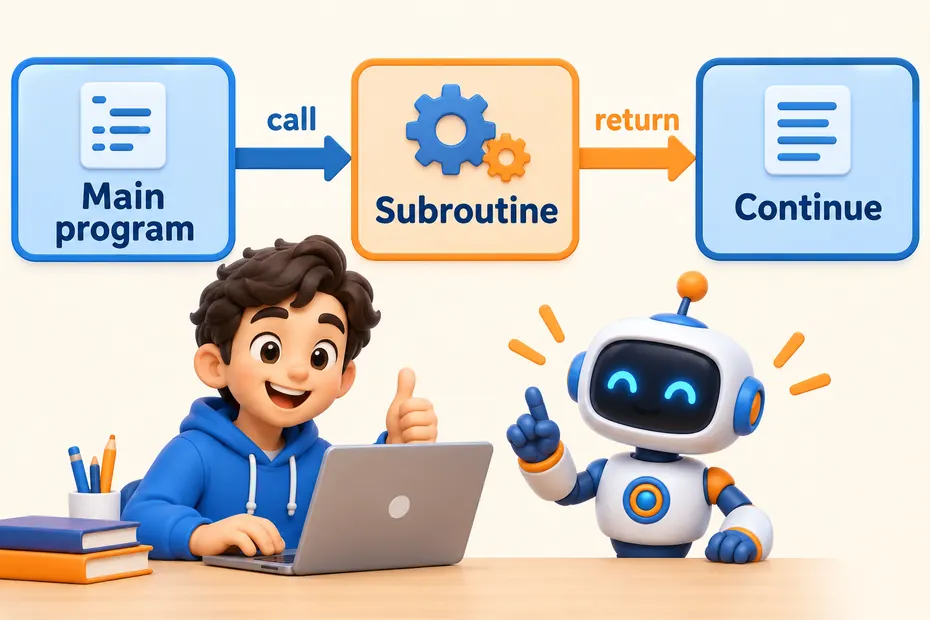
| call a subroutine | The main program calls a subroutine after loading the file. | Describes execution |
| pass data to a subroutine | We pass the filename to the subroutine. | Describes an input |
| return from a subroutine | The program continues after returning from the subroutine. | Describes control flow |
| plural subroutines | Two subroutines handle the report’s headings and totals. | Names multiple helpers |
Sentence writing is different from calling code
The original how-to section below mixes natural-language writing with programming instructions. A sentence does not need matching parameters or a functioning call to use the vocabulary word correctly. “The subroutine calculates the garden’s area” is an English sentence. A call such as rectangle_area(4, 3) is a programming expression.
The garden example below mentions a function name without using the word subroutine. If your assignment specifically asks for that word, write “The area subroutine helps estimate the size of the rectangular garden.” This revision names the concept and explains what it does without inserting a code identifier awkwardly into everyday prose.
A simple Python example connects the two kinds of language:
def rectangle_area(length, width):
    return length * width

assert rectangle_area(4, 3) == 12
Here, “We defined a subroutine to calculate a rectangle’s area” describes the first part. “The test calls the subroutine with two arguments” describes the final line. The assertion checks the example’s result. Python’s own terminology calls this helper a function; its definition and call rules are explained in the official Python tutorial.
Useful verbs to pair with subroutine
Different verbs show different stages of work. You define or write a subroutine when creating it. You call it when asking the program to run it. You test it when checking expected behavior, and debug it when investigating a fault. “Use a subroutine” is understandable, but a more specific verb often makes technical writing clearer.
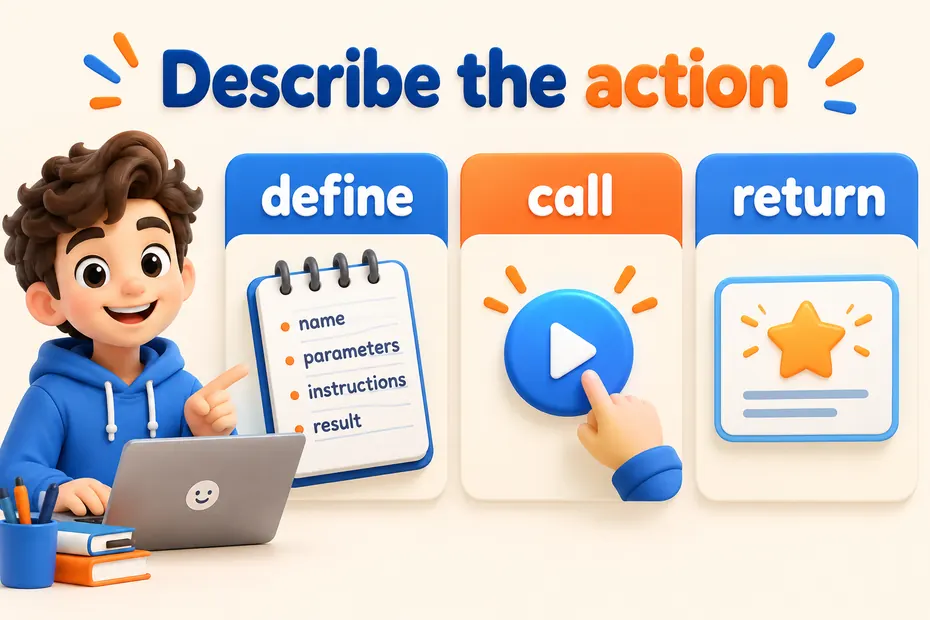
- The developer defined a subroutine for creating report headings.
- The application calls the subroutine whenever a report opens.
- Our test checks whether the subroutine handles an empty title.
- Priya debugged the subroutine after finding an incorrect total.
- The documentation explains which inputs the subroutine accepts.
- The subroutine returns control to its caller after finishing.
- We reused the existing subroutine instead of copying its instructions.
- The reviewer asked us to give the subroutine a clearer name.
These examples add a concrete task or event. Compare “Subroutines are useful” with “The reporting subroutine prevents us from repeating the heading code.” The second sentence explains the benefit instead of merely praising the concept. Reuse can reduce duplication, but organizing code into subroutines does not by itself prove that the program runs faster.
Frequently asked questions about subroutine
Is subroutine a verb?
Subroutine is a noun. In “The system calls a subroutine,” calls is the verb. In “The subroutine fails,” fails is the verb. Use an action word alongside the noun to show what the program or developer does.
Should I write a subroutine or an subroutine?
Write a subroutine. The word begins with a consonant sound, so it takes a, not an. Once you have introduced the helper, you can refer to it as the subroutine if readers know which one you mean.
Is a subroutine always called a function?
Terminology depends on the programming language and context. Python uses function for the defined helper above. When documenting actual code, follow the language’s terminology rather than assuming every language distinguishes functions, procedures, and subroutines in exactly the same way.
What is a simple sentence for a beginner?
“A subroutine performs one task in a program” is a clear starting point. To make the example more informative, name the task: “A subroutine formats the date before the program displays it.” That sentence shows both the helper’s job and its place in the larger operation.

Have you ever heard of the term “subroutine” in programming? In the world of coding, a subroutine is a set of instructions that perform a specific task within a larger program.
These subroutines are extremely useful in breaking down complex tasks into smaller, more manageable pieces, making the overall program easier to understand and maintain. Let’s delve deeper into how subroutines work and why they are essential in software development.
7 Examples Of Subroutine Used In a Sentence For Kids
- Subroutine is like a small helper that follows instructions.
- We use subroutine to perform specific tasks.
- Let’s learn how to create a subroutine in our program.
- Subroutine helps us break big tasks into smaller ones.
- When we need to repeat a task, we can use a subroutine.
- Subroutine makes coding more organized and easier to understand.
- Practice using subroutine to make your programs better.
14 Sentences with Subroutine Examples
- Subroutine is a small independent program within a larger program that performs a specific task.
- In computer programming, subroutines are essential for breaking down complex problems into manageable parts.
- College students often use subroutines to organize their code and make it more readable.
- Subroutines can help students avoid repeating the same code multiple times in a program.
- Understanding how to create and use subroutines is crucial for college students studying computer science.
- When a task needs to be performed multiple times, it’s a good idea to create a subroutine for it.
- Subroutines can be called multiple times within a program to execute a specific set of instructions.
- College students can save time and effort by using subroutines to break down complex algorithms.
- By using subroutines, students can improve the efficiency and structure of their code.
- It’s important for college students to practice writing subroutines to become more proficient in programming.
- Subroutines allow students to modularize their code, making it easier to debug and maintain.
- When faced with a complex programming problem, students can simplify it by creating subroutines for individual tasks.
- Utilizing subroutines effectively can help students improve their problem-solving skills in programming.
- College students can enhance their coding abilities by mastering the art of writing efficient subroutines.
How To Use Subroutine in Sentences?
To use a Subroutine in a sentence, follow these steps:
- Identify the function or task you want the Subroutine to perform within your sentence.
- Integrate the Subroutine seamlessly into your sentence by calling it wherever it is needed.
- Ensure that the parameters of the Subroutine match the context of your sentence for accuracy and relevance.
- Test your sentence to ensure that the Subroutine is functioning as expected and producing the desired outcome.
For example, if you have a Subroutine named “calculateArea” that calculates the area of a rectangle, you can use it in a sentence like this: “The garden is rectangular in shape, and I need to calculateArea to determine how much grass I should buy.”
Remember that when incorporating a Subroutine in a sentence, you are essentially integrating a specific function or operation to enhance the overall message or functionality. By following these steps and practicing with various Subroutines, you will become familiar with how to seamlessly incorporate them in your writing to convey information effectively and efficiently.
Conclusion
In programming, a subroutine is a block of code that performs a specific task and can be reused in different parts of a program. By breaking down tasks into smaller subroutines, developers can write cleaner, more organized code that is easier to manage and maintain. For example, functions like calculating factorial or sorting arrays can be encapsulated within subroutines for efficient and modular programming.
Overall, using subroutines in programming allows for better code organization, readability, and reusability. By isolating specific tasks into separate subroutines, programmers can simplify complex algorithms and improve the overall structure of their programs. Subroutines are essential tools for ensuring efficiency and maintainability in software development.