
Subsume is a transitive verb meaning to include something as part of a larger group, category or system, usually so that it no longer stands alone. To use subsume in a sentence, name the smaller item and the larger class with under, into or within: “The scheme subsumes three small grants under one fund.”
Subsume at a glance
- Subsume is a transitive verb; its forms are subsumes, subsumed, subsuming and subsumption.
- The dominant patterns are subsume + object + under/into/within + category.
- Typical subjects are rules, categories, laws, headings and larger systems.
- The word belongs to formal, academic and legal writing.
- The commonest error is dropping the linking preposition that names the larger class.
What does subsume mean?
Subsume is a transitive verb meaning to place something inside a larger category and absorb it, so that the smaller item loses its separate standing. The Cambridge entry for subsume records the sense of including something in a larger group. The Merriam-Webster entry for subsume adds the sense of taking something in. Where the hierarchy is not the point, include is the plainer verb, and where a category openly takes in many kinds, assimilate names the process.
| Sense | Plain meaning | Example sentence |
|---|---|---|
| Include within a category | Place a smaller thing inside a larger class | The new label subsumes three older categories. |
| Absorb and make subordinate | Take in so the smaller unit loses separate status | The agency subsumed the local office into its main branch. |
| Cover under a rule | Bring a case within a general principle | The clause subsumes every later amendment. |
One limitation is worth stating. Subsume does not mean joining two equal things; it means one thing covers or swallows another, and the smaller item keeps no independent standing. Where the two parts remain separate and equal, incorporate is more accurate, because it joins without demoting.
How do you use subsume in a sentence?
Name the small item as the object and name the big class after a preposition, so the hierarchy is visible. Five patterns cover almost every real sentence, and the preposition under, into or within decides which direction the absorption runs.
| Pattern | Example | What it signals |
|---|---|---|
| subsume + object + under + category | The scheme subsumes the small grants under one fund. | Places the item below a governing heading. |
| subsume + object + into + group | The merger subsumed the rival firm into a single company. | Shows full absorption into a whole. |
| subsume + object + within + class | The syllabus subsumes grammar within wider communication. | Frames the item as one part of a field. |
| be subsumed + under/into | The local rules were subsumed into national law. | Passive form common in legal and academic prose. |
| subsume + object, no preposition | A broad heading can subsume many examples. | Used when the larger class is already clear. |
The passive is far more common than the active in published writing, because the writer usually cares about the item that was absorbed rather than about whoever absorbed it. Compare the small office was subsumed into the ministry with the ministry subsumed the small office.

Subsume in a sentence: examples across contexts
The nine sentences below keep subsume transitive while moving from a classroom to a tax code, and each one names the larger class that does the absorbing. Where the point is simply that one thing contains another, comprise is the closer neutral verb. To classify something is to sort it into a class, while to subsume it is to absorb the whole item into that class.
| Context | Example sentence | Why this works |
|---|---|---|
| Classroom | The teacher subsumed the two topics under one heading. | A visible hierarchy the class can picture. |
| Workplace email | We subsumed the old checklists into the new handbook. | Shows a practical merger of documents. |
| News report | The regulator subsumed four watchdogs into a single body. | Names the absorbing authority and the absorbed parts. |
| Legal writing | Later cases are subsumed under the earlier ruling. | Passive form states the governing decision. |
| Philosophy | The theory subsumes perception within a wider account of mind. | Frames a smaller idea inside a system. |
| Linguistics | One broad category subsumes dozens of irregular forms. | Shows a class covering many members. |
| Conversation | That question really subsumes the one she asked. | Everyday use for one point covering another. |
| Tax writing | The definition subsumes both salaried and freelance income. | A single term reaching several kinds. |
| Management | The local teams were subsumed into a national structure. | Passive absorption into a bigger whole. |
The philosophy and linguistics rows keep the active verb, while the legal and management rows prefer the passive. That split tracks how much the writer wants to hide the agent of the absorption.
Subsume vs include, contain and encompass
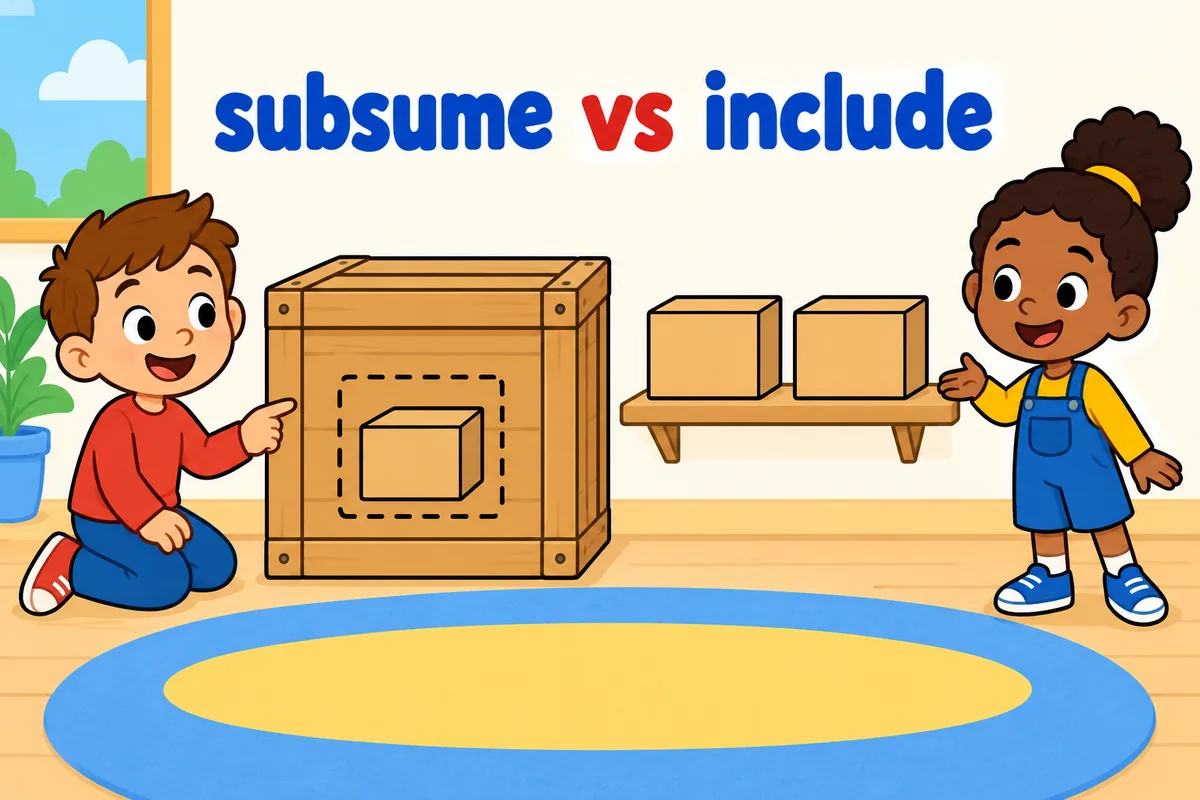
Subsume overlaps with three verbs and is interchangeable with none of them. Include simply lists one thing among others, contain holds something inside, encompass covers a whole range, and subsume alone says that the smaller item loses separate standing inside a larger class.
| Attribute | subsume | include | contain | encompass |
|---|---|---|---|---|
| Structure | One class absorbs a smaller item | One class has an item among others | One thing holds another inside | One thing covers a whole range |
| Loses separate status | Yes | No | No | Sometimes |
| Typical partner | under, into, within | in, among | no preposition needed | a range or a scope |
| Register | Formal, academic and legal | Neutral | Neutral | Formal |
| Example | subsumed under one law | includes two examples | contains three chapters | encompasses many fields |
Verdict: choose include for a plain list, contain for physical holding, encompass for a broad range, and subsume only when a smaller item is absorbed into a larger class and stops standing alone.
Word forms and grammar of subsume
Subsume inflects regularly, and its noun subsumption is common in analytic prose. The table also lists the form learners build wrongly by treating the verb as if it needed no object.
| Form | Part of speech | Example |
|---|---|---|
| subsume | verb, base form | One heading can subsume many cases. |
| subsumes | third person singular | The code subsumes every earlier rule. |
| subsumed | past tense and past participle | The office was subsumed into the ministry. |
| subsuming | present participle | The panel is subsuming the smaller reviews. |
| subsumption | noun | Subsumption of local rules under national law took years. |
| subsumed | adjective, participial | The absorbed team now feels subsumed. |
The verb never works alone: subsume must have something to absorb. When a writer wants the smaller item to keep its own identity, the whole verb is the wrong choice rather than a different form of it.
Common mistakes with subsume
- Incorrect:
The law subsumes of the earlier rules.Correct: The law subsumes the earlier rules. Rule: Subsume is transitive and takes its object directly, with no of. - Incorrect:
The small team was subsumed to the larger department.Correct: The small team was subsumed into the larger department. Rule: Use into, under or within, not to. - Incorrect:
The categories subsume together into one.Correct: The categories are subsumed into one. Rule: Subsume needs an object, so the intransitive together form fails. - Incorrect:
She subsumed that the plan would work.Correct: She assumed that the plan would work. Rule: Subsume is not a reporting verb, so do not confuse it with assume. - Incorrect:
The label subsumes a single example.Correct: The label includes a single example. Rule: Subsume implies a class absorbing members, not one item on its own.
Practice using subsume
Work through the six items, then check the reasoning rather than only the answer.
- Fill the gap: The new framework ______ three separate policies under one rule.
- Choose the better word: The report (includes / subsumes) a short appendix of tables.
- Correct the error: The local office was subsumed to the main branch.
- Build a sentence: use be subsumed into about two school clubs becoming one.
- Spot the register: which fits a legal brief — the later cases are subsumed under the ruling, or the cases got folded in, basically?
- Rewrite with under: The chief absorbed all the small teams. Use subsume under.
Answers
- subsumes — the framework is the larger class absorbing the policies.
- includes — an appendix sits among other parts and keeps its standing, so include is correct.
- The local office was subsumed into the main branch — use into, not to.
- Model answer: The two small clubs were subsumed into a single larger society.
- The later cases are subsumed under the ruling — a brief keeps the formal passive.
- Model answer: The chief subsumed all the small teams under one command.
The bottom line
Use subsume in a sentence when a larger class absorbs a smaller item and the item stops standing alone, and name the larger class with under, into or within. The two points that decide most sentences are that subsume is transitive, so it always needs an object, and that it implies hierarchy rather than a plain list. Where the parts stay equal, include or incorporate is the more accurate choice.
Frequently asked questions about subsume
Is subsume followed by a preposition?
Subsume usually takes under, within or into, as in the new category subsumes the old rules under one heading. The passive form is common: the small schemes were subsumed into a single fund. Without that linking preposition, the sentence often leaves the larger category unclear.
What is the difference between subsume and include?
Include simply says one thing contains another. Subsume goes further: it places the smaller thing inside a larger category so that it loses its separate status. A list includes an item, but a broad category subsumes it, absorbing the item into the group.
Is subsume a formal word?
Subsume belongs to academic, legal and technical writing. It appears in definitions, taxonomies and analytic prose. In everyday conversation people say include or cover instead, and a plain sentence such as the plan covers both teams is usually clearer than one built around subsume.
What is the noun form of subsume?
The noun is subsumption. It names the act of placing something inside a larger class, as in the subsumption of local rules under national law. The related participial adjective is subsumed, which describes an item that has already been absorbed.
“Subsume” is a term often used in academic and philosophical discussions to describe the act of encompassing something within a larger category or concept. Essentially, it involves absorbing or integrating a specific idea or element into a broader framework.
In simpler terms, when you subsume something, you are essentially including it as part of a bigger idea or category, highlighting its connection or relevance within that larger context.
7 Examples Of Subsume Used In a Sentence For Kids
- Subsume means to include something as part of a bigger group.
- The word subsume can help us understand how things are connected.
- When we subsume items, we put them together in a group.
- Let’s try to subsume all the colorful toys in one box.
- We can subsume all the fruits in a bowl.
- It’s fun to subsume all the building blocks in a neat pile.
- Can you help me subsume all the books on the shelf?
14 Sentences with Subsume Examples
- Subsume your class notes into concise study guides to better prepare for exams.
- It’s important to subsume the main points of each lecture in order to understand the material fully.
- Do not subsume important details in lengthy paragraphs; break them down for easier memorization.
- Make sure to subsume all relevant information from your textbooks when writing research papers.
- Subsume key concepts from various sources to enhance your understanding of complex subjects.
- Before exams, it’s helpful to subsume all the key formulas and theories in one place for quick reference.
- In group projects, it’s essential to subsume everyone’s ideas and input to create a cohesive final product.
- When preparing presentations, remember to subsume only the most relevant information to keep your audience engaged.
- Don’t forget to subsume feedback from professors to improve your academic performance.
- As you conduct experiments in the lab, remember to subsume all data accurately in your lab reports.
- Subsume different perspectives in your thesis to provide a well-rounded argument.
- To excel in extracurricular activities, students should subsume time management skills into their daily routine.
- It is important to subsume positive habits like regular exercise and healthy eating habits into your college lifestyle.
- Remember to subsume self-care practices into your routine to maintain a healthy work-life balance.
How To Use Subsume in Sentences?
Subsume means to include or absorb something into something larger or more comprehensive. When using the word “subsume” in a sentence, remember to follow these tips:
-
Identify the main idea: Before using the word “subsume,” make sure you understand the main concept or idea you want to incorporate into a larger category.
-
Start with the main subject: Begin your sentence with the subject that will be encompassing the subordinate idea. For example, “The new policies will subsume all previous regulations.”
-
Introduce the subordinate idea: After establishing the main subject, introduce the idea that will be absorbed or included. For instance, “All current projects will be subsumed into the new initiative.”
-
Use the word correctly: Be sure to place the word “subsume” in the correct context within your sentence to emphasize the act of encompassing or absorbing one thing into another.
-
Practice and expand your vocabulary: To become more comfortable using the word “subsume” in your writing, practice incorporating it into different sentences. Try reading more texts that use the word to understand its various applications.
Remember, using “subsume” correctly can enhance your writing and communication skills by helping you express complex ideas in a clear and concise manner.
Conclusion
In linguistics, sentences with the keyword “subsume” often demonstrate how one concept or category encompasses or includes another within a broader framework. These sentences illustrate how the broader category subsumes the specific elements or instances, highlighting the hierarchical relationship between them. By using “subsume” in sentences, writers can emphasize the overarching or inclusive nature of a concept or idea, making it easier for readers to understand the relationships between different components.
Overall, sentences with “subsume” serve to clarify complex relationships by showing how specific parts are encompassed or contained within a larger whole. Through these examples, readers can grasp the idea of subsumption and how it is used to classify, organize, or explain various elements within a systematic structure, aiding in the comprehension of complex concepts within a given context.


