
Assimilate means to take something in and make it part of a whole, whether the thing is food, information or a newcomer. To use assimilate in a sentence, name what is taken in and where it goes: “The gut assimilates nutrients from each meal.” A second pattern, assimilate into, needs no object at all.
Assimilate at a glance
- Assimilate is a transitive verb that becomes intransitive in the pattern assimilate into a group; its forms are assimilates, assimilated, assimilating and the noun assimilation.
- The two main senses are absorbing a substance or idea and joining a community.
- The usual subjects are a body, a learner, a reader or a group of newcomers.
- Its common partners are nutrients, knowledge, ideas and into.
- The commonest error is swapping assimilate for simulate, which means to imitate.
What does assimilate mean?
Assimilate is a verb meaning to absorb something and make it part of a larger whole, or to become part of a group. The Cambridge entry for assimilate lists senses that run from food to ideas to people, and the difference matters: food is taken into a body, ideas into a mind, and people into a community. Where a sentence only describes soaking something up, absorb nutrients is the plainer choice, because assimilate carries the extra idea of becoming part of a whole.
| Sense | Plain meaning | Example sentence |
|---|---|---|
| Absorb nutrients | Take food into the body and use it | Small children assimilate iron from the food they eat. |
| Take in information | Understand and absorb ideas fully | Students assimilate new words faster when they use them. |
| Join a group | Become part of a community over time | The family assimilated into the village within a year. |
| Make sounds alike | Let one speech sound move toward a neighbour | The sounds assimilate and hide the middle of the word. |
One limitation is worth stating plainly. Assimilate does not mean to memorise or copy. A reader can recognise a word without assimilating it, and a newcomer can live in a town for years without assimilating into it, because the word describes becoming part of a whole rather than simply being present.
How do you use assimilate in a sentence?
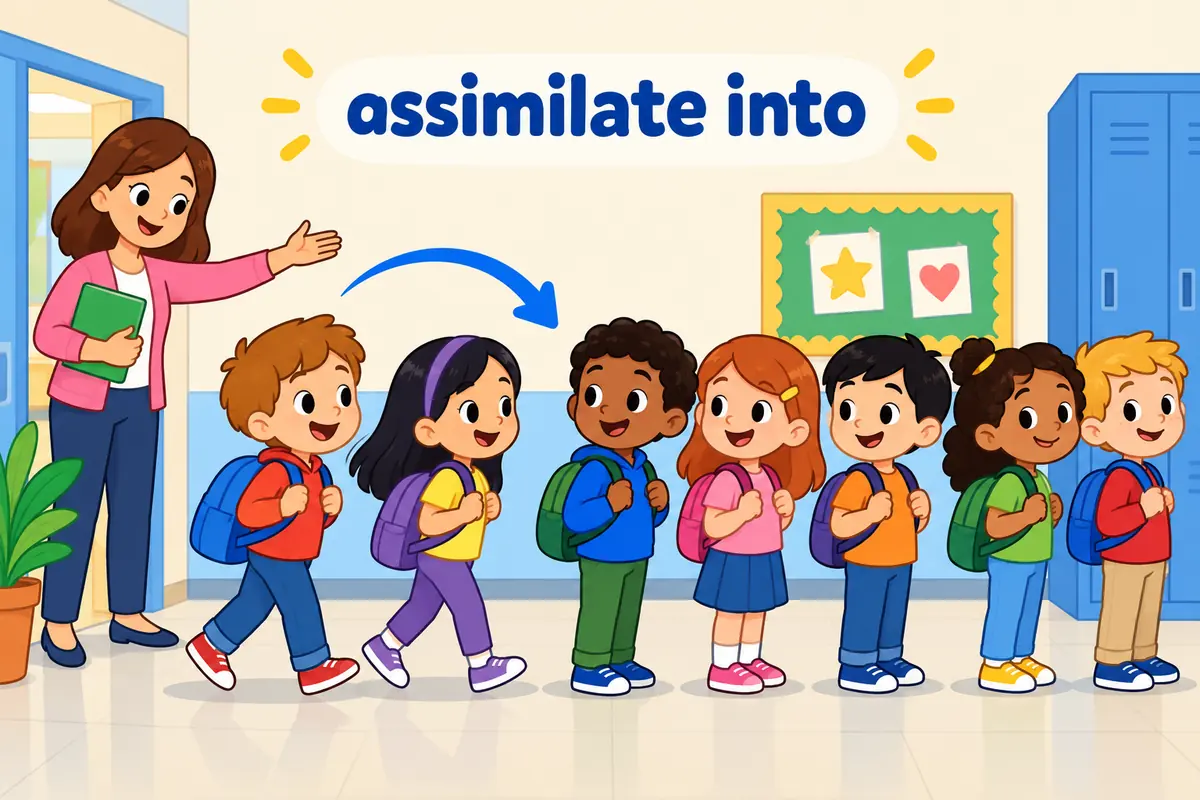
Put the thing absorbed before the verb and its destination after it: a body assimilates nutrients, a learner assimilates a rule, and a newcomer assimilates into a community. The verb is transitive when it names what is absorbed, but intransitive in the frequent pattern assimilate into a group, where nothing follows the person.
| Pattern | Example | What it signals |
|---|---|---|
| assimilate + object | The body assimilates iron slowly. | A substance or an idea is taken in directly. |
| assimilate into + group | New staff assimilate into the team by the second week. | No object; a person joins a whole over time. |
| be assimilated into + group | The custom was assimilated into local practice. | Passive; the received thing is the focus. |
| assimilate + knowledge | Readers assimilate a chapter at a time. | Transitive with an abstract object. |
| assimilate with + group | Some dialects assimilate more with neighbours. | Less common; suggests blending alongside. |
A practitioner rule settles most choices: if you can replace the verb with take in, assimilate fits; if you mean copy or fake, the verb you want is simulate.
Assimilate in a sentence: examples across contexts
Assimilate keeps one meaning while its subject changes from body to mind to community. These nine sentences move from a school laboratory to a news report, and each one names what is taken in.
| Context | Example sentence | Why this works |
|---|---|---|
| Classroom | Young readers assimilate a new sound after hearing it many times. | A concrete skill shows the learning sense. |
| Workplace email | New hires usually assimilate into the team within a month. | The intransitive pattern fits a group joining story. |
| Nutrition writing | The small intestine assimilates most of the iron from a meal. | An organ as subject marks the technical sense. |
| News report | Many families assimilated into the city over two generations. | A time span shows gradual social change. |
| Science writing | Plants assimilate carbon dioxide during daylight. | The subject is a living process, not a person. |
| Academic prose | Students who summarise tend to assimilate a theory more deeply. | Names the mental act, not the result. |
| History essay | The province assimilated its neighbours’ customs slowly. | A place as subject widens the sense to culture. |
| Linguistics | In fast speech, one consonant assimilates to the next. | The technical sense uses to, not into. |
| Conversation | I need a day to assimilate everything we discussed. | The everyday sense means to take information in. |
Readers who pause can digest a difficult paragraph before moving on, which is the everyday cousin of assimilating it.
Assimilate vs integrate, absorb and simulate
Assimilate overlaps with three verbs and matches none of them exactly. Where the emphasis is on soaking up a liquid or energy rather than reshaping it, absorb nutrients is the simpler word. Teams integrate new members on purpose, while people assimilate gradually, and simulate means to imitate conditions rather than take them in.
| Attribute | assimilate | integrate | simulate |
|---|---|---|---|
| Core job | Take in and make part of a whole | Join separate parts into one system | Imitate conditions on purpose |
| Typical subject | A body, learner or group | A planner or a system | A model or a tester |
| What it implies | Slow, internal change | Deliberate connection | No real absorption |
| Common partner | into | into or with | by or on |
| Register | Neutral to formal | Formal | Technical |
Verdict: choose absorb for a physical soak, integrate for deliberate joining, keep simulate for imitation, and reach for assimilate when something is taken in and quietly becomes part of a larger whole. Language learners internalize a rule only after using it many times, which is why assimilate suits study habits so well.
Word forms and grammar of assimilate
Assimilate inflects regularly, and its noun assimilation names the whole process. The table also lists simulate, the look-alike that many learners reach for by mistake.
| Form | Part of speech | Example |
|---|---|---|
| assimilate | verb, base form | Children assimilate language from the people around them. |
| assimilates | verb, third person singular | The soil assimilates the fertiliser over winter. |
| assimilated | verb, past and past participle | The group assimilated its rivals’ methods quietly. |
| assimilating | verb, present participle | She is still assimilating the news. |
| assimilation | noun | The assimilation of new ideas takes time. |
| assimilable | adjective | Not every rule is easily assimilable. |
| simulate | verb — different meaning | The program simulates heavy rain. |
Keep simulate out of this family in meaning even though it shares several letters: simulate describes an imitation, not an absorption.
Common mistakes with assimilate
- Incorrect:
The class assimilated into the new rules quickly.Correct: The class assimilated the new rules quickly. Rule: Use the object form for ideas; reserve into for a group a person joins. - Incorrect:
Newcomers should assimilate themselves into the team.Correct: Newcomers should assimilate into the team. Rule: The verb is not reflexive in this pattern, so drop the pronoun. - Incorrect:
She simulated the data before the exam.Correct: She assimilated the data before the exam. Rule: Simulate means to imitate; assimilate means to take in. - Incorrect:
The company assimilated with the new system.Correct: The company adapted to the new system. Rule: A company adapts to a system, but a person assimilates into a group.
Practice using assimilate
Work through the six items, then check the reasoning rather than only the key.
- Fill the gap: Young readers ______ new vocabulary faster when a story repeats it.
- Choose the better word: After two years the family had fully (assimilated / simulated) into the neighbourhood.
- Correct the error: The committee assimilated that the plan was too costly.
- Build a sentence: use assimilate + object about a plant taking in nutrients.
- Spot the register: which fits a science report — the body assimilates iron slowly, or I totally assimilated that show?
- Rewrite with the noun: The students assimilated the method. Use assimilation instead.
Answers
- assimilate — the readers take the words in, and the object is vocabulary.
- assimilated — the family joined the neighbourhood, and simulate would mean they faked it.
- The committee decided that the plan was too costly — assimilate cannot take a that-clause.
- Model answer: The seedling assimilates minerals from the soil within days.
- The body assimilates iron slowly — a report avoids the first person and the word totally.
- The students’ assimilation of the method was quick — the noun takes of before the thing absorbed.
The bottom line
Use assimilate in a sentence when something is taken in and made part of a whole, and name both the thing absorbed and its destination. Two details decide most sentences: assimilate takes an object for a substance or idea but the pattern assimilate into for a person joining a group, and simulate, its look-alike, means to imitate rather than to take in.

Frequently asked questions about assimilate
Is it assimilate into or assimilate to?
Assimilate into is the standard pattern for a person joining a group: newcomers assimilate into a community. Assimilate to appears mostly in linguistics, where one sound assimilates to a neighbour. Choose into for people and groups, and to for sounds or, rarely, for slow adaptation to a condition.
What is the noun form of assimilate?
The noun is assimilation, as in the assimilation of nutrients or the assimilation of new staff. It names the whole process rather than a single act, and it takes of or into: the assimilation of ideas into a shared method. The adjective assimilable describes something that can be taken in.
Can assimilate be used intransitively?
Yes. Assimilate is intransitive in the pattern assimilate into a group, where no object follows: the newcomers assimilated into the village. It is transitive when it names what is absorbed, as in the body assimilates iron. The two frames answer different questions, so neither replaces the other.
What is the difference between assimilate and simulate?
Assimilate means to take something in and make it part of a whole. Simulate means to imitate conditions or behaviour, often on purpose. A learner assimilates a rule and a machine simulates a storm; sharing several letters does not make the two verbs interchangeable in any sentence.
Ever wondered how to effortlessly blend in with a new group or culture? Assimilation, the process of integrating and adapting to a new environment or society, is a key strategy to navigate unfamiliar territories with ease.
By understanding the social norms, customs, and language of a particular group, individuals can effectively assimilate and establish connections. Whether it’s through observing behaviors or mirroring speech patterns, assimilation plays a crucial role in fostering belongingness and building relationships in diverse settings.
7 Examples Of Assimilate Used In a Sentence For Kids
- Assimilate the colors of the Indian flag: orange, white, and green.
- Let’s try to assimilate the alphabet in order from A to Z.
- We need to assimilate the shapes – circle, square, and triangle.
- Can you assimilate the numbers from 1 to 10?
- It’s fun to assimilate new words into our vocabulary.
- Our goal is to assimilate new ideas and learn every day.
- Remember to assimilate the good values and teachings from our elders.
14 Sentences with Assimilate Examples
- Students should assimilate the key concepts before attempting to solve complex mathematical problems.
- It is essential to assimilate information from various sources when preparing for a research project.
- College students often find it challenging to assimilate new study techniques into their routines.
- To excel in their exams, students must assimilate the guidance provided by experienced professors.
- It is crucial for international students to assimilate into the local culture to feel more at ease in their new surroundings.
- As part of their coursework, students are encouraged to assimilate theoretical knowledge with practical applications.
- Reflection and critical thinking are essential tools for students to assimilate new ideas in the classroom.
- Attending workshops and seminars can help students assimilate the latest trends in their field of study.
- Networking with peers is a great way for students to assimilate diverse perspectives on a particular topic.
- To enhance their language skills, students should assimilate new vocabulary and grammar rules regularly.
- Students are advised to assimilate feedback from instructors to improve their academic performance.
- Engaging in group discussions can help students assimilate differing opinions and viewpoints on a subject.
- Collaborating on group projects allows students to assimilate knowledge and skills from their teammates.
- Taking breaks during study sessions can help students assimilate information more effectively and prevent burnout.
How To Use Assimilate in Sentences?
Assimilate is used to describe the process of taking in and incorporating new information or experiences into one’s existing knowledge or understanding. When using assimilate in a sentence, it is important to understand its context and how it enhances the meaning of your sentence.
Here’s a simple guide on how to use assimilate effectively in a sentence:
-
Identify the context: Determine if you are referring to a person or entity incorporating new information or ideas. This will help you frame your sentence appropriately.
-
Choose the right tense: Depending on when the assimilation took place, use past, present, or future tense accordingly.
-
Structure your sentence: Use assimilate with a subject and an object to clearly convey the process of incorporation. For example, “She assimilated the new cultural norms quickly.”
-
Check for accuracy: Ensure that the sentence accurately reflects the concept of incorporating new information into existing knowledge.
-
Practice using assimilate in various contexts to become comfortable with its usage.
By following these guidelines, you can effectively incorporate assimilate into your sentences to convey the idea of absorbing and integrating new knowledge or experiences.
Conclusion
In conclusion, the process of assimilation involves integrating new information, ideas, or experiences into one’s existing knowledge or identity. This can be seen in various contexts, such as learning a new language, adapting to a new culture, or understanding complex concepts. Assimilating information allows individuals to expand their perspectives, enhance their skills, and adapt to different environments effectively.
By examining the sentences with assimilate, we can understand the importance of assimilation in personal growth and development. Whether it’s assimilating new vocabulary in a foreign language or assimilating diverse cultural practices, the ability to assimilate enables individuals to navigate the complexities of the world around them and foster a deeper understanding of themselves and others.


