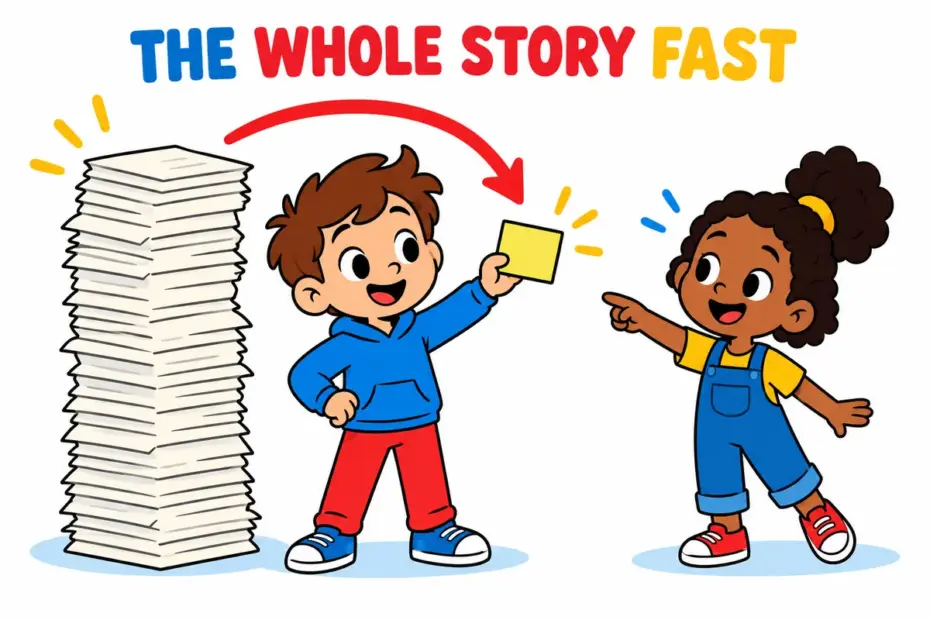
Sum up means to state the main points of something in a few words, and it also means to form a quick judgement of a person. To use sum up in a sentence, name what is being condensed: “The chair summed up the debate.” The phrase is separable, so a pronoun goes between sum and up.
Sum up at a glance
- Sum up is a separable phrasal verb meaning to state the main points briefly.
- It is transitive: sum up the argument, or sum the argument up.
- A pronoun must go between the words: sum it up, never sum up it.
- Its other senses are judging a person quickly and adding amounts into a total.
- The commonest error is using sum up for arithmetic when add up is meant.
What does sum up mean?
Sum up is a separable phrasal verb meaning to state the main points of something briefly, and it carries two further senses: to form a quick opinion of a person, and to add amounts into a total. The Cambridge entry for sum up records the summary sense and the sense of forming a judgement. Where the writer needs a formal single verb, conclude closes a piece of reasoning, though it does not carry the quick-judgement sense.
| Sense | Plain meaning | Example sentence |
|---|---|---|
| Restate the main points | Give a brief summary | The chair summed up the discussion. |
| Describe concisely | Capture the whole of something in one detail | The photograph sums up the mood of the day. |
| Judge quickly | Form an opinion of someone fast | She summed him up in a single glance. |
An honest limit matters here. Sum up is not for long explanations, and it is not a synonym for decide. It also does not replace summarize in very formal writing, where the single verb reads better. When the point is only to shorten a text without restating its ideas, condense is the more precise verb, because sum up always selects the points that matter most.
How do you use sum up in a sentence?
Sum up is transitive and separable, so the object may sit before or after up, but a pronoun must go in the middle: sum it up. The phrase often works as a signpost at the end of a talk, followed by the short recap itself, or with a single telling detail as the subject.
| Pattern | Example | What it signals |
|---|---|---|
| sum up + object | Let me sum up the findings. | Object after up, the usual signpost. |
| sum + object + up | She summed the argument up neatly. | Separable variant, common in speech. |
| sum + pronoun + up | Can you sum it up? | Pronoun must sit in the middle. |
| sum up + as + noun | The critics summed up the film as dull. | Delivers a verdict in one phrase. |
| subject + sum up + object | One photo summed up the whole trip. | A detail stands for the whole. |
For everyday arithmetic the natural phrase is add up, as in add up the bill. Sum up is used for adding only in formal or technical writing, where it names the total rather than the act of counting.

Sum up in a sentence: examples across contexts
Sum up keeps one core meaning, making something shorter, while its subject moves from a chair to a single photograph. The sentences below show the settings the phrase actually appears in.
| Context | Example sentence | Why this works |
|---|---|---|
| Meeting | The chair summed up the discussion before the vote. | A formal signpost at a natural pause. |
| Classroom | The teacher summed up the lesson in three sentences. | Names the short form the recap takes. |
| To sum up, the schedule will not change. | A fixed opener before the main point. | |
| Review | The critic summed up the novel as a slow triumph. | Condenses a verdict into one phrase. |
| Conversation | So, to sum up, we need more time. | Spoken signpost, warm and informal. |
| Caption | That photo sums up the whole summer. | One image stands for a whole period. |
| Management | She summed up the candidate in five minutes. | The quick-judgement sense in action. |
| Finance | The clerk summed up the day’s takings. | The formal add sense, naming a total. |
Sum up vs summarize
Sum up and summarize mean almost the same thing, and the choice is mostly about register. The phrasal verb is warmer and fits speech, emails and reviews; the single verb is more formal and fits reports, essays and minutes. Only sum up adds the further senses of judging a person and adding amounts.
| Attribute | sum up | summarize |
|---|---|---|
| Form | phrasal verb | single verb |
| Register | neutral to conversational | neutral to formal |
| Core action | state the main points briefly | state the main points briefly |
| Extra senses | judge a person, add amounts | none |
| Best in | talks, emails, reviews | reports, essays, minutes |
| Typical shape | separable, with the pronoun in the middle | always one unit |
Verdict: choose sum up for a spoken or informal recap and summarize for formal writing, because the meaning is the same but the tone is not. When one detail captures an idea completely, encapsulate is even more compressed, and when a writer must add detail rather than cut it, expand is the opposite move.
Word forms and grammar of sum up
Sum up inflects regularly, and its participle doubles as a noun for the act of recapping, especially in legal writing. The table sets out the family and the two object positions the separable form allows.
| Form | Part of speech | Example |
|---|---|---|
| sum up | verb, base form | Let me sum up the plan. |
| sums up | verb, third person singular | The report sums up the year in a page. |
| summed up | verb, past and past participle | He summed up the meeting in one line. |
| summing up | participle or noun | Her summing up was fair and short. |
| sum + object + up | separable order | She summed the argument up neatly. |
| sum it up | pronoun order | Sum it up for us. |
Two formal verbs cover nearby ground. recapitulate means to go through the main points again, often step by step, and condense means to make the same content shorter without choosing highlights. Neither carries the quick-judgement sense that sum up has.
Common mistakes with sum up
- Incorrect:
Please sum up it for the team.Correct: Please sum it up for the team. Rule: a pronoun goes between sum and up. - Incorrect:
She summed up the meeting for an hour.Correct: She summed up the meeting in a minute. Rule: sum up implies brevity, so a long explanation contradicts it. - Incorrect:
To sum up, the plan will take a month and here are the twenty tasks.Better: To sum up, the plan will take a month. Rule: sum up introduces the short version, not new detail. - Incorrect:
He summed up that the project was late.Correct: He concluded that the project was late. Rule: sum up takes a noun phrase; before a that-clause use conclude. - Incorrect:
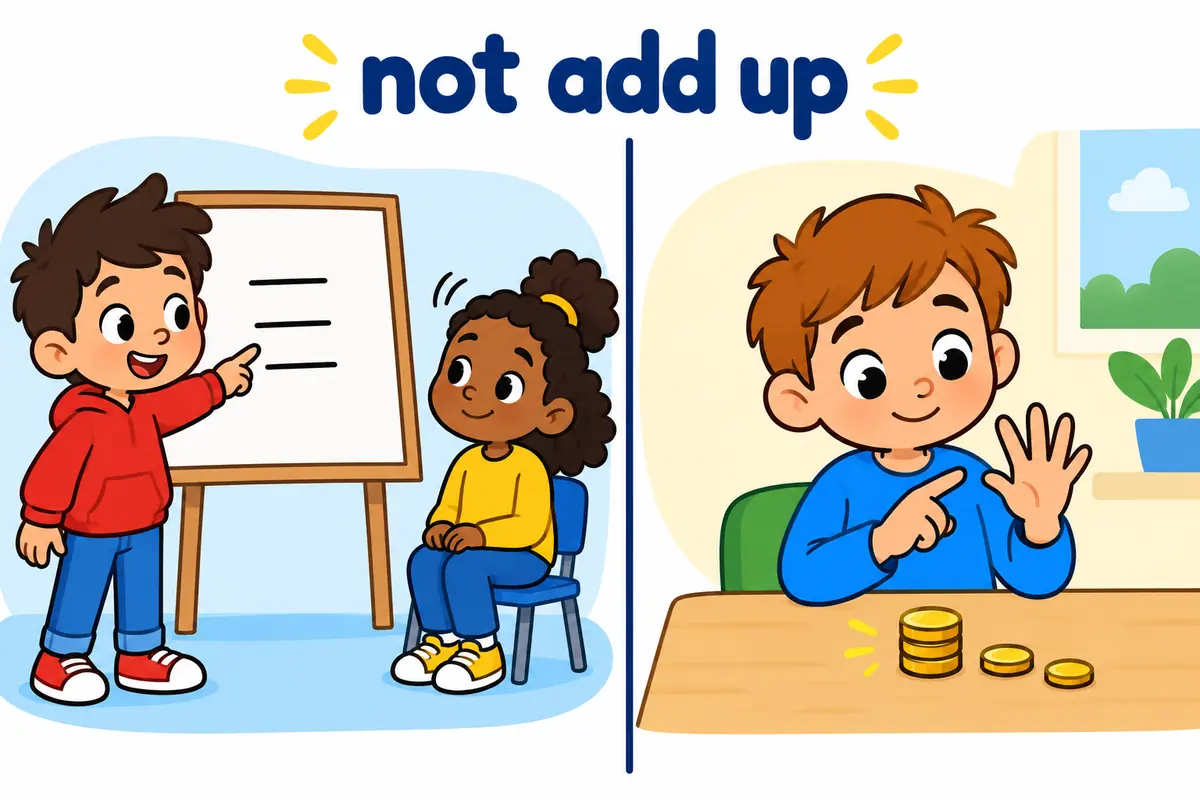
He summed up the coins to check the total.Better: He added up the coins to check the total. Rule: everyday arithmetic takes add up, not sum up.
Practice using sum up
- Fill the blank: The editor asked the reporter to ______ the story in one paragraph.
- Choose the better word: Please (sum up / add up) the main reasons for the delay.
- Correct the error: He summed up it in a single sentence.
- Build a sentence: use sum up as a signpost at the start of a short spoken recap.
- Spot the register: which fits a formal report, this section summarizes the findings, or this bit sums up the findings?
- Rewrite with the pronoun: Can you sum up the argument? Use it instead of the argument.
Answers
- sum up. The reporter condenses the story to its main points.
- sum up. The task is to restate points, not to total numbers.
- He summed it up in a single sentence. A pronoun goes between sum and up.
- Model answer: To sum up, we finished under budget and on time.
- This section summarizes the findings. A formal report prefers the single verb.
- Can you sum it up? The pronoun takes the middle position.
The bottom line
Use sum up in a sentence when you restate the main points in a few words, judge someone at a glance, or name a total, and keep the object or its pronoun next to the verb. The two facts that decide most uses are that the phrase is separable with the pronoun in the middle, and that it always implies brevity. For formal writing, summarize is the safer single verb.
Frequently asked questions about sum up
Is sum up separable?
Yes. Sum up is separable, so you can write sum up the argument or sum the argument up. A pronoun must sit between the two words: sum it up, never sum up it. The middle position is required rather than merely preferred.
What is the difference between sum up and add up?
Sum up means to restate the main points briefly. Add up most often means to total numbers, as in add up the bill, and it can also mean to make sense, as in the story does not add up. The two phrases are not interchangeable in a sentence.
Can you sum up a person?
Yes. To sum up a person is to form a quick opinion of them, as in she summed up the candidate in minutes. This sense is about judgement rather than summary, and it usually suggests the opinion was reached fast and with confidence.
Is sum up formal enough for writing?
Sum up is acceptable in most writing, but very formal reports and academic essays often prefer summarize. Use sum up in talks, emails and reviews, and switch to summarize when the surrounding prose is stiff or technical; the meaning stays the same.
Have you ever found yourself struggling to summarize a lengthy piece of writing succinctly? The process of summing up the key points of a text in a concise manner is known as summarizing. Summarizing involves selecting the most salient information and presenting it in a clear and condensed form.
By distilling the essential ideas of a passage, summary writing helps readers grasp the main concepts without getting bogged down in unnecessary details. It allows for a quick overview of the material and aids in comprehension and retention of information. Mastering the skill of summarizing is not just about shortening text; it requires critical thinking and the ability to identify core ideas.
7 Examples Of Sum Up Used In a Sentence For Kids
- Let’s sum up how many fingers we have on our hands.
- Can you sum up how many animals you see in the picture?
- Let’s sum up all the colors of the rainbow.
- We can sum up all the numbers in this counting game.
- Can you sum up how many friends are in our class today?
- Let’s sum up how many toys you have in your room.
- We will sum up all the shapes we learned today.
14 Sentences with Sum Up Examples
- Sum up the key points from the lecture so we can review them later.
- Can someone sum up the main themes of the novel we have been studying in class?
- Before the exam, let’s sum up all the formulas for the math problems.
- Sum up your research findings and present them to the class next week.
- Let’s sum up our group project progress and assign tasks for the week.
- It’s important to sum up your thoughts in a conclusion for your essay.
- As we approach the end of the semester, sum up your learning experiences so far.
- In your presentation, be sure to sum up the benefits of using this new technology.
- Before starting the group discussion, let’s sum up the assigned readings first.
- Can you sum up the debate points for our upcoming class discussion?
- Remember to sum up your arguments in a clear and concise manner during the debate.
- To prepare for the viva, make sure to sum up the key topics covered in the syllabus.
- Sum up the key takeaways from your internship experience in a final report.
- To improve your communication skills, try to sum up complex ideas in a simple manner.
How To Use Sum Up in Sentences?
To use Sum Up in a sentence, simply follow these easy steps. First, think of what you want to say and the main point you wish to convey. Next, construct your sentence using proper grammar and punctuation. Then, identify the key idea or concept you want to emphasize in your sentence. This is where you will use Sum Up.
When you are ready to use Sum Up in your sentence, place the main idea or concept that you want to summarize within the app. Sum Up will then condense your sentence into a shorter, more concise version while still capturing the essence of your original message.
For example, imagine you want to use Sum Up to simplify the sentence “The students worked hard on their project and presented it to the class.” You would input this sentence into the app and Sum Up would generate a concise summary such as “The students diligently completed and presented their project.”
After using Sum Up successfully, you can share your summarized sentence with others to effectively communicate your message in a clear and concise manner. This tool is especially helpful when you need to convey information quickly or when you want to emphasize a specific point in your writing.
Conclusion
In conclusion, sentences that sum up provide a quick and concise overview of the main points in a discussion or text. By capturing the key ideas in a brief statement, these sentences help readers understand the core message without having to delve into all the details. They are useful for emphasizing important information, highlighting key takeaways, and guiding the reader’s focus.
Overall, sentences that sum up serve as a handy tool for simplifying complex content and aiding comprehension. They facilitate quick understanding and retention of essential points, making them a valuable addition to any written or spoken communication. Whether used in academic essays, presentations, or everyday conversations, these summarized sentences play a crucial role in conveying information effectively and efficiently.