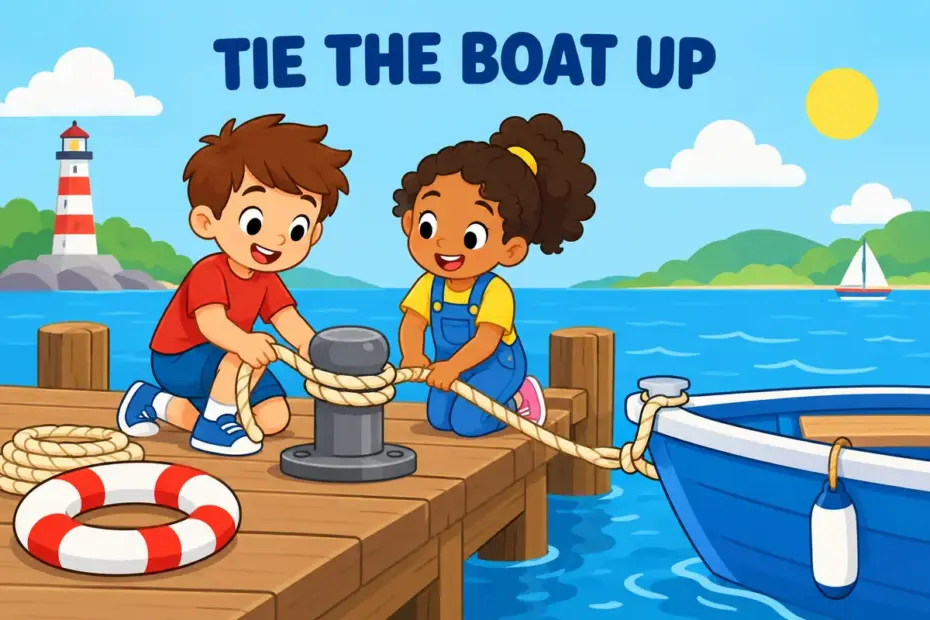
Tie up means to fasten something with rope or cord, to keep someone fully busy, or to block money, traffic or resources so they cannot be used. In a sentence, tie up is a separable phrasal verb, so the object may sit between the two words, as in tie the boat up, or directly after them.
Tie up at a glance
- Tie up is a transitive phrasal verb with four common senses: fasten, occupy, block and conclude.
- Its forms are ties up, tied up, tying up and the noun tie-up.
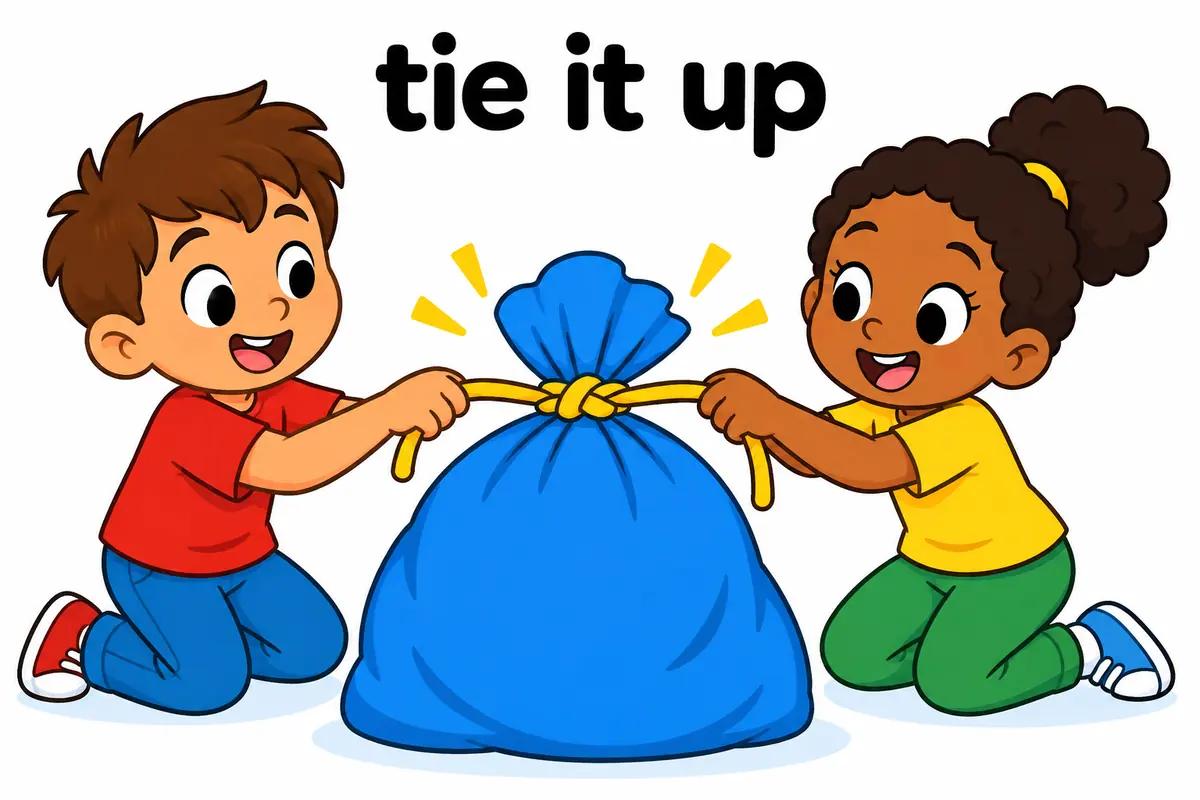
- The particle moves after a noun object but stays put after a pronoun: tie it up.
- The usual objects are a boat, a parcel, a person, money, traffic and loose ends.
- The commonest learner error is placing a pronoun after the particle, as in tie up it.
What does tie up mean?
Tie up is a transitive phrasal verb meaning to fasten something with cord or rope, to keep a person or thing fully occupied, or to block money, traffic or resources from being used. A fourth sense, to conclude a deal or finish loose ends, grew out of the fasten sense: something is made secure before it is left alone.
| Sense | Plain meaning | Example sentence |
|---|---|---|
| Fasten | Bind with rope or cord | The crew tied up the dinghy at the pier. |
| Keep busy | Occupy someone’s time completely | The audit tied up two partners all week. |
| Block | Stop money or traffic from moving | Capital stays tied up in the old plant. |
| Conclude | Bring a deal or task to an end | They tied up the loose ends on Friday. |
The Cambridge entry for tie up records the fasten and occupy senses and shows the phrasal verb taking a direct object, which is the thread running through all four. Where the meaning is simply to fasten one thing to another, the plain verb fasten the rope is often the more precise choice, because tie up adds the idea of finishing the job.
One limitation is worth stating. Tie up is not a synonym for tie down. Tie down means to restrict or hold in place, so a job ties a person down, while a job ties a person up only for a while. Nor does tie up always mean busy: the fastening and concluding senses need no person at all.
How do you use tie up in a sentence?
Tie up is separable, which means the object can move. A full noun may go before or after the particle, but a pronoun must go between the two words. The particle also stays next to the verb in the passive, which is why the busy sense so often appears as be tied up.
| Pattern | Example | What it signals |
|---|---|---|
| tie + object + up | She tied the boat up. | Object between verb and particle; the commonest spoken order. |
| tie up + object | She tied up the boat. | Object after the particle, common when the object is long. |
| tie + pronoun + up | She tied it up. | A pronoun must sit between; tie up it is non-standard. |
| be tied up | The line was tied up for an hour. | Passive, often meaning engaged or blocked. |
| get tied up in | Investors got tied up in a failed fund. | Introduces the thing that traps or blocks. |
| tie up loose ends | We tied up the loose ends before launch. | Fixed phrase meaning to finish unfinished business. |
To secure a load rather than finish a task, writers often reach for secure the load, which keeps the focus on safety. To keep somebody occupied, the plain verb occupy the morning names the time involved.
Tie up in a sentence: examples across contexts
The same phrasal verb moves from the harbour to the office unchanged. The sentences below show each sense in a natural setting.
| Context | Example sentence | Why this works |
|---|---|---|
| Boating | The harbourmaster told us to tie up beyond the second buoy. | The fasten sense with a plain place phrase. |
| Workplace email | I am tied up until four, so let us speak after that. | The busy sense as a past participle adjective. |
| Finance news | Millions stay tied up in accounts nobody can trace. | The block sense applied to money. |
| Traffic report | An overturned lorry tied up the ring road for three hours. | Causes the blockage and names the duration. |
| Project planning | We tied up the last loose ends before the handover. | The fixed phrase for finishing open items. |
| Business news | The two chains announced a tie-up after months of talks. | The hyphenated noun means a partnership. |
| Legal writing | The funds were tied up in escrow until the dispute closed. | The passive keeps the money in focus. |
Notice how often the busy sense uses the past participle after be or get: the dock needs the active verb, while the schedule needs the adjective.
Tie up vs tie down and tidy up
Two neighbours in the dictionary cause most of the confusion: tie down shares the verb and restricts, and wrap up the deal shares the finishing sense but changes the image.
| Attribute | tie up | tie down | tidy up |
|---|---|---|---|
| Core meaning | Fasten, occupy, block or finish | Restrict or hold in place | Make a space or task neat |
| Typical object | A boat, a person, money, loose ends | A person, a schedule | A room, a desk, a file |
| Separable | Yes; tie it up | Yes; tie him down | Yes; tidy it up |
| Usual register | Neutral, wide-ranging | Neutral, slightly critical | Informal and practical |
| Example | Tie up the boat before the storm. | The job tied him down all summer. | Tidy up the desk before you leave. |
Verdict: choose tie up for fastening, occupying and finishing; choose tie down for restriction; and keep tidy up for putting a space or a set of files in order.
Word forms and grammar of tie up
The phrasal verb inflects on the verb, never on the particle, and the hyphenated noun is a separate word class. The table also shows the attributive adjective, which learners often write without the hyphens.
| Form | Part of speech | Example |
|---|---|---|
| tie up | base phrasal verb | We should tie up the boat. |
| ties up | verb, third person singular | She ties up the parcel in string. |
| tied up | verb past and past participle; adjective | They tied up the load; he is tied up all day. |
| tying up | verb, present participle | Jack is tying up the sails. |
| tied-up | attributive adjective | The tied-up dinghy rocked on the swell. |
| tie-up | noun | The tie-up between the clinics lasted a year. |
A useful companion page shows how to add up the totals, another phrasal verb whose particle behaves in exactly the same way, and how a rope can bind the parcel when tie up would be too general.
Common mistakes with tie up
- Incorrect:
Please tie up it before the tide turns.Correct: Please tie it up before the tide turns. Rule: A pronoun object goes between the verb and the particle, never after it. - Incorrect:
The traffic was tie up for miles.Correct: The traffic was tied up for miles. Rule: The passive needs the past participle tied, not the base form. - Incorrect:
He is tie up in meetings.Correct: He is tied up in meetings. Rule: The busy sense uses tied up as an adjective after be. - Incorrect:
She tied up to finish the report.Correct: She was tied up finishing the report. Rule: Tie up does not take an infinitive of purpose. - Incorrect:
The firm tied up the money from being spent.Correct: The firm tied the money up in a long lease. Rule: The blocked thing is the object of tie up, and the place it is stuck is named with in.
Practice using tie up
Work through the six items, then read the reasons rather than only the answers.
- Fill the gap: The sailors ______ the ropes before the storm arrived.
- Choose the better word: This contract will (tie up / tie down) the supplier for five years.
- Correct the error: Kindly tie up it to the post at the gate.
- Build a sentence: use be tied up about a colleague who cannot attend a meeting.
- Spot the register: which belongs in a business report, The merger created a new tie-up, or The two companies got tied up together?
- Rewrite as a noun: The two hospitals agreed to share equipment. Use tie-up.
Answers
- tied up — the past tense fastens the ropes and completes the action.
- tie down — the contract restricts the supplier, which is the tie down sense.
- Kindly tie it up to the post at the gate — a pronoun goes between verb and particle.
- Model answer: Priya is tied up in the budget meeting and cannot join us.
- The merger created a new tie-up — the hyphenated noun suits a formal report.
- The two hospitals announced a tie-up to share equipment — the noun names the link.
The bottom line
Use tie up in a sentence when something is fastened, somebody is fully occupied, resources are blocked, or a deal is brought to a close. The two details that decide most sentences are separability, since a pronoun must sit between verb and particle, and the difference from tie down, which restricts rather than finishes. Keep the fasten sense for real objects and the busy sense for people.
Frequently asked questions about tie up
Is tie up one word or two?
The verb is two words, tie up, and the particle never joins it into one word. The noun is hyphenated, a tie-up, and means a link between organisations or a stoppage. So the crew tied the boat up, but the merger created a new tie-up between the two firms.
Can you say tie up it?
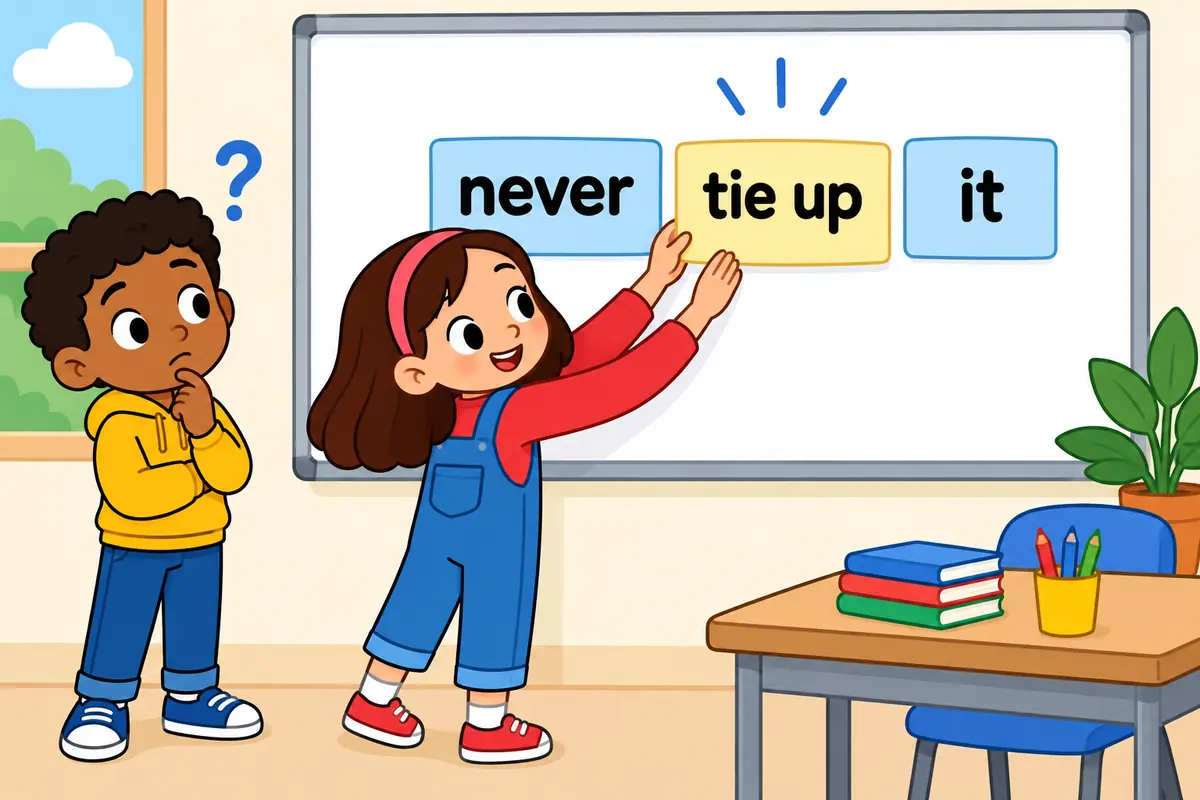
No. A pronoun object must sit between the verb and the particle, so tie it up is correct while tie up it is wrong. A full noun object may go either side, so both tie the boat up and tie up the boat are acceptable in standard usage.
What does tied up mean at work?
It usually means occupied and unavailable. Saying I am tied up until three tells a colleague that meetings or tasks are holding you, not that a rope is involved. The same sense appears in the line is tied up, which describes a phone or a road in use.
Is tie up formal or informal?
The verb belongs to neutral, everyday usage and appears in speech and writing alike. The hyphenated noun tie-up sounds more businesslike, as in a tie-up between two airlines, and the fixed phrase tie up loose ends is common in both planning and conversation.
Do you ever find yourself struggling to clearly connect two ideas in your writing? In linguistic terms, a “tie up” sentence serves as a bridge that links different concepts or emphasizes a relationship between them.
These sentences often play a crucial role in maintaining the coherence and flow of your writing, ensuring that your ideas are effectively communicated to your audience. Let’s explore the importance of “tie up” sentences and how they can enhance the overall clarity and structure of your writing.
7 Examples Of Tie Up Used In a Sentence For Kids
- Tie up your shoelaces before running.
- Let’s tie up the balloons for the party.
- Tie up your hair with a ribbon.
- We can tie up the curtains with a rope.
- It is important to tie up your school bag properly.
- You can tie up your old newspapers with a string.
- Don’t forget to tie up your apron before cooking.
14 Sentences with Tie Up Examples
- Tie up your hair before heading to the lab to avoid any distractions.
- Remember to tie up loose ends on your project before the deadline.
- Make sure to tie up any loose sheets in your notes to keep them organized.
- Tie up your shoelaces properly to avoid tripping on campus.
- It’s important to tie up any loose connections in your research to present a cohesive argument.
- Before the exam, tie up any last-minute study materials to ensure you’re well-prepared.
- Don’t forget to tie up any financial aid paperwork before the semester ends.
- Tie up any loose ends in your internship application to increase your chances of being selected.
- Remember to tie up any loose threads in your presentation to make a strong impression.
- It’s crucial to tie up any misunderstandings with your group members before starting a new project.
- Before leaving for the day, tie up any pending assignments to stay on track.
- Tie up any loose cords on your laptop charger to prevent accidents in your dorm room.
- Make sure to tie up any loose agreements with your part-time job to avoid any conflicts.
- Tie up any loose ends in your resume before sending it out to potential employers.
How To Use Tie Up in Sentences?
To use Tie Up in a sentence, follow these simple steps:
-
Definition: First, Tie Up means to secure something by fastening it with string, rope, or another material. It can also refer to finishing or dealing with something, like completing loose ends.
-
Identify the context: Determine if you are talking about physically fastening something using a knot or finishing up a task.
-
Subject: Start your sentence with the subject, which is the one doing the action.
-
Action: Follow the subject with the action of what is being tied up. This could be a boat, a package, a project, or any other object or task.
-
Details: Add details to your sentence to clarify what is being tied up, why, or how.
-
Examples:
- Physically tying up: “I need to tie up my shoelaces before going for a run.”
- Completing a task: “I will tie up the project report and submit it by the end of the day.”
-
Practice: Try to create more sentences using Tie Up in different contexts to improve your understanding and usage of the term.
Remember, using Tie Up effectively in a sentence is all about correctly conveying the action of securing or finishing something, so make sure your sentence clearly communicates this action.
Conclusion
In summary, sentences involving the phrase “tie up” commonly refer to securing or binding something, whether literally with rope or figuratively in terms of completing tasks or making arrangements. For instance, “I need to tie up loose ends before starting a new project” denotes the need to finish incomplete tasks. On the other hand, “The robber tied up the hostages” illustrates the physical act of restraining individuals.
Overall, the phrase “tie up” is versatile and can be used in various contexts, indicating completion, organization, or physical restraint. Understanding the nuances of this phrase can help improve communication clarity and convey specific meanings effectively in different situations.


