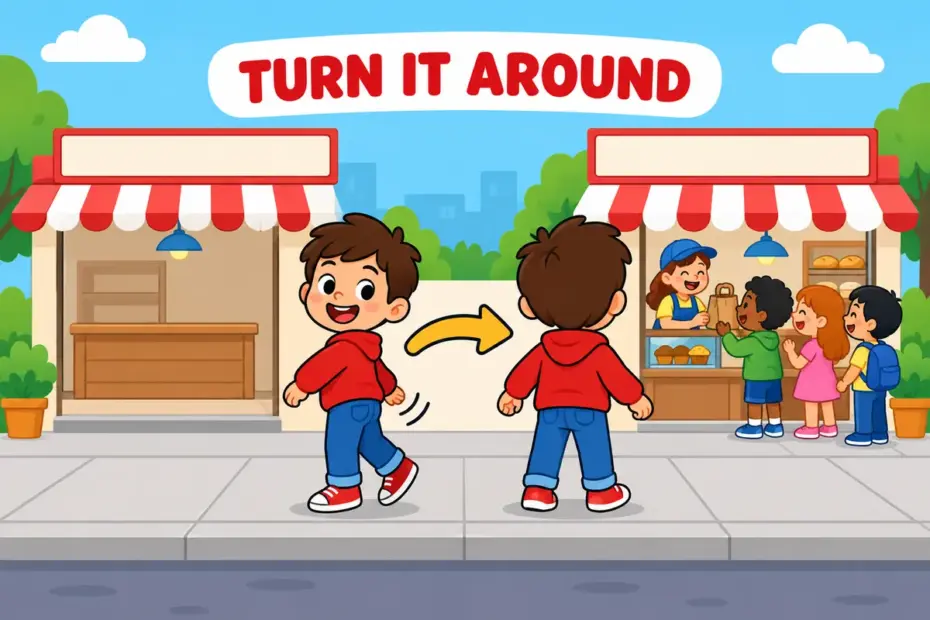
Turn around means to rotate so you face the opposite way, or to change a failing situation into a successful one. To use turn around in a sentence, decide which sense you need: “She turned around to check the door” is physical, while “The coach turned the team around” is figurative. The particle stays close to the verb.
Turn around at a glance
- Turn around is a separable phrasal verb made of turn plus the particle around.
- The literal sense is to face or move in the opposite direction.
- The figurative sense is to reverse a bad result and make it good.
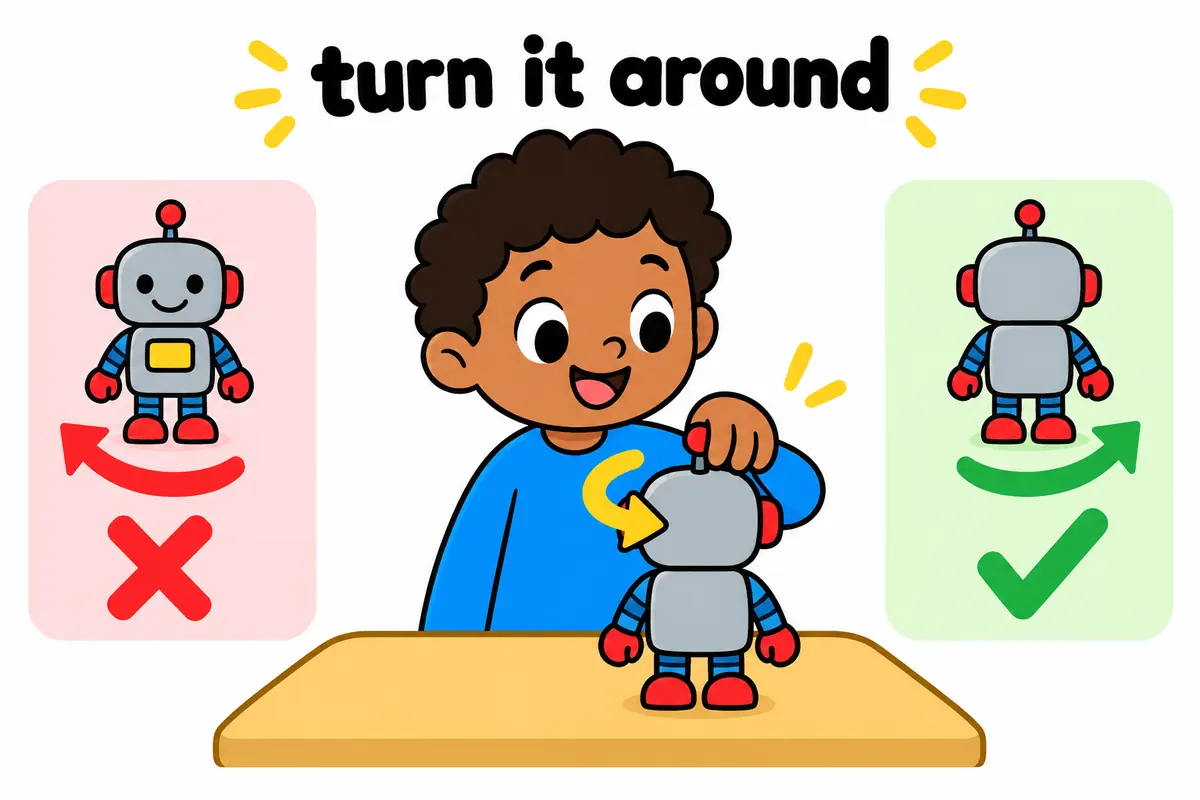
- With a pronoun object the particle must follow it: turn it around, never turn around it.
- The noun is turnaround, written as one word, and it covers both senses.
What does turn around mean?
Turn around is a phrasal verb meaning to face or move in the opposite direction, and also to reverse a failing situation so that it succeeds. The Cambridge entry for turn around gives both the movement sense and the recovery sense, and it is the second that fills business writing. A third, narrower sense means to complete work within a set time.
| Sense | Plain meaning | Example sentence |
|---|---|---|
| Face the other way | Rotate so you look in the opposite direction | He turned around when he heard his name. |
| Reverse a situation | Change a failing system into a success | New funding turned the school around. |
| Change an opinion | Adopt the opposite view after evidence | She turned around on the plan after the trial. |
| Complete in time | Finish work within a set period | The team turned around the report by Friday. |
One limitation is worth stating. Turn around does not mean postpone or cancel. A meeting that is moved to next week is put back, and a decision that is dropped is scrapped; turning something around changes its direction or its fortunes, not its date.
How do you use turn around in a sentence?
Separability is the first thing to master. When the object is a noun it may sit between the verb and the particle or after both, but when the object is a pronoun it must sit between them. The patterns below cover almost every real sentence.
| Pattern | Example | What it signals |
|---|---|---|
| turn around, no object | The bus turned around at the bridge. | Intransitive: the subject rotates itself. |
| turn + noun + around | She turned the photograph around. | Separable literal sense; the object goes between. |
| turn + pronoun + around | Turn it around before you leave. | Pronouns force the particle to the end. |
| turn around + noun | The manager turned around the struggling branch. | Figurative sense; the object often stays after. |
| turnaround, one word | The turnaround took two years. | The noun form, spelled as a single word. |
The particle is what separates this verb from the many other turn up and turn down combinations, so a learner who drops around changes the meaning entirely.
Turn around in a sentence: examples across contexts
The phrasal verb keeps one shape while its subject changes from a person to a company to a whole season. The ten sentences below show how far the recovery sense stretches.
| Context | Example sentence | Why this works |
|---|---|---|
| Classroom | Turn around and look at the board, please. | Uses the literal sense as a simple instruction. |
| Road directions | The van turned around in the farm gateway. | Names the exact place, which makes the movement clear. |
| Business report | The new director turned around the loss-making depot. | Applies the recovery sense to a named unit. |
| Sports writing | One substitution turned around the whole match. | Shows a small cause reversing a large result. |
| School news | Extra tutoring turned around the exam results. | Keeps the object abstract, which suits reporting. |
| Personal note | She turned her health around with two small habits. | The object is a life area, not a business. |
| Workplace email | We can get around the delay if we turn the schedule around today. | Pairs the verb with a deadline to mean finish quickly. |
| Science writing | A single trial turned around the earlier conclusion. | Reverses a belief rather than a system. |
| Conversation | I turned around and the whole queue had vanished. | Stands alone with no object, the everyday pattern. |
| Travel writing | They turned around at the ridge and walked back down. | Movement sense with an explicit turning point. |
The recovery sense almost always takes a named thing as its object, such as a company, a team, a season or a set of results. A sentence that says only that someone turned around, with no object, is almost always the literal movement. A shopper might look around a showroom before deciding to turn the whole business around.
Turn around vs spin around
Turn around and spin around both describe rotation, so writers swap them by accident. Turn around usually means a single half-turn to face the other way; spin around means turning quickly and repeatedly on the spot. Only turn around has the figurative recovery sense.
| Attribute | turn around | spin around |
|---|---|---|
| Core meaning | Face the opposite way, or reverse a result | Rotate quickly and repeatedly on a spot |
| Number of turns | One half-turn, usually | Many fast rotations |
| Typical subject | A person, vehicle, company or team | A dancer, a top or a delighted child |
| Figurative use | Common: reverse a failing situation | Rare: mostly physical |
| Register | Neutral and everyday | Vivid and often playful |
Verdict: choose turn around when the point is a change of direction or a recovery, and choose spin around when the point is fast, repeated motion.
Word forms and grammar of turn around
The verb inflects normally and the noun is written solid. The table also flags an informal variant that formal writing avoids.
| Form | Part of speech | Example |
|---|---|---|
| turn around | phrasal verb, base | They turn around the failing shop. |
| turned around | past tense and participle | He turned around and walked out. |
| turning around | present participle | The company is turning around at last. |
| turnaround | noun | A quick turnaround is expected. |
| turn-around | noun, informal variant | We need a turn-around by Monday. |
Keep the two-word form for the verb and the one-word form for the noun. Turning around is a pair of words, while a turnaround is a single noun, and mixing them is the error that readers notice first. Do not confuse turn around with push around, which means to bully rather than to rotate.
Common mistakes with turn around
- Incorrect:
Please turn around it.Correct: Please turn it around. Rule: A pronoun object must sit between the verb and the particle. - Incorrect:
The firm made a turn around last year.Correct: The firm made a turnaround last year. Rule: The noun is written as one word. - Incorrect:
He turned around the idea in his mind.Correct: He turned the idea over in his mind. Rule: Turn around suggests physical rotation or recovery; turn over is the phrase for thinking. - Incorrect:
The meeting was turned around to next week.Correct: The meeting was put back to next week. Rule: Turn around does not mean postpone; the right verb is put back or postpone. - Incorrect:
She turned around the corner.Correct: She turned the corner. Rule: To go past a corner, turn the corner; adding around changes the meaning.
Practice using turn around
Try all six items, then check the reasoning as well as the answer.
- Fill the gap: The driver ____ ____ after missing the exit.
- Choose the better word: The child (turned around / spun around) on the spot until she was dizzy.
- Correct the error: We need a turn around on this job by noon.
- Build a sentence: use turn around about a shop that was losing money before new owners arrived.
- Spot the register: which belongs in a business report — the firm turned around its losses, or the firm totally flipped?
- Rewrite with the noun: The team turned around its season. Use turnaround instead.
Answers
- turned around — no object, so the particle simply follows the verb.
- spun around — repeated fast rotation on one spot is the spin pattern.
- We need a turnaround on this job by noon — the noun is one word.
- Model answer: New owners turned the shop around within a year.
- The firm turned around its losses — a report avoids totally and flipped.
- The team completed a remarkable turnaround of its season — the noun keeps the article with it.
The bottom line
Use turn around in a sentence for a half-turn to face the other way or for a failing situation that becomes a success, and remember the object rule: nouns may follow the particle, but pronouns must sit between turn and around. The noun form is the single word turnaround, and the verb never means postpone. Keep the literal and figurative senses apart, because only the second takes a company, a team or a season as its object.
Frequently asked questions about turn around
Is turn around one word or two?
The verb is always two words: turn around. The noun is one word: turnaround. A sentence such as we need a quick turnaround uses the noun, while the team turned around its season uses the verb. Mixing the two forms is the error readers spot immediately.
Why must I say turn it around rather than turn around it?
Turn around is a separable phrasal verb, and a pronoun object has to sit between the verb and the particle. With a noun you have a choice, so you may write turn the car around or turn around the car. With it, only turn it around is correct.
Can turn around be used in business writing?
Yes, and it is common there. The recovery sense describes a company, team or economy that stops failing and starts succeeding, as in the new chief turned the airline around. For a formal report, the noun turnaround often reads better, as in a remarkable turnaround in sales.
Does turn around mean the same as turn round?
Turn round is the usual British spelling of the same phrase, and turn around is standard in American English. Both mean to rotate or to reverse a situation, and both keep the same object rules. Choose the spelling that matches the rest of your document and stay consistent.
Have you ever wondered how the phrase “turn around” can have both a literal and a metaphorical meaning? In its most basic sense, “turn around” refers to the act of rotating or pivoting to face the opposite direction.
In a figurative context, “turn around” implies a change in situation or perspective, often leading to improvement or a positive outcome. This versatile expression is commonly used in both everyday conversations and professional settings to illustrate transformation, growth, and progress.
7 Examples Of Turn Around Used In a Sentence For Kids
- Let’s turn around and see what’s behind us!
- It’s fun to turn around in circles and get dizzy!
- Can you turn around and face your friend?
- We need to turn around to see the board.
- When we play games, we have to turn around and run fast!
- Remember to turn around and check if your friends are following you.
- The teacher said to turn around and line up at the door.
14 Sentences with Turn Around Examples
- Turn around and see if you’ve left any belongings behind in the lecture hall.
- Remember to turn around and check for traffic before crossing the street.
- If you’re lost on campus, turn around and look for a map to get directions.
- Don’t forget to turn around and greet your classmates before starting the group project.
- Before submitting your assignment, make sure to turn around and check for any errors.
- As a college student, it’s important to turn around and ask for help when you’re struggling with your studies.
- When facing a difficult situation, sometimes it helps to turn around and approach it from a different perspective.
- Before giving up on a challenging task, remember to turn around and seek advice from your professors.
- Take a moment to turn around and appreciate how far you’ve come in your academic journey.
- In times of stress, it can be beneficial to turn around and take a break to clear your mind.
- Before entering a new academic program, make sure to turn around and evaluate if it aligns with your career goals.
- If you’re feeling overwhelmed by your workload, it might be helpful to turn around and prioritize your tasks.
- Always remember to turn around and thank those who have supported you throughout your college experience.
- When preparing for exams, sometimes it’s necessary to turn around and study smarter, not harder.
How To Use Turn Around in Sentences?
When you want to express a change in direction or action, you can use the phrase “Turn Around” in a sentence. Here are some tips on how to use it effectively:
-
Direction: Use “Turn Around” to indicate physically rotating towards the opposite side or heading back. Example: “He realized he was going the wrong way and decided to turn around to find his way back home.”
-
Change of Mind: You can also use “Turn Around” to mean changing your opinion or decision. Example: “After hearing all the evidence, she decided to turn around and support the new policy.”
-
Improvement: Another way to use “Turn Around” is to describe a situation that was once negative but has now become positive. Example: “The company was struggling, but with the new CEO’s leadership, they were able to turn around and become successful again.”
-
Response: Use “Turn Around” to describe a quick response or reaction to a situation. Example: “She was surprised by how fast he was able to turn around a solution to the problem.”
Remember, when using “Turn Around” in a sentence, make sure it fits the context of the situation and clearly conveys the intended meaning. Practice incorporating this phrase in different scenarios to become more comfortable with using it effectively.
Conclusion
In conclusion, the examples of sentences with “turn around” illustrate the concept of reversing direction or altering a situation for the better. Whether it’s a physical movement like “Turn around and you’ll see the sign on the wall” or a metaphorical change such as “The new manager managed to turn around the failing project,” the phrase encapsulates the idea of transformation and improvement. These sentences convey the versatility of “turn around” in describing both literal and figurative shifts in direction, highlighting its relevance in various contexts.
Through these examples, it becomes clear that “turn around” is a versatile phrase that can be used in a variety of situations to signify a change or improvement. From navigating physical spaces to managing projects or relationships, the phrase captures the essence of transformation and provides a vivid image of redirection and progress.


