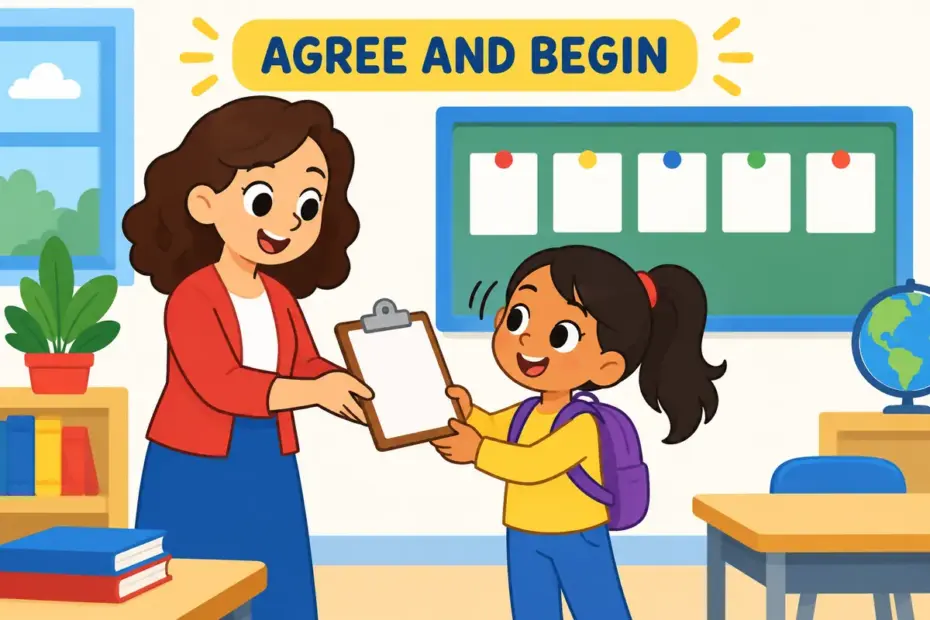
Undertake is a verb meaning to begin or agree to carry out a task, and in formal writing to promise to do something. It usually takes a task noun as its object: “She undertook the survey herself.” The past tense is undertook and the past participle is undertaken.
Undertake at a glance
- Undertake is a transitive verb; its forms are undertakes, undertook, undertaken and undertaking.
- The dominant pattern is undertake plus a task noun, as in undertake a review or undertake research.
- A second formal sense is to promise: the company undertook to repay the loan.
- Common collocations are undertake a review, undertake a journey and undertake to do something.
- The commonest error is confusing undertake with undergo, which means to experience something.
What does undertake mean?
Undertake is a transitive verb meaning to agree to do a task, to begin work on it, or formally to promise. The Cambridge entry for undertake records both the begin-a-task sense and the promise sense, and the object tells them apart. The related promise names only the commitment, while undertake adds the work that follows it.
| Sense | Plain meaning | Example sentence |
|---|---|---|
| Begin a task | Start work on something substantial | The team undertook a full safety review. |
| Agree to carry out | Accept the work as your own | She undertook the repairs herself. |
| Promise formally | Commit to a future action | The supplier undertook to replace the part. |
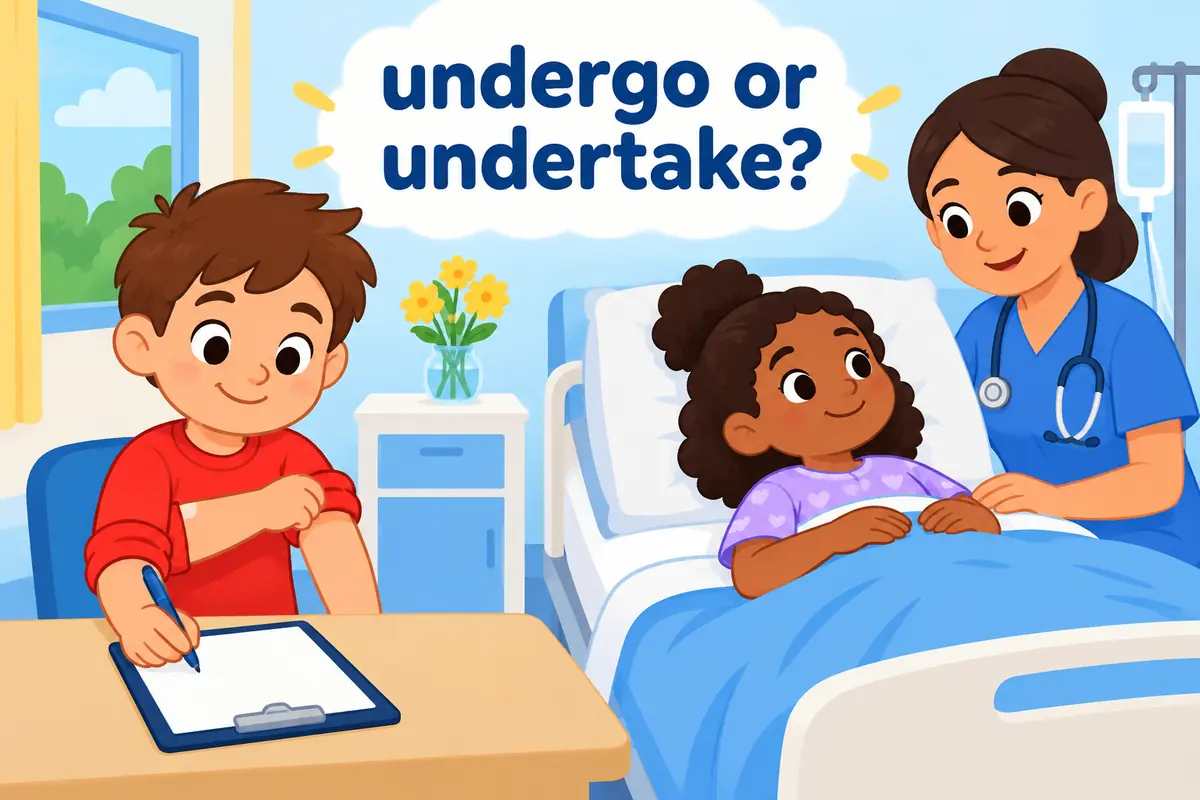
One limitation is worth stating plainly. Undertake is not a synonym of try, and it never means to experience something. It signals a decision and a duty, not an attempt and not an accident, so a passenger who survives a crash undergoes it but does not undertake it.
How do you use undertake in a sentence?
Undertake needs an object, and the form of that object decides which sense the sentence carries. A task noun gives the doing sense; the infinitive to plus a verb gives the promise sense.
| Pattern | Example | What it signals |
|---|---|---|
| undertake + task noun | The council undertook a survey of local traffic. | Work accepted and begun. |
| undertake + a journey / repairs | They undertook the repairs over one weekend. | A concrete job taken on. |
| undertake to + base verb | The bank undertook to cover all the fees. | A formal, binding promise. |
| be undertaken | The review was undertaken in three stages. | Passive form, common in reports. |
| undertake + research / a study | Her group undertook a long study of the soil. | Academic work formally started. |
Notice that undertake to do something is the only common pattern with a verb after it. Closely related verbs such as embark take on or upon instead, so the prepositions are not interchangeable.
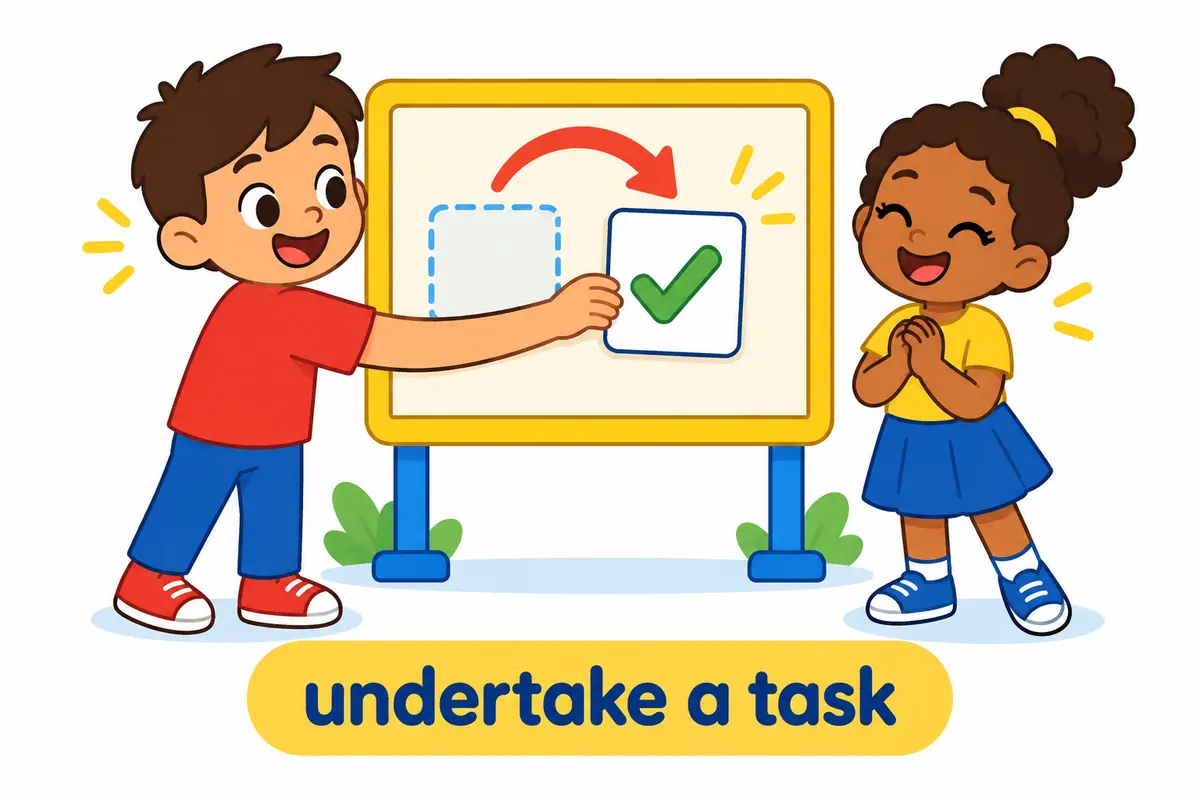
Undertake in a sentence: examples across contexts
Undertake shifts register from a classroom promise to a legal undertaking while keeping the same core idea of accepted work. The nine sentences below each name what was taken on and by whom.
| Context | Example sentence | Why this works |
|---|---|---|
| Classroom | The class undertook to tidy the garden every Friday. | A promise between people, plainly stated. |
| Workplace email | Our team will undertake the audit next month. | Names the task and the timing. |
| News report | The ministry undertook a review of the failed scheme. | Formal reporting uses the task noun. |
| Business writing | The supplier undertook to deliver within two weeks. | The promise sense with to plus verb. |
| Academic prose | Researchers undertook a five-year study of the reef. | A long project formally begun. |
| Travel writing | They undertook the crossing in a small open boat. | A journey taken on deliberately. |
| Legal writing | The tenant undertook to keep the roof in repair. | A binding duty, the formal register. |
| Conversation | He undertook the whole job before asking for help. | Everyday sense of taking work on. |
| Project report | The work was undertaken in two phases over the winter. | Passive form, standard in reports. |
Two neighbours are worth separating. Venture adds risk and boldness to the act of starting, while tackle adds effort against a difficulty; undertake is the plainest of the three and carries no extra colour.
Undertake vs undergo
Undertake and undergo share a prefix and little else, yet learners reach for the wrong one constantly.
| Attribute | undertake | undergo |
|---|---|---|
| Core idea | Agree to do a task | Experience something done to you |
| Who acts | The person chooses the work | Events happen to the person |
| Typical object | A review, a study, repairs | Treatment, surgery, a change |
| Control | The subject is in control | The subject is often passive |
| Register | Formal and businesslike | Neutral to medical |
Verdict: choose undertake when somebody takes on work, and undergo when somebody endures an experience. The near-synonym assume fits a third case, taking on a duty or role, as in assume responsibility, which is lighter than the work undertaken by a whole project.
Word forms and grammar of undertake
Undertake is irregular, and its noun and participle forms do a great deal of work in contracts and reports.
| Form | Part of speech | Example |
|---|---|---|
| undertake | verb, base form | We will undertake the survey in spring. |
| undertakes | verb, third person singular | She undertakes every repair herself. |
| undertook | verb, past tense | They undertook the crossing at dawn. |
| undertaken | verb, past participle | The work was undertaken in stages. |
| undertaking | noun, and present participle | The build was a costly undertaking. |
The past participle undertaken carries the passive, and the noun undertaking names both a large task and a formal promise. Neither form takes the base verb after it: undertaken by, not undertaken do.
Common mistakes with undertake
- Incorrect:
The patient undertook a long recovery.Correct: The patient underwent a long recovery. Rule: Undergo means to experience; undertake means to agree to do. - Incorrect:
She undertook to the repairs last week.Correct: She undertook the repairs last week. Rule: The task is a direct object, so no preposition precedes it. - Incorrect:
The company undertook pay the invoice.Correct: The company undertook to pay the invoice. Rule: Before a verb, undertake needs the word to. - Incorrect:
I will undertake that I finish it.Correct: I will undertake to finish it. Rule: Modern usage takes to plus a verb, not a that-clause. - Incorrect:
The work was undertook last year.Correct: The work was undertaken last year. Rule: The passive uses the past participle undertaken, not the past tense undertook.
Practice using undertake
Work through the six items, then read the reasoning rather than only the answer.
- Fill the gap: The council will ______ a review of the bus routes this autumn.
- Choose the better word: The bridge will (undergo / undertake) major repairs next year.
- Correct the error: The builder undertook to fixing the roof by Friday.
- Build a sentence: use undertake to about a shop promising a refund.
- Spot the register: which belongs in a contract — the tenant undertakes to pay the rent, or the tenant will have a go at paying?
- Rewrite in the passive: The team undertook the inspection in May. Use was undertaken.
Answers
- undertake — the review is the task noun that follows the verb.
- undergo — the bridge experiences the repairs, it does not agree to do them.
- The builder undertook to fix the roof by Friday — after to, use the base verb, not the -ing form.
- Model answer: The shop undertook to refund every customer within a week.
- The tenant undertakes to pay the rent — a contract uses the formal promise pattern.
- The inspection was undertaken by the team in May — the passive takes the participle undertaken.
The bottom line
Use undertake in a sentence when someone takes on work or makes a formal promise, and give it a task noun or the pattern undertake to plus a verb. The two nuances that decide most sentences are transitivity, which requires an object, and the split between undertaking work and undergoing an experience. When the meaning is simply to experience something, the verb must be undergo.
Frequently asked questions about undertake
Is undertake a formal word?
Yes, in the promise sense especially. Contracts, reports and official letters use undertake to fix a duty, as in the tenant undertakes to pay. The begin-a-task sense is more neutral and appears in ordinary business and academic writing. In casual chat most people say take on instead.
What is the past tense of undertake?
The past tense is undertook, as in the team undertook a survey. The past participle is undertaken, used after have or be, as in they have undertaken the work and the work was undertaken. The verb is irregular, so it never takes the regular -ed ending.
What does undertaking mean?
Undertaking is both the present participle of undertake and a noun. As a noun it names a large task, as in a costly undertaking, or a formal promise, as in a written undertaking to repay. Context separates the two, because the noun almost always follows an article or adjective.
Can undertake be followed by a verb?
Yes, but only with to in between. The pattern undertake to plus a base verb marks a formal promise, as in the bank undertook to cover the fees. Without to, the verb needs a noun object instead, as in undertake the review. A bare verb directly after undertake is never correct.
Have you ever wondered what it means to “undertake” a task or project? In simple terms, undertaking something involves committing to and initiating a specific action or responsibility. It signifies taking on a task with a sense of purpose and determination.
Undertaking something often requires careful planning, effort, and dedication to see it through to completion. Whether it’s embarking on a new project at work or tackling a personal goal, the act of undertaking involves a willingness to take on challenges and responsibilities with a proactive mindset.
7 Examples Of Undertake Used In a Sentence For Kids
- Undertake a fun coloring activity with crayons.
- Let’s undertake a puzzle together.
- We can undertake a nature walk in the park.
- Undertake planting seeds in the garden.
- It’s time to undertake a storytelling session.
- Let’s undertake a dance party to celebrate.
- We can undertake a science experiment with water and oil.
14 Sentences with Undertake Examples
- Before the semester begins, every college student must undertake the task of purchasing their required textbooks.
- Many students choose to undertake internships during their summer breaks to gain practical work experience.
- It is important for students to undertake proper time management skills to balance their academic and extracurricular activities.
- College students often undertake group projects as a way to collaborate with their peers and enhance their teamwork skills.
- Some students undertake part-time jobs to help cover their expenses while pursuing their education.
- Students may undertake research projects in collaboration with professors to delve deeper into their areas of interest.
- College students are encouraged to undertake volunteer work to give back to their communities and broaden their perspectives.
- Before graduation, students must undertake a certain number of credit hours to fulfill their degree requirements.
- Students who are passionate about a particular subject may undertake independent study projects to delve deeper into the topic.
- Language students often undertake language exchange programs to practice their language skills with native speakers.
- As part of their coursework, students may undertake field trips to gain hands-on experience in their chosen field of study.
- College students can undertake online courses to supplement their traditional classroom education.
- Students who are interested in entrepreneurship may undertake business ventures while still pursuing their studies.
- Before embarking on a study abroad program, students must undertake the necessary preparations to ensure a smooth transition.
How To Use Undertake in Sentences?
Undertake means to commit to or take on a task or responsibility.
When using Undertake in a sentence, start by identifying the task or responsibility being taken on. For example, “She decided to undertake the project of organizing the charity event.”
The main verb in the sentence should be undertake, and it should always be followed by the task or responsibility being assumed. Try to frame the sentence in a clear and direct way to ensure that the meaning is easily understood.
It’s important to note that undertake is typically used in a formal context or when referring to tasks that require commitment and effort. For instance, “The company will undertake a thorough review of their business operations.”
Remember that undertake implies a sense of seriousness and dedication towards the task at hand. Avoid using it for simple or everyday activities. Instead, reserve it for situations where careful planning and effort are involved.
Practice incorporating Undertake into your sentences to become more comfortable using it in various contexts. Over time, you’ll gain confidence in utilizing this word effectively to convey your commitment to tasks or responsibilities.
Conclusion
In conclusion, the examples of sentences with the keyword “undertake” demonstrate how the word is used to convey the action of taking on a task or responsibility. Whether it’s agreeing to undertake a new project at work, fostering a willingness to undertake risks, or recognizing the importance of seeking professional help when needed, the word underscores the notion of assuming or committing to something.
By showcasing different contexts in which the word “undertake” is utilized, we can understand its versatile application in expressing the act of embarking on a venture or duty. From personal endeavors to professional obligations, the word encapsulates the essence of being proactive and proactive in tackling challenges or assignments.


