
In a sentence, volunteer can name a person who offers help or describe the act of offering to do something. Use volunteer to plus a verb for an offered action (“Maya volunteered to tutor”) and volunteer for plus a role or cause (“Maya volunteered for the coordinator role”).

At a glance
- Volunteer is both a countable noun for a willing helper and a verb meaning offer to do something.
- The common verb pattern is volunteer to + base verb: “They volunteered to organize the event.”
- Use volunteer for before a role, group, or cause; use volunteer at to name a place.
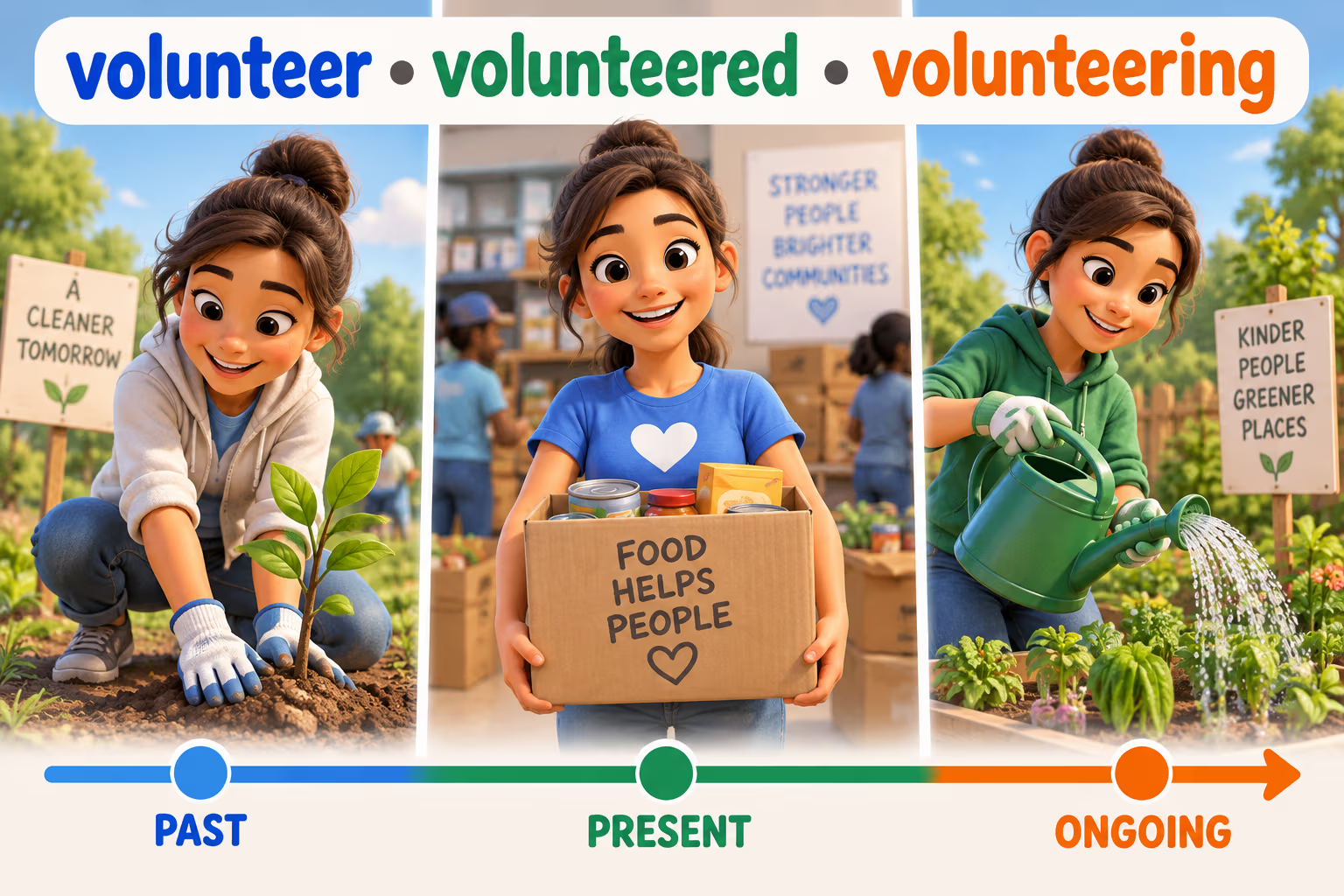
- The simple past and past participle are volunteered; the present participle is volunteering.
- The verb can also mean to give information without being asked: “He volunteered an explanation.”
What Does Volunteer Mean in a Sentence?
Volunteer has related noun and verb uses. As a noun, a volunteer is a person who willingly offers to do something, often unpaid; as a verb, to volunteer means to offer to do something, often without being asked. The verb also has a transitive use for offering information without prompting.
The wording matters: volunteer does not mean only “work for free.” A sentence may focus on willingness, a role, or an offer; whether a particular position is unpaid, reimbursed, or otherwise compensated depends on its arrangement. Cambridge Dictionary separates the noun, the offer-to-do verb, and the information-giving verb senses.
How Do You Use Volunteer to Describe an Action?
Use volunteer to followed by the base form of a verb when someone offers to perform an action. The word to introduces an infinitive, so write “volunteered to help,” not “volunteered to helping.”
| Pattern | Meaning | Example |
|---|---|---|
| volunteer to + verb | Offer to perform an action | “Nia volunteered to take notes during the meeting.” |
| volunteer for + role / cause | Offer for a position, group, or activity | “Omar volunteered for the school garden team.” |
| volunteer at + place | Give time or service at a location | “We volunteer at the neighborhood library.” |
| volunteer + noun | Offer something, often time or service | “She volunteered her Saturday morning.” |

Choose the preposition based on what follows: an action (to coach), a role or cause (for the team), or a location (at the center). A sentence may combine patterns: “Ravi volunteered to read at the library.”
Can Volunteer Mean Give Information?
Yes. In the transitive pattern volunteer + information, a person offers a fact, answer, or explanation without being asked for it. “She volunteered the answer” has she as the subject, volunteered as the verb, and the answer as its direct object.

Use this sense when the person supplies information or a comment; it does not necessarily describe organized community service. For example, “The witness volunteered an additional detail” means the witness offered the detail without prompting. Cambridge Dictionary records both this transitive use and the more familiar offer-to-act sense.
What Are the Verb Forms of Volunteer?
Volunteer is a regular verb: add -s for third-person singular present, -ed for the simple past and past participle, and -ing for the present participle. The spelling doubles neither the final consonant nor changes the final e in volunteered; the present participle drops that final e.
| Form | Use | Example |
|---|---|---|
| volunteer | Base form / present with I, you, we, they | “They volunteer twice a month.” |
| volunteers | Present with he, she, it | “Alex volunteers at the clinic.” |
| volunteered | Simple past and past participle | “We volunteered last spring.” / “She has volunteered before.” |
| volunteering | Progressive form or gerund | “I am volunteering this weekend.” / “Volunteering builds experience.” |
Common Volunteer Sentence Mistakes
- Use a plural verb for plural volunteers: “The volunteers are ready,” but “A volunteer is ready.”
- Keep the infinitive after the action pattern: “He volunteered to drive,” not “He volunteered to driving.”
- Do not use volunteer as if it always means a registered charity role: people can volunteer for a one-time task, offer a response, or give time informally.
- Use context to clarify a role: “She volunteered for the position” means she offered herself as a candidate; “She volunteered at the position” would normally suggest a place and is unlikely to fit.
Sources and Further Reading
The noun and verb senses, including volunteer to plus an infinitive and the transitive “offer information” use, are checked against Cambridge Dictionary’s entry for volunteer. Its Learner’s Dictionary entry gives the core verb pattern in a simpler form.
The full original article, including all 21 listed examples, its usage notes, and conclusion, is preserved below word-for-word. The previously featured image is also retained inline.

Have you ever wondered what it truly means to volunteer? Simply put, volunteering is the act of offering your time and skills to help others without expecting anything in return. It is a selfless gesture that can make a significant impact on individuals, communities, and even the world at large.
Volunteering comes in many forms, from assisting at a local soup kitchen to participating in a beach cleanup event. The beauty of volunteering lies in its ability to bring people together for a common cause, fostering a sense of unity and compassion. Whether it’s spending time with the elderly, tutoring students, or planting trees, every act of volunteering contributes to creating a kinder and more connected society.
7 Examples Of Volunteer Used In a Sentence For Kids
- Volunteer helps others for free.
- I can volunteer to clean up the park.
- We can volunteer to read stories to children.
- Let’s all be a volunteer in our community.
- Volunteer can make the world a better place.
- I want to be a volunteer at the animal shelter.
- Volunteer is someone who helps without expecting anything in return.
14 Sentences with Volunteer Examples
- Volunteer at local NGOs to gain practical experience in social work.
- Join a volunteer program to help underprivileged children with their studies.
- Volunteer at a wildlife sanctuary to learn about conservation efforts.
- Take part in a beach cleaning drive as a volunteer to promote environmental awareness.
- Volunteer at a hospital to assist medical staff and gain insight into healthcare.
- Participate in a food donation drive as a volunteer to support the less fortunate.
- Volunteer to organize events on campus and develop leadership skills.
- Volunteer at an animal shelter to care for abandoned pets.
- Join a volunteer group to mentor high school students on career choices.
- Volunteer to teach basic computer skills to elderly individuals in your community.
- Volunteer with a disaster relief organization to help those affected by natural calamities.
- Participate in a tree planting campaign as a volunteer to contribute to environmental sustainability.
- Join a volunteer team to raise awareness about mental health issues on campus.
- Volunteer to guide new students as part of a peer mentoring program.
How To Use Volunteer in Sentences?
Volunteer means to offer your services or help for free.
Example sentence: I decided to volunteer at the local animal shelter on weekends.
Here are a few tips on how to use volunteer in a sentence:
-
Identify the action: When using volunteer in a sentence, it is important to understand that it refers to offering assistance without expecting payment in return.
-
Subject-Verb Agreement: Ensure that the subject of the sentence is in agreement with the action of volunteer. For example, “She volunteers at the hospital” or “They volunteered at the food bank.”
-
Complementing the action: It is helpful to provide context or details about the volunteer work being done. For instance, “He volunteered his time to help build homes for the less fortunate.”
-
Use it in different tenses: Practice using volunteer in various tenses to strengthen your understanding and usage. For example, “I will volunteer at the community center next month” or “She has volunteered for this organization for many years.”
By following these tips and practicing using volunteer in sentences, you will become more comfortable incorporating it into your everyday language.
Conclusion
In conclusion, volunteering allows individuals to contribute their time and skills to meaningful causes, benefiting both the community and the volunteers themselves. By engaging in volunteer activities, individuals can make a positive impact on society, support those in need, and foster personal growth. For example, serving meals at a homeless shelter or tutoring underprivileged children are both valuable ways to volunteer.
Volunteering not only helps address societal issues but also promotes empathy, teamwork, and a sense of fulfillment. Whether participating in organized events or offering help independently, the act of volunteering can bring about positive change and create a sense of unity within communities. Overall, volunteering is a powerful tool for building a better world while also enriching the lives of those who choose to participate.
Frequently Asked Questions About Volunteer
Is volunteer a noun or a verb?
Volunteer is both. As a noun, it means a person who willingly offers help or service. As a verb, it means to offer to do something or, in a separate transitive use, to offer information without being asked. The sentence structure shows which part of speech is intended.
Should I write volunteer to or volunteer for?
Use volunteer to before an action: “I volunteered to help.” Use volunteer for before a role, team, activity, or cause: “I volunteered for the open coordinator role.” Use volunteer at to name the place where the service happens.
What is the past tense of volunteer?
The simple past is volunteered, as in “They volunteered last summer.” The past participle is also volunteered: “She has volunteered for several events.” The present participle is volunteering.
Can you volunteer information?
Yes. Volunteer can take an object meaning information offered without prompting: “The student volunteered the answer.” In this use, the object may be an answer, detail, explanation, or opinion; the sentence does not have to refer to unpaid community service.
Does volunteering always mean unpaid work?
The word usually signals a willing offer and commonly refers to unpaid service, but a sentence about volunteering alone does not specify every condition of an arrangement. Some organizations may reimburse expenses or define other terms. State those details separately when compensation or eligibility matters.