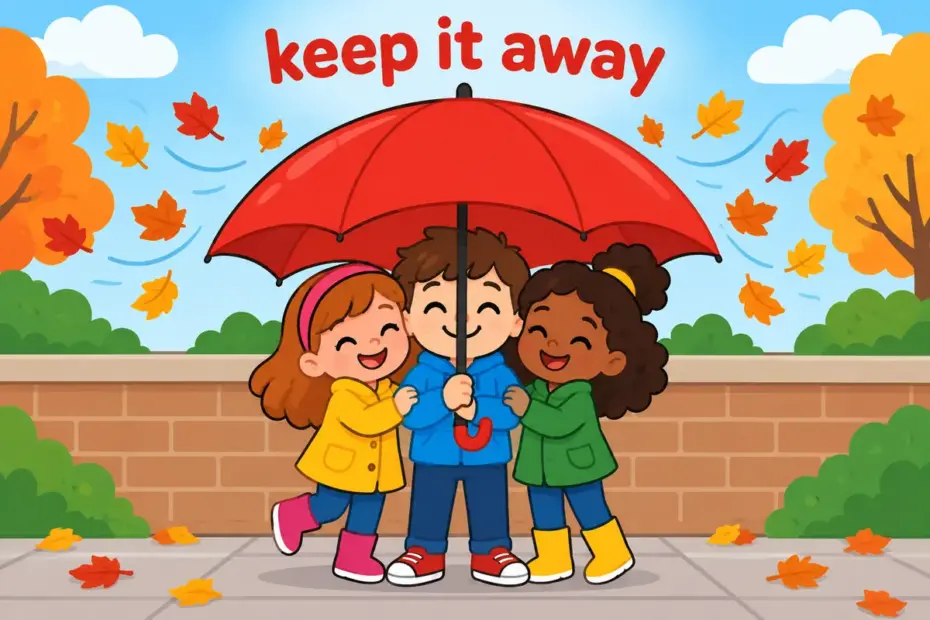
Ward off means to keep something unwanted away or to stop it from arriving. To use ward off in a sentence, place the danger or illness after the phrase: “A scarf can ward off a chill.” The verb is transitive, and a pronoun always slips between ward and off: ward it off.
Ward off at a glance
- Ward off is a transitive phrasal verb made of ward plus the particle off.
- Its forms are wards off, warded off and warding off.
- Its object is the thing kept away: danger, illness, an attack, a blow or a chill.
- The phrase belongs to everyday and health writing; avert is its formal relative.
- The commonest error is adding from, as in ward off from the cold, which is not standard.
What does ward off mean?
Ward off is a transitive phrasal verb meaning to keep something unwanted at a distance or stop it from arriving. The Cambridge entry for ward off covers the physical sense of blocking a blow and the wider sense of preventing harm, and both follow the same pattern.
| Sense | Plain meaning | Example sentence |
|---|---|---|
| Block a physical threat | Stop a blow or attack from landing | He raised an arm to ward off the branch. |
| Avoid illness or harm | Stop something bad from taking hold | Warm clothing helps ward off a chill. |
| Keep a nuisance distant | Hold people or problems away | The guard warded off curious onlookers. |
One limit is worth stating. Ward off is not cure or heal: it means keeping a threat out before it arrives. You can ward off a cold that is going around, but once you have caught it you cannot ward it off; you treat it instead.
How do you use ward off in a sentence?
The verb takes the thing being kept away as its object, and the particle off may move to the far side of that object. The single fixed rule is that a pronoun has to sit between ward and off, as in ward it off.
| Pattern | Example | What it signals |
|---|---|---|
| ward off + noun | The alarm warded off intruders. | The whole phrase stays together, the commonest order. |
| ward + noun + off | The alarm warded intruders off. | The particle can separate past a full noun object. |
| ward + pronoun + off | The alarm warded them off. | A pronoun must sit between the verb and the particle. |
| be warded off | The attack was warded off in seconds. | Passive voice; the particle stays after the participle. |
| ward off + abstract noun | A joke can ward off embarrassment. | The object may be a feeling, not only a physical thing. |
Separability is the whole grammar of this verb: the phrase can split around a full noun, must split around a pronoun, and keeps the particle after the verb in the passive. That is why the intruders were warded off sounds natural while the intruders were off warded does not. Speakers who reach for related particles find back off close in spirit but intransitive, because it takes no object at all.
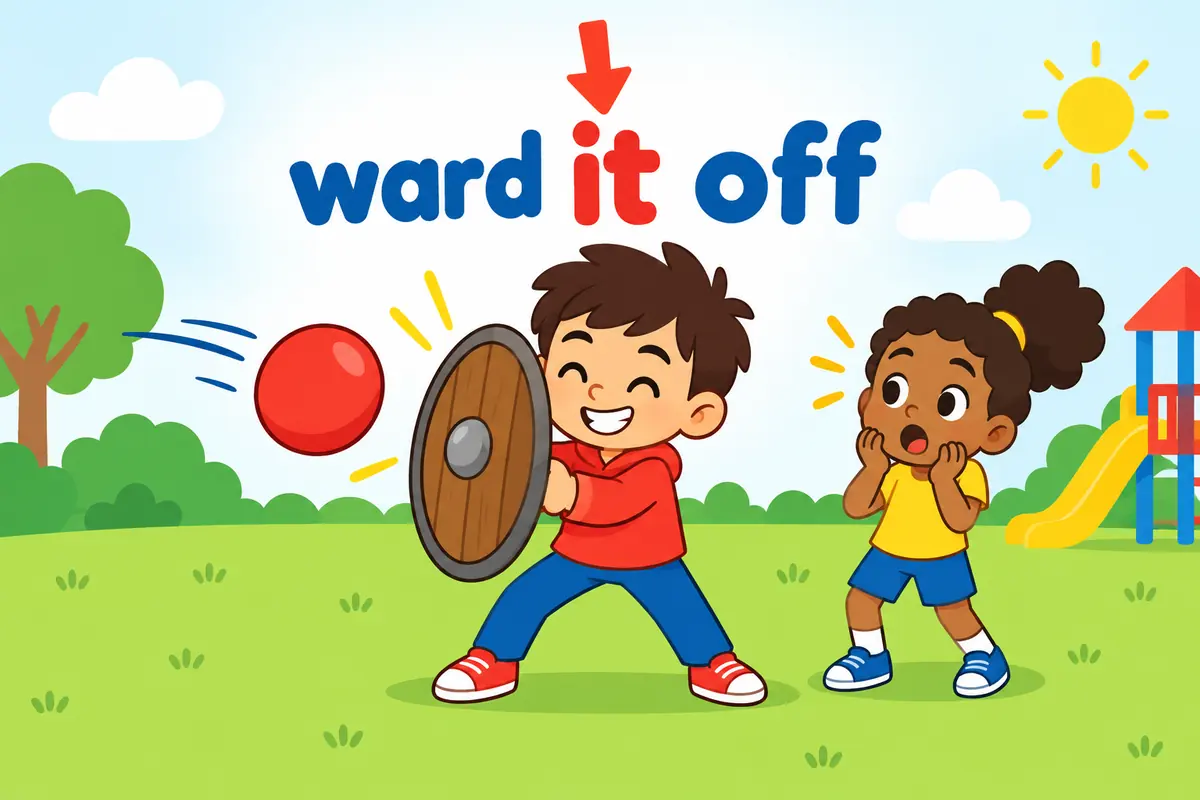
Ward off in a sentence: examples across contexts
Ward off changes register more than it changes meaning. The nine sentences below keep the same phrase while moving from a classroom to a health leaflet, and each one names the threat being held away.
| Context | Example sentence | Why this works |
|---|---|---|
| Classroom | A kind word can ward off a quarrel at break time. | A small, concrete action shows the pattern clearly. |
| Health leaflet | Hand washing helps ward off seasonal infections. | The subject is a habit and the object is an illness. |
| Workplace email | An early reply can ward off a bigger complaint. | An abstract object fits a measured, professional tone. |
| News report | Sandbags were piled up to ward off the floodwater. | Passive construction keeps the threat in focus. |
| Sports writing | The keeper stretched a glove to ward off the shot. | A physical threat suits the block-a-blow sense. |
| Home advice | Close the curtains to ward off the evening chill. | The imperative gives direct, practical instruction. |
| Gardening | Netting wards off birds from the young fruit. | The object is a nuisance rather than a danger. |
| Conversation | I told a joke to ward off an awkward silence. | The first person and abstract object sound spoken. |
| Formal report | Early checks ward off costly repairs later. | Abstract objects and a neutral tone suit a report. |
Only the health and news examples use a real hazard; the rest keep a mild nuisance or an awkward moment at bay, which is how the phrase behaves in ordinary writing.
Ward off vs prevent and avert
Ward off overlaps with prevent and avert, but it pictures a threat already moving toward you. prevent illness and avert name the general act of stopping an outcome, while ward off keeps the image of holding something back at arm’s length.
| Attribute | ward off | prevent | avert |
|---|---|---|---|
| Core job | Hold an approaching threat away | Stop an outcome from happening | Turn aside something likely |
| Image | A shield raised at arm’s length | A closed door before any knock | A head turned from a blow |
| Typical object | Illness, blows, pests, silence | Accidents, errors, waste | Crisis, disaster, strike |
| Implied nearness | The threat is close | No nearness required | The threat is imminent |
| Register | Neutral to health writing | Neutral and technical | Formal and journalistic |
Verdict: use prevent for a general safeguard, avert for a crisis almost upon you, and ward off when you want the picture of holding a specific threat at a distance.
Word forms and grammar of ward off
Ward off inflects on ward, while the particle never changes shape. The table also lists the separations that careful writers avoid, and the related phrase brush off criticism shows the same particle in a different verb.
| Form | Part of speech | Example |
|---|---|---|
| ward off | verb, base form | Good boots ward off wet feet. |
| wards off | verb, third person singular | Garlic is said to ward off midges. |
| warded off | verb, past and past participle | She warded off the question politely. |
| warding off | verb, present participle | He is warding off a summer cold. |
| ward-off | attributive compound | A ward-off gesture kept the crowd back. |
| ward off from | non-standard | Do not write ward off from the cold; the verb takes no from. |
Common mistakes with ward off
- Incorrect:
She warded off from the noise.Correct: She warded off the noise. Rule: Ward off is transitive and needs no preposition before its object. - Incorrect:
The umbrella warded off it.Correct: The umbrella warded it off. Rule: A pronoun must sit between the verb and the particle. - Incorrect:
He warded the rain.Correct: He warded off the rain. Rule: The particle carries the meaning; ward alone is rare and archaic. - Incorrect:
The intruders were warded.Correct: The intruders were warded off. Rule: The passive keeps off after the participle. - Incorrect:
She is warding off to catch a cold.Correct: She is warding off a cold. Rule: The object follows the phrase; do not insert to before it.
Practice using ward off
Work through the six items, then check the reasoning rather than only the answer.
- Fill the gap: A thick coat can ______ the winter wind.
- Choose the better word: A quick check can (prevent / ward off) an error, but only a raised arm can (prevent / ward off) a thrown ball.
- Correct the error: The net warded off from the birds.
- Build a sentence: use ward off with a pronoun object about a swarm of midges at a picnic.
- Spot the register: which belongs in a health leaflet — regular sleep helps ward off infection, or sleep totally wards off every bug?
- Rewrite in the passive: The goalkeeper warded off the shot. Change it to the passive voice.
Answers
- ward off — the coat keeps the wind away and the object follows the phrase.
- prevent, then ward off — the ball is a threat already arriving, which suits ward off.
- The net warded off the birds — the verb takes a direct object with no from.
- Model answer: Citronella candles warded them off during the picnic.
- Regular sleep helps ward off infection — a leaflet avoids absolute claims and keep it measured.
- The shot was warded off by the goalkeeper — the passive keeps off after the participle.
The bottom line
Use ward off in a sentence when something unwanted is closing in and you want to keep it at a distance, and put the threat in the object position. The two points that settle most sentences are these: the phrase is transitive, so it always needs a thing being kept away, and a pronoun must sit inside it as ward it off. Where no threat is near, resist infection and prevent are the more precise choices.

Frequently asked questions about ward off
Is ward off one word or two?
As a verb it is always two words, ward off, and inflects on ward alone: she wards off, they warded off. The hyphenated form ward-off appears only as a compound before a noun, as in a ward-off gesture. It is never spelled as a single word.
Can you say ward the attack off?
Yes, because ward off is separable and the particle may follow a full noun object. Ward the attack off is grammatical, though warded off the attack is more common. The one fixed case is a pronoun, which must go between: ward it off, never ward off it.
What is the difference between ward off and prevent?
Prevent is the broad verb and ward off is the narrower one. Prevent names any act of stopping an outcome, even one nobody could see coming. Ward off pictures a threat already moving toward you that you hold at a distance, which is why it suits illness, blows and pests.
Is ward off formal or informal?
Ward off sits in neutral, everyday English and appears freely in health writing and news reports. Its formal relatives are avert and prevent, which a tribunal filing or a scientific paper would prefer. In conversation ward off sounds natural, as in I played some music to ward off the silence.
Have you ever heard of the phrase ‘ward off’ and wondered what it means? Well, to ‘ward off’ something essentially means to try to prevent or protect yourself from it. It involves creating a barrier or taking action to keep away potential harm or danger.
This phrase can be used in various contexts, whether you’re talking about physical threats like illness or danger, or more abstract concepts like negative energy or bad luck. ‘Ward off’ is a powerful expression that signifies the act of actively guarding oneself or others from undesirable outcomes.
7 Examples Of Ward Off Used In a Sentence For Kids
- Ward off the mosquitoes by using mosquito repellent.
- Remember to ward off the evil eye by wearing a black dot on your forehead.
- Ward off any bad dreams by keeping a dreamcatcher near your bed.
- Make sure to ward off cold and flu by washing your hands frequently.
- Ward off negative energy by surrounding yourself with positive people.
- Carry a lucky charm to ward off any bad luck.
- Eating fruits and vegetables can help ward off illnesses.
14 Sentences with Ward Off Examples
- Ward off procrastination by creating a study schedule and sticking to it.
- Make sure to eat a balanced diet rich in vitamins and minerals to ward off illnesses during exam season.
- Ward off distractions by finding a quiet study spot in the library or a cafe.
- Regular exercise can help ward off feelings of stress and anxiety.
- Ward off peer pressure by staying true to your values and beliefs.
- Getting enough sleep each night can help ward off feelings of fatigue and improve cognitive function.
- Use noise-cancelling headphones to ward off noisy roommates while studying.
- Ward off the temptation to overspend by creating a budget and sticking to it.
- Surround yourself with positive and supportive friends to ward off negative influences.
- Start your assignments early to ward off the last-minute rush to complete them.
- Ward off homesickness by staying connected with family and friends through regular phone calls or video chats.
- Staying hydrated can help ward off headaches and improve concentration.
- Practice mindfulness and meditation to ward off feelings of stress and overwhelm.
- Ward off burnout by taking breaks and practicing self-care regularly.
How To Use Ward Off in Sentences?
To use Ward Off in a sentence, you must first understand its meaning. Ward Off means to deflect or avert something undesired, such as danger, harm, or an attack.
When constructing a sentence with Ward Off, you can start by identifying the potential threat or danger that needs to be avoided. For example: “She used her umbrella to ward off the heavy rain.” In this sentence, the Ward Off action involves using the umbrella as a shield against the rain.
Another example could be: “The scarecrow helped ward off the birds from the field.” Here, the scarecrow serves as a deterrent to the birds, preventing them from causing harm to the crops.
It is important to note that the phrase Ward Off is often followed by the thing being prevented, such as an illness, an attack, or a negative outcome. For instance: “He takes vitamin C to help ward off colds during the winter months.”
By understanding the meaning and context of Ward Off, you can effectively incorporate it into your sentences to convey the idea of protection or avoidance of harm. Remember to use it in situations where there is a need to repel something undesirable or harmful.
Conclusion
In conclusion, the phrase “ward off” is commonly used to describe actions taken to prevent or protect against something unwanted or harmful. Whether it’s warding off sickness by boosting your immune system with vitamins, warding off burglars with security measures, or warding off negativity with positive affirmations, the concept of warding off is about actively keeping undesirable outcomes at bay.
By being proactive and implementing preventive strategies, individuals can successfully ward off potential threats and maintain a sense of security and well-being. From physical protection to mental resilience, the practice of warding off plays a crucial role in safeguarding oneself from various risks and adversities in life.


