
Wistful describes a gentle, regretful longing for something lost or out of reach. To use wistful in a sentence, attach it to a look, smile or memory and keep the feeling mild rather than painful: “She gave a wistful glance at the old photograph.” The adjective rarely names action, because wistful is something a face or a thought shows.
Wistful at a glance
- Wistful is an adjective; its forms are wistfully (adverb) and wistfulness (noun).
- It means a mild, regretful longing for something absent, past or unlikely.
- The usual nouns are look, smile, sigh, memory, glance and longing.
- Wistful belongs to literary and reflective writing, and it usually sounds gentle rather than sad.
- The commonest error is treating wistful as a synonym for sad or depressed, which makes it far too heavy.
What does wistful mean?
Wistful is an adjective meaning full of a mild, regretful longing for something that is absent or out of reach. The Cambridge entry for wistful and the Merriam-Webster entry both stress the quiet, thoughtful quality of the feeling, which is closer to a soft ache than to grief.
The longing can point backwards or forwards. A wistful look at a childhood home faces the past, while a wistful glance at a departing train faces something that will never happen. The word also covers the mood itself, which is why a wistful tune or a wistful silence sounds natural.
One limitation matters here. Wistful is not the same as sad, and it is not melancholy. Happiness can sit beside it: a wistful smile may remember something lovely and still feel a small pang that it is gone.
How do you use wistful in a sentence?
Place wistful before the noun that shows the feeling, or use it after a linking verb such as be, look or seem. The five patterns below cover most real sentences, from a novel to a quiet remark at dinner.
| Pattern | Example | What it signals |
|---|---|---|
| wistful + look, glance or gaze | He gave the empty stage a wistful look. | The feeling is seen, not spoken. |
| wistful + smile or sigh | A wistful smile crossed her face. | A small, mixed expression of pleasure and loss. |
| wistful + memory or longing | A wistful memory of summer kept him going. | Names the absent thing being missed. |
| be or look wistful | She looked wistful as the train left. | Reports the mood without an object. |
| wistful + about + noun | They were wistful about the old neighbourhood. | Names what the longing is directed at. |
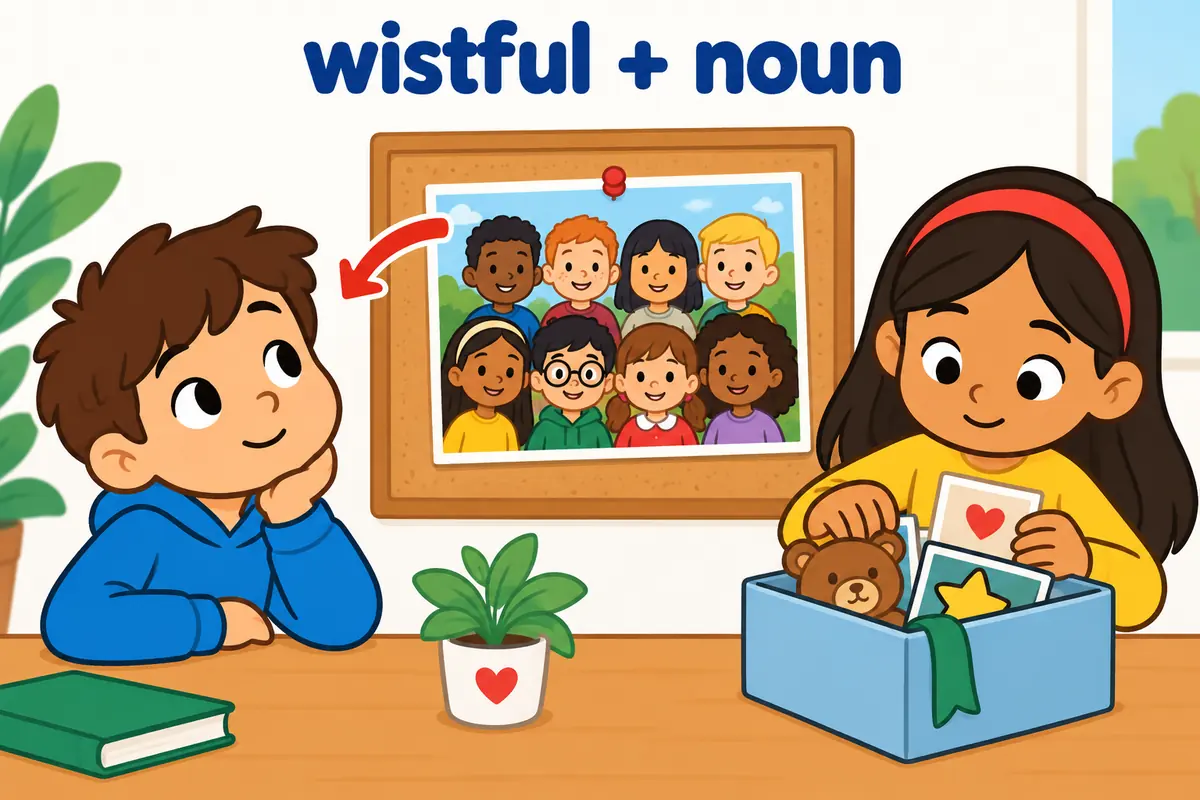
Wistful in a sentence: examples across contexts
Wistful keeps its softness wherever it appears. The nine sentences below move from a school desk to a concert hall, and each one names the person or thing that the longing is quietly aimed at.
| Context | Example sentence | Why this works |
|---|---|---|
| Classroom | He was wistful about the friends who had moved away. | The longing has a clear, named object. |
| Workplace email | We felt a little wistful closing the old office. | Mild regret keeps the tone workplace-safe. |
| News feature | Residents spoke wistfully of the market that once filled the square. | Describes a shared, vanished past. |
| Literary writing | Her wistful gaze followed the last of the light. | The feeling is shown through an image. |
| Music review | The final movement is wistful rather than mournful. | Distinguishes gentle longing from grief. |
| Academic prose | The memoir takes a wistful view of a lost countryside. | Names the tone of a whole text. |
| Conversation | I get wistful when the summer holidays end. | Everyday use with a yearly, familiar loss. |
| Sports report | The veteran was wistful about the season behind him. | Applies a tender word to a tough setting. |
| Personal essay | A wistful longing for the sea never quite left her. | Pairing longing and wistful sharpens the mood. |
Each sentence keeps the feeling understated, which is the point. Replace wistful with devastated or heartbroken and the mood tips into melodrama. Where the longing grows stronger, yearning is the stronger word.
Wistful vs nostalgic
Wistful and nostalgic both point at something absent, and they differ in where the feeling is aimed. Nostalgic always looks backwards to the past, while pensive describes quiet thought that carries no longing at all.
| Attribute | wistful | nostalgic |
|---|---|---|
| Core meaning | Mild, regretful longing | Sentimental affection for the past |
| Direction | Backwards or towards the unattainable | Always towards the past |
| Typical subject | A look, smile, sigh or memory | A person, song, place or mood |
| What it implies | Something is out of reach | Something was good and is gone |
| Register | Literary and reflective | Neutral and common |
Verdict: choose nostalgic for warm affection for the past and wistful when the missing thing may never have been yours to keep.
Word forms and grammar of wistful
The adjective is regularly formed, and the adverb appears often in fiction to describe how someone looks or speaks. The table also lists the noun and the comparative built with more.
| Form | Part of speech | Example |
|---|---|---|
| wistful | adjective | A wistful mood settled on the room. |
| wistfully | adverb | He spoke wistfully about the farm. |
| wistfulness | noun | A gentle wistfulness filled her voice. |
| more wistful, most wistful | comparative and superlative | Autumn makes him more wistful than spring. |
| wistfull | spelling – non-standard | The correct spelling ends in a single l. |
Common mistakes with wistful
- Incorrect:
The team was wistful about winning the cup.Correct: The team was delighted about winning the cup. Rule: Wistful implies longing for something absent, not joy at something present. - Incorrect:
She felt wistful for her stolen phone.Correct: She felt upset about her stolen phone. Rule: Wistful suits a gentle, meaningful loss, not everyday frustration. - Incorrect:
He spoke wistful about his childhood.Correct: He spoke wistfully about his childhood. Rule: Wistfully is the adverb that describes speaking; wistful is the adjective. - Incorrect:
a wistful of the old houseCorrect: a wistful memory of the old house. Rule: Wistful is an adjective and needs a noun to modify. - Incorrect:
Her wistful was obvious.Correct: Her wistfulness was obvious. Rule: The noun is wistfulness; wistful is only the adjective.
Practice using wistful
Work through the six items, then check the reason beside each answer.
- Fill the gap: A ______ smile crossed her face as she packed the last box.
- Choose the better word: Old songs make me (wistful / heartbroken) for summers I barely remember.
- Correct the error: The band played a wistfulness tune.
- Build a sentence: use wistful glance about a departing train.
- Spot the register: which belongs in a music review – The coda is wistful rather than mournful, or The coda is a total downer?
- Rewrite with the adverb: She looked at the sea in a wistful way. Use wistfully instead.
Answers
- wistful – it modifies smile, the small expression that shows the feeling.
- wistful – the longing is gentle and fond, not a heavy grief, so heartbroken is too strong.
- The band played a wistful tune – the adjective, not the noun, must precede tune.
- Model answer: He gave the departing train a wistful glance.
- The coda is wistful rather than mournful – a review keeps the reflective register and avoids slang.
- She looked wistfully at the sea – the adverb describes how she looked.
The bottom line
Use wistful in a sentence for a gentle, regretful longing that shows in a look, a smile or a memory, and keep the feeling soft rather than heavy. The two facts that settle most sentences are that wistful can point backwards or towards something unattainable, and that it stays close to fondness instead of grief. When the affection turns openly tender, sentimental is the warmer choice.

Frequently asked questions about wistful
Does wistful always mean looking back?
No. Wistful most often looks backwards, because the past is what we usually miss, but it can also point at something still out of reach. A wistful glance at a house you will never afford faces the future. Nostalgic, by contrast, always turns towards the past.
Can wistful describe a place or a sound?
It can, because wistful names a mood as well as an expression. A wistful tune, a wistful silence or a wistful street all suggest a soft longing hanging in the air. The noun keeps the feeling mild, so it works best when the scene is quiet and reflective.
Is wistful the same as sad?
No. Sad is broader and can be painful, while wistful is gentle and often mixed with fondness. A wistful person may smile at the same moment they sigh. Choosing sad or depressed where wistful belongs makes the sentence far heavier than the feeling actually is.
What is the noun form of wistful?
The noun is wistfulness, as in a quiet wistfulness filled the room. The adverb wistfully describes how someone looks, speaks or sighs. Both forms keep the mild, longing quality of the adjective, so none of them carries the weight of grief or despair.
Wistful describes a thoughtful, slightly sad feeling connected to something in the past or something a person cannot have. In a sentence, it often modifies a look, smile, memory, or voice: “He gave the old clubhouse a wistful glance.” The word suggests longing, not simply sadness or happiness.
Key facts at a glance
- Wistful is an adjective for thoughtful sadness or longing about something past or out of reach.
- It commonly describes a look, smile, expression, memory, or tone of voice.
- Use wistful about or wistful for to name the subject of the longing.
- Wistfully is the adverb form; wistfulness is the noun.
What does wistful mean?
The Cambridge Dictionary defines wistful as sad while thinking about something impossible or in the past; it also gives pensive as a synonym. The word often carries a gentle, reflective quality: a person may feel pleased to remember something and still miss it.
Use wistful for that mixed emotion rather than for any sad moment. A character who misses a former home may look wistful; someone who is simply angry or disappointed would need a different adjective.
How do you use wistful in a sentence?
Use wistful before a noun or after a linking verb. Common pairings include wistful smile, wistful look, wistful memory, and feel wistful. A phrase with about or for can make the object of the longing explicit.
| Pattern | Example sentence | Effect |
|---|---|---|
| wistful + expression | “She wore a wistful smile while looking at the old team photo.” | Shows reflective emotion |
| feel wistful about + subject | “I felt wistful about our final summer at the lake.” | Names the memory |
| wistful for + noun | “The traveler grew wistful for home.” | Names what is missed |
| speak wistfully of + subject | “He spoke wistfully of his first classroom.” | Uses the adverb to describe speech |

Is wistful the same as nostalgic?
Nostalgic specifically points to affection or longing for the past. Wistful can describe that feeling, but it can also refer to wanting something that may never happen. “She felt nostalgic about her childhood” looks back; “he gave a wistful glance at the stage” may suggest a wish to perform there.
The terms overlap, so choose by emphasis: use nostalgic when remembering the past is central, and wistful when the sentence needs a note of thoughtful longing or gentle sadness.

What grammar forms are related to wistful?
Wistful is the adjective: “a wistful expression.” Wistfully is the adverb: “She looked wistfully toward the train station.” Wistfulness is the noun: “A sense of wistfulness came over him.” Use the form that describes the right part of the sentence rather than treating the three words as interchangeable.
- Use wistful to describe a person, expression, or memory.
- Use wistfully to describe how an action is done.
- Use wistfulness to name the feeling itself.
Frequently asked questions
What is a simple sentence with wistful?
“Maya gave the empty playground a wistful look” is a simple sentence with wistful. The adjective describes look and suggests Maya is remembering or longing for something connected to that place. Add a phrase such as “after moving away” if the reason matters.
Is wistful a positive or negative feeling?
Wistful usually includes some sadness or longing, but it is not necessarily strongly negative. A person can fondly remember a joyful event and still feel a gentle sense of loss because it has ended. The surrounding context tells readers whether the mood is tender, regretful, or subdued.
Is wistful an adjective or an adverb?
Wistful is an adjective, as in “a wistful smile.” Wistfully is the adverb, as in “she smiled wistfully,” and wistfulness is the noun for the feeling. Choose the form according to whether you are describing a thing, an action, or an emotion.
What does a wistful smile mean?
A wistful smile is a smile that shows thoughtful longing or gentle sadness, often because a person is remembering the past or wishing for something out of reach. The phrase can suggest warmth as well as regret, so add context if readers need to know what the person misses.
Conclusion
A strong wistful sentence connects the adjective to a visible expression or a specific object of longing. Use wistful for reflective sadness about the past or an unrealized wish, and use wistfully when you need to describe how someone acts or speaks.
Have you ever felt a sense of longing or melancholy, mixed with a hint of hope and nostalgia? This complex blend of emotions can be described as wistful.
When someone is feeling wistful, they are experiencing a bittersweet yearning for something in the past or imagining an idealized future that may never come to fruition. It’s a sentimental and slightly melancholic feeling that often evokes memories or thoughts of possibilities that are both cherished and out of reach.
7 Examples Of Wistful Used In a Sentence For Kids
- Wistful dreams of flying like birds.
- We feel wistful when we miss our friends.
- Imagine a wistful unicorn with magical powers.
- Wistful thoughts of dancing with fairies.
- A wistful wish upon a shooting star.
- Gazing at the stars with a wistful smile.
- Wistful hopes of finding a hidden treasure.
14 Sentences with Wistful Examples
- Wistful reminiscences of carefree days spent in the college canteen filled the air.
- As the final year approached, a wistful feeling of nostalgia settled over the graduating students.
- The sight of freshers exploring the campus filled the seniors with wistful memories of their own first days at college.
- Amidst the pressure of exams, a wistful longing for simpler times of leisure and fun was palpable among the students.
- While browsing through old photographs, a group of friends shared wistful laughs over past college adventures.
- The mention of a favorite professor’s name brought a wistful smile to the faces of the graduating students.
- The empty campus during holidays left a wistful feeling of missing the hustle and bustle of college life.
- A wistful tone echoed in conversations as students discussed their post-graduation plans and parting ways.
- The end of a college festival brought about a wistful realization that another year had passed too quickly.
- Flipping through textbooks from the first semester, a sense of wistful growth and learning was felt by the students.
- The thought of leaving behind familiar faces and routines filled the seniors with a wistful sense of bittersweet nostalgia.
- Despite their excitement for the future, a tinge of wistful reluctance lingered in the hearts of the graduating class.
- On the last day of college, amidst hugs and tearful goodbyes, a wistful sense of finality settled over the students.
- Walking through the silent library at midnight, a wistful reflection on all the late-night study sessions filled the graduating students’ minds.
How To Use Wistful in Sentences?
To use Wistful in a sentence, start by reflecting on a moment or memory that evokes a feeling of longing or nostalgia. For example, “As she looked out at the sunset, she couldn’t help but feel wistful for the carefree days of her childhood.”
Next, ensure that the context of your sentence conveys a sense of melancholy or thoughtful reflection. You can describe a person’s expression, a place, a piece of music, or any other experience that makes you feel wistful.
Remember that wistful is an adjective used to describe a feeling of sadness and longing for something in the past. It is often associated with bittersweet emotions and a sense of yearning.
You can also combine wistful with other words to enhance the imagery in your sentence, such as “Her wistful smile revealed the depth of her yearning for the days gone by.”
Consider the tone and mood you want to convey when using wistful in a sentence. It is a word that lends itself well to writing that is reflective, introspective, and emotionally evocative.
By following these simple steps and keeping the meaning of wistful in mind, you can effectively incorporate this word into your writing to express a sense of nostalgia and longing.
Conclusion
In summary, the examples of sentences with “wistful” convey a sense of longing or yearning for something that may be out of reach or in the past. The wistful tone in these sentences communicates a mix of nostalgia, sadness, and hope. Whether describing memories, dreams, or desires, the word “wistful” adds a layer of emotional depth to the writing, evoking a mood of reflection or contemplation.
Through these sentences, readers can easily grasp the bittersweet nature of wistfulness and appreciate how it can enrich storytelling. This word captures the human experience of holding onto fleeting moments or unfulfilled wishes, allowing for a deeper connection between the writer and the audience. Overall, sentences with “wistful” create a poignant atmosphere that resonates with those who have experienced similar feelings of longing and reminiscence.


