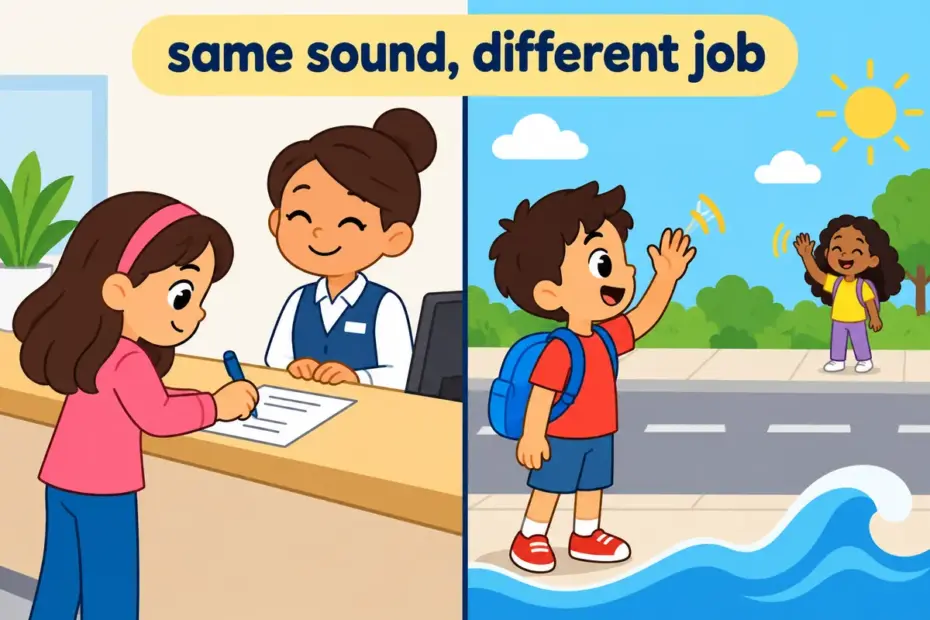
Waive vs wave is a decision about meaning rather than sound: use waive to give up a right, fee or claim on purpose, and wave to move your hand in greeting or to name a rising ridge of water. Both appear in formal and casual writing, so the sentence decides.
Waive vs wave at a glance
- Waive is a verb meaning to give up a right, claim or fee deliberately.
- Wave is a verb meaning to move a hand or held object, and a noun meaning a ridge of water or a surge.
- Waive is formal, legal and administrative; wave is everyday and physical.
- Neither word substitutes for the other, even though they are pronounced alike.
- The commonest error is writing wave where a right or fee is being given up.
Waive vs wave: the decision table
| Criteria | Waive | Wave |
|---|---|---|
| Part of speech | verb only | verb and noun |
| Core meaning | give up a right, charge or claim | move a hand; a ridge of water; a surge |
| Pronunciation | /weɪv/ | /weɪv/, identical |
| Register | formal, legal and administrative | everyday and neutral |
| Typical object | a fee, a right, a penalty, a rule | a hand, a flag, a wand or a torch |
| Typical subject | a person or body with authority | a person, the sea or the wind |
| Common context | contracts, tickets and policies | greetings, weather, physics and hair |
| Confusion risk | high, because the sound is the same | high, because the sound is the same |
What does waive mean?
Waive is a verb meaning to give up a right, claim, fee or rule deliberately, usually in a formal setting. The Cambridge entry for waive defines it as not using or not demanding something you are entitled to. The act is voluntary and usually helps someone else: a bank waives a fee, a council waives a rule. To give something up entirely, writers may forgo it or relinquish it, but waive is precise when a right or charge is formally set aside.
| Sense | Plain meaning | Example sentence |
|---|---|---|
| Give up a fee or charge | Choose not to collect money owed | The airline waived the change fee. |
| Drop a right or claim | Formally surrender an entitlement | She waived her right to appeal. |
| Set aside a requirement | Allow a normally required step to be skipped | The board waived the usual waiting period. |
What does wave mean?
Wave is a verb meaning to move a hand or a held object to and fro, and a noun meaning a ridge on the surface of water or a surge of feeling or activity. The Cambridge entry for wave records both the gesture and the water sense. A person waves hello to a neighbour as the sea sends waves onto the shore. A raised hand is often a friendly gesture, and the sweep of an arm at a match is a signal or motion that referees read instantly.
| Sense | Plain meaning | Example sentence |
|---|---|---|
| Gesture of greeting or farewell | Move a hand to signal | He waved from the platform. |
| Ridge on water | A raised moving crest on water | A huge wave struck the pier. |
| Surge of activity or feeling | A sudden widespread rise | A wave of applause filled the hall. |
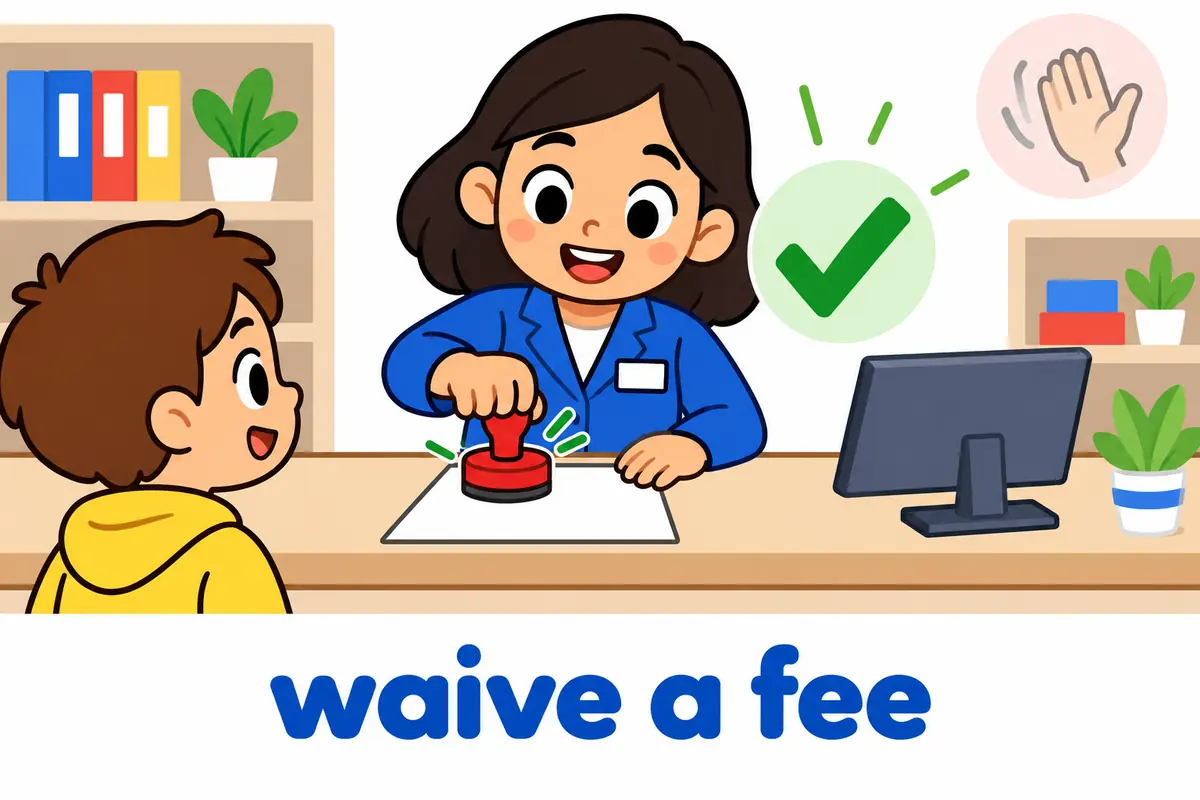
Waive vs wave in a sentence: examples across contexts
| Context | Example sentence | Why this works |
|---|---|---|
| Classroom | The teacher waived the late penalty for the whole class. | Shows waive removing a charge. |
| Workplace email | The manager agreed to waive the deposit. | Fits an administrative, formal register. |
| News report | Crowds waved flags as the team arrived. | Uses wave for a physical gesture. |
| Legal writing | The tenant waived the right to a hearing. | Waive fits formal rights language. |
| Conversation | She waved goodbye from the bus window. | Everyday wave for a farewell. |
| Academic writing | A wave of reform followed the report. | Wave as a surge of activity. |
| Science lesson | The wave travelled across the tank in two seconds. | Wave as a physical ridge in water. |
| Travel | The officer waived the extra baggage charge. | Waive for money that is not collected. |
| Home | He waved a torch to signal for help. | Wave with a held object. |
Which should you use?
Match the situation to the meaning and the choice becomes clear.
- Removing a fee or penalty: waive, as in the school waived the fine.
- Greeting or saying goodbye by hand: wave, as in she waved from the gate.
- Describing sea movement: wave, as in the waves crashed on the rocks.
- Formally giving up a legal right: waive, as in he waived the right to silence.
- Moving a flag, wand or torch: wave, as in the referee waved the flag.
Word forms and grammar of waive and wave
| Form | Part of speech | Example |
|---|---|---|
| waive | base verb | The bank waived the fee. |
| waived | past tense and participle | They waived the penalty. |
| waiving | present participle | Waiving the deposit helped the buyer. |
| waiver | noun | She signed a liability waiver. |
| wave | verb and noun | He waved from the door. |
| waved | past tense | She waved goodbye. |
| waving | present participle | The crowd was waving flags. |
| wave of | noun phrase | A wave of applause filled the hall. |
Common mistakes with waive and wave
The school waved the exam fee.Correct: The school waived the exam fee. Rule: a fee that is set aside uses waive, not wave.She waived at her friend across the street.Correct: She waved at her friend across the street. Rule: a hand gesture is wave.They waive goodbye as the train leaves.Correct: They wave goodbye as the train leaves. Rule: the gesture in a present-habit clause uses wave.He signed a wave for the gym.Correct: He signed a waiver for the gym. Rule: the noun for giving up a claim is waiver.The boat was hit by a waive.Correct: The boat was hit by a wave. Rule: the ridge on water is spelled wave.
Practice using waive and wave
Work through the six items, then compare your answers and the reason beside each one.
- Fill in the blank: The council agreed to ___ the parking fine.
- Choose the better word: The goalkeeper (waived / waved) to the crowd.
- Correct the error: The manager waved the delivery charge.
- Build a sentence: describe a legal right being given up, using waive plus right.
- Spot the register: which fits a contract, “The buyer waives all claims” or “The buyer waves all claims”?
- Fill in the blank with the noun: She signed a ___ before joining the climb.
Answers
- waive – a fine is money not collected, so waive is correct.
- waved – the goalkeeper moved a hand, which is the wave sense.
- The manager waived the delivery charge – a charge that is dropped takes waive.
- Sample: The tenant waived the right to a hearing – waive plus right names the surrender.
- “The buyer waives all claims” fits a contract; the wave version is a misspelling.
- waiver – the noun for giving up a claim is waiver.
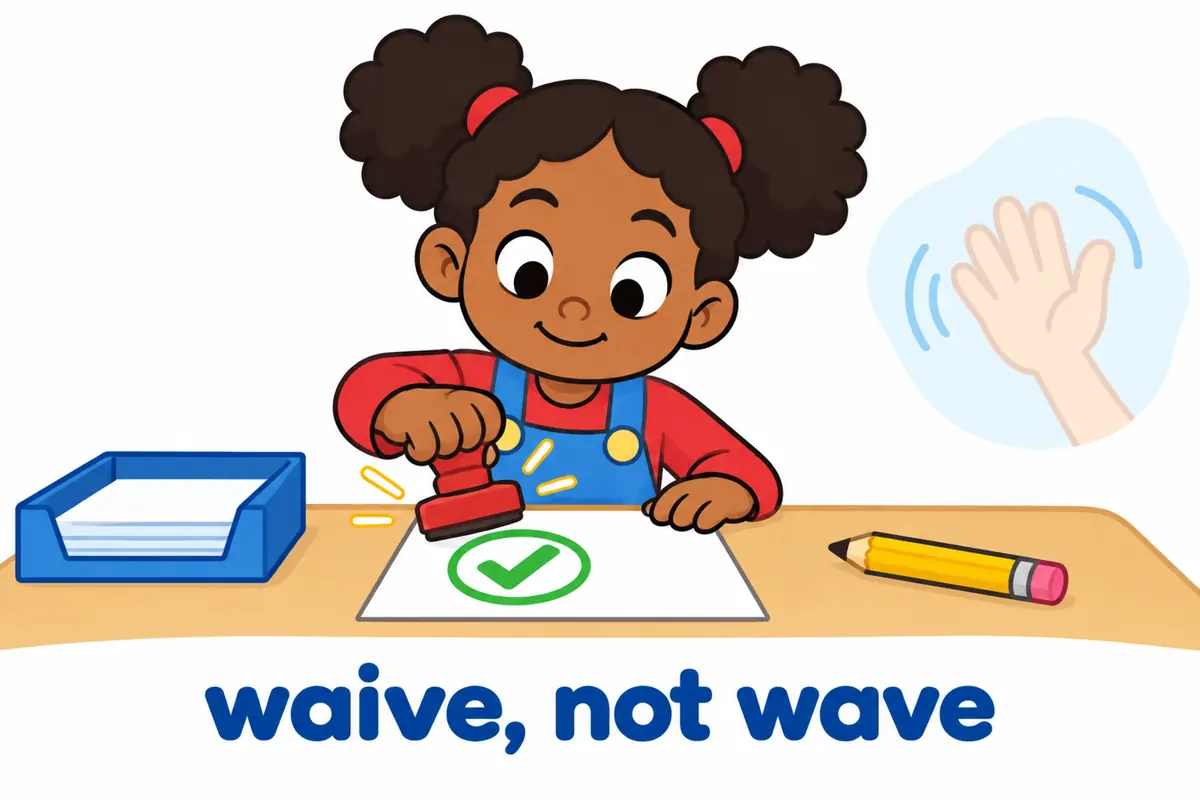
The bottom line
Waive vs wave is decided by meaning, not spelling: waive gives up a right, fee or claim, and wave is a hand gesture or a ridge of water. Because the two words sound identical, proofread by asking whether something is being surrendered or moved. Use waive in contracts and official notices, and wave in descriptions of greeting, weather and motion.
Frequently asked questions about waive vs wave
Does waive rhyme with wave?
Yes, waive and wave are homophones: they share the same pronunciation, /weɪv/, so the ear cannot tell them apart. Only the meaning and the words around them show which spelling is right, which is why a quick proofread matters so much with this pair.
What is the noun form of waive?
The noun is waiver, as in a liability waiver or a fee waiver. It keeps the waive- spelling and names the document or the act of giving something up. The separate noun wave, by contrast, means a hand movement or a ridge of water, and it never appears in a contract.
Can wave mean a sudden increase?
Yes. Beyond water and gestures, wave can name a sudden widespread rise, as in a wave of support, a wave of protest or a crime wave. The image is a crest moving through a crowd, which is why the same word covers both water and surges of activity.
Is waive ever spelled wave?
No. Waive is the only correct spelling when a right, fee or claim is given up, and wave is a misspelling in that sense. The reverse also holds: a hand movement is never spelled waive, even though the two words sound exactly alike in speech.
Waive means give up a claim or set aside a requirement, while wave can mean move a hand or name moving water. In waive vs wave, choose waive for relinquishing or exempting and wave for movement. “They waived the fee” and “they waved goodbye” use different verbs despite their similar sound.
Key facts at a glance
- waive means give up a claim or set aside a requirement.
- wave means move back and forth or signal with a hand.
- wave means a moving ridge of water.
- Waive forms waived and waiving. Wave forms waved and waving; waves is a plural noun or present verb. Waiver is a noun related to waive.
Which spelling fits the meaning?
| Word | Meaning | Example |
|---|---|---|
| waive | give up a claim or set aside a requirement | The organizer waived the registration fee. |
| wave | move back and forth or signal with a hand | She waved to the driver. |
| wave | a moving ridge of water | A wave reached the shore. |

How does the context decide your choice?
Waive commonly takes an object such as a fee, requirement, or right. The vocabulary example explains the action, not whether a particular waiver is legally effective or advisable. Those questions depend on actual circumstances and applicable rules.
Wave can be a noun or verb. “A wave of excitement” extends the noun figuratively, while “wave a flag” names movement. Neither meaning concerns giving up a claim.
What are useful example sentences?
- The organizer waived the registration fee.
- She waved to the driver.
- A wave reached the shore.
Read the example with the table definition in mind. The surrounding noun, action, or setting provides the clue; similar pronunciation does not make the meanings interchangeable.
Which forms and grammar patterns matter?
Waive forms waived and waiving. Wave forms waved and waving; waves is a plural noun or present verb. Waiver is a noun related to waive.
Connect waive with setting something aside and wave with a movement or water ridge. A waiver and a hand wave are different kinds of things.
How can you check waive vs wave?
- Identify the intended person, thing, quality, or action.
- Substitute the relevant definition for the doubtful word.
- Check whether the grammatical role fits the sentence.
- Use the dictionary for a specialized sense or unfamiliar proper name.
Merriam-Webster Dictionary: waive and Merriam-Webster Dictionary: wave document the vocabulary distinctions. The sample sentences here are original usage examples.

Frequently asked questions
Can these words be substituted for each other?
No. Waive concerns relinquishing or exempting, while wave concerns movement or a water ridge. The sentence’s intended action determines which verb fits. Read the whole sentence before changing the spelling. The intended meaning and grammatical role provide stronger evidence than sound alone, especially when a word also has a specialized or less common sense.
What is the quickest proofreading test?
Check the object: a fee or requirement may be waived, while a flag or hand may be waved. Do not infer legal consequences from spelling alone. Read the whole sentence before changing the spelling. The intended meaning and grammatical role provide stronger evidence than sound alone, especially when a word also has a specialized or less common sense.
Does similar pronunciation prove the spelling?
No. Shared pronunciation does not identify the action. The object and context distinguish setting aside a requirement from making a movement. Read the whole sentence before changing the spelling. The intended meaning and grammatical role provide stronger evidence than sound alone, especially when a word also has a specialized or less common sense.
How can a learner practice the distinction?
Write one sentence about an organizer waiving a fee and one about a person waving. Identify the direct object or gesture in each example. Read the whole sentence before changing the spelling. The intended meaning and grammatical role provide stronger evidence than sound alone, especially when a word also has a specialized or less common sense.
Have you ever found yourself confused between “waive” and “wave”? I know I have! In this text, I’ll clarify the difference between these two commonly misused words and provide you with some helpful tips on how to use them appropriately. Understanding the distinction between “waive” and “wave” is crucial for effective communication, whether it’s in your professional or personal life. So, let’s immerse and unravel the mystery behind these words, ensuring that you never mix them up again. Get ready to wave goodbye to confusion and confidently navigate the world of language with ease.
Key Takeaways
- “Waive” means to give up or forgo a right, claim, or privilege voluntarily, while “wave” refers to a body of water or the action of moving your hand in a sweeping motion.
- “Waive” is commonly used in legal and contractual contexts, while “wave” is typically used in conversations about water, motion, or greeting someone.
- Proper understanding of the context in which these words are used is crucial to avoid confusion.
- Examples of using “waive” include waiving a right, fee or penalty, a requirement or condition, or legal rights.
- Examples of using “wave” include referring to ocean waves, sound waves, or radio waves.
- Using “waive” and “wave” appropriately will ensure clear and effective communication.
Waive vs Wave: Understanding the Difference
As an expert in language and communication, I often come across words that are commonly misused and interchangeably used. One such pair of words that frequently causes confusion is “waive” and “wave”. Understanding the difference between these two words is essential for effective communication, whether it’s in your professional or personal life.
Let’s start by clarifying the definitions of “waive” and “wave”:
- Waive: The word “waive” means to give up or forgo a right, claim, or privilege voluntarily. It implies a deliberate decision not to exercise or demand something that one is entitled to.
- Wave: On the other hand, “wave” is a noun that refers to a long body of water that is pushed forward by the wind. It can also be used as a verb, which means to move your hand or an object back and forth in a sweeping motion.
Now that we have the definitions, let’s dive deeper into the key differences between “waive” and “wave”:
- Meaning: The first and most important distinction between these words is their meaning. “Waive” is about relinquishing or giving up a right or claim, while “wave” refers to a body of water or the action of moving your hand in a sweeping motion.
- Usage: “Waive” is commonly used in legal and contractual contexts, where individuals or parties choose not to enforce a legal right or requirement. On the other hand, “wave” is typically used in conversations about water, motion, or greeting someone by waving your hand.
- Context: Understanding the context in which these words are used is crucial. “Waive” is often used in professional settings when discussing legal matters, contracts, or agreements, whereas “wave” is used in more informal or casual situations.
Let’s look at some examples to solidify our understanding:
- I decided to waive my right to a jury trial.
- The surfer caught an impressive wave and rode it to the shore.
- I saw my friend across the street and waved to get their attention.
The Definition of “Waive”
As an expert blogger, I understand the importance of clarity and accurate usage when it comes to commonly confused words. In this section, I’ll investigate into the definition of “waive” to help you better understand its meaning and usage.
What is “waive”?
“Waive” is a verb that means to voluntarily give up, relinquish, or forgo a right, claim, or privilege. When you waive something, you are choosing not to pursue it or to hold others accountable for it. It’s a word often used in legal and contractual contexts.
The key differences
Now that we have defined “waive,” it’s important to understand its key differences from the word “wave.” Let’s highlight some of the main distinctions between these two commonly confused words:
- “Waive” is a verb, while “wave” can be both a verb and a noun.
- “Waive” is associated with giving up or forgoing something, while “wave” refers to a physical motion, typically with your hand or an object.
- “Waive” often involves a voluntary decision, whereas “wave” can be a spontaneous or intentional action.
Examples of using “waive”
To further solidify your understanding of “waive,” here are a few examples that showcase its usage in different contexts:
- In a legal setting: The plaintiff decided to waive their right to further pursue the case.
- In sports: The team captain chose to waive the penalty against the opposing team.
- In a contractual agreement: The employee agreed to waive their right to a severance package.
By grasping the definition of “waive” and its distinctions from “wave,” you can confidently use these words in the appropriate context and avoid any confusion.
Next, we’ll explore the definition of “wave” and uncover its unique characteristics, providing you with a comprehensive understanding of both words without drawing any conclusions.
Ways to Use “Waive” Appropriately
When it comes to using the word “waive,” it’s important to understand its definition and how it differs from similar words like “wave.” In this section, I’ll guide you through the various ways you can use “waive” appropriately in your writing. Let’s immerse!
- Waiving a Right: One common usage of “waive” is to voluntarily give up or relinquish a right, claim, or privilege. For example, in a legal or contractual context, you might come across phrases like “waiving your right to remain silent” or “waiving your claim to compensation.” In these cases, “waive” indicates a conscious decision to forego something you are entitled to.
- Waiving a Fee or Penalty: Another way to use “waive” is in the context of fees or penalties. For instance, a company might waive a late payment fee as a gesture of goodwill or to incentivize customers. Similarly, a landlord might agree to waive a portion of the security deposit for a reliable tenant. By waiving such charges, individuals or businesses show flexibility or leniency.
- Waiving a Requirement or Condition: Sometimes, “waive” is used to indicate the suspension or exemption of a requirement or condition. Let’s say you’re applying for a job, and the employer agrees to waive the requirement for a college degree based on your extensive experience. In this scenario, “waive” conveys the idea of setting aside a usual condition.
- Waiving Legal Rights: “Waive” can also be used in legal proceedings to refer to the act of giving up one’s legal rights. For example, a person might sign a waiver before participating in an activity, acknowledging and accepting the risks involved. This legal document is known as a waiver because it allows individuals to voluntarily relinquish certain rights.
By properly understanding the various contexts in which “waive” is used, you can confidently employ it in your writing. Remember, “waive” is a verb that signifies relinquishing or forgoing something voluntarily. It’s essential to differentiate it from “wave,” which is a noun or a verb used to describe a gesture or movement.
Note: The next section will explore the definition of “wave” and its unique characteristics.
The Definition of “Wave”
When it comes to the commonly confused words “waive” and “wave,” understanding their definitions and correct usage is essential. In the previous section, I shed light on the meaning and usage of “waive.” Now, let’s investigate into the definition of “wave” and explore its unique characteristics.
What is a “wave”?
In its simplest form, a “wave” refers to a rhythmic disturbance or oscillation that travels through a medium. This medium can be air, water, or any other substance capable of transmitting energy. Waves can take various forms, including sound waves, ocean waves, electromagnetic waves, and more.
Difference between “waive” and “wave”
While “waive” and “wave” may sound similar, they are distinct words with different meanings and uses. The table below summarizes the main differences between the two:
| Word | Part of Speech | Meaning |
|---|---|---|
| “waive” | verb | To voluntarily give up or forgo a right, claim, or privilege |
| “wave” | noun or verb | A rhythmic disturbance or oscillation that travels through a medium |
As you can see, “waive” is a verb used to describe relinquishing one’s rights or claims voluntarily, often in legal or contractual contexts. On the other hand, “wave” can function as a noun or a verb and refers to the movement or propagation of a disturbance through a medium.
Understanding the usage of “wave”
Now that we have a clear definition of “wave,” let’s explore how we can use this word appropriately in various contexts. Understanding these different uses will allow you to incorporate “wave” accurately into your writing. Here are a few common instances in which “wave” is used:
- Ocean Waves: The rhythmic movements observed in bodies of water, often caused by wind or tides.
- Sound Waves: The vibrations that produce auditory sensations, enabling us to experience sound.
- Radio Waves: Electromagnetic waves used for communication, broadcasting, and wireless technologies.
It’s important to note that these examples represent only a fraction of the different contexts in which “wave” can be used. Whether it’s describing a hand gesture, a signal, or even a hairstyle, this versatile word has a wide range of applications.
How to Use “Wave” Correctly
As I continue to investigate into the proper usage of commonly confused words, let’s now turn our attention to “wave.” Understanding the distinction between “waive” and “wave” is essential to effectively communicating in English. So, let’s explore the correct usage of “wave” and clarify any lingering confusions.
What Is the Definition of “Wave”?
“Wave” is a versatile term that finds its application in various contexts. At its core, a wave is a rhythmic disturbance or oscillation that travels through a medium, such as air or water. This definition allows for a wide range of applications and examples where “wave” comes into play.
How to Use “Wave” Properly
To ensure accurate usage, consider the following examples and scenarios where “wave” is commonly employed:
- Ocean Waves: When you think of “wave,” one of the first images that may come to mind is the majestic sight of ocean waves crashing against the shore. Whether describing the calm rolling waves or the powerful crashing waves, make sure to use the term “wave” to accurately portray this natural phenomenon.
- Sound Waves: Another common use of “wave” is in the area of sound. From the melodic notes of music to the spoken word, sound waves travel through the air enabling us to hear and appreciate the world around us. So, whether you’re discussing the propagation of sound through the air or the audio waves created by musical instruments, remember to use “wave” to accurately describe this process.
- Radio Waves: “Wave” also finds its place in the area of technology and communication. Radio waves are used to transmit signals across vast distances, allowing us to tune into our favorite radio stations or communicate wirelessly. So, when discussing radio frequencies or wireless communication, employing the term “wave” conveys the right meaning.
Remember, these examples represent just a fraction of the possible applications of “wave.” By keeping the definition of a rhythmic disturbance or oscillation in mind, you can confidently apply “wave” to various contexts accurately.
Conclusion
Understanding the difference between “waive” and “wave” is crucial for effective communication. Throughout this article, I have provided clear definitions and examples to help solidify your understanding of these two words.
“Waive” is a verb used to describe voluntarily giving up or forgoing a right, claim, or privilege. It is commonly used in legal and contractual contexts. On the other hand, “wave” refers to a rhythmic disturbance or oscillation that travels through a medium, such as air or water. It has a wide range of applications, including ocean waves, sound waves, and radio waves.
By distinguishing between “waive” and “wave,” you can confidently use these words in the appropriate contexts. Remember, “waive” is used when relinquishing something, while “wave” pertains to oscillations or disturbances in a medium.
Now armed with this knowledge, you can express yourself accurately and effectively, avoiding any confusion or misunderstandings. So go ahead and confidently apply “waive” and “wave” in your writing and conversations.
Q: What does the word “waive” mean?
A: “Waive” is a verb that means to voluntarily give up or forgo a right, claim, or privilege, often used in legal and contractual contexts.
Q: What is the difference between “waive” and “wave”?
A: The key difference is that “waive” is a verb that relates to giving up or forgoing, while “wave” is a noun or verb that refers to a rhythmic disturbance or oscillation that travels through a medium.
Q: Can you provide examples of how “waive” is used?
A: Sure! Examples of using “waive” include: waiving your right to remain silent, waiving a fee, or waiving a contractual obligation.
Q: How is the word “wave” used in different contexts?
A: “Wave” can refer to various types of rhythmic disturbances, such as ocean waves, sound waves, and radio waves. It has a broad range of applications beyond these examples.
Q: Any final advice on using “wave” correctly?
A: Feel confident applying the term “wave” accurately to different contexts. It’s important to understand its specific meaning in each situation.


