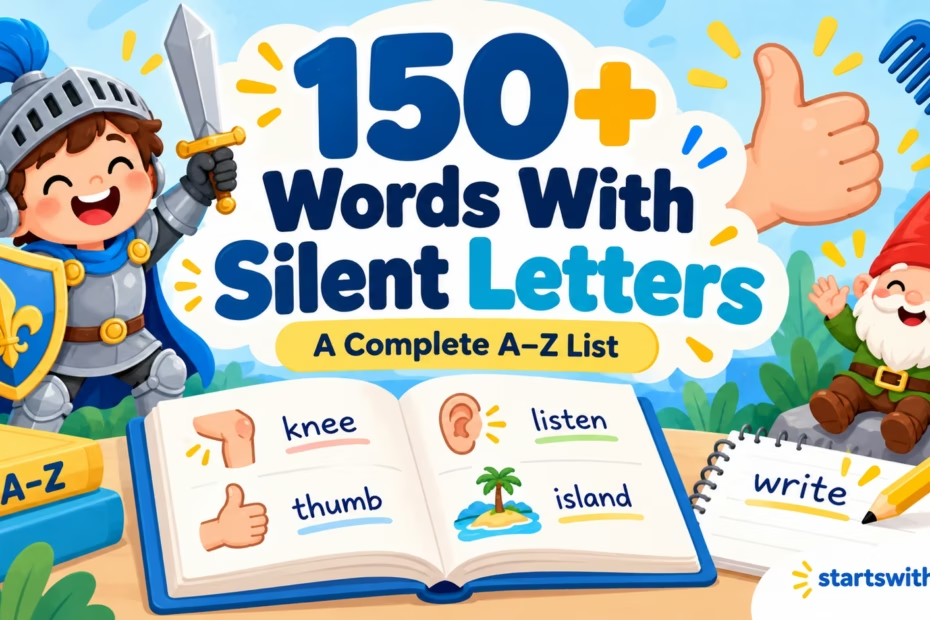
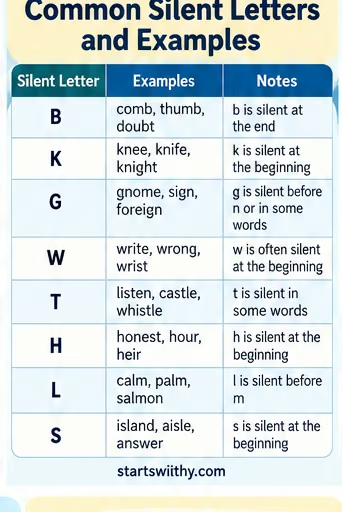
Words with silent letters contain written letters that do not represent separately pronounced sounds in their usual spoken forms. Knee, write, lamb, island, and honest are familiar examples. Silent-letter patterns help students connect pronunciation to spelling, although historical spelling and accent variation mean that not all rules apply universally.
Key facts
- Initial KN often has a silent K, as in knife and knee.
- Initial WR often has a silent W, as in write and wrong.
- Final silent E frequently changes an earlier vowel sound, as in cap → cape.
- Some letter combinations work as units; do not label every unpronounced-looking letter independently.
Silent B
- Bomb
- climb
- comb
- crumb
- debt
- doubt
- dumb
- lamb
- limb
- numb
- plumb
- subtle
- succumb
- thumb
- tomb
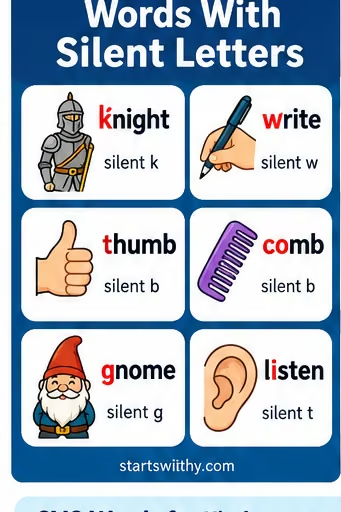
Read “The lamb followed its mother” and “She used a comb.” B is silent at the end of lamb and comb, but it is pronounced in lumber.
Silent C and D
Common words taught with silent C include ascend, ascent, conscience, conscious, descend, descent, fascinate, muscle, scene, scent, scissors, and science. Some SC combinations represent one sound as a spelling unit, so examine the pronunciation rather than treating all SC words identically. Words with a silent or non-separately pronounced D include handkerchief, Wednesday, badge, bridge, edge, judge, and knowledge; DG in badge is best taught as a spelling for the J sound.
Silent final E
- Bake
- bike
- bite
- bone
- cake
- came
- cave
- cute
- date
- drive
- face
- fine
- game
- grade
- home
- hope
- huge
- lake
- late
- life
- like
- make
- name
- note
- plane
- plate
- ride
- rope
- rose
- safe
- same
- save
- shape
- shine
- smile
- snake
- stone
- take
- time
- use
- wave
- white
- wipe
Compare cap/cape, kit/kite, pin/pine, hop/hope, cub/cube, and tap/tape. Final E does not always make the preceding vowel long: have, give, love, and some are useful exceptions.
Silent G
- Align
- assign
- benign
- campaign
- champagne
- design
- feign
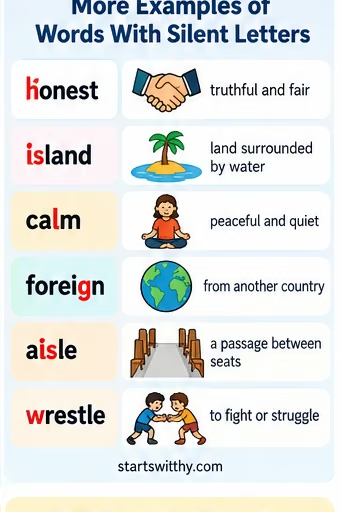
- foreign
- gnat
- gnaw
- gnome
- gnu
- reign
- resign
- sign
- high
In sign, G is silent; in the related signature it is pronounced. The GH spelling can be silent in light and night but pronounced differently in laugh and rough.
Silent H
- Heir
- heiress
- honest
- honestly
- honor
- honorable
- hour
- hourly
Because hour begins with a vowel sound, write “an hour.” Herb commonly has a silent H in American English and a pronounced H in British English.
Silent K
- Knack
- knapsack
- knead
- knee
- kneecap
- kneel
- knelt
- knew
- knife
- knight
- knit
- knob
- knock
- knot
- know
- knowledge
- known
- knuckle
Ask learners to read “The knight tied a knot” and identify which initial consonant sound they actually hear.
Silent L
- Balm
- calf
- calm
- chalk
- could
- folk
- half
- palm
- salmon
- should
- talk
- walk
- would
- yolk
The L in walk and would is silent in usual pronunciation, but words such as almond vary by accent.
Silent N
- Autumn
- column
- condemn
- damn
- hymn
- limn
- solemn
Compare autumn with autumnal and solemn with solemnity: related forms can pronounce consonants absent in the simpler word.
Silent P
- Pneumatic
- pneumonia
- pseudo
- pseudonym
- psychiatrist
- psychiatry
- psychic
- psychology
- psychologist
- psychotherapy
- psalm
- psalmist
- pterodactyl
- pterosaur
- ptarmigan
Initial PS, PN, and PT offer useful word-family patterns.
Silent S and T
Aisle, apropos, bourgeois, corps, debris, island, isle, and viscount have spellings in which S is not pronounced. Silent-T examples include apostle, ballet, bristle, bustle, castle, fasten, glisten, hustle, listen, moisten, soften, thistle, whistle, and wrestle. Often may be pronounced with or without T, depending on speaker and accent.
Silent U and W
GU spelling examples include baguette, build, built, disguise, guide, guild, guilt, guitar, guess, guest, guard, rogue, tongue, and vogue; U does not represent a separate vowel in many of these words. Silent-W examples include answer, sword, two, whole, whom, wreck, wren, wrench, wrestle, wriggle, wrinkle, wrist, write, writer, written, wrong, and wrote.
How can students remember silent letters?
Study one pattern at a time. Read knee, knife, know, knot, and knock aloud, mark silent K, and use each in a sentence. Sort words by spelling and pronunciation; build a notebook recording the full word, the pattern, and an example. Use whole words and recognize that conventions may differ across accents.
Frequently asked questions
Is K always silent at the beginning of KN words?
In familiar modern English words such as knee and knife, yes; unfamiliar proper names and borrowings should be checked separately.
Is every final E silent?
No. It is pronounced in be, he, me, and she. In cake and hope, final E is silent and affects the preceding vowel.
Why do silent letters exist?
Spellings preserve earlier pronunciations, word histories, borrowing, and relationships between words even when their modern pronunciations have changed.
Conclusion
Words with silent letters become easier to read and spell when learners recognize word families, compare related forms, and practice full words in sentences rather than guessing from spelling alone.