Tactile in a Sentence: Meaning, Examples & Practice
Tactile describes anything connected with the sense of touch, or anything that feels pleasing to the fingers. To use tactile in a sentence, place it before the noun it describes: “The tactile map helped her find the door.” It also names a learning preference built on handling real objects.
Tactile at a glance
- Tactile is an adjective relating to the sense of touch or to things that feel pleasant to handle.
- Related forms are tactility (noun) and tactually (adverb, rare); tactual is a technical synonym.
- The dominant pattern is attributive: tactile feedback, a tactile map, a tactile learner.
- The register is neutral to technical, common in design, science, medicine and education.
- The commonest error is confusing tactile with tangible, which means real or clearly evident.
What does tactile mean?
Tactile is an adjective meaning relating to the sense of touch, or having a surface that feels pleasant when handled. The Cambridge entry for tactile keeps the word close to the feeling produced by contact, so a tactile surface is one the fingers notice, not merely one the eyes can see. The four senses below cover almost every use.
| Sense | Plain meaning | Example sentence |
|---|---|---|
| Relating to touch | Connected with the sense of touch | The fingertips are highly tactile. |
| Pleasing to the touch | Having a surface that feels good to handle | The wool has a soft, tactile finish. |
| Designed for touch | Made to be found or used by hand | The lift has tactile buttons beside every door. |
| Learning by handling | Preferring to learn through touch and movement | Tactile learners build the model before reading about it. |
Two ideas sit behind the word and are worth separating. The first is sensory: tactile information reaches the brain through the skin, so it is distinct from what you see or hear. The second is aesthetic: a designer may call a material tactile as praise, meaning it invites handling rather than repelling it. A rough stone and a smooth pebble can both be tactile, because the word describes the role of touch, not one particular texture.
One limitation is worth stating plainly. Tactile is not a synonym for tangible. Tangible means real, able to be touched, or clear enough to count, as in tangible proof or a tangible benefit. Something tactile is about the sense of touch; something tangible is definite and present. A feeling can be palpable without being tactile, because palpable means strong enough to seem almost physical.
How do you use tactile in a sentence?
Tactile is almost always attributive, sitting directly before the noun it describes. The patterns below show where it sounds natural and what each one emphasises, and the compound nouns in the third row are the ones you will meet most in technical writing.
| Pattern | Example | What it signals |
|---|---|---|
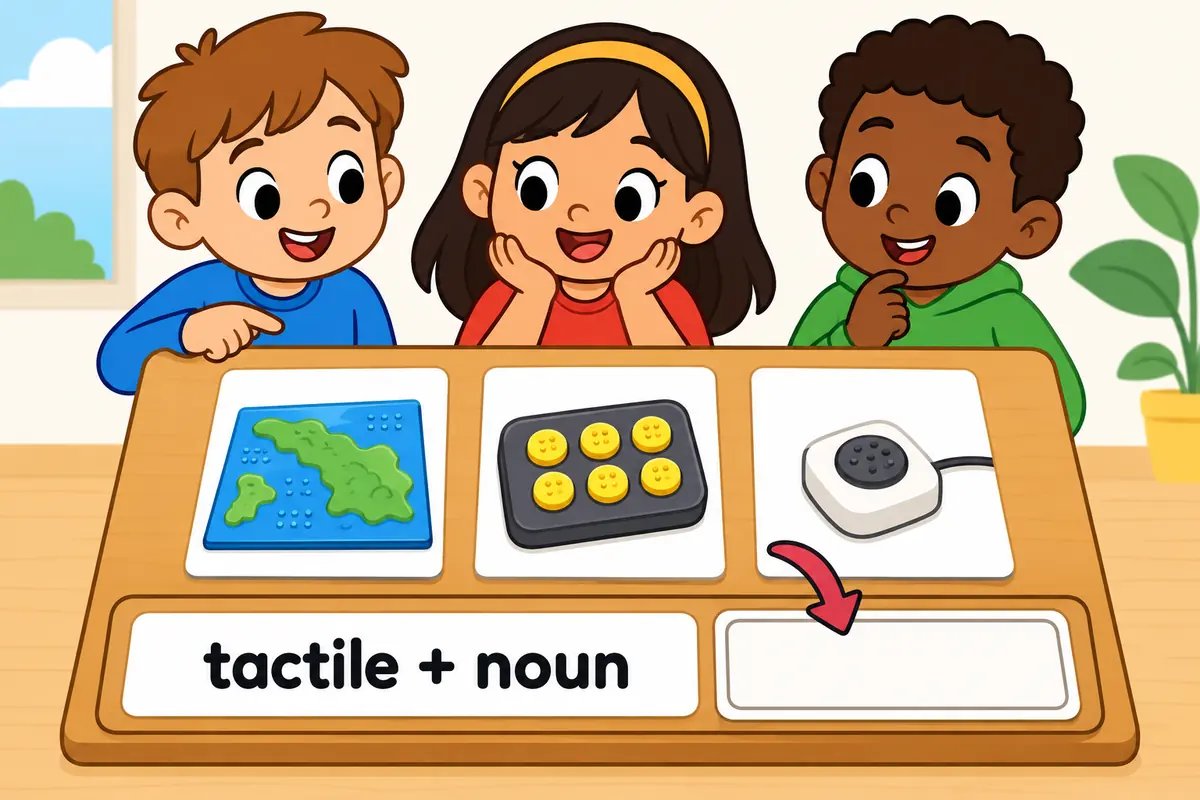
| tactile + noun | The museum added a tactile model of the bridge. | Attributive use, by far the commonest. |
| be tactile | The fabric is wonderfully tactile. | Predicative use after a linking verb. |
| tactile + sense / feedback / learner | Braille offers tactile feedback. | Technical compounds that name the channel. |
| for the tactile learner | Charts help, but for the tactile learner a model works better. | Names the kind of learner. |
| more / less tactile | Sandpaper makes the surface more tactile. | Compares how much touch is involved. |
Because the adjective already implies the physical channel, a careful sentence does not add the word touch after it; a tactile map is understood to be read by hand, so tactile touch is redundant.
Tactile in a sentence: examples across contexts
Tactile shifts its subject more than its meaning. The eleven sentences below move from a nursery to a laboratory, and each one names the surface, signal or learner that the adjective is doing work for.
| Context | Example sentence | Why this works |
|---|---|---|
| Classroom | The teacher kept a box of tactile letters for spelling practice. | Names the object the fingers use. |
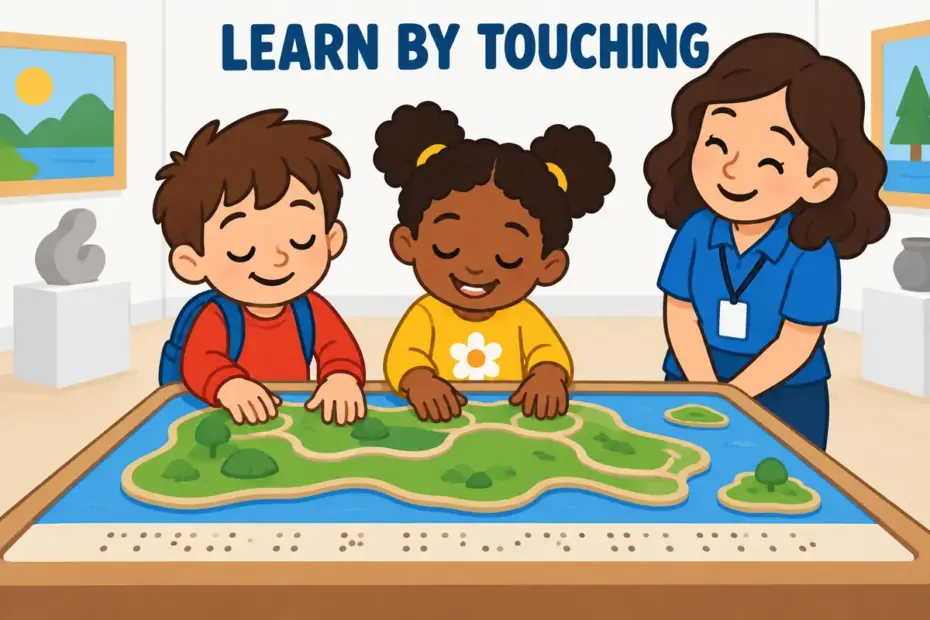
| Museum | A tactile model let visitors trace the shape of the cathedral. | Shows touch replacing sight for access. |
| Design studio | The designer chose a tactile lid that clicks under the thumb. | Links feel to a deliberate product decision. |
| Science lab | The robot used tactile sensors to grip the glass slides. | Applies the word to machine sensing. |
| Product review | The keyboard is quiet and pleasantly tactile. | Praises the felt quality of a device. |
| Accessibility | Tactile paving warns people at the edge of the platform. | Uses the standard term for a safety surface. |
| Early years | Tactile play with sand and water builds finger strength. | Shows the learning sense in a nursery. |
| Physiotherapy | The therapist used tactile cues to steady the patient. | Describes touch as a treatment signal. |
| Fashion | The coat has a rich, tactile weave that feels warm. | Judges material by how it handles. |
| Conversation | She is a very tactile person and greets everyone with a hug. | Shows the everyday sense of liking contact. |
| Psychology | Tactile memory for a shape can outlast the words that named it. | Names the type of memory being studied. |
Only two of the eleven sentences describe a person, and both use the learning or contact sense rather than judging character, which is the usual limit of the word.
Tactile vs tangible
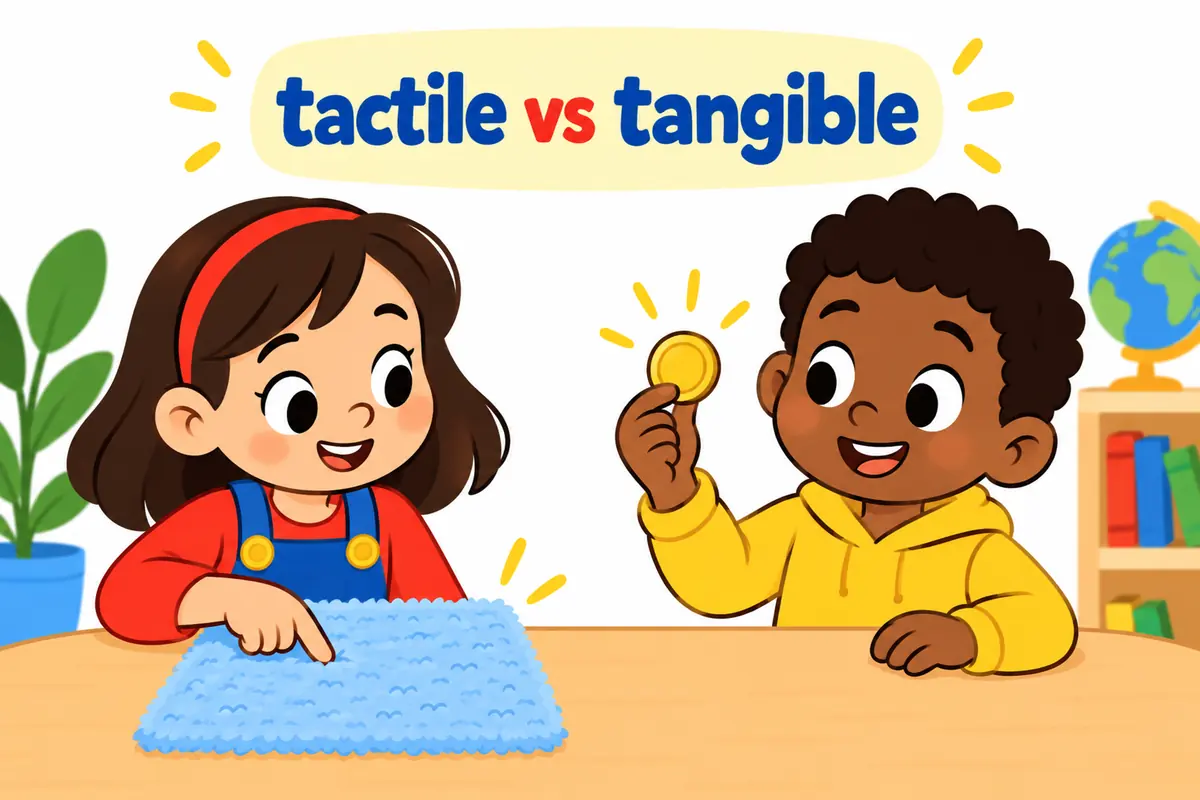
Tactile and tangible are the classic pair to confuse, because both point back to the hand. Tactile belongs to the sense of touch; tangible belongs to proof and reality, and it often describes results you can count.
| Attribute | tactile | tangible |
|---|---|---|
| Core idea | Related to the sense of touch | Real, definite or countable |
| Typical noun | A surface, map, feedback or learner | Proof, benefit, result or asset |
| Opposite | Visual or auditory | Intangible or abstract |
| Register | Design, science, education | Business, law, everyday argument |
| Can describe a feeling? | Yes, a felt sensation | No, a feeling can be tangible only if it counts |
Verdict: choose tactile when touch is the channel, and tangible when the point is that something is real enough to be measured or relied on.
Word forms and grammar of tactile
Tactile has a small family, and two of its members are close enough to be worth splitting. The final rows mark the forms learners invent by adding the wrong ending.
| Form | Part of speech | Example |
|---|---|---|
| tactile | adjective | The buttons are easy to find because they are tactile. |
| more / most tactile | comparative / superlative | Felt is more tactile than plastic. |
| tactility | noun | The tactility of the paper surprised her. |
| tactually | adverb, rare | The child explored the shape tactually. |
| tactual | adjective, technical synonym | Tactual acuity declines with age. |
| tactilely | non-standard | Use tactually; tactilely is not accepted in careful writing. |
The noun tactility names the quality itself, while the synonym tactual appears mostly in psychology, where writers prefer it for measurable abilities rather than pleasant surfaces.
Common mistakes with tactile
- Incorrect:
The report gave tactile proof of the loss.Correct: The report gave tangible proof of the loss. Rule: Proof that is real or countable is tangible, not tactile. - Incorrect:
Chocolate has a lovely tangible taste.Correct: Chocolate has a lovely tactile feel. Rule: Taste and smell are not touch, so the word for a felt surface is tactile. - Incorrect:
He is a tactile learner, so he never handles anything.Correct: He is a tactile learner, so he learns by handling things. Rule: The adjective implies contact, not avoidance of it. - Incorrect:
The speaker gave a tactile presentation.Correct: The speaker gave a visual presentation. Rule: Do not use tactile for anything the audience only sees or hears. - Incorrect:
She explored the shape tactiley.Correct: She explored the shape tactually. Rule: The established adverb is tactually; the spelling tactiley is not standard.
Practice using tactile
Work through the seven items and then read the reasoning, which shows which sense or which kind of proof each sentence needs.
- Fill the gap: The gallery installed a ______ copy of the sculpture so visitors could feel it.
- Choose the better word: After the audit, the savings were (tactile / tangible).
- Correct the error: The orchestra gave a tactile performance.
- Build a sentence: use tactile before a noun to describe a safety surface.
- Spot the register: which suits a science report — tactile sensors recorded the pressure, or the robot could feel things?
- Rewrite with the noun: The paper was lovely to touch. Use tactility instead.
- Correct the error: The fabric felt very tactilely smooth.
Answers
- tactile — the copy is meant to be read by hand, which is the touch sense.
- tangible — money saved is real and countable, so the proof word is needed.
- The orchestra gave a visual performance — music is heard, not felt by hand.
- Model answer: Tactile paving marked the edge of the railway platform.
- Tactile sensors recorded the pressure — a report keeps the precise technical term.
- The paper was admired for its tactility — the noun names the quality of the surface.
- The fabric felt very smooth — tactually is rare, and the sentence is cleaner without the adverb.
The bottom line
Use tactile in a sentence when touch is the channel, whether you mean a surface, a signal, a map or a way of learning. Two nuances decide most uses: tactile belongs to the sense of touch while tangible belongs to what is real or countable, and the word stays safe when it describes objects rather than judging a person. Where a felt sensation is strong enough to seem physical, the older word hands it that extra force.
Frequently asked questions about tactile
Does tactile mean something you can touch?
Not exactly. Tactile means relating to the sense of touch or pleasant to handle, so a tactile surface is one the fingers notice. Something you can touch is better called touchable, and something real and countable is tangible. Keep tactile for the sense and the quality of the surface.
What is the noun form of tactile?
The noun is tactility, meaning the quality of being tactile or the richness of what touch conveys. A reviewer might praise the tactility of a fabric or a keypad. The adverb is tactually, and the technical synonym tactual describes measurable touch abilities in psychology.
Can a person be described as tactile?
Yes, in two limited ways. A tactile person likes to touch and be touched, and a tactile learner prefers handling objects to reading or listening. Neither use judges character, so a sentence should keep the word for the preference or the learning style rather than for personality.
Is tactile learning a proven method?
It is best treated as a description of preference rather than a proven method. Decades of classroom research have not shown that matching lessons to a preferred style raises results, so the word usefully describes how a learner likes to work without promising that the match improves the learning.