For Your Information FYI in a Sentence: Meaning & Examples
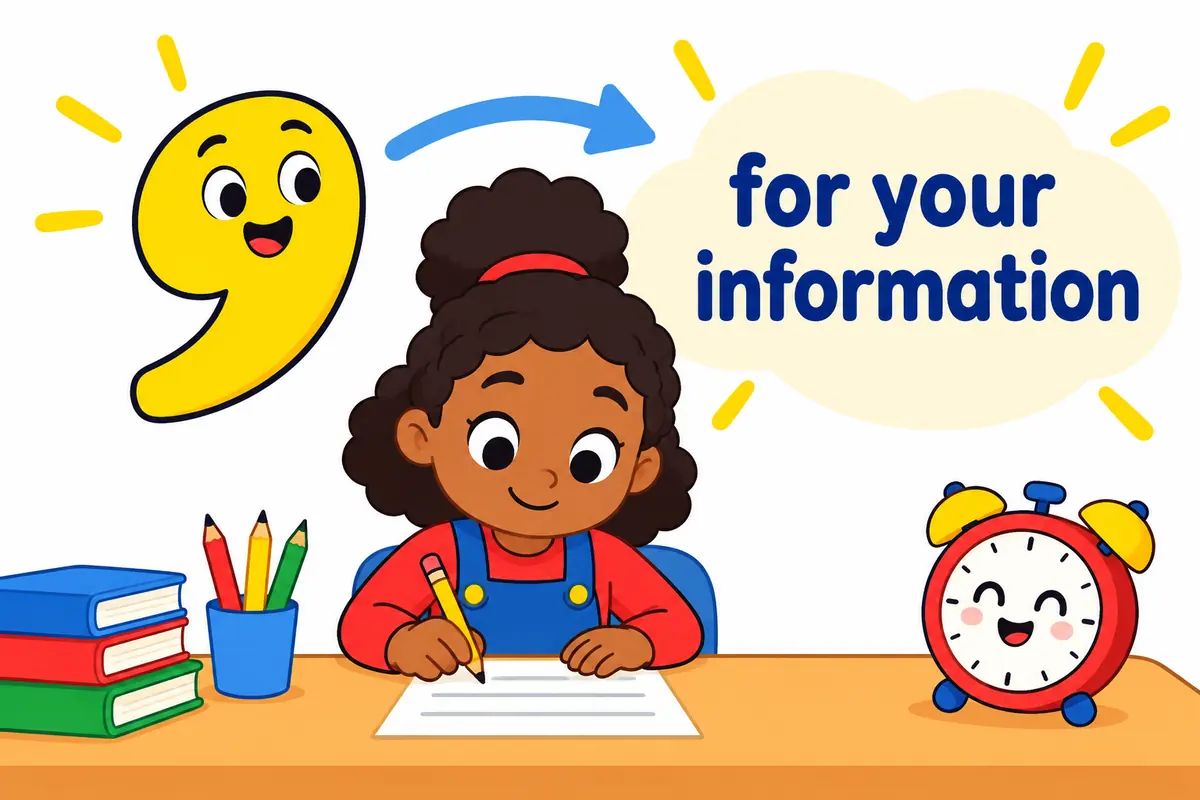
For your information FYI is a set phrase, and its shortening, used to pass on a fact without asking for a reply. To use for your information FYI in a sentence, put a comma after it: “For your information, the meeting has moved to Friday.” In most writing the long form is shortened to the four capital letters FYI.
For your information FYI at a glance
- The full expression is for your information; FYI is its initialism, always written in capitals.
- It introduces a fact and normally expects no reply, which separates it from a request.
- Sentence-initial use takes a comma; FYI often takes a comma too, as in FYI, the room has changed.
- It belongs to email, memos, chat and meeting notes rather than academic or literary prose.
- The long form can sound pointed when spoken, as if the speaker is correcting someone.
- The commonest error is mixing information with an instruction in the same sentence.
What does for your information FYI mean?
For your information FYI means here is a fact you may not have, offered without any request for action. The Cambridge entry for for your information FYI treats the full phrase and the abbreviation together, and both share one job: to hand over a piece of information and stop there. The tone is neutral in writing and often sharp in speech, because a spoken for your information can imply that the listener should already have known.
| Use | Plain meaning | Example sentence |
|---|---|---|
| Neutral notice | Here is a fact for your records | For your information, the office closes at four on Friday. |
| Written label | A short tag marking a message as informational | FYI: the client has signed the contract. |
| Pointed aside | A spoken reminder that someone has missed a fact | For your information, I booked the tickets last week. |
One limitation is worth stating plainly. For your information FYI is a tool for forwarding facts, not for asking people to act. When the sentence needs a task done, a plain please plus the task is clearer than FYI, which readers in a hurry often skim and ignore.
How do you use for your information FYI in a sentence?
The phrase behaves like a sentence opener rather than a verb, so it is followed by a comma and then a complete clause. Five patterns cover almost every real example, and each one keeps the fact separate from any instruction.
| Pattern | Example | What it signals |
|---|---|---|
| For your information, + clause | For your information, the deadline has moved. | The full form, slightly formal and occasionally pointed. |
| FYI, + clause | FYI, the deadline has moved to Friday. | The everyday abbreviation in email and chat. |
| FYI as a label or heading | FYI: new printer codes in the staff room. | A colon after FYI marks a title or a subject line. |
| Just FYI, + clause | Just FYI, the car park is full today. | Makes the note casual and softens any implied criticism. |
| FYI only | FYI only, no action required. | Used in subject lines to state that nobody needs to reply. |
For your information FYI in a sentence: examples across contexts
For your information FYI keeps one meaning while the setting changes the tone. The nine sentences below move from a classroom note to a newsroom diary, and each one states a fact without asking for a reply.
| Context | Example sentence | Why this works |
|---|---|---|
| Classroom | For your information, the library reopens on Monday. | A neutral notice children can act on or ignore. |
| Email subject line | FYI: agenda for Thursday’s staff meeting. | The colon turns the abbreviation into a clean label. |
| Workplace chat | FYI, the shared drive is being updated tonight. | Short, factual and free of any implied task. |
| Formal letter | For your information, a copy of the report is enclosed. | The long form suits a document that may be filed. |
| Meeting note | FYI, the budget was approved without change. | Records a decision that others need only to know. |
| Newsroom diary | FYI: the press conference has been moved forward. | Alerts colleagues to a fact, not a task. |
| School newsletter | For your information, term ends three days earlier. | Reaches parents who may not read a chat message. |
| Project update | FYI, the supplier confirmed the new delivery date. | Shares progress without requesting a response. |
| Conversation | Just FYI, the road outside is closed this morning. | The casual opener keeps a spoken warning friendly. |
Every row keeps the note free of any request, and the tone stays flat rather than urgent. Moving an instruction into the same sentence is what turns a helpful FYI into a confusing message.
For your information FYI vs a heads up
For your information FYI shares a job with a heads up, and the two differ in expectation. FYI says here is a fact; a heads up says something is coming, so be ready. FYI also belongs to writing, while a heads up is at home in speech.
| Attribute | for your information FYI | a heads up |
|---|---|---|
| Core job | Pass on a fact | Warn that something is coming |
| Expects action | No | Often yes, prepare or respond |
| Usual medium | Email, memo, note | Speech and quick messages |
| Register | Neutral to formal | Informal |
| Length | One note, one fact | Forward-looking, about what is next |
Verdict: send for your information FYI when a colleague simply needs the fact on file, and give a heads up when they need time to prepare for what is coming.
Word forms and variations of for your information FYI
For your information FYI is a fixed phrase, so the words inside it cannot be reordered. What may vary is the length, the punctuation and the small additions that change the tone. The table marks each variation as standard, informal or wrong.
| Variation | Status | Example or note |
|---|---|---|
| for your information | Standard full phrase | For your information, the hall is booked. |
| FYI | Standard initialism, always capitals | FYI, the hall is booked. |
| fyi | Informal in chat only | Acceptable in a quick message, not in a report. |
| F.Y.I. | Old-fashioned, avoid | Dots were once common; modern writing uses FYI. |
| just FYI | Informal softening | Just FYI, the room has changed. |
| FYI only | Standard in subject lines | FYI only, no action needed. |
| for your informations | Wrong | Information is uncountable and has no plural. |
The related verb inform someone formally gives the same idea in one word, which is useful when a memo has to sound official but still brief.
Common mistakes with for your information FYI
- Incorrect:
FYI, please send the report by Friday.Correct: FYI, the report is due Friday. Rule: FYI passes on a fact, so an instruction needs its own sentence. - Incorrect:
For your information that the office is closed.Correct: For your information, the office is closed. Rule: The phrase is followed by a comma and a complete clause. - Incorrect:
Please find the for your information attached.Correct: For your information, the file is attached. Rule: The phrase is an opener, never the object of a verb. - Incorrect:
He gave me many informations as an FYI.Correct: He gave me some information as an FYI. Rule: Information is uncountable, and FYI takes the article an. - Incorrect:
FYI was sent to the whole team.Correct: An FYI was sent to the whole team. Rule: When FYI acts as a noun it needs an article.
The abbreviation is also used as a noun, as in that email was just an FYI. Give it an article and it reads naturally; leave the article out and the sentence sounds clipped.
Using for your information FYI in email and subject lines
Most readers meet the phrase in a subject line before they meet it in a sentence, and the way it is punctuated there changes how the message is filed. The table below shows the common written shapes and what each one tells a busy reader.
| Written shape | Example | What the reader expects |
|---|---|---|
| FYI as a label | FYI: new phone system on Monday | Open only if the fact matters today. |
| FYI only | FYI only, no action needed | Read and archive; no reply wanted. |
| For your information at the start | For your information, the room has changed. | A slightly formal note, often in a letter. |
| Just FYI | Just FYI, the deadline slipped to Friday. | A soft warning that avoids alarm. |
| FYI inside a sentence | The figures are attached FYI. | Casual and best kept to chat. |
| As an FYI | I mention this as an FYI. | The abbreviation used as a noun, with an article. |
Subject lines reward restraint. A label that fits one line is read, while a long one is skimmed, so the four letters do most of their work at the front. Inside a sentence the phrase reads more easily as as an FYI, because treated as a noun it takes the same article as any other countable word.
Practice using for your information FYI
Work through the six items, then read the reasoning rather than only the answer.
- Fill the gap: ______, the rehearsal has moved to the main hall.
- Choose the better opener: (For your information / A heads up), be ready for a busy morning tomorrow.
- Correct the error: FYI that the canteen closes early today.
- Build a sentence: use FYI only as the start of an email subject line about a policy change.
- Spot the register: which belongs in an academic essay, for your information the results appear below, or the results appear below?
- Rewrite with the full phrase: FYI, the forms are on my desk. Use for your information instead.
Answers
- For your information — the full opener suits a written notice, followed by a comma.
- A heads up — the sentence asks the reader to prepare, which is a warning, not a fact.
- For your information, the canteen closes early today — the opener needs a comma and a clause.
- Model answer: FYI only, change to the late-payment policy.
- The results appear below — an academic essay avoids the conversational opener.
- For your information, the forms are on my desk — the long form keeps a formal letter consistent.

The bottom line
Use for your information fyi in a sentence to hand over a fact and expect no reply, keeping the opener separate from any task. Two details settle most choices: the long form takes a comma before its clause and suits formal writing, while FYI is the everyday version for email and chat. Where the reader must prepare for something, a short announcement or a heads up carries the warning that FYI deliberately does not.
Frequently asked questions about for your information FYI
What does FYI stand for?
FYI stands for for your information. The four letters are the written short form of the longer phrase and are always printed in capitals. In email and chat it introduces a fact rather than a request, so a message marked FYI usually needs no reply from the reader.
Is FYI formal or informal?
FYI sits between the two. It is perfectly acceptable in business email, memos and meeting notes, which makes it more formal than a chat abbreviation. It is still too casual for an academic essay or a legal document, where the full phrase or a plain sentence performs the same job.
Can you start a sentence with FYI?
Yes. FYI commonly opens a sentence and is followed by a comma, as in FYI, the date has changed. A colon works instead when the abbreviation labels a heading, as in a subject line. Both patterns keep the abbreviation separate from the clause that carries the fact.
How do you use for your information in an email?
Put the full phrase at the start of the sentence and follow it with a comma and the fact: For your information, the client has signed. In a subject line, FYI plus a colon and a short label is quicker. Keep any request in a separate sentence so the reader knows whether to act.