Vacuous in a Sentence: Meaning & Examples
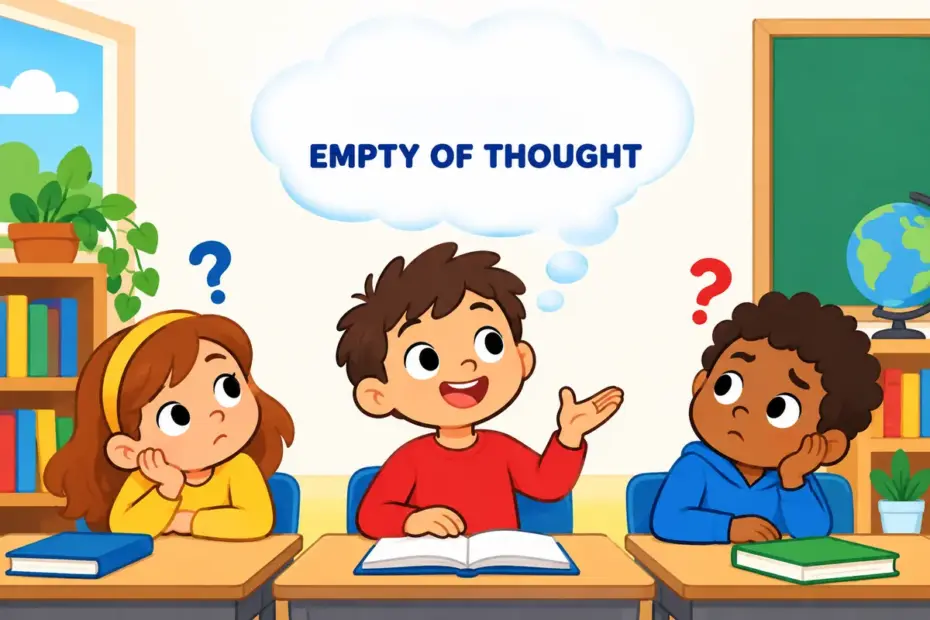
Vacuous means showing no thought or intelligence, describing a remark, expression or promise that is empty of meaning. To use vacuous in a sentence, place it before the thing it judges, as in a vacuous smile or a vacuous slogan. It is a formal criticism, sharper and colder than the word empty.
Vacuous at a glance
- Vacuous is an adjective, with the adverb vacuously and the nouns vacuity and vacuousness.
- It means empty of thought, meaning or serious content.
- The usual pattern is vacuous before a noun, as in a vacuous look.
- The word belongs to formal criticism of speech, writing and expression.
- The commonest error is confusing vacuous with vacant, which describes an empty room.
What does vacuous mean?
Vacuous is an adjective meaning showing no thought or intelligence. The Cambridge Dictionary entry for vacuous records the sense of not expressing or showing intelligent thought, and the Merriam-Webster entry for vacuous keeps the idea of emptiness of mind or content. Three shades are worth separating. A vacuous look is blank and uncomprehending. A vacuous remark contains words but no meaning. A vacuous promise is loud and hollow. Vacuous is not the same as silent: a person can be talkative and still vacuous, because the fault is emptiness rather than quietness. When you mean simply empty of people or things, use empty, and vacant is the word for an empty room; when you mean dull rather than blank, hollow and vapid are closer.
Because the word denies thought, it lands hardest on things a mind is expected to produce. A vacuous smile, a vacuous remark and a vacuous promise all say that nothing is going on behind the surface. The opposite of vacuous in this sense is not full but thoughtful, which is why the word never describes a container or a car park.
| Sense | Plain meaning | Example sentence |
|---|---|---|
| Blank expression | Showing no thought or feeling | She gave a vacuous stare at the question. |
| Empty talk | Saying nothing of real meaning | The speech was a vacuous promise of change. |
| Lack of intelligence | Thoughtless in a way that irritates | He grinned at his own vacuous joke. |
How do you use vacuous in a sentence?
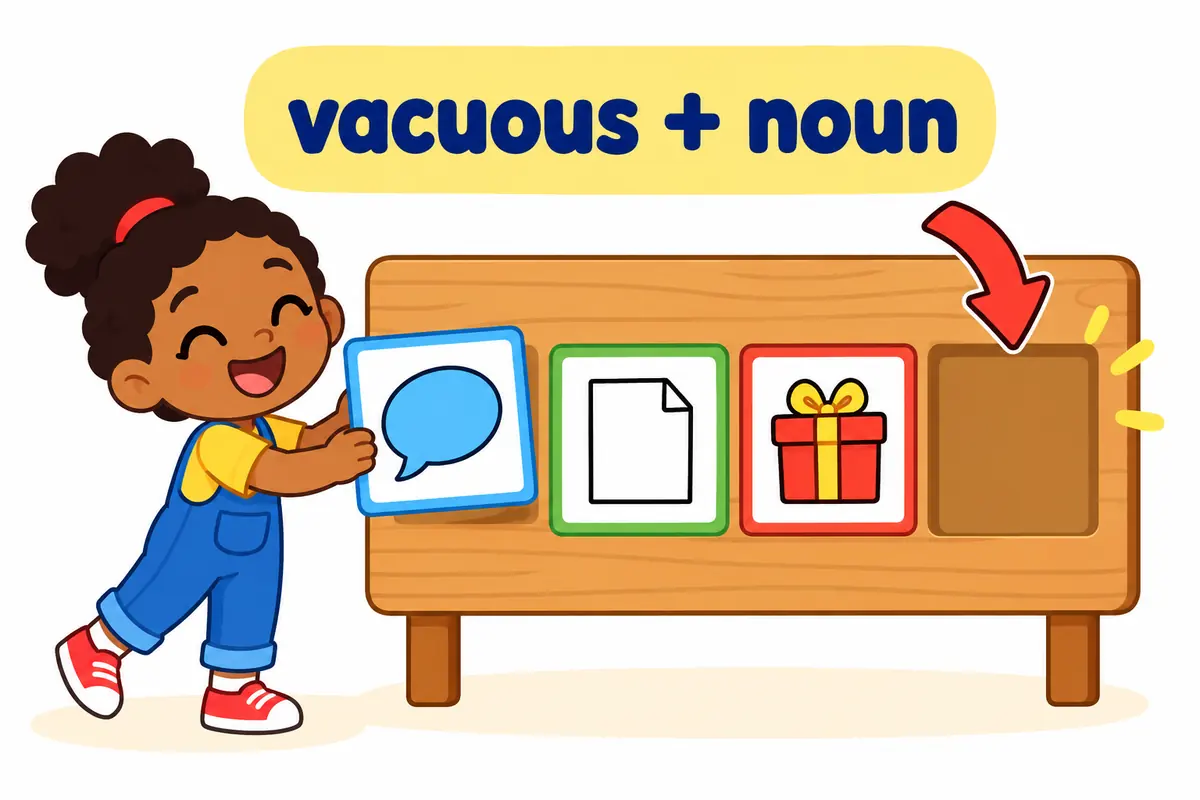
Vacuous usually comes before the noun it judges, or after a linking verb such as feel or seem. The pattern decides whether you criticise a face, a remark or a whole promise.
| Pattern | Example | What it signals |
|---|---|---|
| vacuous + noun | a vacuous slogan | The adjective labels the empty thing. |
| linking verb + vacuous | The interview felt vacuous. | It reports an impression of emptiness. |
| vacuous + look/expression | a vacuous look | The word often describes a blank face. |
| It is vacuous to + verb | It is vacuous to discuss change without a plan. | A formal pattern condemning an action. |
| more/most vacuous | the most vacuous remark of the debate | The adjective grades degrees of emptiness. |
Five fixed pairings carry most of the word’s force. Each one attaches vacuous to a product of thought, which is where the criticism belongs.
| Collocation | What it criticises | Example |
|---|---|---|
| a vacuous smile | a face with no thought behind it | He answered with a vacuous smile. |
| a vacuous remark | a comment that carries no meaning | The debate turned on one vacuous remark. |
| a vacuous promise | a pledge with nothing behind it | Voters saw through the vacuous promise. |
| a vacuous slogan | a phrase repeated without content | The poster carried a vacuous slogan. |
| a vacuous stare | an uncomprehending look | She gave the form a vacuous stare. |
Vacuous in a sentence: examples across contexts
From a marked essay to a news report, vacuous keeps the same core meaning of emptiness. The reason column shows what each speaker gains from choosing it.
| Context | Example sentence | Why this works |
|---|---|---|
| Classroom | The essay was marked down for a vacuous conclusion. | It names the ending as empty rather than merely short. |
| News report | Critics called the summit a vacuous display of unity. | The adjective accuses the event of having no substance. |
| Workplace email | Please avoid vacuous phrases such as thinking outside the box. | It pinpoints filler language that carries no meaning. |
| Film review | The sequel is beautiful but vacuous. | The linking-verb pattern balances praise with a verdict. |
| Academic writing | The theory rests on a vacuous assumption. | It signals a premise with no content. |
| Conversation | He gave me a vacuous smile and changed the subject. | A concrete noun plus the adjective makes a sharp image. |
| Performance review | We cannot set targets from such vacuous data. | It criticises the data as empty of insight. |
| Political speech | The manifesto was dismissed as a vacuous list of slogans. | It attacks a document’s lack of substance. |
| Book review | The chapter is elegant but vacuous. | It separates style from meaning in one short judgement. |
| Parenting | A vacuous cartoon kept the children quiet for an hour. | The word can judge entertainment as content-free. |
| Social media | The post was a vacuous caption under someone else’s photograph. | Criticises the words as empty of meaning. |
| Job interview | The candidate gave a vacuous answer about teamwork. | Names an answer with no substance behind it. |
Vacuous vs Vapid
Vacuous and vapid are near neighbours, and writers often reach for the wrong one. Vacuous points to an absence of thought or meaning; vapid points to an absence of liveliness or interest. A blank stare is vacuous, while a dull evening is vapid.
| Attribute | Vacuous | Vapid |
|---|---|---|
| Core meaning | Showing no thought or intelligence | Dull and flat; lacking interest |
| What it names | An absence of meaning or content | An absence of flavour or liveliness |
| Typical subject | expression, smile, remark, promise | conversation, film, performance, prose |
| Feeling it creates | Blank and unthinking | Tired and lifeless |
| Register | Formal criticism | Formal criticism |
| Example | a vacuous smile during the briefing | a vapid sequel with no new ideas |
Use vacuous when something is empty of thought and vapid when it is merely dull; a blank stare is vacuous, while a boring party is vapid.
Word forms and grammar of vacuous
The adjective is regular, but learners build nouns that do not exist. The standard nouns are vacuity and vacuousness.
| Form | Part of speech | Example |
|---|---|---|
| vacuous | adjective | a vacuous promise |
| vacuously | adverb | She nodded vacuously. |
| vacuity | noun | the vacuity of the slogan |
| vacuousness | noun | the vacuousness of the reply |
| more vacuous | comparative adjective | a still more vacuous speech |
| most vacuous | superlative adjective | the most vacuous claim of the night |
| non-standard noun | Use vacuity or vacuousness instead. |
Common mistakes with vacuous
These slips mix up vacuous with vacant and with words for dullness. Each line gives the wrong form, the correction and the rule.
The office was vacuous after everyone left.Correct: The office was vacant after everyone left. Rule: vacant means empty of people; vacuous means empty of thought.He vacuoused through the meeting.Correct: He sat through the meeting with a vacuous expression. Rule: vacuous is an adjective, not a verb.a vacuous, well-argued essayCorrect: a vacuous, badly argued essay. Rule: a well-argued essay cannot be vacuous, because the word rejects content.She felt vacuous after lunch.Correct: She felt sluggish after lunch. Rule: vacuous judges a thing’s emptiness, not a person’s physical feeling.vacuous of ideasCorrect: vacuous talk, or devoid of ideas. Rule: vacuous does not take of; use devoid of when you need that pattern.
Vacuous and its near-synonyms
Several words circle the same emptiness, and each one carries a different weight. The table below shows where vacuous sits among them.
| Word | Core idea | Typical subject | Example |
|---|---|---|---|
| fatuous | Smugly foolish as well as empty | remark, excuse, optimism | a fatuous excuse |
| vacuous | Empty of thought or meaning | remark, smile, promise | a vacuous slogan |
| empty | Containing nothing | room, box, gesture | an empty room |
| hollow | Without real substance or feeling | promise, victory, sound | a hollow victory |
| vapid | Dull and lacking interest | film, chat, prose | a vapid conversation |
| shallow | Lacking depth of thought | argument, person, water | a shallow argument |
The table also fixes which word can take of. Devoid of ideas, empty of meaning and hollow of promise all read naturally, while vacuous of ideas does not. When a sentence needs that pattern, switch to devoid or empty and keep vacuous for the direct position in front of its noun.
When vacuous is too harsh
Vacuous accuses a person or thing of having no mind behind it, which is a strong charge. Three gentler options fit different situations.
- Empty describes a lack of content without judging intelligence, as in an empty gesture.
- Vague blames unclear wording rather than a missing mind, as in a vague answer.
- Formulaic names recycled phrasing that the speaker may not mean, as in a formulaic tribute.
- Unconvincing targets the listener’s doubt rather than the speaker’s mind.
Choosing the gentler word is precision, not weakness. A vague answer may come from a careful speaker who lacks information, while a vacuous answer accuses the speaker of having nothing to say. Match the word to the fault you can actually point to in the sentence.
Practice using vacuous
Work through the items, then compare each answer with the reason given.
- Fill in the blank: The interview was ____; nobody said anything that mattered.
- Choose the better word: The meeting had an (empty / vacuous) agenda that addressed nothing real.
- Correct the error: They debated in a vacuous of detail room.
- Build a sentence: describe a blank expression using vacuous plus a noun.
- Spot the register: Which belongs in a formal review — “a vacuous spectacle” or “a total waste of time”?
- Fill in the blank: He smiled ____ and looked away. (adverb)
- Choose the better word: The award speech was long but (vacuous / detailed).
- Rewrite with the noun: The slogan was vacuous. Use vacuity.
Answers
- vacuous — the sentence blames the interview for lacking thought, which is the word’s core sense.
- vacuous — an agenda can be empty of substance, and vacuous captures that better than empty.
- The phrase should be a room vacuous of detail, or simply a vacuous room; vacuous does not sit after of in this way.
- Model answer: She answered with a vacuous look that showed she had not listened.
- “a vacuous spectacle” suits a formal review; the second phrase is conversational.
- vacuously — the adverb describes how he smiled.
- vacuous — the sentence calls the speech empty of content, not thorough.
- Model: The vacuity of the slogan was obvious to everyone in the hall. — The noun vacuity names the emptiness itself.
The bottom line
Vacuous is an adjective for something empty of thought or meaning, and the phrase vacuous in a sentence usually puts it straight before a noun such as smile, slogan or promise. It is colder than empty, because it denies the presence of a mind rather than the presence of things. Keep it for genuine emptiness, and choose vacant for rooms, hollow for promises and vapid for dull entertainment.
Frequently asked questions about vacuous
Is vacuous an insult?
Vacuous is a strong criticism but not always a personal insult. Applied to a remark or a slogan it attacks an empty idea; applied to a person it suggests they have no depth of thought, which is harsher. Use it for products of thought rather than for people when you want to stay fair.
Does vacuous mean the same as vacant?
No. Vacant means empty of people or contents, as in a vacant seat or a vacant office. Vacuous means empty of thought or meaning, as in a vacuous look. The shared root suggests emptiness, but only vacuous judges the mind behind the words.
What is the noun form of vacuous?
The standard nouns are vacuity and vacuousness, both meaning empty-headedness or lack of content. The noun vacuity is the more formal choice and fits phrases such as the vacuity of the slogan. The adverb vacuously describes an action done without thought.
Is vacuous used in everyday speech?
Vacuous appears mostly in formal criticism, reviews and academic writing. In casual conversation speakers usually prefer empty, blank or meaningless. Choosing vacuous in speech can sound pointed, so it works best when the emptiness is the precise thing you want to name.