Faux in a Sentence: Meaning, Uses & Examples
Faux means artificial or imitation, and it describes things made to look like something they are not. To use faux in a sentence, put it before the noun it describes: “She wore a faux fur coat to the party.” Faux is attributive, so it rarely appears after a linking verb.
Faux at a glance
- Faux is an adjective borrowed from French; it has no verb and no separate plural.
- It comes before the noun, as in faux leather, faux marble or a faux pas.
- The word means imitation, not automatically inferior, because faux can be a deliberate choice.
- Faux is common in fashion, interiors and design writing.
- The commonest error is using faux after a linking verb, as in the leather is faux.
What does faux mean?
Faux is an adjective meaning artificial or imitation. The Cambridge entry for faux shows the word in fixed pairs such as faux fur and faux pas, and that fixedness is the key to using it well. The fixed phrase a faux pas is the one most learners meet first, and there the word keeps its French sense of false or mistaken.
| Sense | Plain meaning | Example sentence |
|---|---|---|
| Imitation material | A substitute made to look like the real thing | He zipped up a faux leather jacket. |
| Imitation appearance | A decoration that copies a style | Faux beams crossed the whole ceiling. |
| Insincere manner | A false show of feeling | Her faux apology fooled nobody. |
One limitation is worth stating plainly. Faux is not the same as counterfeit, because counterfeit implies illegal deception for profit, while faux can be openly artificial. An an imitation watch copies a design without claiming to be the original, and that honesty is the difference.
How do you use faux in a sentence?
Faux sits directly in front of the noun, and the noun supplies nearly all the meaning. Five patterns cover nearly every real sentence, and the last one shows the placement learners get wrong.
| Pattern | Example | What it signals |
|---|---|---|
| faux + material | Faux fur lined the collar. | Names a substitute fabric. |
| faux + feature | A faux fireplace warmed the room visually. | Names a decorative copy of a real feature. |
| faux + manner | He gave a faux smile and left. | A show of feeling that is not real. |
| a faux pas | She committed a faux pas at dinner. | The fixed noun phrase for a social blunder. |
| predicate use (avoid) | The coat is faux. | Rare and awkward; use imitation instead. |
Faux clusters around a short list of nouns, and learning them as whole units saves guesswork. Fashion writing returns to faux fur, faux leather and faux suede; interiors prefer faux marble, faux wood and faux flowers; design copy reaches for faux finish and faux vintage. The pairing signals the field, so an unexpected partner such as faux engine reads as a joke.
| Collocation | Typical field | Example |
|---|---|---|
| faux fur | fashion | The faux fur trim softened the collar. |
| faux leather | retail and fashion | A faux leather notebook lay on the desk. |
| faux marble | interiors | Faux marble panels lined the lobby. |
| faux flowers | home decor | Faux flowers need no watering. |
| faux pas | etiquette | He made a faux pas at the reception. |
Artificial leather is the plainer phrase in a product description, while faux keeps a fashionable tone. The practitioner rule is simple: if the noun sounds wrong after faux, the writer probably wanted fake, imitation or artificial.
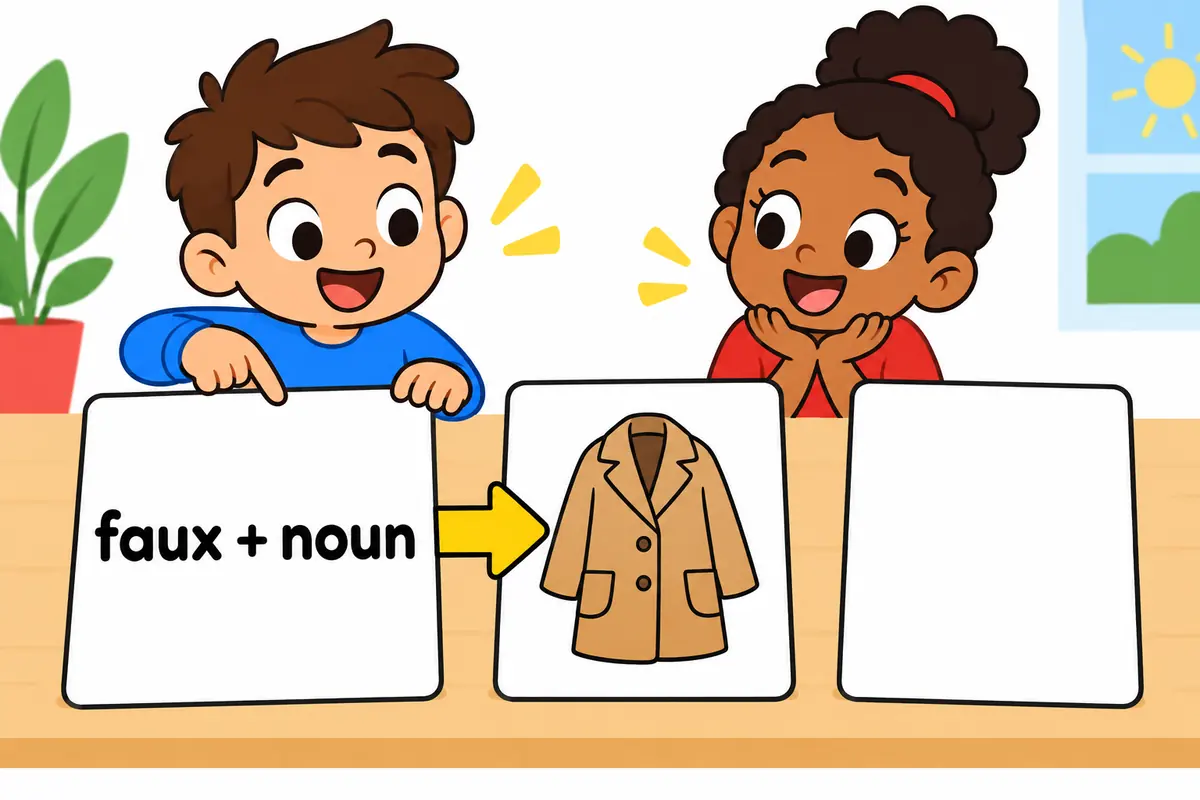
Faux in a sentence: examples across contexts
Faux keeps its meaning while the setting changes. In everyday shopping talk, fake fur and faux fur name the same material, so the word choice is about tone rather than fact. The ten sentences below move from a classroom to a design magazine.
| Context | Example sentence | Why this works |
|---|---|---|
| Classroom | The costumes were made with faux leather to keep the animals safe. | A real reason makes the adjective concrete. |
| Fashion writing | The collection paired faux fur with wool coats. | The fixed pair faux fur reads as a material name. |
| Interior design | Faux beams gave the new room a rustic look. | Names a decorative copy of a building feature. |
| Retail listing | A faux marble countertop costs far less than stone. | Contrasts the copy with the real material. |
| News report | The shop was fined for selling faux designer bags. | The word signals an imitation of a style. |
| Conversation | I bought a faux plant because I travel too much. | A personal reason makes the choice sound natural. |
| Etiquette column | Forgetting her name was a minor faux pas. | The fixed phrase names a social slip. |
| Food writing | The cafe serves faux meat to please every guest. | Extends the word to a substitute product. |
| Home blog | She hung a faux curtain to hide the boiler. | Names a decorative copy with a practical job. |
| Art review | The faux naivety of the painting is carefully planned. | A manner rather than a material, which shows the range. |
| Product review | The faux suede held up far better than real hide in the rain. | Names the imitation material without passing judgement. |
| Estate agent listing | Faux shutters improved the front of the house at little cost. | Names a decorative copy with a clear practical benefit. |
Note that every noun after faux is a thing a reader can picture, from a jacket to a beam. When the noun turns abstract, the word strains, which is why faux honesty sounds worse than false honesty.
Faux vs fake and artificial
Faux overlaps with fake and artificial, and the three carry different amounts of judgement. A counterfeit handbag pretends to be a brand, which faux never does.
| Attribute | faux | fake | artificial |
|---|---|---|---|
| Core meaning | Imitation, often stylish | Not genuine, often deceptive | Made by people, not nature |
| Tone | Neutral to approving | Negative or blunt | Technical and neutral |
| Typical partner | Fur, leather, marble, pas | Money, smile, identity | Light, flavour, limb, intelligence |
| Implies deception | No | Often yes | No |
| Placement | Before the noun only | Before the noun or after be | Before the noun or after be |
Verdict: choose faux for a deliberate imitation with style, fake for something presented as real, and artificial for anything made by people rather than found in nature.
A useful test is to ask what the thing is made of and whether anyone is being misled. Faux fur is marketed as an honest alternative, fake fur is often passed off as real, and artificial fur simply names a manufactured fibre. That question about honesty, not the material, separates faux from its neighbours.
Word forms and grammar of faux
Faux is unusually fixed for an English adjective. It does not inflect, it does not take a comparative, and the borrowed phrase faux pas behaves like a noun with an unchanged plural.
| Form | Part of speech | Example |
|---|---|---|
| faux | adjective | A faux leather wallet sat on the desk. |
| faux pas | noun, singular | Arriving late was a small faux pas. |
| faux pas | noun, plural | Two faux pas in one evening embarrassed him. |
| fauxs | not standard | Never add a plural to the adjective faux. |
| fauxly | not standard | No adverb exists; rewrite the sentence for the manner. |
The noun faux pas is the exception that trips writers up, because its plural is identical to its singular. If a plural is genuinely needed, faux pas is still the correct form, never faux pas or faux pas with an s.
Two spelling traps sit beside the word. Faux keeps its French spelling, so it never becomes foe or fo, and the whole phrase faux pas stays together. British and American writing spell faux identically, unlike pairs such as colour and color, so there is no regional variant to learn.
Common mistakes with faux
- Incorrect:
The jacket is faux.Correct: The jacket is imitation leather. Rule: Faux is attributive, so it needs a noun directly after it. - Incorrect:
She bought three fauxs.Correct: She bought three faux scarves. Rule: Faux never takes a plural ending, because it is an adjective, not a noun. - Incorrect:
He made a faux at the party.Correct: He made a faux pas at the party. Rule: The social-blunder sense belongs to the whole fixed phrase faux pas. - Incorrect:
A counterfeit fur coat kept her warm.Correct: A faux fur coat kept her warm. Rule: Counterfeit implies illegal deception, which a fake fur does not involve. - Incorrect:
The faux is very realistic.Correct: The faux marble is very realistic. Rule: An adjective cannot stand alone as a subject; keep its noun.
Practice using faux
Work through the eight items, then check the reasoning rather than only the answer.
- Fill the gap: The set designer used ______ stone for the castle wall.
- Choose the better word: The watch was an open (faux / counterfeit) copy of a famous design.
- Correct the error: The cushions are faux.
- Build a sentence: use faux fur in a description of a winter coat.
- Spot the register: which suits a shop listing — faux leather, or pretend leather?
- Rewrite with the fixed phrase: He embarrassed himself at dinner. Use faux pas as the subject.
- Fix the plural: She noticed two fauxs during the meal.
- Explain the choice: why is faux better than fake in a home-decor advert?
Answers
- faux — the adjective sits before its noun, here stone.
- faux — the copy is openly an imitation, so counterfeit would overstate the deception.
- The cushions are imitation leather — faux cannot follow the linking verb are.
- Model answer: A faux fur coat kept her warm all winter.
- faux leather — a listing prefers the fashionable borrowed word.
- His faux pas at dinner embarrassed him — the noun phrase names the social blunder.
- She noticed two faux pas during the meal — the plural is unchanged.
- Faux sounds stylish and neutral, while fake sounds blunt and slightly dishonest.
The bottom line
Use faux in a sentence when a thing is made to look like something else, and always place it directly before the noun. Two nuances decide most sentences: the word is attributive, so the leather is faux sounds wrong, and it carries less judgement than fake, so it suits fashion and design writing. When deception for profit is the point, counterfeit is the accurate word.
Frequently asked questions about faux
Is faux the same as fake?
Faux and fake both mean not real, but faux is neutral and often stylish, while fake sounds blunt and can suggest cheating. Faux fur describes an honest substitute that a shopper chooses, whereas a fake smile describes something insincere. The meaning overlaps, but the tone does not.
How do you pronounce faux?
Faux rhymes with go and low, and the final x is silent because the word comes from French. It is one syllable, not two, so it never sounds like fox. The same silent final letter appears in other French borrowings that English has kept, which is why the spelling looks longer than the sound.
Can faux be used after a verb?
Almost never. Faux is attributive, which means it belongs directly in front of a noun, as in faux marble. A sentence such as the marble is faux sounds awkward, so writers switch to imitation, artificial or fake when the adjective must follow a linking verb.
What does faux pas mean?
A faux pas is a social blunder, such as using the wrong fork or forgetting a name. The phrase is borrowed whole from French, so both words keep their French spelling and the plural is unchanged. In a sentence it behaves as a noun, as in he committed a small faux pas.