
Abstract nouns name ideas, qualities and feelings rather than physical objects, so freedom, courage and patience take no shape you can see. Because they are often uncountable and rarely take a and an, abstract nouns sit at the centre of most academic and reflective writing.
Abstract nouns at a glance
- An abstract noun names an idea, quality or feeling rather than a physical object.
- Examples include freedom, honesty, patience and joy.
- Most abstract nouns are uncountable, so they avoid a and an.
- Many form from adjectives or verbs with endings such as -ness, -ity and -tion.
- Abstract nouns often carry the main idea of academic and reflective writing.
- A few, like idea and decision, are countable and take a plural.
What is an abstract noun?
An abstract noun names something you cannot touch: a quality, a state, a feeling or a concept. Kindness, joy and freedom are abstract because they have no physical form, unlike a table or a stone. They fall into a few clear groups, and each group behaves in a predictable way.
| Type | What it names | Example |
|---|---|---|
| Quality | A trait someone shows | Her kindness helped the team. |
| State or feeling | An inner condition | His joy was obvious. |
| Idea or concept | A thought without shape | Freedom matters to everyone. |
| Event as a thing | An action turned into a noun | The celebration lasted an hour. |
| Measure of a quality | How much of a trait a person shows | Her honesty impressed the judge. |
For a single worked sentence, see an abstract noun in a sentence.
How do you use an abstract noun in a sentence?
An abstract noun behaves like any other noun: it can be a subject, an object or the object of a preposition. Because many are uncountable, they usually appear with no article, and a following of phrase names where the idea comes from.
| Pattern | Example | What it signals |
|---|---|---|
| abstract noun as subject | Courage wins respect. | The idea acts as the doer. |
| abstract noun as object | She praised his honesty. | The idea receives the action. |
| the plus abstract noun | The patience of the staff was clear. | the points to a specific instance. |
| followed by of plus noun | A sense of duty drove him. | of links the idea to its source. |
| abstract noun in apposition | His dream, success, came true. | The noun restates the one before it. |
The same idea appears in abstract sentences, where the subject names a concept rather than a thing.

Abstract nouns in sentences across contexts
The table shows the same word class in conversation, reports and reflection. Each row explains why the abstract noun fits. For a single worked sentence, see an abstract noun in a sentence.
| Context | Example sentence | Why this works |
|---|---|---|
| Classroom | Kindness costs nothing. | The abstract noun is the subject. |
| Work email | We value your honesty. | honesty is the object of value. |
| News report | The decision surprised the crowd. | decision names an event as a thing. |
| Academic writing | Freedom shapes political theory. | The concept is the topic of the sentence. |
| Conversation | His patience impressed me. | patience names a personal quality. |
| Story | Fear gripped the village. | fear names a shared feeling. |
| Motivational writing | Success rewards persistence. | Two abstract nouns balance the line. |
| Technical writing | Accuracy decides the result. | accuracy names a required quality. |
| Reflection | Gratitude changed her outlook. | gratitude names an inner state. |
| Debate | Justice demands a fair hearing. | justice names a principle people argue about. |
| Report | Profit depends on steady demand. | Two abstract nouns name business measures. |
Reflective writing leans on abstract thought sentences to discuss ideas that have no physical form.
Abstract nouns vs concrete nouns
The contrast is the test: if you can see or touch it, the noun is concrete. Abstract nouns name what the senses cannot reach, and that difference shapes how each type is counted and used in a sentence.
| Feature | Abstract noun | Concrete noun |
|---|---|---|
| What it names | An idea or feeling | A physical thing |
| Example | courage | a helmet |
| Can you see it? | No | Yes |
| Countability | Often uncountable | Usually countable |
| Typical ending | -ness, -ity, -tion | none in particular |
| Test | You can only imagine it | You can point at it |
Word forms and grammar of abstract nouns
Many abstract nouns form from adjectives with endings such as -ness and -ity, or from verbs with -tion and -ment. Learning the ending helps you spot the noun form and gives you a useful building block when you write in a formal register.
| Form | Part of speech | Example |
|---|---|---|
| kindness | noun from adjective kind | Her kindness reassured the group. |
| freedom | noun from adjective free | Freedom brings responsibility. |
| decision | noun from verb decide | The decision took a week. |
| joy | noun, base word | Joy filled the room. |
| friendliness | noun from adjective friendly | Friendliness opens doors. |
| happiness | noun from adjective happy | Happiness cannot be bought. |
A letter-based list such as nouns that start with c mixes abstract and concrete words together.
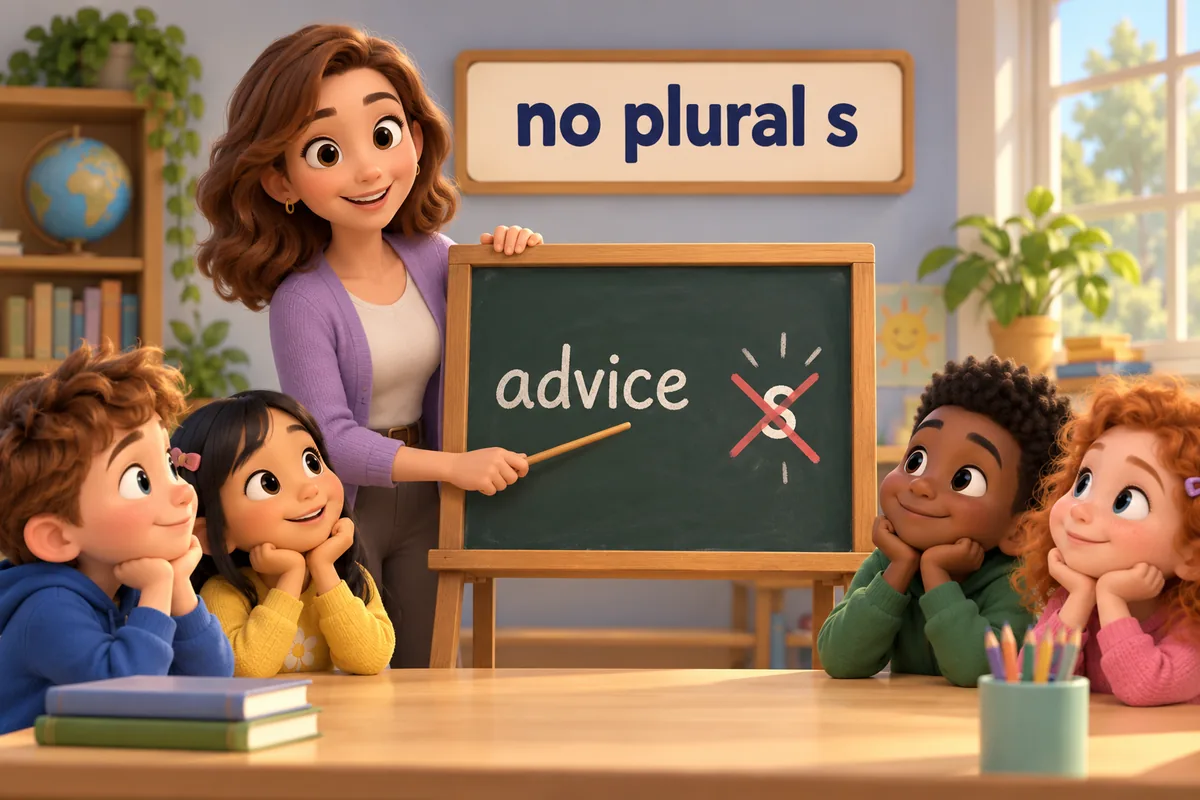
The switch between countable and uncountable is where most errors live. Advice, information and progress never take a plural, so an advice and many informations are wrong, while idea, decision and mistake behave like ordinary countable nouns and freely take a and an s. A reliable habit is to learn each new abstract noun together with its article, recording progress alongside a decision, because the pattern cannot be guessed from the meaning. Register also matters: a formal report prefers the noun form accuracy to the adjective accurate, since the noun turns a quality into a topic the sentence can discuss. When the countability is unclear, a dictionary marks it. A short check helps as well: if the noun names something you cannot photograph, treat it as uncountable until a dictionary tells you otherwise, and record a plural only when the entry clearly allows one. That single habit prevents most of the article mistakes learners make in formal writing, because the wrong article is the error a reader notices first.
Common mistakes with abstract nouns
- Incorrect:
She showed a great kindness to us.Correct: She showed great kindness to us. Rule: uncountable abstract nouns take no a. - Incorrect:
The informations were useful.Correct: The information was useful. Rule: information is uncountable and has no plural. - Incorrect:
He gave me many advices.Correct: He gave me much advice. Rule: advice is uncountable. - Incorrect:
We discussed about the plan.Correct: We discussed the plan. Rule: discuss takes a direct object, not about. - Incorrect:
Her happy was clear.Correct: Her happiness was clear. Rule: use the noun form happiness, not the adjective. - Incorrect:
He made a great progress.Correct: He made great progress. Rule: progress is uncountable and takes no a.
Practice using abstract nouns
- Fill the gap with the noun form: ______ is the best policy. (honest)
- Fill the gap with the noun form: His ______ surprised the nurse. (patient)
- Choose the noun: She values (free / freedom).
- Correct the error: The news were encouraging.
- Build a sentence using success as the subject of the sentence.
- Spot the register: which fits an academic essay, (a) Freedom shapes law, or (b) Freedom is a nice thing?
Answers
- Honesty, because the adjective honest becomes the noun honesty.
- patience, because the adjective patient becomes the noun patience.
- freedom, because the sentence needs the noun form as the object.
- The news was encouraging, because news looks plural but takes a singular verb.
- Success rewards steady effort, because success is the abstract subject of the line.
- (a) Freedom shapes law, because it states an idea with a concrete verb.
The bottom line
Abstract nouns give a name to what cannot be seen, and the group runs from qualities such as honesty to states such as joy. Most are uncountable, so they rarely take a or an and seldom form a plural. Check the ending to find the noun form, and let the surrounding words show the exact sense.
Frequently asked questions about abstract nouns
Is an abstract noun always uncountable?
No. Many are uncountable, as in advice and information, but plenty count normally. Idea, decision and mistake are abstract nouns that take a and form plurals, so countability is learned word by word rather than assumed once and for all.
How do you spot an abstract noun in a sentence?
Ask whether the noun can be seen or touched. If it names a quality, state or idea, such as honesty, sadness or justice, it is abstract rather than concrete. The endings -ness, -ity, -tion and -ment are useful clues to look for.
Can abstract nouns be plural?
Some can. Countable abstract nouns such as idea, hope and decision take plurals, as in two hopes or several decisions. Uncountable ones such as courage and information stay singular, so they never add an s, and the dictionary entry tells you which type a word is.
Do abstract nouns need an article?
Uncountable abstract nouns usually take no article, as in Patience helps or She showed courage. A countable abstract noun follows the normal rules and takes a or the, as in a decision that changed everything or the courage to speak.