
Accolade in a sentence names an award, honour or piece of praise given for achievement, and it also describes the ceremonial tap of a sword on a shoulder. The noun usually follows verbs such as receive, earn or win: “She received an accolade for her research.” It rarely appears as a countable object without a giver.
Accolade at a glance
- Accolade is a noun; the plural is accolades.
- It means an award, honour or expression of praise, and historically a ceremonial touch on the shoulder.
- It usually follows receive, earn, win, deserve or attract.
- The word belongs to formal, journalistic and ceremonial writing rather than casual chat.
- The commonest error is treating accolade as a verb, as in “she was accoladed”.
What does accolade mean?
Accolade is a noun meaning an award, honour or expression of praise given in recognition of achievement. The Cambridge entry for accolade records both the modern sense of praise and the historical sense of a ceremonial touch on the shoulder with a sword. A prize is usually a tangible object or a sum of money, whereas an accolade is the recognition itself.
| Sense | Plain meaning | Example sentence |
|---|---|---|
| Award or honour | A formal mark of recognition | The film won three accolades at the festival. |
| Praise | Public or private commendation | The teacher’s accolade meant more than the medal. |
| Ceremonial dubbing | A light touch with a sword at knighthood | The knight rose after receiving the accolade. |
One limit is worth stating plainly. An accolade is not a synonym for any compliment. It implies an achievement that others judged worthy, so it sounds inflated when applied to ordinary politeness, such as holding open a door.
How do you use accolade in a sentence?
The noun nearly always arrives with a verb of receiving, and the five patterns below cover almost every natural use.
| Pattern | Example | What it signals |
|---|---|---|
| receive / earn / win + accolade | She earned the accolade after years of work. | The standard collocation; the subject deserves it. |
| the highest accolade | The prize is the highest accolade in physics. | Ranks the recognition above others. |
| accolades + for + achievement | He won accolades for his teaching. | Names what the praise is for. |
| heap / shower + accolades + on | Critics heaped accolades on the play. | Describes plentiful public praise. |
| the accolade of + noun | She enjoyed the accolade of a place in the team. | Uses accolade as a countable honour. |

Accolade in a sentence: examples across contexts
The noun shifts slightly in tone depending on who gives it, as the nine examples below show.
| Context | Example sentence | Why this works |
|---|---|---|
| School | Maya earned the accolade of student of the year for her science project. | Shows a concrete school honour. |
| Workplace | The team received an accolade from the director for finishing the audit early. | Names the giver and the reason. |
| Sport | The goalkeeper’s save brought him the accolade of player of the match. | Uses accolade for a single judged moment. |
| Academia | The paper attracted accolades from reviewers across the field. | Places the praise among expert peers. |
| Entertainment | The play collected accolades long before it reached the capital. | Suggests accumulating critical praise. |
| Public life | The highest accolade the city can give is its freedom award. | Ranks a civic honour. |
| This accolade belongs to the whole department, not to me alone. | Deflects credit in professional tone. | |
| News | The scientist accepted the accolade with a short, modest speech. | Reads naturally in a report. |
| Conversation | That compliment was a real accolade from a tough teacher. | Loosens the word for informal praise. |
Accolade vs award
Learners swap these two freely, but the distinction is simple: the award is the thing, and the accolade is the recognition.
| Attribute | Accolade | Award |
|---|---|---|
| Core meaning | Recognition or honour | A formal prize or grant |
| Tangibility | Usually abstract praise | Often a trophy, medal or sum |
| Typical verb | earn, receive, attract | win, present, give |
| Where it appears | Reviews, speeches, journalism | Ceremonies and official records |
| Implied judge | Peers, critics or the public | An organised body |
Choose award for the object handed over on the night, and accolade for the respect it carries. The related noun acclaim is an uncountable mass of public praise, while a trophy is the physical keepsake.
Word forms and grammar of accolade
Accolade is a regular countable noun with no standard verb, and learners sometimes borrow one by mistake.
| Form | Part of speech | Example |
|---|---|---|
| accolade | noun, singular | an accolade for her research |
| accolades | noun, plural | a shelf of accolades |
| accoladed | non-standard verb form | Avoid “she was accoladed”; write “she received an accolade”. |
| honour | noun, near synonym | The honour was announced at assembly. |
| acclaimed | adjective, different root | a widely acclaimed novel |
The plural accolades is common in reviews, where a work collects many separate judgements. Singular accolade suits a single named honour, and the definite article in the accolade of signals that everyone knows which one is meant.
Common mistakes with accolade
Four errors account for most learner sentences, and each comes with the rule that fixes it.
1. Inventing a verb. She was accoladed for her research. She received an accolade for her research. Rule: accolade is a noun, and there is no standard verb to accolade.
2. Using it for routine kindness. He gave me an accolade for holding the door. He thanked me for holding the door. Rule: an accolade marks a real achievement, not ordinary courtesy.
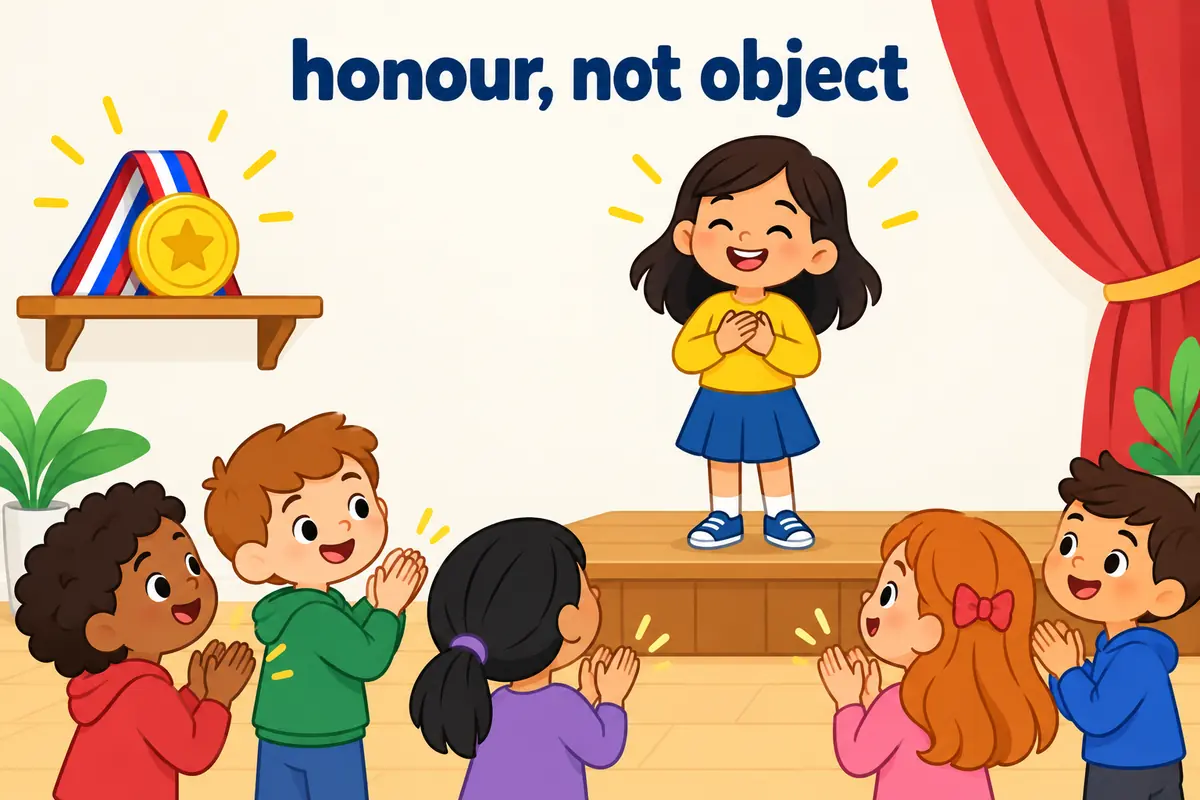
3. Making the accolade the object on the shelf. She kept the accolade in a glass case. She kept the award in a glass case. Rule: the tangible item is an award or trophy; the accolade is the recognition it stands for.
4. Breaking plural agreement. Many accolade were given that evening. Many accolades were given that evening. Rule: the countable plural accolades needs a plural verb, so write “many accolades were given”.
Practice using accolade
- After the concert the young violinist ______ an accolade from the critic.
- The director heaped ______ on the volunteers at the end of the year.
- Choose the better word: the school keeps a ______ trophy in the cabinet. (accolade / award)
- Correct the error: “The whole team was accoladed for its work.”
- Build a sentence using accolade about a science-fair winner.
- Spot the register. Which sentence belongs in a news report? (a) The mayor gave her a big shout-out. (b) The mayor presented the city’s highest accolade.
Answers
- earned — the verb earn is the natural partner of accolade.
- accolades — the countable plural follows the phrase heaped on.
- award — the tangible item in the cabinet is an award, not an accolade.
- The whole team received accolades for its work. — replace the invented verb with a noun phrase.
- Ravi earned the accolade of best project when his model bridge held the most weight. — it names both the honour and the reason.
- (b) — it reports the presentation in neutral, formal wording.
The bottom line
Accolade names the recognition, honour or praise that follows a real achievement, while the award is the object that carries it. Use accolade in a sentence after verbs such as earn, receive or win, and keep the plural accolades for a collection of separate honours. Reserve the word for achievements others judged worthy. For the tangible keepsake, write award or trophy instead.
Frequently asked questions about accolade
Is an accolade the same as an award?
They overlap but are not identical. An accolade is the recognition or honour itself, while an award is often the prize or sum that carries it. A trophy is an award; the respect it represents is the accolade. Use accolade for the recognition and award for the object.
How do you use accolade in the plural?
The plural is accolades, a regular countable form, as in the team gathered accolades across the season. It takes a plural verb, so write accolades were given, not accolades was given. Reviewers often use the plural because a single work collects many separate judgements.
Can accolade be used as a verb?
No, there is no standard verb to accolade. Writers who need a verb choose receive, earn, win or honour instead, as in she was honoured for her research. Invented forms such as accoladed read as errors in formal writing, so keep accolade as a noun.
Does accolade always mean a prize?
No. The word covers praise and honour as well as formal prizes, so a warm review can be an accolade even when no trophy exists. The historical sense, a ceremonial touch with a sword at knighthood, survives in ceremonial writing. Context tells you which sense is meant.
An accolade is a special honor or award given to recognize someone’s achievements or contributions. It serves as a symbol of appreciation and admiration for outstanding performance in various fields such as sports, arts, academics, or professional work.
Receiving an accolade often brings a sense of pride and satisfaction to the recipient, showcasing their hard work and dedication. It is a way for individuals or organizations to highlight excellence and inspire others to strive for similar success.
7 Examples Of Accolade Used In a Sentence For Kids
- Accolade means praise or recognition for doing something well.
- I received an accolade for my good behavior in class.
- Let’s give a big cheer for the student who received an accolade today!
- Everyone clapped and cheered when the teacher presented the accolade.
- When you work hard and do your best, you might earn an accolade too.
- It feels great to receive an accolade for being kind and helpful.
- Congratulations on receiving an accolade for your excellent work in school!
14 Sentences with Accolade Examples
- Accolades are given to students who achieve top marks in their exams.
- Winning an accolade for best project presentation is a great accomplishment.
- It is important for college students to aim for academic accolades.
- Receiving an accolade for outstanding sports performances can boost morale in college.
- Being recognized with an accolade can motivate students to work harder.
- The professor bestowed an accolade upon the student for their exceptional research paper.
- Winning an accolade for leadership skills in college clubs is a prestigious achievement.
- Striving for accolades can encourage healthy competition among students.
- College students should aim for accolades in extracurricular activities as well as academics.
- Achieving accolades can open up opportunities for scholarships and internships.
- Participating in competitions can lead to earning accolades for college students.
- Receiving an accolade for volunteer work shows dedication to giving back to the community.
- Winning an accolade for artistic talents can help students gain recognition in their field.
- It is important for college students to set goals to strive for accolades during their academic journey.
How To Use Accolade in Sentences?
Accolade is a noun that refers to an award, honor, or expression of praise or recognition for one’s achievements or qualities. When using “accolade” in a sentence, it is important to place it correctly to convey the intended meaning.
To use “accolade” in a sentence, start by identifying the accomplishment or quality being recognized. For example, “She received an accolade for her outstanding performance in the competition.”
Remember to place “accolade” early in the sentence to clearly show what is being acknowledged. Avoid using overly complex sentences to ensure clarity in conveying the recognition being received.
Consider how to incorporate synonyms for “accolade,” such as award, honor, tribute, or recognition, to add variety to your writing. For instance, “The artist’s latest masterpiece earned her another well-deserved accolade.”
To practice using “accolade” effectively in sentences, engage in writing exercises where you create sentences that highlight different achievements or qualities deserving of recognition. This will help you become more comfortable and confident in incorporating “accolade” in your writing.
Overall, incorporating “accolade” in sentences involves identifying achievements or qualities deserving of recognition and placing the word appropriately within the sentence structure to convey praise or honor accurately.
Conclusion
In conclusion, accolades are valuable recognitions or awards that highlight outstanding achievements or qualities. They serve as commendations for excellence in various fields, such as sports, academics, and arts. Examples of accolades include trophies, certificates, and medals, which are symbols of accomplishment and success. Receiving accolades can boost confidence, motivation, and provide a sense of validation for one’s efforts and hard work.
It is important to acknowledge and celebrate accolades, as they not only honor individual achievements but also inspire others to strive for greatness. Whether a simple recognition or a prestigious award, accolades serve as reminders of dedication, talent, and perseverance, encouraging continuous growth and excellence in diverse aspects of life.


