
Ache in a sentence can be a noun describing discomfort, as in “I felt an ache in my shoulder,” or a verb, as in “My shoulders ache.” The word also describes emotional pain or strong longing: “She ached for home.” Choose a complete noun or verb pattern and make the intended meaning clear.
Ache at a glance
- Ache works as both a noun and an intransitive verb.
- The noun commonly describes a dull, continuing pain.
- The verb forms are aches, ached, and aching.
- Drop the final e before adding -ing: ache becomes aching.
- Ache for and ache to can express longing rather than bodily pain.

What does ache mean?
Ache commonly names or describes a dull, persistent discomfort. Figurative use can express sadness, compassion, or yearning. The sentence should help readers distinguish those meanings: “Her ankle ached” describes physical discomfort, while “She ached to return to the village” describes a strong desire.
Merriam-Webster’s ache entry documents the noun and verb, including pain and yearning, and gives the forms ached and aching. The sentences below are original language examples. Describing a sensation with a word does not explain its medical cause or establish how it should be treated.
| Pattern | Original sentence | Role and meaning |
|---|---|---|
| An ache in + body part | Jules noticed an ache in his wrist. | Noun describing discomfort |
| Body part + aches | My wrist aches this evening. | Present-tense verb |
| Body part + ached | Her feet ached at the end of the walk. | Past-tense verb |
| Ache for + noun | He ached for the familiar voices of home. | Longing for something |
| Ache to + verb | They ached to see their family again. | Longing to do something |
How do you use ache as a noun?
Use a determiner with singular countable ache: “an ache,” “the ache,” or “this ache.” Because ache begins with a vowel sound, the indefinite article is an. “I noticed an ache” is complete; “I noticed a ache” uses the wrong article.
- “An ache in her shoulder interrupted her concentration.”
- “The ache remained noticeable through the afternoon.”
- “He described a dull ache near his elbow.”
- “She spoke about the ache of missing her friends.”
- “The narrator uses an ache as an image of homesickness.”
Dull modifies ache in “a dull ache,” so the article becomes a, following the sound of dull. The choice depends on the next spoken word, rather than always on the noun at the end of the phrase. Compare “an ache” with “a persistent ache.”
Use plural aches when naming multiple sensations or the broad phrase “aches and pains.” Plural nouns do not take an: write “She described several aches.” Add a location when that distinction helps the sentence, rather than relying on an unexplained “ache” to carry the whole scene.
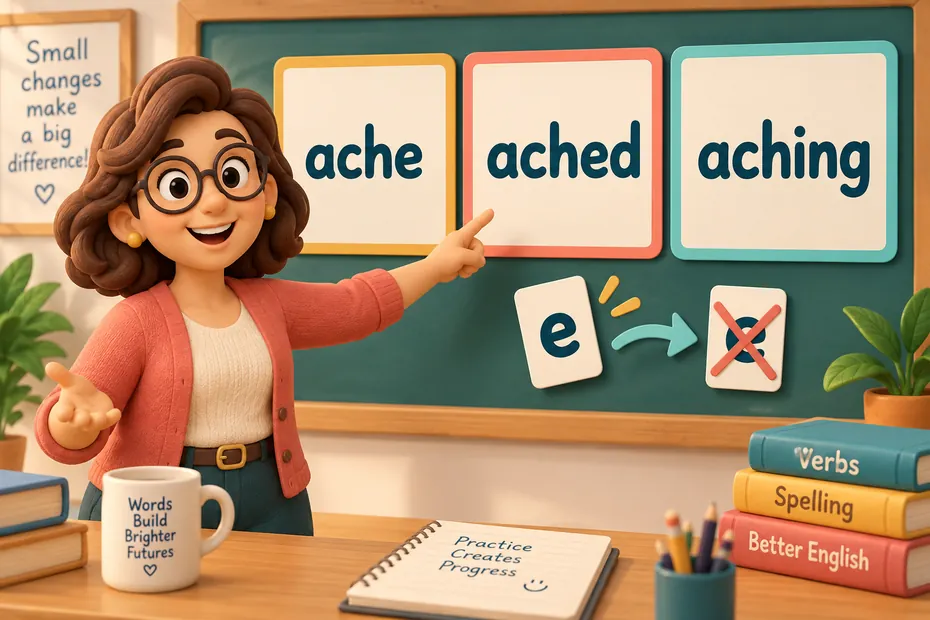
Ache as a verb: agreement and spelling
The verb ache normally describes what the subject experiences and does not take a direct object. Write “My knees ache,” rather than “My knees ache me.” If you need a different construction, use “I have an ache in my knees” or “My knees hurt.”
Match the present-tense verb to the subject. A singular body part takes aches: “My shoulder aches.” A plural takes ache: “My shoulders ache.” I and you also take the base form: “I ache all over” and “You ache after the long rehearsal” are grammatically consistent patterns.
The past tense is ached. The present participle is aching, formed by dropping the silent final e. Use an auxiliary when the participle carries the main ongoing action: “My shoulder is aching.” In “an aching shoulder,” the same form describes the noun rather than forming a complete clause.

How do ache for and ache to differ?
Use ache for before a noun phrase and ache to before a base-form verb. “She ached for a quiet evening” names the desired thing. “She ached to spend an evening alone” names the desired action. Both express an intense longing in this context.
Context matters with heart. “My heart aches for the displaced families” conventionally expresses compassion. In a real account of bodily symptoms, however, a writer should describe the physical sensation directly rather than expecting readers to distinguish it from metaphor. Figurative vocabulary should not obscure what the speaker means.
Complete sentences and clearer descriptions
Several older examples below are phrases, such as “The ache in my back from sitting.” A phrase can serve as a note or label, but a complete sentence needs a finite verb: “The ache in my back distracted me” or “My back ached.” Add the missing verb before treating the phrase as a sentence model.
The older collection also mentions foods, water, rest, medicine, and massage. Those are language examples, not general evidence about causes or reliable treatments. For a vocabulary exercise, describe an observation without promising a remedy: “The ache eased later” reports a change without claiming why it happened.
Frequently asked questions about ache
Is ache pronounced like “aitch”?
No. Ache sounds like “ake” and rhymes with cake. The written ch represents a k sound in this word. The noun and verb share that pronunciation, so listening to “an ache” and “my arms ache” will not identify the grammatical role by sound alone.
Is ache always physical?
No. “The empty room left an ache of loneliness” describes emotion, while “She ached to hear his voice” describes yearning. Physical examples usually identify a body part or bodily sensation. Figurative examples identify an emotion, desired experience, or relationship, allowing the reader to recognize the intended sense.
What is the difference between ache and aching?
Ache is the base verb or a noun; aching is the participle and can also describe a noun. Compare “My legs ache,” “My legs are aching,” and “My aching legs slowed me down.” Choose a complete pattern rather than writing the fragment “My legs aching” as a standalone sentence.
How can I check my example quickly?
Identify whether ache names a sensation or describes a subject’s experience. Then check the article, subject agreement, and any auxiliary verb. To use ache in a sentence clearly, name the physical location or the emotional context and avoid adding unsupported claims about what caused or cured the discomfort.
Have you ever experienced a persistent discomfort or distress in your body that made you feel uneasy? This sensation, known as an ache, is often described as a dull, continuous pain that can range from mild to severe.
Aches can manifest in various parts of the body, such as muscles, joints, or even internal organs, and they can be caused by a myriad of factors including injury, illness, or overexertion. It’s important to address aches promptly to prevent them from escalating into more serious issues.
7 Examples Of Ache Used In a Sentence For Kids
- My head aches when I have too much chocolate.
- Ache goes away when I drink water and rest.
- Sometimes, my tummy aches after eating too much ice cream.
- I feel better after taking medicine for my ache.
- It’s important to tell a grown-up if you have an ache.
- Brushing your teeth can help prevent tooth aches.
- Massage can help soothe a muscle ache.
14 Sentences with Ache Examples
- Ache in the shoulder from carrying heavy college bags all day.
- The ache in my head after pulling an all-nighter to finish my assignment.
- Ache in my fingers from typing non-stop during exam season.
- The ache in my back from sitting hunched over my books for hours.
- The ache in my stomach from eating too much junk food during late-night study sessions.
- Ache in my legs from climbing multiple flights of stairs to reach my classroom.
- The ache in my eyes from staring at my laptop screen for too long.
- The ache in my throat from speaking too loudly during college fests.
- Ache in my brain from trying to memorize countless formulas and theories.
- The ache in my ears from attending back-to-back lectures in noisy classrooms.
- Ache in my neck from constantly looking down at my phone.
- The ache in my wallet from buying expensive textbooks and study materials.
- Ache in my heart from missing out on fun events and parties due to academic commitments.
- The ache in my legs from standing in long queues during registration and exam time.
How To Use Ache in Sentences?
To use “Ache” in a sentence, follow these steps:
First, identify the emotion or physical sensation you want to convey. “Ache” typically relates to a dull, persistent pain or longing.
Second, choose a subject to describe who is experiencing the ache, such as a person, animal, or even an inanimate object.
Next, select a verb that accurately portrays the action associated with the ache. Common verbs include “feeling,” “experiencing,” or “sensing.”
After that, add any additional details to enhance the sentence, such as the location of the ache, the intensity, or the cause.
For example, you can say, “She was aching for her lost childhood memories,” to convey a deep longing for past experiences.
Alternatively, you could use, “My muscles are aching after the intense workout,” to describe physical discomfort.
Remember to ensure that the sentence flows smoothly and clearly conveys the desired meaning. Experiment with different sentence structures and variations to find the best way to use “Ache” in your writing.
Conclusion
In conclusion, the various examples of sentences using the keyword “ache” demonstrate its versatility in describing different types of physical or emotional discomfort. These sentences highlight how an ache can manifest in various parts of the body, such as the head, back, or heart, indicating different levels of pain and distress. From a dull ache to a sharp, piercing sensation, these sentences capture the range of experiences that can be associated with this common term.
By examining these sentences, one can gain a deeper understanding of the nuanced ways in which an ache can be described and felt. Whether it is a chronic ache or a sudden onset of pain, the word “ache” serves as a simple yet powerful descriptor for the discomfort that individuals may experience in their daily lives.