Act Out in a Sentence: Meaning, Examples & Practice
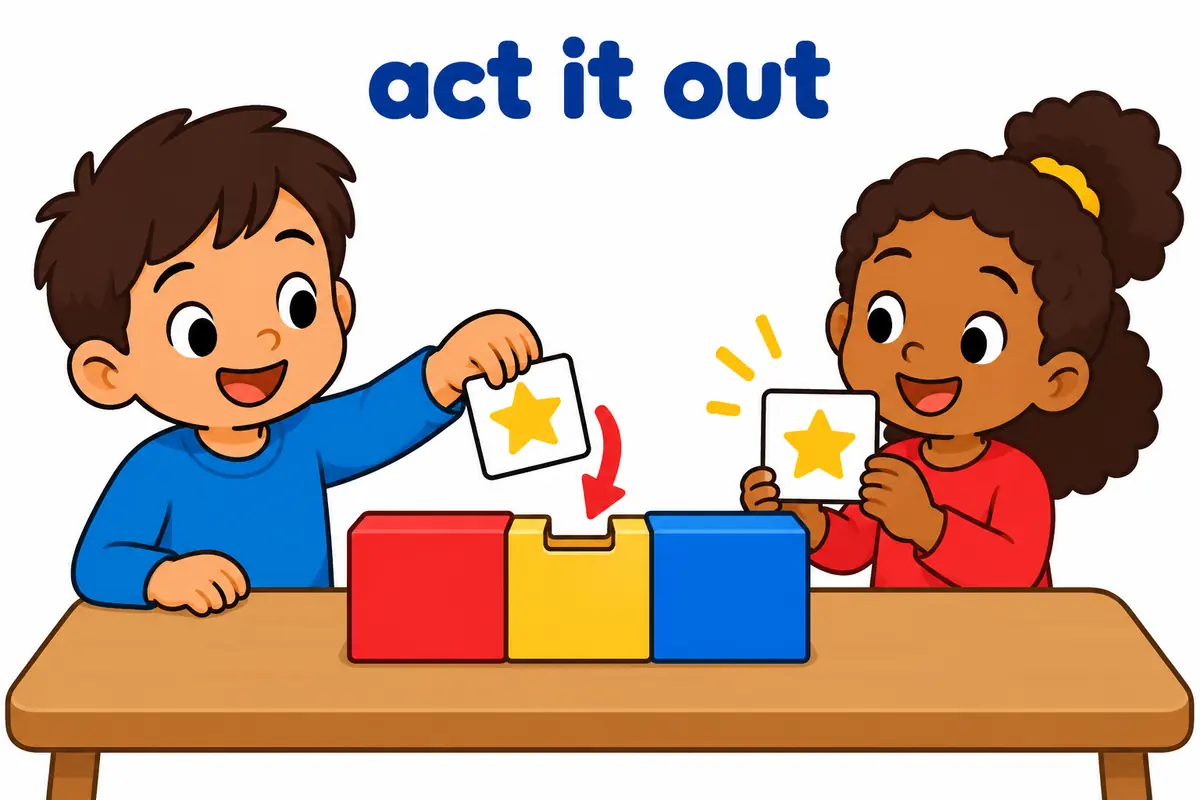
Act out means to perform a scene or story through movement and speech, or to show a feeling through behaviour instead of words. In a sentence it works as a separable phrasal verb, so a pronoun sits inside it: the class acted out the chapter, then acted it out again.
Act out at a glance
- Act out is a separable phrasal verb; its forms are acts out, acted out and acting out.
- The performance sense is transitive, so it takes an object such as a scene, a story or a word.
- The behavioural sense often has no object, as in the tired child acted out.
- The register spans classrooms and child development; the behavioural sense is largely informal.
- The commonest error is putting a pronoun after out, as in act out it.
What does act out mean?
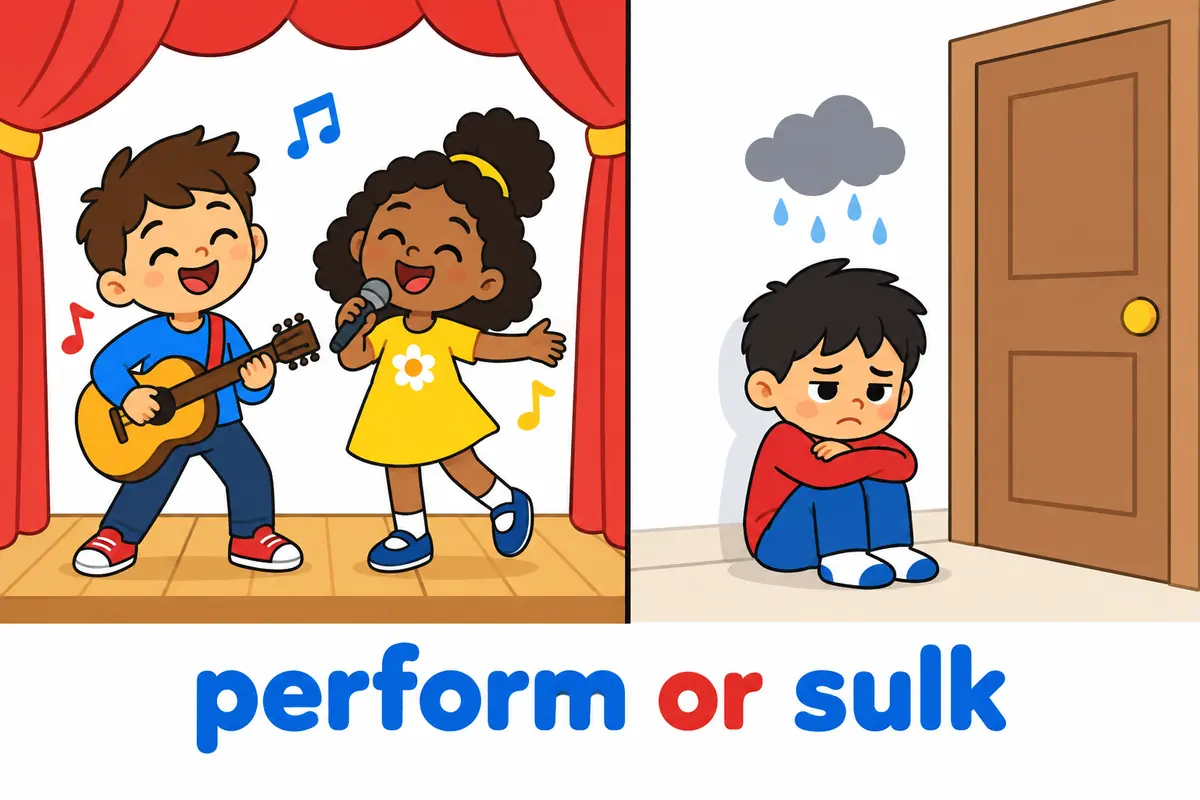
Act out is a phrasal verb meaning to perform something through action, or to release a feeling through behaviour rather than speech. The Cambridge entry for act out records both the dramatic sense and the psychological one, and the two rarely mix in a single sentence. The dramatic sense has a clear object, while the behavioural sense often describes a person with no object at all. Where the emphasis is on words rather than movement, express anger is the nearer verb.
| Sense | Plain meaning | Example sentence |
|---|---|---|
| Perform a scene | Act a story, role or idea aloud | The class acted out the last chapter. |
| Express through action | Show a feeling by behaving rather than speaking | He acted out his frustration at the door. |
| Behave badly | Misbehave as a way of releasing distress | The tired child acted out during the trip. |
One limitation is worth stating plainly. Act out is not a gentle synonym for explain or describe, because it always involves visible action. In the behavioural sense it also carries a judgement, so it should not be used for ordinary mistakes. A child who forgets a book has not acted out; only repeated misbehaviour that expresses a feeling earns the phrase. A child who can name a feeling will often behave well without acting out at all.
How do you use act out in a sentence?
Decide first whether the sentence is about a performance or about behaviour, then apply the separability rule. Five patterns cover almost every real sentence, and the position of a pronoun is the part that marks a careful writer.
| Pattern | Example | What it signals |
|---|---|---|
| act out + noun | The class acted out the final scene. | The commonest separable order. |
| act + noun + out | The class acted the final scene out. | The other allowed separable order. |
| act + pronoun + out | The class acted it out twice. | A pronoun must sit between act and out. |
| act out + feeling | He acted out his frustration on the door. | The expressive sense with an object. |
| act out (no object) | The tired child was acting out in class. | The behavioural sense, usually intransitive. |
The practitioner rule is simple: a full noun can go on either side of out, but a pronoun must go in the middle. Writers say act it out and never act out it. The behavioural sense usually drops the object entirely, which is why acting out reads as a description of a person rather than of a task.
Act out in a sentence: examples across contexts
Act out shifts register more than meaning, because a classroom prompt and a psychologist note use the same words. The ten sentences below keep the phrasal verb while moving the setting, and each one shows what is being acted or expressed.
| Context | Example sentence | Why this works |
|---|---|---|
| Classroom | In pairs, act out the conversation in the book. | An instruction that suits a lesson task. |
| Classroom | The children acted out the water cycle with scarves. | A concrete prop makes an abstract process visible. |
| Language teaching | Learners mime the action, then act out the dialogue before reading it. | Shows rehearsal as a teaching technique. |
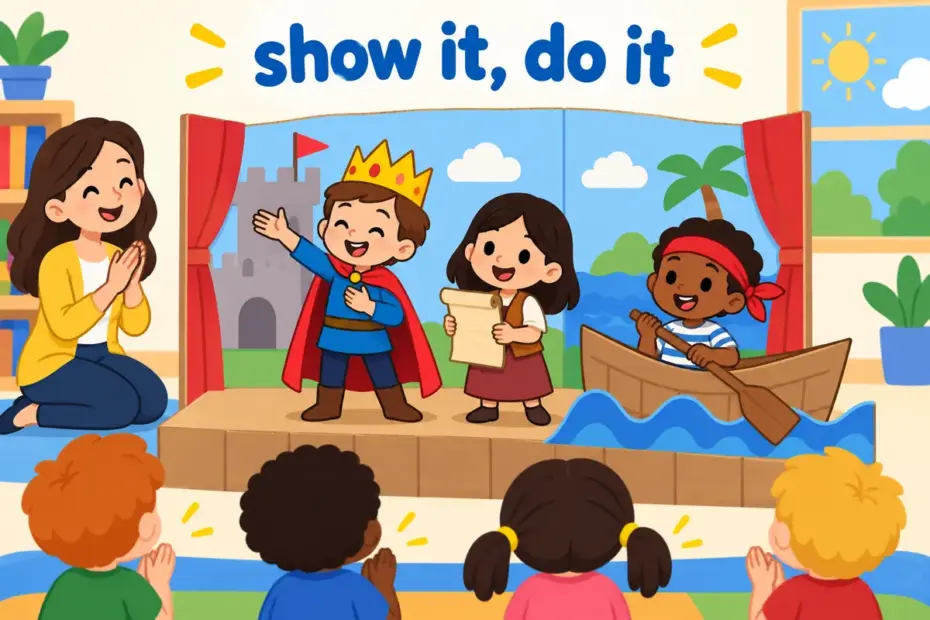
| Drama club | They acted out the trial in front of the school. | Names both the scene and its audience. |
| Child development | Toddlers often act out a story they cannot yet tell. | The no-object behavioural sense in context. |
| Parenting advice | A child may act out when the routine changes. | Links the behaviour to a hidden cause. |
| News report | Protesters acted out the scene outside the court. | Uses the performance sense for a public gesture. |
| Academic writing | The study asked pupils to act out a conflict, then discuss it. | Turns performance into a research method. |
| Workplace training | New staff acted out a difficult customer call. | Role-play as job preparation. |
| Conversation | He acted it out for us at dinner, hand gestures and all. | A pronoun sits mid-verb in informal speech. |
Notice that the two child-development rows use no object, while every classroom row names one. That split is the quickest test of which sense a writer intends.
Act out vs dramatize, enact and perform
Act out overlaps with three verbs and is the most physical of them. dramatize a story turns it into drama on the page; enact a scene has a formal, literary tone; to perform the play means to present it to an audience.
| Attribute | act out | dramatize | perform |
|---|---|---|---|
| Core action | Show something by moving and speaking | Present something as drama | Present a work to others |
| Needs an audience | Not necessarily | Not necessarily | Usually yes |
| Separable | Yes, with a pronoun inside | No | No |
| Extra implication | May also mean misbehaviour | May mean exaggeration | Implies skill and rehearsal |
| Register | Everyday to academic | Neutral to formal | Formal and artistic |
Verdict: choose act out for hands-on role-play, dramatize when a text is adapted into drama, and perform when an audience is watching. Only act out carries the second, behavioural sense, so a sentence about a restless toddler can use it and nothing else on this list.
Word forms and grammar of act out
Act out keeps the regular verb act and adds a particle that may separate. The table lists the inflected forms and marks the word order that learners wrongly produce, along with the noun use of the gerund.
| Form | Part of speech | Example |
|---|---|---|
| act out | phrasal verb, base form | The group will act out the poem. |
| acts out | phrasal verb, third person singular | She acts out every scene she writes. |
| acted out | phrasal verb, past and past participle | They acted out the story for the class. |
| acting out | participle and noun | Acting out is common when children are anxious. |
| act out it | non-standard order | Write act it out, never act out it. |
Keep the noun use of acting out for the behavioural sense and the verb for the performance sense, because the two appear in different kinds of writing. The same particle also builds other phrasal verbs such as back out, which is worth noting when the meaning seems unrelated.
Common mistakes with act out
- Incorrect:
The children acted out it for the class.Correct: The children acted it out for the class. Rule: A pronoun must sit between act and the particle out. - Incorrect:
He acted out of his anger by slamming the door.Correct: He acted out his anger by slamming the door. Rule: Act out takes the feeling as an object; out of means because of and is a different phrase. - Incorrect:
She acted out to the teacher when the lesson was hard.Correct: She acted out in class when the lesson was hard. Rule: The behavioural sense is intransitive, so it takes no object and no to. - Incorrect:
We will dramatize out the scene.Correct: We will act out the scene. Rule: Only act out takes the particle; dramatize is a single-word verb. - Incorrect:
The class acted the final scene out it.Correct: The class acted it out. Rule: The object is named once, in the middle position, not twice.
Practice using act out
Work through the seven items, then check the reasoning rather than only the answer.
- Fill the gap: In pairs, ______ the dialogue at the front of the room.
- Choose the better word: The actors will (act out / perform) the play for a paying audience.
- Correct the error: The twins acted out it with puppets.
- Build a sentence: use act + pronoun + out about a student retelling a story with gestures.
- Spot the register: which belongs in a psychologist note — the child was acting out at home, or the kid was kicking off at home?
- Rewrite separably: The group acted out the scene. Put the object after act.
- Distinguish senses: write one sentence using act out to mean perform, and one to mean misbehave.
Answers
- act out — a teacher gives an instruction with the base form, and the dialogue is the object.
- perform — a paying audience and a written work suit perform rather than the more informal act out.
- The twins acted it out with puppets — a pronoun must sit between act and out.
- Model answer: She acted the ending out with her hands and a happy face.
- The child was acting out at home — a note keeps the standard phrase; kicking off is too casual.
- The group acted the scene out — the noun object may sit after act, before the particle.
- Perform: The class acted out the poem. Misbehave: The bored child acted out all afternoon.
The bottom line
Use act out in a sentence for a hands-on performance or for behaviour that expresses a feeling, and remember that it is separable. The two nuances that settle most sentences are these: a full noun may sit on either side of out, but a pronoun must go in the middle, and only the behavioural sense works without an object. When a real audience and a script are involved, perform or enact is the sharper choice.
Frequently asked questions about act out
Is act out separable?
Yes. A noun object can go on either side, so both act out the scene and act the scene out are correct, although the first is commoner. A pronoun must sit between act and out, giving act it out. The passive also keeps the particle together, as in the scene was acted out by the class.
What does act out mean for children?
For children, act out usually describes behaviour, not drama. It means showing a strong feeling through actions, often misbehaving, when a child cannot put the feeling into words. A tired or anxious child may act out at home or in class. Professionals treat it as communication rather than simple naughtiness, which is why the phrase appears in child-development writing.
What is the difference between act out and act up?
Act up means to malfunction or to behave badly in a general way, as in the car acted up or the class acted up. Act out is narrower and ties the behaviour to an unspoken feeling, and it has a second, dramatic sense. A machine can act up but never acts out, which is a useful test.
Can act out be used without an object?
Yes, in the behavioural sense. Sentences such as the toddler acted out all morning have no object, because the point is the child rather than a scene. The performance sense normally needs an object such as a story, a scene or a word. If no object is present and no performance is meant, the sentence is describing behaviour.