Adjectives for Grief: Words for Loss and Sadness
An adjective for grief names the quality, intensity, or expression of sorrow, such as profound, raw, quiet, or enduring. Choose a word that fits the person and context rather than implying a fixed timeline: grief varies between people and losses, and an adjective describes an experience without diagnosing it.
Key facts at a glance
- Adjectives can describe grief’s intensity, texture, duration, or shared setting.
- Raw, profound, and lingering describe different qualities rather than ranked stages.
- Grief-stricken and bereaved usually describe a person, not grief itself.
- Grief can follow many meaningful losses; it does not look identical for everyone.
- Choose language that reflects what someone says about their own experience.
What adjectives describe grief?
Useful adjectives identify a specific quality of sorrow instead of treating grief as one uniform feeling. The Cambridge Dictionary defines grief as great sadness, especially after a death, while the American Psychological Association notes that grief and mourning are related but distinct responses to loss. These words can describe death-related grief or sorrow after another significant loss.
Intensity: deep, profound, overwhelming, acute, crushing, and searing. “The family carried a profound grief” communicates depth; “acute grief” sounds more formal and can suggest a particularly sharp experience.
Texture or expression: raw, quiet, private, numb, aching, and disorienting. A writer might describe “raw grief” soon after a loss, or “quiet grief” when sorrow is present without outward display. “Numb with grief” is often more natural than “numb grief.”
Duration or context: fresh, lingering, enduring, sudden, collective, and anticipatory. These terms add context: “collective grief” belongs to a community, while “anticipatory grief” refers to sorrow before an expected loss. They are descriptions, not a schedule or diagnosis.
People experiencing loss: grief-stricken, bereaved, heartbroken, sorrowful, and inconsolable. Use them carefully. “The bereaved neighbors gathered” identifies people after a death; “heartbroken” conveys intense sadness but is more personal and expressive.
How do you choose the right word?
Start with the detail you can support: intensity, outward expression, duration, or who shares the loss. “The city mourned a sudden loss” is more precise than “the city felt bad.” If the sentence is about a person, choose a person-describing adjective; if it is about grief, choose a word that modifies the noun naturally.
| Adjective | What it emphasizes | Example phrase |
|---|---|---|
| raw | Immediate, sharply felt sorrow | raw grief after the funeral |
| profound | Great depth or significance | a profound sense of loss |
| quiet | Private or less visible expression | quiet grief during the anniversary |
| lingering | Sorrow that remains over time | lingering grief around familiar places |
| collective | A loss felt by a group | collective grief across the town |
| anticipatory | Sorrow before an expected loss | anticipatory grief during a long illness |

Examples of adjectives for grief in sentences
- Her raw grief made the first family gathering especially difficult.
- The community expressed collective grief after the local coach died.
- He described an aching sorrow that returned whenever he visited the garden.
- The letter acknowledged the family’s profound loss without trying to explain it away.
- Quiet grief can be easy to miss when a person keeps up with daily routines.
- The bereaved neighbors accepted practical help while making their own arrangements.
- She felt anticipatory grief as the family prepared for a likely farewell.
- His lingering sadness did not mean that every day felt the same.

Grief, sorrow, bereavement, and mourning
Grief names the emotional response to a significant loss; sorrow is a broader word for sadness. Bereavement refers especially to the state of having lost someone through death, while mourning often describes the outward, personal, cultural, or communal ways people express loss. The distinctions help a sentence name whether it focuses on feeling, circumstance, or expression.
Avoid turning adjectives into a checklist. The APA explains that people’s responses to loss vary, and grief is not a simple sequence everyone follows. Words such as complicated may have specialized clinical uses in some contexts; in everyday writing, do not use a diagnosis to describe another person based on a brief observation.
Frequently asked questions about adjectives for grief
What is the strongest adjective for grief?
Overwhelming, devastating, or profound can express intense grief, but no single word is strongest for every person or situation. Choose a term that reflects what the person describes or what the scene shows. “Profound” is measured; “devastating” communicates severe impact.
Is “grief” an adjective?
No. Grief is a noun naming sorrow or distress after a loss. An adjective can describe the noun, as in “deep grief,” or describe someone affected by it, as in “a grief-stricken family.” Grieving is a participle commonly used adjectivally, as in “grieving relatives.”
What adjective describes a person experiencing grief?
Bereaved usually describes someone who has lost a loved one through death, while grief-stricken emphasizes intense sorrow. Heartbroken is more conversational. Ask what wording a person prefers when possible, because a label should not presume how they feel or how they want others to speak about them.
Can grief be described as “healthy” or “unhealthy”?
Those labels can oversimplify a deeply personal response. A sentence can describe observable feelings or circumstances without judging someone’s grief as correct or incorrect. If a person is worried about distress, functioning, or safety, encourage support from a qualified professional rather than using an adjective as an assessment.
Choosing grief language with care
Adjectives for grief should clarify a feeling, not set a standard for how quickly someone should recover. People respond to loss in different ways and at different times; a word such as raw, quiet, or lingering is most useful when it reflects the person’s own description.
Grief is a difficult emotion to describe, and often the words we use to talk about it fall short. That’s why we’ve compiled this list of adjectives for grief.
Whether you’re looking for a word to describe your own experience of grief or you’re trying to find the perfect way to express your condolences, we hope you’ll find the right adjective on this list. From “heartbreaking” to “harrowing,” these words capture the many different facets of grief. We hope they’ll help you find the perfect way to express yourself.
How to describe Grief With Adjectives: A Comprehensive Guide
A
The adjective for grief that starts with A is “apocalyptic.” The word comes from the Greek apokalupsis, meaning “a lifting of the veil,” and is used to describe something that is so terrible it heralds an end to the world. One example is when Jesus predicts the coming of the Antichrist, an event that heralds the end of the world.
A new adjective for grief has been created by a linguistics professor at the University of Utah. The professor, Rachel Simmons, has named the new adjective “archetypal.” Archetypal refers to the idea that there are universal patterns or models that underlie our experiences. Simmons says that the new adjective is needed because there is no word in English that accurately describes the emotional response to a death.
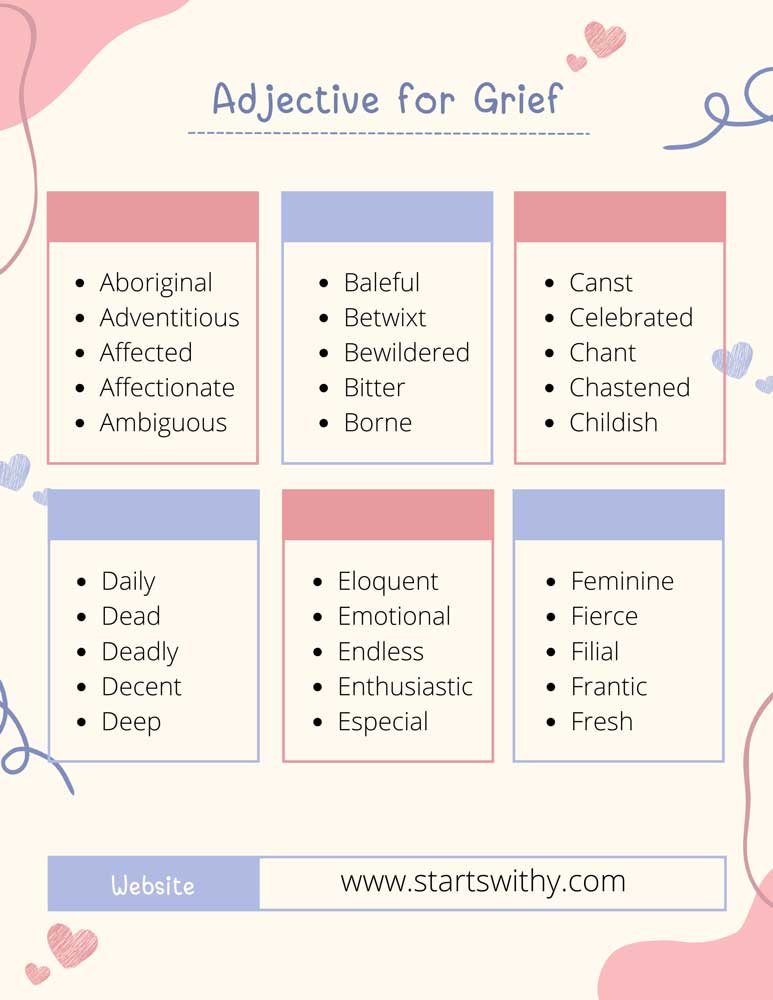
| Aboriginal | Adventitious | Affected |
| Affectionate | Agonising | Ambiguous |
| Angry | Anxious | Apparent |
| Arbitrary | Audible | Augmenteth |
| Awful |
B
| Baleful | Betwixt | Bewildered |
| Bitter | Black | Borne |
| Baleful | Betwixt | Bewildered |
| Bitter | Black | Borne |
C
| Calmher | Canst | Celebrated |
| Chant | Chastened | Childish |
| Chilly | Chronic | Clamorous |
| Cloudy | Collective | Complex |
| Complicated | Conjugal | Conscious |
| Constant | Continual | Continued |
| Counterfeit | Cruel | Cureless |
| Curious |
D
| Daily | Dead | Deadly |
| Decent | Deep | Deepened |
| Defiant | Despairing | Desperate |
| Devastating | Devilish | Devouring |
| Difficult | Direst | Divided |
| Divine | Domestic | Dreadful |
| Dull | Dumb |
E
| Earthly | Easie | Easy |
| Eerie | Eloquent | Emotional |
| Endless | Enthusiastic | Especial |
| Eternal | Evident | Exceptional |
| Excessive | Expel | Explosive |
| Exquisite | Extravagant | Extreme |
F
| Faint | Faithful | Fancied |
| Fatal | Female | Feminine |
| Fierce | Filial | Frantic |
| Fresh | Frightful | Frothy |
| Fruitless |
G
| Generous | Genuine | Gloomy |
| Greater | Grey | Grim |
H
| Happy | Hard | Headlong |
| Hearted | Heartfelt | Heavy |
| Helpless | Heroic | Hidden |
| Holy | Hopeful | Hopeless |
| Human | Humble | Hypocritic |
I
| Idle | Imaginary | Immeasurable |
| Immoderate | Immortal | Impending |
| Impetuous | Impious | Incommunicable |
| Incomparable | Inconsolable | Incredible |
| Incurable | Indignant | Individual |
| Inexplicable | Inexpressible | Inferior |
| Infinite | Innumerable | Instant |
| Intense | Internal | International |
| Intimate | Intolerable | Inward |
J | K | L
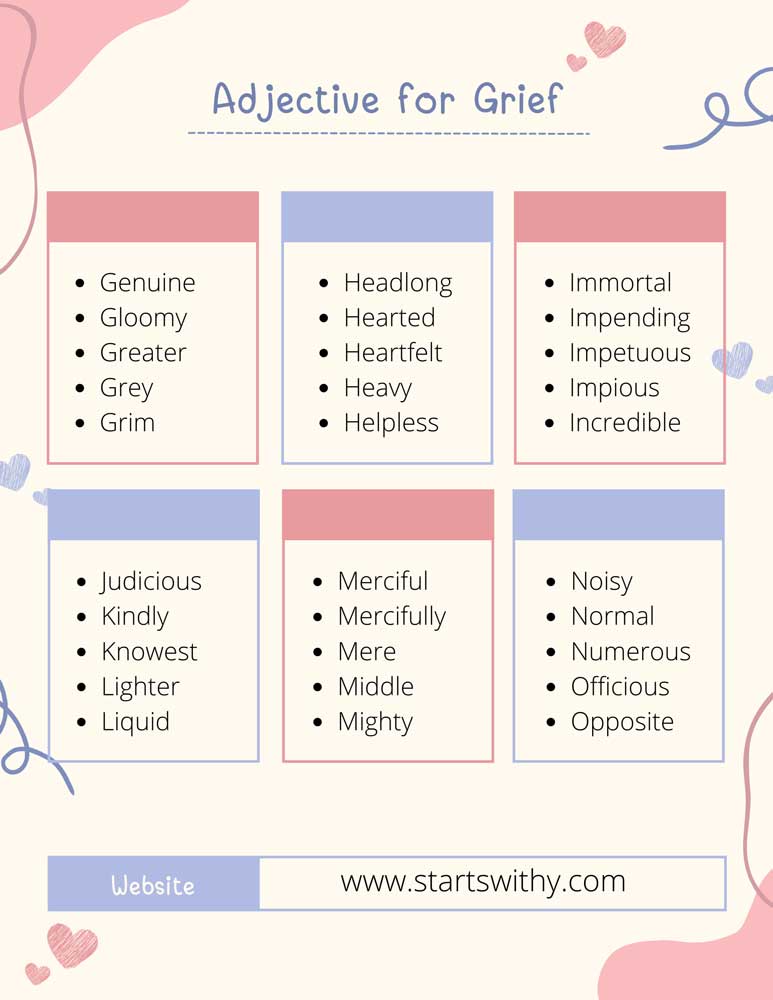
| Jaunty | Judicious | Justest |
| Keen | Kindly | Knowest |
| Lighter | Liquid | Livelier |
| Lonely |
M
| Majestic | Male | Maternal |
| Measureless | Mental | Merciful |
| Mercifully | Mere | Middle |
| Mighty | Mingled | Modest |
| Morbid | Mortal | Mutual |
N | O
| Narrow | Natural | Noble |
| Noisest | Noisy | Normal |
| Numerous | Officious | Opposite |
| Ordinary | Overwhelming |
P
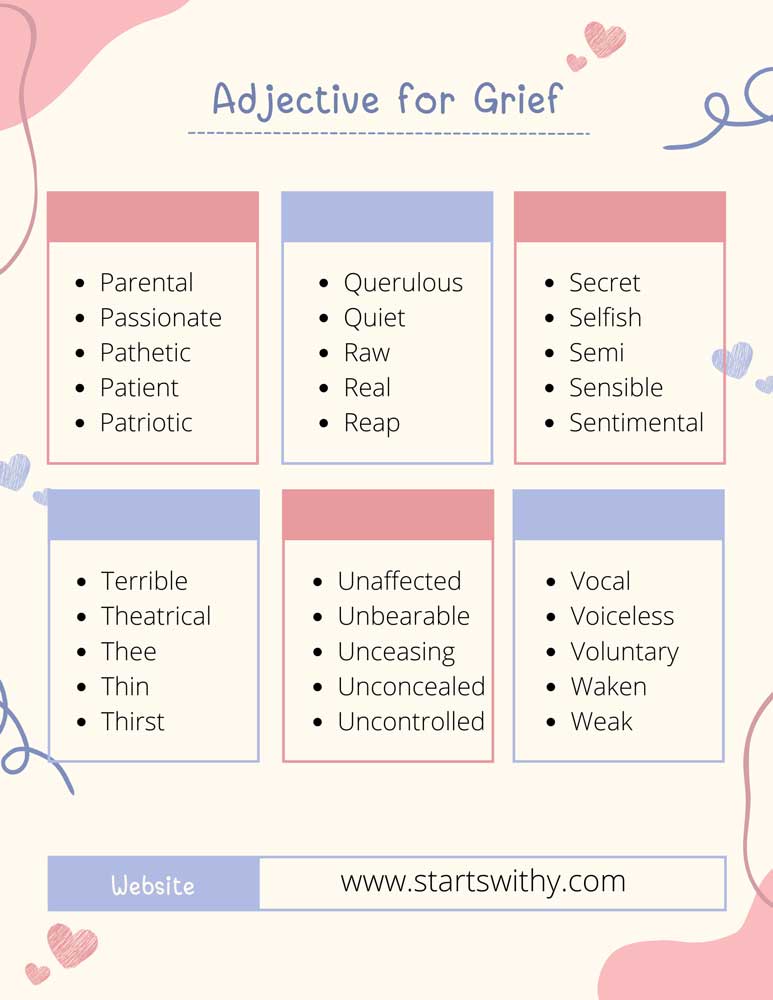
| Painful | Parental | Passionate |
| Pathetic | Patient | Patriotic |
| Perfect | Pet | Petty |
| Petulant | Pious | Piteous |
| Pitiful | Placid | Poignant |
| Poor | Popular | Potential |
| Premature | Present | Principal |
| Profound | Prolonged | Proper |
| Pure |
Q | R
| Querulous | Quiet | Raw |
| Real | Reap | Reasonable |
| Refined | Regretsmy | Remorseful |
S
| Sacred | Sad | Saddest |
| Secret | Selfish | Semi |
| Sensible | Sentimental | Sham |
| Sharp | Sheer | Short |
| Sighing | Silent | Simple |
| Sincere | Smothered | Soothed |
| Sore | Spare | Spontaneous |
| Stern | Stormy | Strange |
| Stunned | Subsequent | Sudden |
| Suicidal | Sullen | Sundry |
| Supreme | Sympathetic |
T
| Tearful | Tearless | Tempestuous |
| Tender | Terrible | Theatrical |
| Thee | Thin | Thirst |
| Thirsty | Touching | Transitory |
| Traumatic | Travail | Tribal |
| Trifling | Troubled | Twas |
U
| Unaffected | Unbearable | Unceasing |
| Unconcealed | Uncontrollable | Uncontrolled |
| Unfeigned | Unfounded | Ungovernable |
| Ungoverned | Unimaginable | Unimpassioned |
| Universal | Unknown | Unmeasurable |
| Unmingled | Unnecessary | Unresolved |
| Unseen | Unsharable | Unspeakable |
| Unspoken | Unthinking | Unusual |
| Unutterable | Useless | Utmost |
| Utter |
V
| Vague | Vain | Vast |
| Violent | Visible | Vocal |
| Voiceless | Voluntary |
W | Y
| Waken | Weak | Weary |
| Weighty | Wicked | Wild |
| Wilful | Withering | Word |
| Wretched | Wrong | Youthful |
Final verdict
In conclusion, grief is a powerful emotion that can take over a person’s life. It is important to have a support system to help you through the tough times. Don’t be afraid to ask for help when you need it. Seek out counseling if you feel like you are struggling to cope with your grief. There is no wrong way to grieve, as long as you are grieving in a healthy way. Remember, the only way to heal is to allow yourself to feel the pain.
A note on individual experiences
Grief has no single required pattern or timetable. Descriptive words can make a sentence more specific, but they cannot decide whether another person is grieving in a “healthy” way; individual responses and support needs vary.