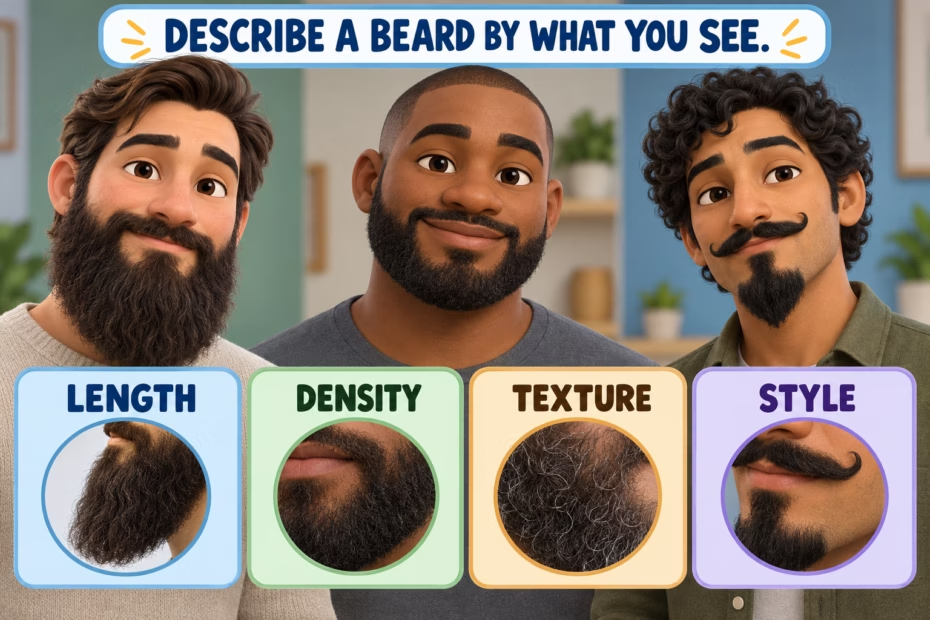
Adjectives for a beard: describe what you see
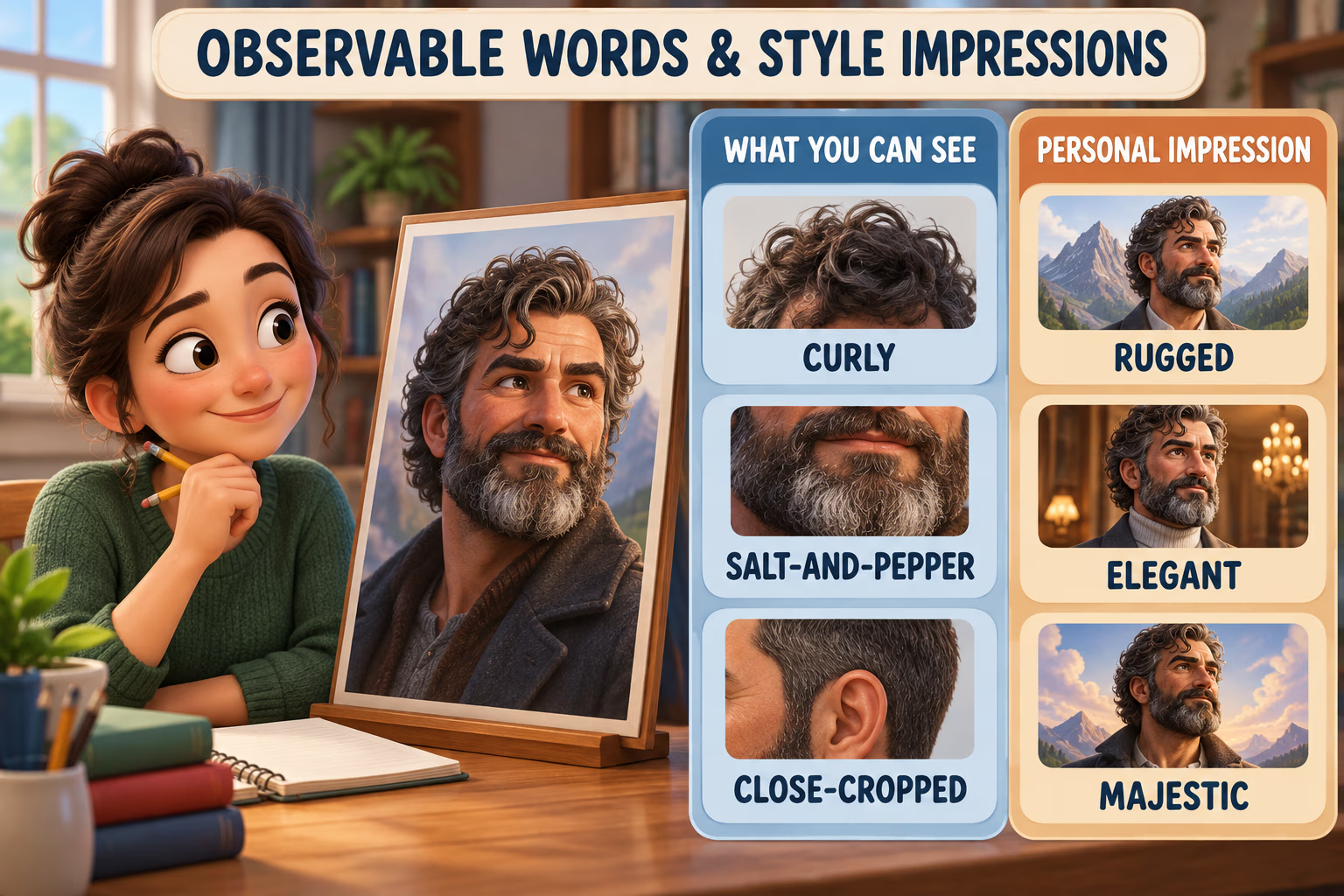
Adjectives for a beard can describe length, density, texture, color, grooming, or style. Words such as close-cropped, curly, and salt-and-pepper point to visible features, while rugged or majestic give a personal impression. Choose the kind of detail your sentence needs, and do not treat facial hair as proof of someone’s gender, personality, hygiene, or health. The Cambridge Dictionary defines a beard as hair on the chin and lower face.
Quick list: try short, full, patchy, wavy, coarse, trimmed, shaggy, gray, reddish, sculpted, or salt-and-pepper. These words describe different dimensions; several can fit the same beard.
Which beard adjectives describe observable details?
Observable descriptors name a feature that a reader could see or, if relevant and welcome, feel. They are usually more precise and less judgmental than general labels such as good-looking or messy.
| Feature | Possible adjectives | Example |
|---|---|---|
| Length | stubbled, short, medium-length, long | He wore a short beard with a clean line at the cheek. |
| Density or coverage | full, thick, sparse, patchy | The beard was full along the jaw and lighter near the cheeks. |
| Texture or curl | curly, wavy, straight, coarse, soft | Short, wavy hairs framed the lower half of the face. |
| Color | black, brown, reddish, gray, salt-and-pepper | A salt-and-pepper beard paired dark strands with silver ones. |
| Grooming or shape | trimmed, shaped, close-cropped, tapered, untrimmed | His tapered beard followed the jawline and narrowed at the chin. |
Coverage can vary naturally. The American Academy of Dermatology notes that genes affect whether facial hair grows in sparse areas; patchy can therefore be a neutral visual description, not a verdict about effort or worth. The word unkempt is more evaluative than untrimmed, so use it only when that judgment is relevant to the scene.
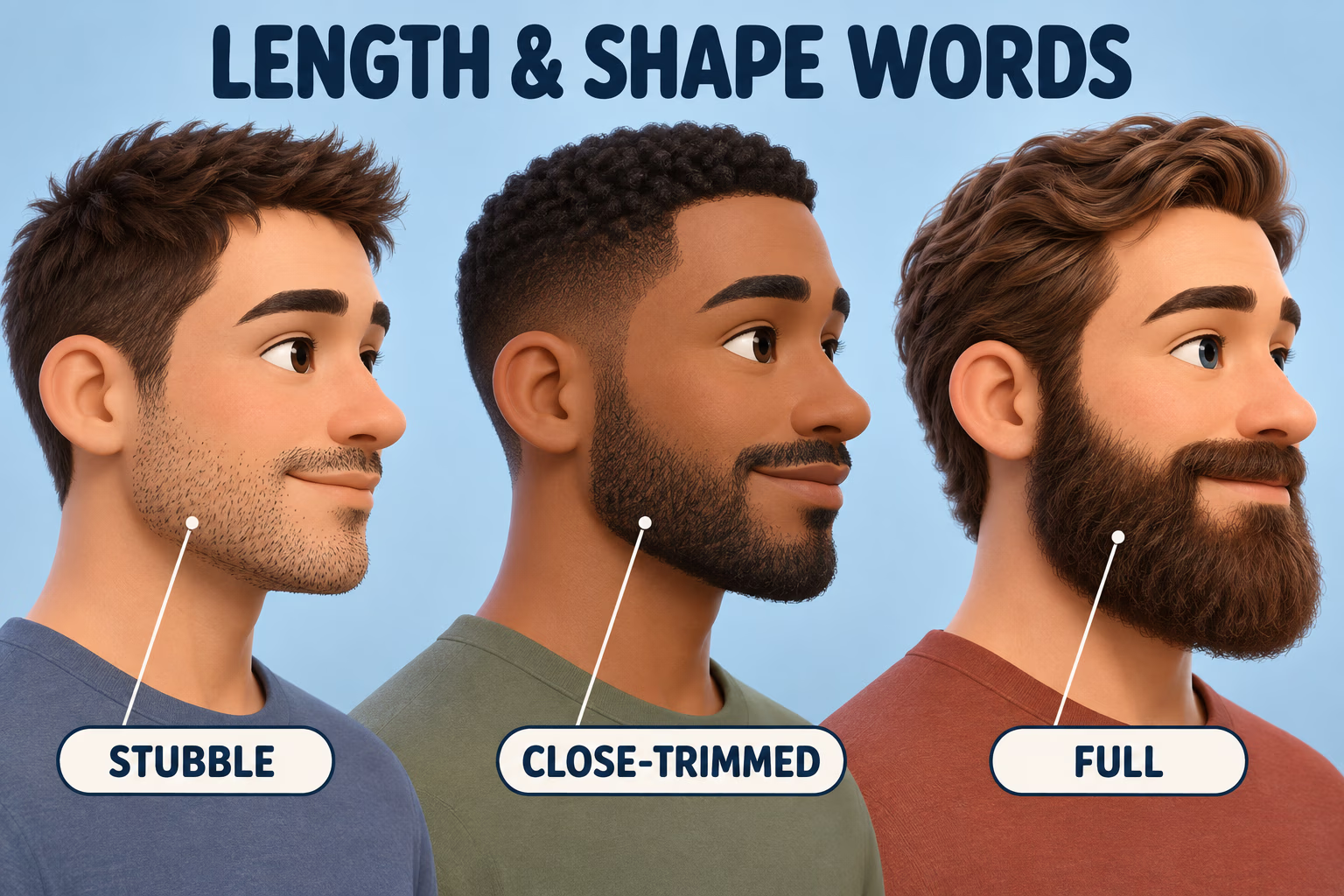
What words describe common beard styles?
Style terms name the arrangement of facial hair, while adjectives add details about it. “Goatee,” “short boxed beard,” “full beard,” and “stubble” identify common shapes or lengths; a beard can then be described as neatly trimmed, curly, or graying.
- Stubble: short, close, or lightly grown facial hair.
- Goatee: a style centered on the chin, sometimes paired with a mustache.
- Full beard: facial hair across the cheeks, jaw, and chin; length and shape vary.
- Short boxed beard: a shorter, shaped style with defined cheek and neck edges.
- Mustache: hair above the upper lip; it can accompany a beard but is not a synonym for one.
Style names can vary by barber, region, and personal preference. For a description that must be exact, explain the visible shape instead of assuming every reader uses a style label in the same way.
How do neutral descriptors differ from style impressions?
Neutral descriptors report an observable feature; impression words express a reader’s interpretation. Curly, gray-streaked, and close-trimmed are more concrete than commanding, distinguished, or majestic, which describe how a beard may come across to a particular observer.
Impression adjectives can still be useful in fiction or a personal description. Make the point of view clear: “The long, untamed beard made the traveler look rugged to the young narrator” marks rugged as an impression. It does not claim that beards make people strong, authoritative, masculine, or confident.
Beard adjective examples in sentences
- The actor’s close-cropped beard showed a few silver strands at the chin.
- A wavy, reddish beard softened the sharp outline of the costume character.
- She described the portrait as having a short beard with a tapered edge.
- The mechanic brushed dust from his coarse beard before the photograph.
- The traveler’s long, braided beard moved in the breeze.
- In the novel, the captain’s unruly beard helped establish the narrator’s first impression.
- His neatly trimmed beard followed the curve of the jaw.
- The older photograph shows a full, dark beard; the newer one shows gray stubble.
- The barber used “patchy” as a neutral description while discussing possible shapes with the client.
- The museum label describes the figure’s narrow mustache and pointed beard without guessing at the person’s character.
When writing about a real person, describe facial hair only when it matters to the reader’s task and use the person’s own language when available. A direct compliment such as “I like the shape you chose” is less likely to imply that one style is objectively better than another.
How should you choose a beard adjective?
- Decide what you need to communicate. A visual caption may need color and shape; a story may need a character’s subjective reaction.
- Choose one or two specific features. “A short, curly beard” is clearer than stacking several broad terms such as “majestic, rugged, and powerful.”
- Check whether the word is evaluative. Words such as scruffy, untidy, and unruly can carry criticism, while untrimmed is more neutral.
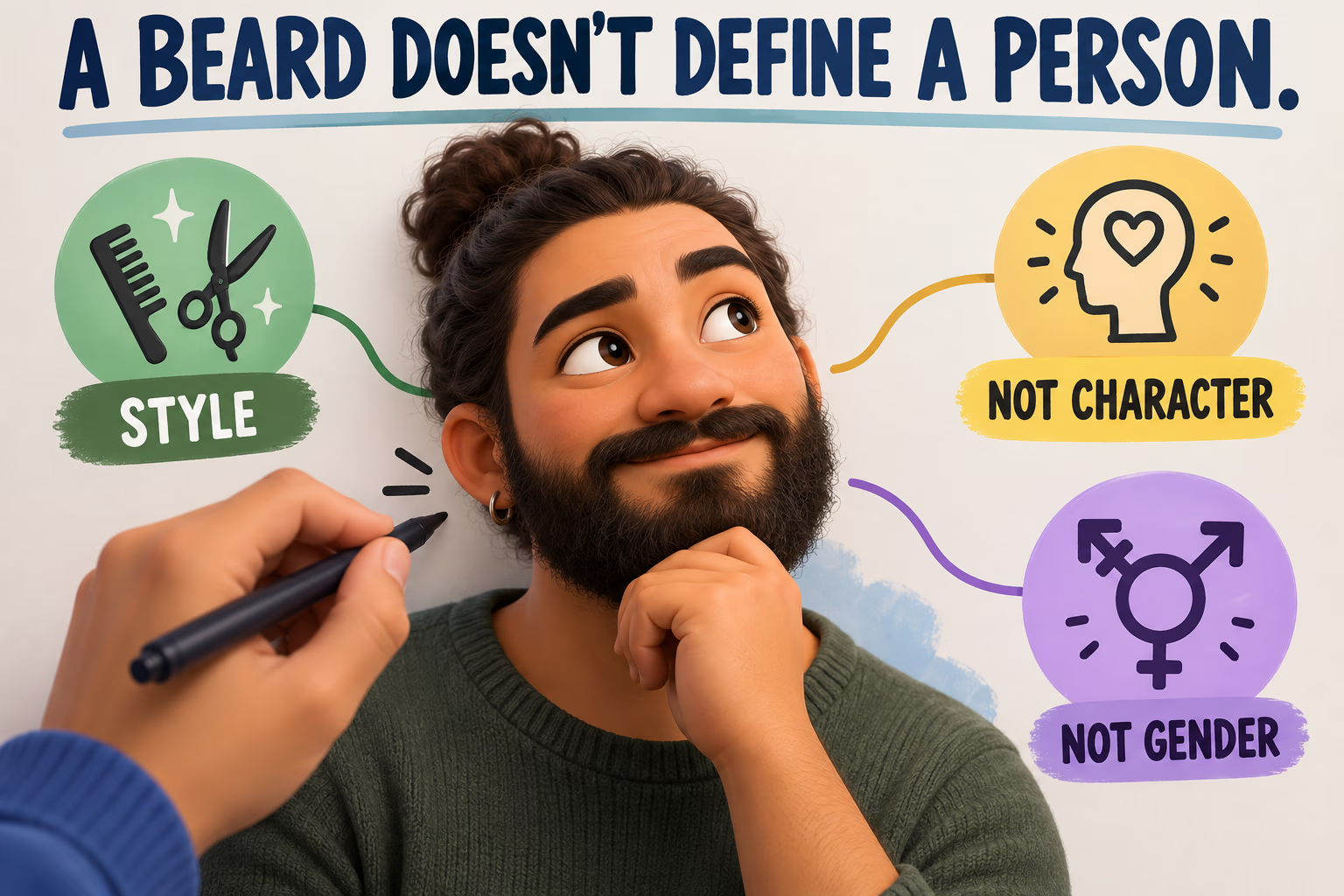
- Keep appearance separate from identity. Facial hair alone does not tell you a person’s gender, role, age, health, or temperament.
Descriptions of grooming also are not health assessments. The American Academy of Dermatology explains that healthy-looking facial hair depends partly on caring for the skin beneath it, and skin needs differ; a beard’s length or neatness alone does not establish someone’s hygiene or health.
Frequently asked questions about beard adjectives
What are neutral adjectives for a beard?
Neutral choices include short, long, full, sparse, curly, wavy, gray, reddish, trimmed, and close-cropped. They identify visible features without automatically praising or criticizing them. If “patchy” is accurate, it can also be neutral when used descriptively rather than as a put-down.
Is mustache a synonym for beard?
No. A mustache is hair above the upper lip; a beard generally refers to facial hair on the chin, jaw, and cheeks. Some styles combine both, but the terms name different areas.
Are clean-shaven and baby-faced antonyms of beard?
They describe a face without visible facial hair or a youthful-looking face; they are not strict lexical opposites of beard. Clean-shaven is the most direct phrase for a recently shaved face, while baby-faced adds an age-related impression.
Can beard adjectives describe personality?
They can describe a narrator’s impression in a story, but a beard does not establish personality. “The beard looked rugged” is an impression about appearance; “the person is rugged” makes a broader claim that needs evidence beyond facial hair.

Context for the preserved list below
The original examples below are retained exactly as written, but several headings and claims are subjective rather than factual categories. “Positive” and “negative” labels reflect one observer’s taste: words such as majestic, glorious, untidy, and scruffy are not universal judgments. The source’s references to masculinity, confidence, authority, and personality are not inherent effects of facial hair, and its gendered references to men or gentlemen do not describe every person who grows a beard. Terms such as chin mane, face carpet, cheek fringe, and jaw whiskers are playful metaphors, not standard synonyms; a mustache is a distinct facial-hair feature, not another name for a beard. The “antonyms” are phrases for a clean-shaven or youthful appearance, not exact opposites. Use the words as optional creative vocabulary, not as rules about someone’s appearance, identity, hygiene, character, or worth.
When it comes to facial hair, nothing quite makes a statement like a well-groomed beard. Whether it’s a full, bushy beard or a neatly trimmed goatee, a beard can add character and style to any face. But how do you find the right words to describe such a magnificent display of masculinity? Fear not, for I’ve compiled a list of adjectives that will help you paint a vivid picture of any beard you encounter.
From rugged and majestic to sleek and sophisticated, there are countless adjectives that can capture the essence of a beard. Imagine a beard that is thick and luscious, exuding an air of power and authority. Or picture a beard that is meticulously maintained, with every hair in place, reflecting a sense of elegance and refinement. Whether you’re describing your own beard or admiring someone else’s, these adjectives will help you find the perfect words to do justice to the facial masterpiece before you.
How to Describe beard? – Different Scenarios
When it comes to describing a beard, finding the right words can help paint a vivid picture. Depending on the style, length, and overall appearance of the beard, different adjectives can be used to capture its essence. Let’s explore some scenarios and examples to help you describe a beard accurately:
Scenario 1: Rugged and Majestic
A rugged beard exudes a sense of strength and masculinity. Here are some adjectives that can be used to describe this type of beard:
- Thick: A substantial amount of facial hair that adds to the beard’s fullness and robustness.
- Wild: A beard that grows freely and may have an untamed appearance.
- Majestic: A beard that commands attention, with a regal and authoritative presence.
For example, I recently came across a man with a thick, wild beard that added to his rugged and majestic aura.
Scenario 2: Sleek and Sophisticated
In contrast to a rugged beard, a sleek beard exudes elegance and refinement. Here are some adjectives that can be used to describe this type of beard:
- Trimmed: A well-maintained beard with neat and precise lines.
- Groomed: A beard that has been carefully shaped, trimmed, and styled.
- Sophisticated: A beard that carries an air of sophistication and class.
For instance, I recently met a gentleman with a perfectly trimmed and groomed beard, adding to his overall sophisticated look.
Scenario 3: Unique and Creative
Some individuals take their beards to the next level by adding unique elements or styling them in creative ways. Here are some adjectives that can be used to describe this type of beard:
- Adorned: A beard that is embellished with accessories or small decorations.
- Styled: A beard that is shaped or manipulated into a distinctive and eye-catching design.
- Outlandish: A beard that stands out due to its unusual or unconventional style.
I recently saw a man with an adorned beard, featuring colorful beads and small ornaments, which added to his outlandish and unique personality.
Using the right adjectives to describe a beard can help you accurately convey its style, character, and overall appeal. Whether it’s rugged and majestic, sleek and sophisticated, or unique and creative, each beard tells a story and deserves to be accurately described.
When it comes to describing a beard, finding the right words can make all the difference. A well-chosen adjective can paint a vivid picture in the reader’s mind, conveying the style, character, and overall appeal of a beard. In this section, I will share some examples of adjectives that can be used to describe different types of beards.
Describing Words for beard in English
- Thick: A rugged and majestic beard is often characterized by its thickness, giving it a bold and powerful appearance.
- Rough: This adjective describes a beard that has a slightly untamed quality, adding to its ruggedness and masculine charm.
- Majestic: A majestic beard exudes authority and strength, commanding attention with its regal and distinguished presence.
- Wild: This adjective captures the untamed and untethered nature of a rugged and majestic beard, evoking a sense of adventure.
Adjectives for Sleek and Sophisticated Beards
- Trimmed: A sleek and sophisticated beard is often meticulously trimmed, giving it a polished and refined look.
- Sharp: This adjective conveys the clean and defined lines of a well-groomed beard, adding a touch of elegance to its overall appearance.
- Sophisticated: A sophisticated beard exudes refinement and elegance, showcasing the wearer’s attention to detail and style.
- Sleek: This adjective suggests a smooth and polished surface, reflecting the sleek and well-maintained nature of the beard.
Adjectives for Unique and Creative Beards
- Colorful: A unique and creative beard can be described as colorful, showcasing a blend of vibrant and eye-catching shades.
- Artistic: This adjective captures the creativity and individuality expressed through a unique and stylized beard design.
- Innovative: An innovative beard pushes the boundaries of traditional styles, incorporating unconventional elements for a truly unique look.
- Unconventional: This adjective describes a beard that defies norms and conventions, standing out as a distinctive and original expression of the wearer’s personality.
Adjectives for beard
Positive Adjectives for Beard with 12 Example Sentences
When it comes to describing a beard, there are plenty of positive adjectives that can capture its style, character, and overall appeal. Here are twelve examples of positive adjectives that can be used to describe a beard:
- Rugged: My beard gives me a rugged and masculine look.
- Majestic: His beard is long and flowing, giving him a majestic appearance.
- Sleek: His sleek beard is well-groomed and exudes sophistication.
- Sophisticated: A well-trimmed and maintained beard adds a touch of sophistication.
- Glorious: His glorious beard is the envy of many.
- Commanding: A commanding beard can make a powerful statement.
- Distinguished: A perfectly gray-streaked beard adds a sense of distinction.
- Elegant: A carefully styled beard can enhance your overall elegance.
- Impeccable: His impeccably groomed beard is a sight to behold.
- Stylish: A well-groomed beard can be a stylish accessory.
- Regal: A regal beard can exude a sense of royalty.
- Confident: A well-maintained beard can boost one’s confidence.
Negative Adjectives for Beard with 5 Example Sentences
While there are many positive adjectives to describe a beard, there are also some negative ones that can be used. Here are five examples of negative adjectives to describe a beard:
- Untidy: His unkempt beard gives a messy and untidy appearance.
- Patchy: A patchy beard may lack fullness and uniformity.
- Scruffy: A scruffy beard can make one look unkempt and disheveled.
- Unruly: An unruly beard may appear wild and difficult to manage.
- Overgrown: An overgrown beard can become unmanageable and unkempt.
Remember, the choice of adjectives will depend on the style and character of the individual’s beard. Using the right adjectives can accurately convey the uniqueness and appeal of a beard, whether it’s rugged and majestic or sleek and sophisticated.
Synonyms and Antonyms with Example Sentences
Synonyms for beard
When it comes to describing a beard, there are a variety of synonyms that can help paint a vivid picture. Here are some alternative words you can use to add depth and variety to your descriptions:
- Facial hair: His impressive facial hair added an air of sophistication to his appearance.
- Whiskers: The man’s neatly trimmed whiskers gave him a distinguished look.
- Chin mane: His full chin mane made him look powerful and assertive.
- Face carpet: The gentleman’s face carpet accentuated his rugged charm.
- Cheek fringe: The cheek fringe on his face gave him a youthful and trendy vibe.
- Jaw whiskers: The thick jaw whiskers made him look wise and enigmatic.
- Moustache: His carefully groomed moustache brought a touch of elegance to his face.
Antonyms for beard
Not everyone desires a beard, and there may be occasions when you need to describe the absence of facial hair. Here are some antonyms that can come in handy when describing a clean-shaven look:
- Clean-shaven: He had a pristine, clean-shaven look that exuded professionalism.
- Baby-faced: With smooth, baby-faced skin, he looked much younger than his age.
- Smooth-skinned: Her smooth-skinned face had a natural radiance that caught everyone’s attention.
- Hairless: Without any trace of facial hair, his face looked smooth and hairless.
- Fresh-faced: The fresh-faced young man had a youthful glow that made him stand out.
- Bare-faced: Her bare-faced look showcased her flawless complexion.
Remember, the choice of word will depend on the style and character you want to convey. Experiment with different adjectives to find the perfect match for the beard you are describing.
By using synonyms and antonyms, you can add richness and variety to your writing, making it more engaging and captivating for your readers.
Conclusion
Describing beards with the right adjectives is essential for creating vivid and captivating descriptions. Throughout this article, we have explored a range of synonyms and antonyms that can be used to add depth and variety to your descriptions. From terms like “facial hair” and “whiskers” to more creative options like “chin mane” and “face carpet,” there are endless possibilities to choose from.
By using synonyms and antonyms, you can paint a more detailed picture of the style and character of the beard you are describing. Whether it’s a clean-shaven look or a full, bushy beard, the right words can help bring your descriptions to life.
Remember, the choice of words will depend on the specific beard you are describing. Experiment with different adjectives to find the ones that best capture the essence of the beard in question. This will not only make your writing more engaging, but it will also help your readers visualize the beard in their minds.
So, next time you’re writing about beards, don’t be afraid to get creative with your adjectives. Use synonyms and antonyms to make your descriptions more captivating and memorable. Happy writing!


