Usage clarification for the older list below: A country name such as Canada does not have an ordinary lexical antonym. Words such as small and dull contrast with particular descriptive adjectives, not with the country itself. Nicknames are also different from descriptive adjectives.
Adjectives to Describe Canada with Regional Detail
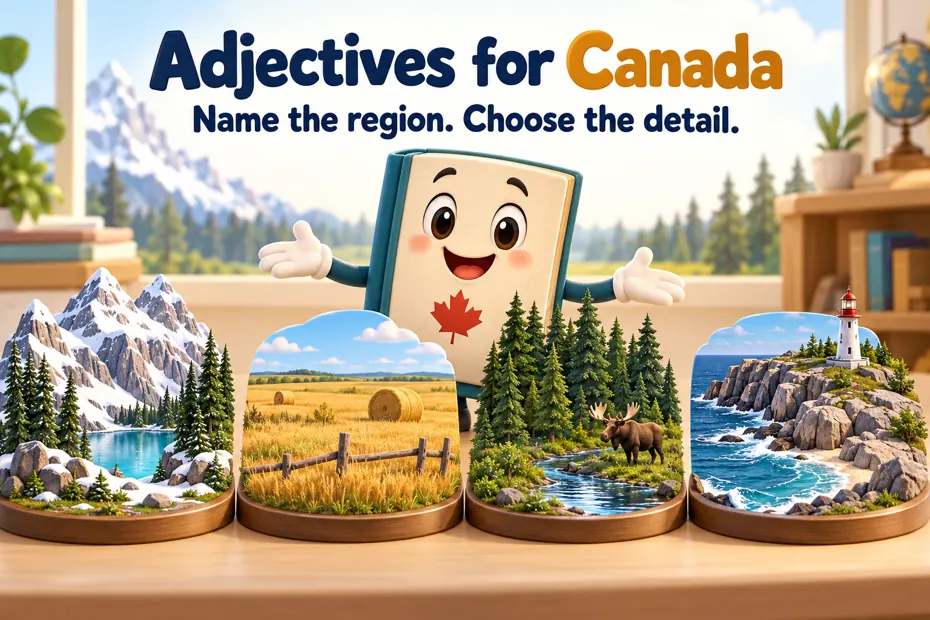
Canada includes many landscapes, climates, and language communities, so a precise description usually names a region or feature. Words such as rugged, prairie, forested, and coastal can help readers picture a particular place more clearly than one adjective meant to describe the entire country.
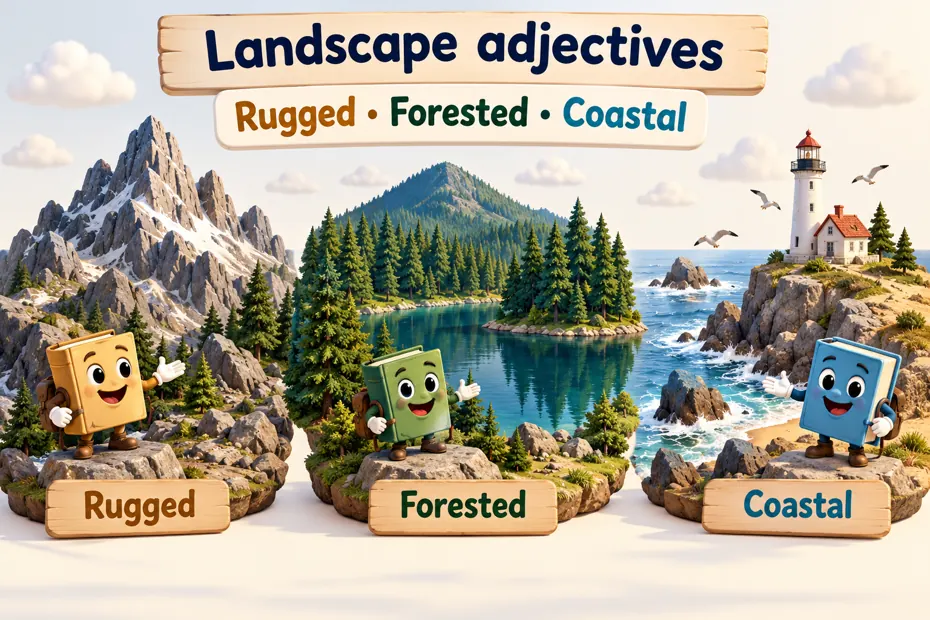
Words for Canada’s landscapes
- Vast: useful when emphasizing the country’s large scale. The train crossed a vast stretch of open country.
- Rugged: uneven, rough, or difficult to cross. Rugged peaks rose above the western valley.
- Mountainous: marked by many mountains. The mountainous region offered a dramatic view.
- Prairie: relating to broad, mostly level grassland. The prairie landscape stretched toward the horizon.
- Forested: covered with trees. A forested shoreline bordered the lake.
- Coastal: near or along a coast. The coastal community looked out across the Atlantic.
- Northern: in or toward the north; use it when the region is clear from context. The northern landscape included tundra and rocky shores.
Canada’s federal land-and-climate guide describes mountains, prairie grasslands, forests, tundra, rivers, and lakes. Natural Resources Canada also divides the country into distinct physiographic regions. These sources support using a landscape adjective for a particular region rather than assuming every part of Canada looks alike.
Words for weather and climate
- Snowy: covered with snow or experiencing snowfall. The snowy winter morning slowed traffic in the town.
- Humid: containing much moisture in the air. The southern Ontario afternoon felt humid.
- Temperate: moderate rather than extremely hot or cold. The Pacific coast has a more temperate, rainy winter than many other regions.
- Cold, warm, or rainy: broad words that become more informative when paired with a season and location. A rainy autumn settled over the Atlantic coast.
Weather varies by region and season. A description such as cold Canada leaves out important differences; name a province, region, city, and time of year when those details matter.
Words for languages and communities
- Bilingual: using two languages. Canada has two official languages, English and French, and federal language rights apply in the circumstances set out in law. This does not mean every resident speaks both languages.
- Multilingual: involving or using several languages. The multilingual neighborhood reflected many family and community histories.
- Regional: connected with a particular part of a country. Regional traditions and expressions varied from one community to another.
- Diverse: made up of different kinds of people, places, or features. Use it with specific details when possible, such as diverse languages or landscapes.
Statistics Canada’s census language reporting includes English and French alongside Indigenous and other non-official languages. When describing a specific community, use the relevant names and context rather than treating all Canadians as culturally or linguistically identical.


Questions about describing Canada
Is “Canadian” itself an adjective? Yes. It identifies a connection with Canada, as in “a Canadian author” or “Canadian geography.” It does not automatically describe a landscape or a personality. “Canadian mountain scenery” identifies the country; “rugged Canadian mountain scenery” adds a visible feature. Capitalize Canadian because it is derived from a proper name.
Can I describe Canada as friendly? You can express a personal impression, but explain its basis and scope. “The shopkeeper gave us a friendly welcome” describes an observed interaction. “All Canadians are friendly” makes a sweeping claim about millions of individuals. A travel account becomes more convincing when it names what people did rather than assigning a shared personality.
Does “bilingual” mean everyone speaks French and English? No. Official bilingualism describes the status of the two languages in federal institutions. Individual language skills differ. A bilingual speaker, a bilingual sign, and an officially bilingual country are three different subjects, so choose the noun carefully before deciding what the adjective means in your sentence.
What makes a description vivid without exaggeration? Combine one place, one observable feature, and one precise adjective: “Mist drifted over the forested lakeshore.” Then add a detail that changes the scene, such as season, light, or sound. Avoid piling up near-synonyms; “beautiful, lovely, gorgeous scenery” says less than “a rocky shoreline under pale morning light.”
Quick examples
| Sentence | What the adjective describes |
|---|---|
| The rugged mountain trail crossed a western valley. | Terrain in a specific region. |
| Open prairie grassland stretched beside the highway. | A landscape type. |
| The coastal town had a rainy autumn. | Location and seasonal weather. |
| Federal services are available in English and French. | Official service languages, not every resident’s language ability. |
| The multilingual community included speakers of several languages. | Language diversity in a particular community. |
Writing tip: name the place first, then choose an adjective that fits it. “A snowy January in Winnipeg,” “a temperate winter on the southwest coast,” and “a forested lakeshore in Ontario” create clearer pictures than a single general description of Canada.
For grounding, see the Government of Canada’s guide to Canada’s land and climate and English and French language services, the Government of Canada’s regional geography guide, and Statistics Canada’s report on multilingual households.
Canada is a country of immense beauty and diversity, from its stunning landscapes to its vibrant cities. As an expert blogger, I have had the privilege of exploring this incredible nation and discovering the many adjectives that perfectly describe its unique characteristics. In this article, I will share with you a comprehensive list of adjectives that capture the essence of Canada, along with examples to help you understand their significance. Whether you’re planning a visit or simply curious about this fascinating country, these descriptive words will paint a vivid picture of what Canada has to offer.
From breathtaking natural wonders to multicultural metropolises, Canada is a land of contrasts. Its adjective-worthy attributes range from majestic and pristine to bustling and cosmopolitan. In this article, I’ll delve into the adjectives that best describe Canada’s stunning landscapes, rich history, diverse culture, and friendly people. By the end, you’ll have a deeper appreciation for the beauty and complexity of this remarkable country. So, let’s dive in and explore the adjectives that truly capture the essence of Canada.
How to Describe canada? – Different Scenarios
When it comes to describing Canada, there are countless adjectives that come to mind. The country’s vast landscapes, vibrant cities, and friendly people offer a multitude of scenarios in which to capture its essence.
Let’s explore how we can describe Canada in various situations:
1. Canada’s Natural Beauty:
- Majestic: Canada’s expansive forests, towering mountains, and breathtaking waterfalls are truly majestic.
- Pristine: From the crystal-clear lakes to the untouched wilderness, Canada’s natural beauty is second to none.
- Serene: The tranquil landscapes of Canada evoke a sense of peace and serenity.
- Picturesque: Canada’s stunning landscapes make it the perfect subject for a postcard-worthy picture.
- Lush: The verdant forests and green meadows of Canada are a feast for the eyes.
2. Canadian Cities:
- Bustling: Canada’s cities, such as Toronto, Vancouver, and Montreal, are vibrant and filled with activity.
- Cosmopolitan: Canada’s urban centers embrace diversity and offer a cosmopolitan atmosphere.
- Modern: Canadian cities boast impressive architecture, modern infrastructure, and a thriving arts scene.
- Multicultural: Canada’s cities are melting pots of cultures, where diversity is celebrated.
- Dynamic: The fast-paced energy and constant evolution of Canadian cities create a dynamic atmosphere.
3. Canadian Culture:
- Inclusive: Canada’s culture is known for its inclusivity and openness to all.
- Rich: From indigenous traditions to diverse immigrant communities, Canada’s culture is rich and varied.
- Celebratory: Canada’s festivals and events, such as Canada Day and the Calgary Stampede, are filled with joy and celebration.
- Artistic: Canada has a flourishing arts scene, with talented artists in various disciplines.
- Foodie: Canadian cuisine is a fusion of international flavors, making it a delight for food lovers.
4. Canadian People:
- Friendly: Canadians are known for their warm and welcoming nature, making visitors feel right at home.
- Polite: Etiquette and politeness are important values in Canadian society.
- Helpful: Canadians are always ready to lend a helping hand to those in need.
- Diverse: Canadians come from all walks of life and embrace their diversity.
- Proud: Canadians take pride in their country and its achievements.
Describing Words for canada in English
As I explore the beauty and diversity of Canada, I am amazed at how many adjectives can be used to describe this incredible country. Let me share with you some of the words that capture the essence of Canada in all its glory.
1. Majestic: When I think of the vast landscapes and breathtaking mountains that stretch across Canada, the word “majestic” comes to mind. The towering Rockies, the stunning Niagara Falls, and the pristine national parks all contribute to its awe-inspiring beauty.
2. Pristine: Canada is known for its pristine wilderness, with numerous lakes, rivers, and forests that have been untouched by human development. This untouched natural environment is a testament to the country’s commitment to conservation.
3. Serene: There’s a sense of serenity that permeates the Canadian landscape. From the calmness of a cool, clear lake to the tranquility of a winter wonderland, Canada offers a peaceful retreat from the hustle and bustle of everyday life.
4. Picturesque: With its charming villages, quaint towns, and stunning coastal scenery, Canada is truly picturesque. Whether it’s the rugged beauty of Newfoundland’s coastline or the colorful houses of Peggy’s Cove, there are countless scenes that will leave you in awe.
5. Lush: Canada’s lush forests and vibrant foliage make it a paradise for nature lovers. From the vibrant autumn colors to the verdant springtime blooms, the country’s vegetation is a sight to behold.
But Canada is not just about its natural beauty. Its cities are equally captivating and diverse, offering a vibrant mix of cultures and experiences. Let’s delve into the adjectives that describe the urban side of this amazing country.
1. Bustling: Whether it’s Toronto, Vancouver, or Montreal, Canadian cities are always bustling with activity. The vibrant energy of the streets, the bustling markets, and the lively nightlife create an atmosphere that is truly exhilarating.
2. Cosmopolitan: Canada’s cities are cosmopolitan centers, attracting people from all over the world. The multiculturalism and diversity present in these urban areas create a vibrant tapestry of cultures, languages, and cuisines.
3. Modern: From the towering skyscrapers to the sleek architecture, Canadian cities embody modernity. These cities are at the forefront of technology, innovation, and design, creating a captivating urban landscape.
Adjectives for canada
Positive Adjectives for Canada with Examples
Canada is an incredible country, and I’m excited to share with you some positive adjectives that perfectly describe its beauty and charm. Here are twelve examples with sentences to help you understand each word’s usage:
| Adjective | Example Sentence |
|---|---|
| Breathtaking | The view of the Rocky Mountains is breathtaking. |
| Enchanting | The northern lights are truly enchanting. |
| Tranquil | The lakes in Canada are so tranquil and serene. |
| Captivating | Niagara Falls is a captivating natural wonder. |
| Majestic | Banff National Park is home to majestic peaks. |
| Thriving | Toronto is a thriving and diverse city. |
| Welcoming | Canadians are known for their warm and welcoming nature. |
| Vibrant | Montreal’s streets are always vibrant with activity. |
| Abundant | Canada’s forests are abundant in wildlife. |
| Pristine | The beaches in Prince Edward Island are pristine. |
| Lush | Vancouver Island is known for its lush rainforests. |
| Charming | Quebec City’s old town is incredibly charming. |
Negative Adjectives for Canada with Examples
While Canada is a beautiful country, there are a few negative adjectives that can be used to describe certain aspects. Here are five examples along with sentences to provide you with a better understanding:
| Adjective | Example Sentence |
|---|---|
| Remote | Some regions of Canada are remote and isolated. |
| Brutal | The winters in Canada can be brutal and extremely cold. |
| Overwhelming | The vastness of Canada’s wilderness can be overwhelming. |
| Limited | Access to certain services may be limited in rural areas. |
| Expensive | Living in major cities like Toronto can be expensive. |
As you can see, these adjectives provide different perspectives on the beauty and complexity of Canada. From enchanting natural wonders to thriving cities, Canada truly has it all. However, it’s important to note that certain aspects like remoteness and harsh winters can be challenging. Nonetheless, the overall experience of being in Canada is nothing short of extraordinary.
Synonyms and Antonyms with Example Sentences
Synonyms for Canada
When it comes to describing Canada, there are various synonyms that can truly capture its essence. Here are some alternatives to the word “Canada” along with example sentences:
| Synonym | Example Sentence |
|---|---|
| Great White North | The Great White North is known for its vast wilderness and stunning landscapes. |
| True North | True North refers to the northernmost regions of Canada, characterized by Arctic tundra and polar bears. |
| Land of the Maple Leaf | The Land of the Maple Leaf is famous for its stunning fall foliage and delicious maple syrup. |
| The Great North | The Great North is home to breathtaking national parks and diverse wildlife. |
Antonyms for Canada
While Canada is undoubtedly a remarkable country, there are also antonyms that describe aspects that are different from its positive attributes. Here are some antonyms for Canada along with example sentences:
| Antonym | Example Sentence |
|---|---|
| Small | Compared to other countries, Canada is anything but small, as it spans a vast expanse of land. |
| Homogeneous | Canada is a multicultural nation that celebrates diversity, making it far from homogeneous. |
| Dull | With its vibrant cities and picturesque landscapes, Canada is far from dull. |
| Lifeless | From buzzing urban centers to stunning national parks, Canada is far from being a lifeless country. |
As you can see, these synonyms and antonyms provide alternative ways to describe Canada, highlighting different aspects and characteristics of the country.
Conclusion
In this article, I have explored the beauty and diversity of Canada, providing a range of adjectives that can be used to describe the country. From “Great White North” to “True North,” “Land of the Maple Leaf” to “The Great North,” these synonyms capture the essence of Canada’s unique qualities. Through example sentences, I have showcased different aspects of Canada, allowing readers to envision its breathtaking landscapes, vibrant culture, and warm hospitality.
Additionally, I have discussed antonyms that describe aspects different from Canada’s positive attributes. Terms like “small,” “homogeneous,” “dull,” and “lifeless” provide a contrasting perspective, highlighting the distinctiveness and vibrancy of Canada.
By offering alternative ways to describe Canada, this article aims to help readers better articulate their experiences and impressions of this incredible country. Whether you are writing a travel article, creating content for a website, or simply conversing with others, these adjectives will enrich your descriptions and convey the true essence of Canada.
Canada is a country of immense beauty, diversity, and uniqueness, and these adjectives serve as a testament to its remarkable qualities.


