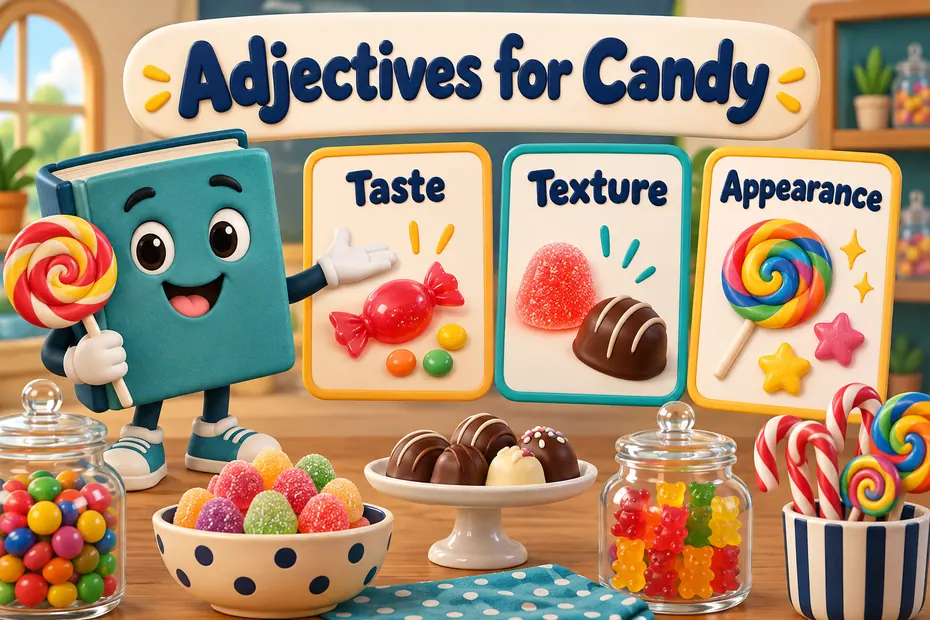
Adjectives for Describing Candy
To describe candy clearly, choose words for its taste, texture, and appearance. These details are more useful than stacking several near-synonyms, and they let a reader picture a particular sweet.
Words for candy taste
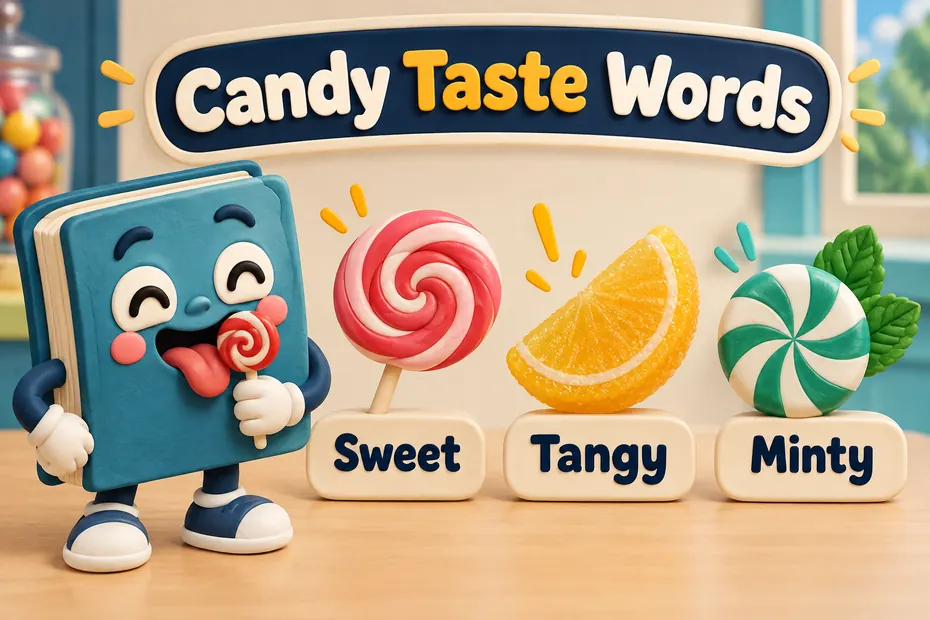
- Sweet: having a sugary flavor. The sweet strawberry drop melted slowly.
- Tangy: pleasantly strong and sharp in flavor. A tangy citrus center balanced the chocolate coating.
- Tart: sharp or slightly sour in taste. The tart raspberry candy left a bright aftertaste.
- Sour: having the sharp taste of lemon or vinegar. The sour candy made the character pucker.
- Bitter: having a sharp taste that is not sweet. The bitter dark-chocolate shell contrasted with the sweet filling.
- Minty, fruity, or chocolatey: these name a noticeable flavor. The minty candy had a cool finish.
- Sugary: containing sugar; depending on context, it can also suggest a very sweet taste. A sugary glaze coated the little candies.
Taste words are partly subjective. Use tart or tangy when the flavor has a sharp note, and sour when that sharpness is stronger or less sweet. Name the flavor itself when possible, such as lemony, berry-flavored, or minty.
Words for candy texture
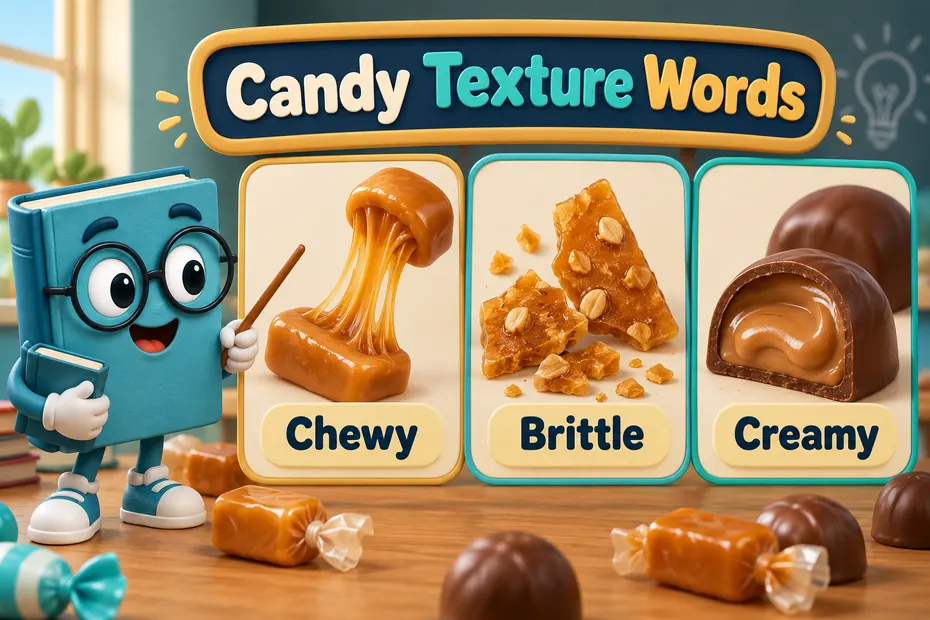
- Chewy: needs to be chewed for a while. The chewy caramel stayed soft in the center.
- Crunchy: firm and makes a short loud sound when eaten. A crunchy sugar shell surrounded the filling.
- Creamy: thick and smooth, like cream. The creamy chocolate filling softened on the tongue.
- Brittle: hard and easily broken. A brittle almond candy snapped into small pieces.
- Sticky: made of or covered with a substance that clings to surfaces. The sticky caramel clung to the paper wrapper.
- Crumbly, gooey, or smooth: use these when the candy breaks into crumbs, feels soft and thick, or has an even surface.
Words for candy appearance
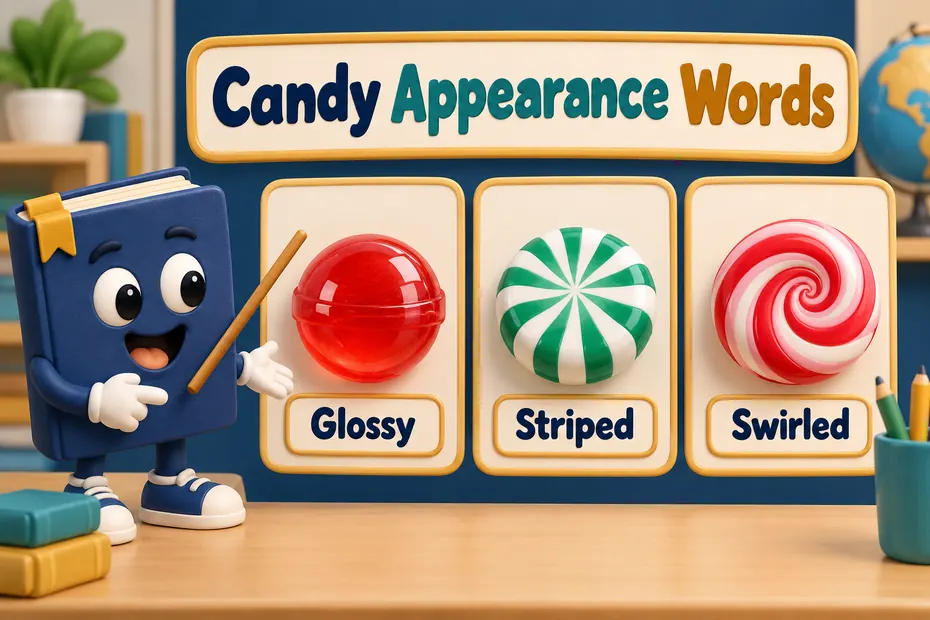
- Glossy: smooth and shiny. The glossy red sweets caught the light.
- Striped, swirled, or layered: describe the visible pattern or construction. Each striped mint had a white center.
- Powdered, coated, or dusted: name a visible surface finish. A dusted layer of sugar covered the lemon drops.
- Colorful, translucent, or bite-sized: describe color, how much light shows through, or approximate size. The translucent fruit drops glowed in the glass dish.
Use details you can see rather than assuming that every candy has the same texture or flavor. One piece can be glossy on the outside, chewy in the center, and tangy in taste.
Combine adjectives for a vivid sentence
Mix descriptors from different categories instead of listing several words for the same feature:
- The glossy lemon candy had a tangy taste and a chewy center.
- A crunchy shell gave way to a smooth chocolate filling.
- The colorful, striped sweets came in fruity and minty flavors.
- One brittle piece broke into crisp, sugary flakes.
| Feature | Useful adjectives | Example |
|---|---|---|
| Taste | sweet, tangy, tart, sour, bitter, minty | a tart cherry candy |
| Texture | chewy, crunchy, creamy, brittle, sticky | a crunchy outer shell |
| Appearance | glossy, striped, swirled, powdered, colorful | a glossy, swirled lollipop |
Writing tip: name one feature at a time. Cambridge Dictionary defines sweet, tangy, tart, sour, and bitter as taste words; its entries also explain chewy, crunchy, sticky, sugary, creamy, glossy, and brittle. Its entry on texture also explains texture in food and drink.
Questions about describing candy
Is tangy the same as sour?
The words overlap, but tangy usually presents a strong, sharp flavor as pleasant, while sour names the sharp taste more directly. They are not steps on an exact scientific scale. A writer might enjoy a tangy lemon candy and find another candy too sour; explain the particular impression rather than assigning a fixed intensity.
Does chewy mean sticky?
No. Chewy describes the effort needed to chew a food, while sticky describes how it clings to a surface. A candy can be both, but one feature does not guarantee the other. “A chewy center” describes the eating texture; “a sticky wrapper” tells the reader that candy adhered to the paper.
Can creamy candy contain no cream?
In a sensory description, creamy can refer to a smooth, rich texture rather than making a precise ingredient claim. If ingredients matter, check the product’s ingredient information instead of relying on an adjective. For a fictional example, “The chocolate had a creamy filling” tells readers about texture without establishing the recipe.
What is the difference between glossy and smooth?
Glossy includes a shiny appearance, while smooth describes an even surface or texture. A candy can be smooth without being shiny. “A glossy red shell” helps readers picture light reflecting from the outside; “a smooth filling” describes the impression of the center. Name the part of the candy to keep the detail clear.
How many adjectives should I put before candy?
Use enough to distinguish the candy, but do not make the reader decode a crowded list. One appearance word and one flavor or texture word are often enough: “a glossy, tangy sweet.” You can move other details into a separate clause: “The glossy sweet had a tangy flavor and a chewy center.”
Candy is one of the most popular food groups in the world. And why wouldn’t it be? Sugar is delicious! But what makes candy so great is the variety. There are so many different flavors, textures, and colors of candy to choose from.
But have you ever stopped to think about the different adjectives we use to describe candy? In this article, we’re going to take a look at some of the most common adjectives used to describe candy, as well as some that might be a little less obvious.
Adjectives For Candy
Candy is one of those things that everyone loves. It comes in all shapes, sizes, and colors, and there’s always a flavor for everyone. But what makes candy so great? The answer is simple: adjectives.
Adjectives are words that describe, and when it comes to candy, they make it even more delicious. Here are some of the best adjectives for candy:
- Sweet: Candy is always sweet, whether it’s made with sugar, honey, or syrup.
- Tangy: Some candy is tangy, like sour candy or gummies.
- Fruity: Many candies are fruity, like those made with real fruit or flavored with fruit juices.
- Creamy: Chocolate candy is always creamy, and some other candies are too.
- Nutty: Nutty candy is usually chocolate candy with nuts in it.
- Chewy: Gummies and caramels are examples of chewy candy.
- Hard: Hard candy is, well, hard! But it’s also delicious.
No matter what your favorite flavor or texture is, there’s a candy out there for you. And with so many adjectives to choose from, you can always find the perfect candy for your mood.

A | B | C | D
| Assorted | Best | Black |
| Blue | Boxed | Brown |
| Cheap | Chewy | Childhoodtaffy |
| Coarse | Colored | Crushed |
| Delicate | Delicious | Desserts |
E | F | G | H
| Expensive | Favorite | Flavored |
| Fresh | Green | Gummy |
| Hard | Hoarhound | Homemade |
| Hot |
I | M | O
| Licorice | Liquid | Lovely |
| Magnificent | Meaning | Mere |
| Mixed | Original |
P | R
| Pecan | Pink | Pre |
| Pure | Purple | Real |
| Red |

S
| Shaped | Sized | Soft |
| Sour | Stale | Sticky |
| Striped | Sugar | Sweet |
T | U | V | W | Y
| Taffy | Ubiquitous | Ultimate |
| Vintage | Word | Yellow |
Final verdict
Candy is one of the most popular treats around, and there are endless ways to describe it. Whether you like your candy sweet, sour, chewy, or crunchy, there’s an adjective for it. And if you’re looking for something a little more unique, there are plenty of adjectives for that too. So next time you’re in the mood for a sweet treat, be sure to check out this list of adjectives for candy.


