
Adjectives for a friend describe qualities, actions, or the impression a person makes, such as loyal, thoughtful, funny, or dependable. Choose a word that matches a real example: dependable fits someone who follows through, while empathetic fits a friend who tries to understand your feelings. Context makes the description more meaningful.

Adjectives for a Friend at a Glance
- Loyal emphasizes steady friendship or support; dependable emphasizes following through.
- Thoughtful and considerate describe attention to another person’s needs; empathetic describes trying to understand how someone else feels.
- Funny, adventurous, and easygoing describe different social styles, not a person’s entire character.
- A concrete example makes a compliment more credible than a string of general praise.
- Adjectives are descriptions, not measurements of friendship quality or guarantees about how a relationship will feel.
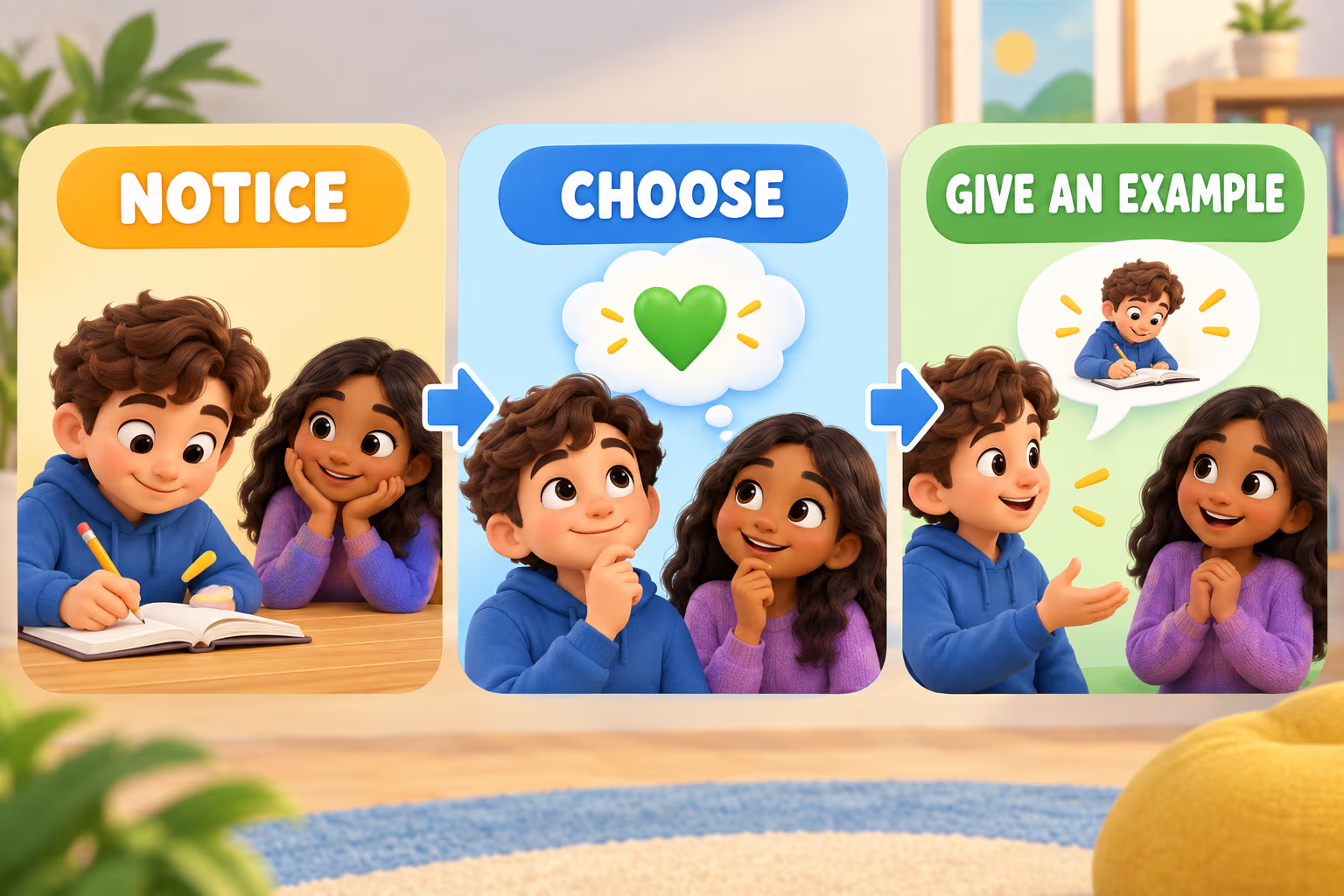
How Do You Choose an Adjective That Fits?
Start with something your friend said or did, then select the adjective that describes that evidence most precisely. A simple three-part check—notice, choose, give an example—keeps a compliment personal and reduces the chance that a broad word will sound generic or exaggerated.
- Notice: Recall an observable action, such as checking in after a difficult day or keeping a promise.
- Choose: Match the action to a word: thoughtful for noticing a need, dependable for following through, or funny for making people laugh.
- Give an example: Add the moment that shows why the word fits: “You were thoughtful when you remembered my interview and asked how it went.”
Cambridge Dictionary distinguishes these nearby words in useful ways: loyal points to firm friendship or support, reliable to expected follow-through, and empathetic to imagining another person’s feelings. Those are related qualities, but they are not exact synonyms.
Which Adjectives Describe Different Friendship Qualities?
Choose a group based on the quality you want to recognize. The same friend can fit several groups, and a word can describe one situation without defining every part of that person’s personality.
| Quality | Adjectives | What the words suggest |
|---|---|---|
| Trust and follow-through | loyal, dependable, reliable, trustworthy, steadfast | Keeping confidence, showing steady support, or doing what was agreed. |
| Care and attention | kind, thoughtful, considerate, compassionate, generous | Noticing another person’s needs and responding with care or practical help. |
| Listening and understanding | empathetic, patient, attentive, understanding, nonjudgmental | Listening carefully and making room for a different perspective. |
| Honest communication | honest, sincere, candid, tactful, open-minded | Speaking truthfully while considering context, tone, and another person’s view. |
| Fun and shared experiences | funny, playful, adventurous, curious, lively | Bringing humor, energy, or willingness to try something new. |
| Comfort and ease | warm, accepting, easygoing, reassuring, welcoming | Helping someone feel included, relaxed, or accepted in a particular setting. |
Dictionary definitions help separate close choices: supportive can mean giving help or encouragement, while considerate emphasizes kindness and helpfulness, and thoughtful can describe care shown by considering what another person may need.
How Can You Use a Friend Adjective in a Sentence?
Pair one adjective with a specific moment to make the sentence sound natural. For a card or message, say what the friend did and how it affected you; for a caption, keep the wording short and choose a quality that suits the photo or occasion.
| Situation | Example |
|---|---|
| Thank-you note | “You were thoughtful to bring dinner when I was juggling a hard week.” |
| Birthday card | “I’m lucky to have such a funny, generous friend who makes ordinary days brighter.” |
| Photo caption | “Another day with my adventurous and easygoing favorite.” |
| Personal appreciation | “Your dependable check-ins helped me feel less alone before the move.” |
For a more detailed note, use the same pattern as appreciation writing: name a quality, mention the action that showed it, and explain what you valued. See our guides to adjectives for appreciation, words to describe a daughter, and adjectives for a son. For communication-style words, see adjectives for communication.
Can an Adjective for a Friend Be Negative?
Yes. A description does not have to be positive if you are trying to explain a real disagreement, but a specific behavior is usually fairer than a permanent label. “You canceled twice this month without telling me” gives clearer feedback than calling someone “unreliable” or “selfish.”
The original alphabetic list below is kept intact, as requested, and works as a broad brainstorming bank. It mixes adjectives with phrases such as “Always There,” nouns such as “Gal,” and context-dependent entries such as “Bovine,” “Leftist,” and “Totalitarian,” so not every item is a natural adjective for an ordinary compliment. Check both grammar and tone before using an entry.
The CDC describes stable, supportive relationships as one source of support during stressful challenges. A 2023 review of 38 studies on adult friendship found generally positive associations between friendship quality and well-being, while noting evidence gaps and a concentration of young-adult samples. These findings describe group-level patterns; no adjective or single friend guarantees a particular health or relationship outcome. Read the CDC overview of social connection and the systematic review of adult friendship and well-being.
A friend is someone who you can rely on, whether you’re going through a tough time or just need someone to talk to. But what are the adjectives that best describe a friend? In this article, we’ll explore some of the most common adjectives used to describe friends, as well as some adjectives that you might not have considered.
From “loyal” to “supportive” to “trustworthy,” there are many adjectives that accurately describe the role of a friend in our lives. So whether you’re searching for the perfect word to describe your own friendship or looking for a thoughtful gift for a friend, this article is a great place to start.
Adjective For Friend
Adjectives for friend (positive adjectives): good-natured, affable, amiable, amicable, cordial, genial, congenial. Adjectives for friend (negative adjectives): bad-tempered, churlish, disagreeable, grumpy, ill-humored. When choosing adjectives to describe your friends, it’s important to pick words that best reflect the qualities you admire most about them.
After all, your friends are an important part of your life and you want to be sure you’re using adjectives that accurately convey how you feel about them! Some other adjectives that could be used to describe friends include: kind, loyal, caring, supportive. No matter what adjectives you choose, they should always be positive and reflect the best aspects of your friendship!
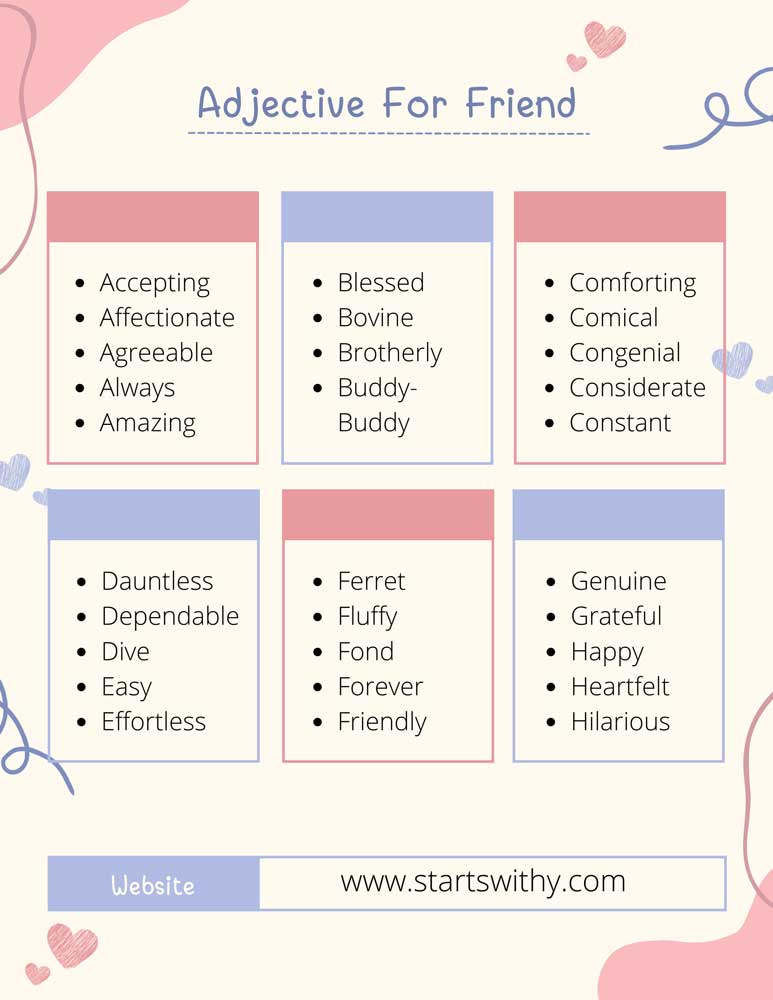
A
| Accepting | Affectionate | Agreeable |
| Always | Always There | Amazing |
| Amiable | Anxious | Appreciated |
| Appreciative |
B
| Beautiful | Best | Bestest |
| Blessed | Bovine | Brotherly |
| Buddy-Buddy |
C
| Caring | Cheerful | Cherished |
| Close | Coastal | Comfortable |
| Comforting | Comical | Congenial |
| Connected | Considerate | Constant |
| Cooperative | Cordial | Crazy |
D | E
| Dauntless | Dear | Dependable |
| Dive | Easy | Effortless |
| Empathizing | Encouraging | Enjoyable |
| Estranged | Everlasting | Everyday |
| Extraordinary |
F
| Fabulous | Faithful | Favorite |
| Ferret | Fluffy | Fond |
| Forever | Fortunate | Friendly |
| Fun | Funnest | Funny |
G
| Gal | Generous | Genuine |
| Grateful | Grounded | Happy |
| Heartfelt | Heartwarming | Hilarious |
| Honest | Human |
I | K
| Important | In Agreement | In Common |
| Intimate | Irreplaceable | Kind |
| Kindhearted |
L
| Laidback | Lasting | Leftist |
| Lifelong | Long-Lasting | Lovable |
| Loving | Loyal |
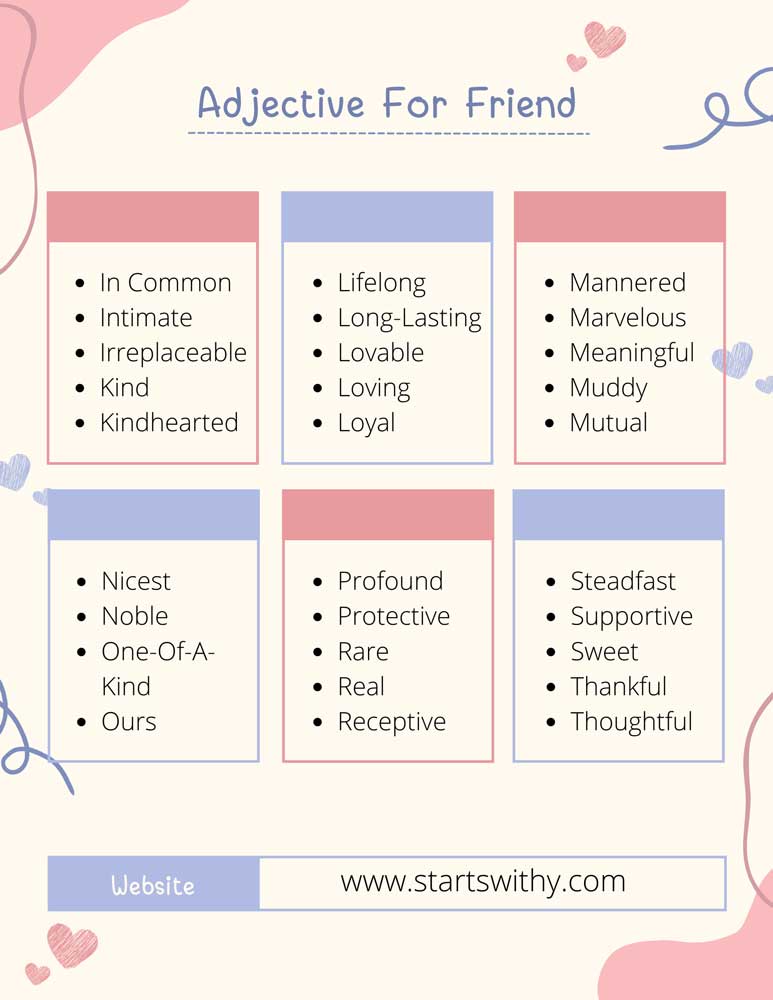
M | N | O
| Mannered | Marvelous | Meaningful |
| Muddy | Mutual | Nicest |
| Noble | One-Of-A-Kind | Ours |
P
| Patient | Perfect | Personal |
| Precious | Priceless | Profound |
| Protective |
R
| Rare | Real | Receptive |
| Regular | Relaxing | Reliable |
| Remarkable | Rich |
S
| Sincere | Sisterly | Slick |
| Special | Steadfast | Supportive |
| Sweet | Sweet-Hearted |
T
| Texted | Thankful | Thoughtful |
| Timeless | Together | Totalitarian |
| Touching | Treasured | Tried-And-True |
| Trustworthy | Truthful |
U
| Ultimate | Uncommon | Unconditional |
| Understanding | Unique | Unpretentious |
| Unselfish | Uplifting |
V | W
| Valued | Warm | Warmhearted |
| Wonderful |
Final verdict
After reading the adjectives for friend, it is evident that there are many different ways to describe a friend. A friend can be someone who you have known for a long time, or someone who you have just met. A friend can be someone who you share a common interest with, or someone who you can confide in.
A friend can be someone who makes you laugh, or someone who is there for you during difficult times. No matter what adjective you use to describe your friend, one thing is certain: friendship is one of the most precious gifts life has to offer.
Choosing Adjectives for a Friend
Adjectives for a friend work best when they are precise, kind, and grounded in an example. Choose loyal for steady support, thoughtful for care shown through attention, or funny for shared laughter; a specific moment will make the word feel more personal than a long string of compliments.
Frequently Asked Questions About Adjectives for a Friend
What are some good adjectives to describe a friend?
Good choices include kind, loyal, thoughtful, dependable, funny, supportive, and honest, but the best adjective depends on what you want to recognize. Use loyal for steady support, dependable for following through, and thoughtful for noticing what matters to someone. A brief example makes each word more personal.
What is one word for a friend who is always there?
Dependable is a strong choice when a friend follows through on promises and can be counted on. Loyal emphasizes steady support for the friendship, while supportive highlights help or encouragement. Choose the word that matches the action you mean, then add a short example if you want the compliment to feel specific.
What can I write about a friend in a card?
Choose one or two qualities, then connect them to a shared moment. For example: “You are thoughtful and funny; I still laugh about the road trip playlist you made.” A concrete detail sounds more personal than a long adjective list, and it helps the recipient understand why you chose those words.
Can I use negative adjectives to describe a friend?
Yes, when a negative description is accurate and useful, but a behavior-based sentence is often clearer than a fixed label. Instead of saying “you are inconsiderate,” describe what happened and how it affected you. That wording leaves room for context, discussion, and a possible change in behavior.
What is the difference between loyal and supportive?
Loyal usually describes steady allegiance or commitment to a person or friendship. Supportive describes giving practical help, encouragement, or emotional backing in a particular situation. A friend may be both, but the words point to different evidence: ongoing steadiness for loyal and a helpful response for supportive.


