How to Describe Good Service
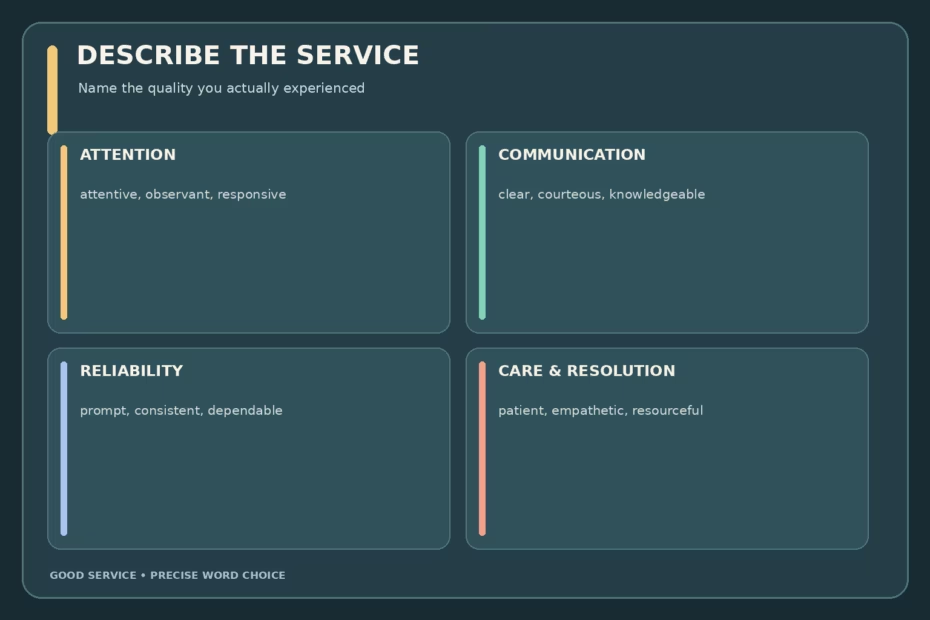
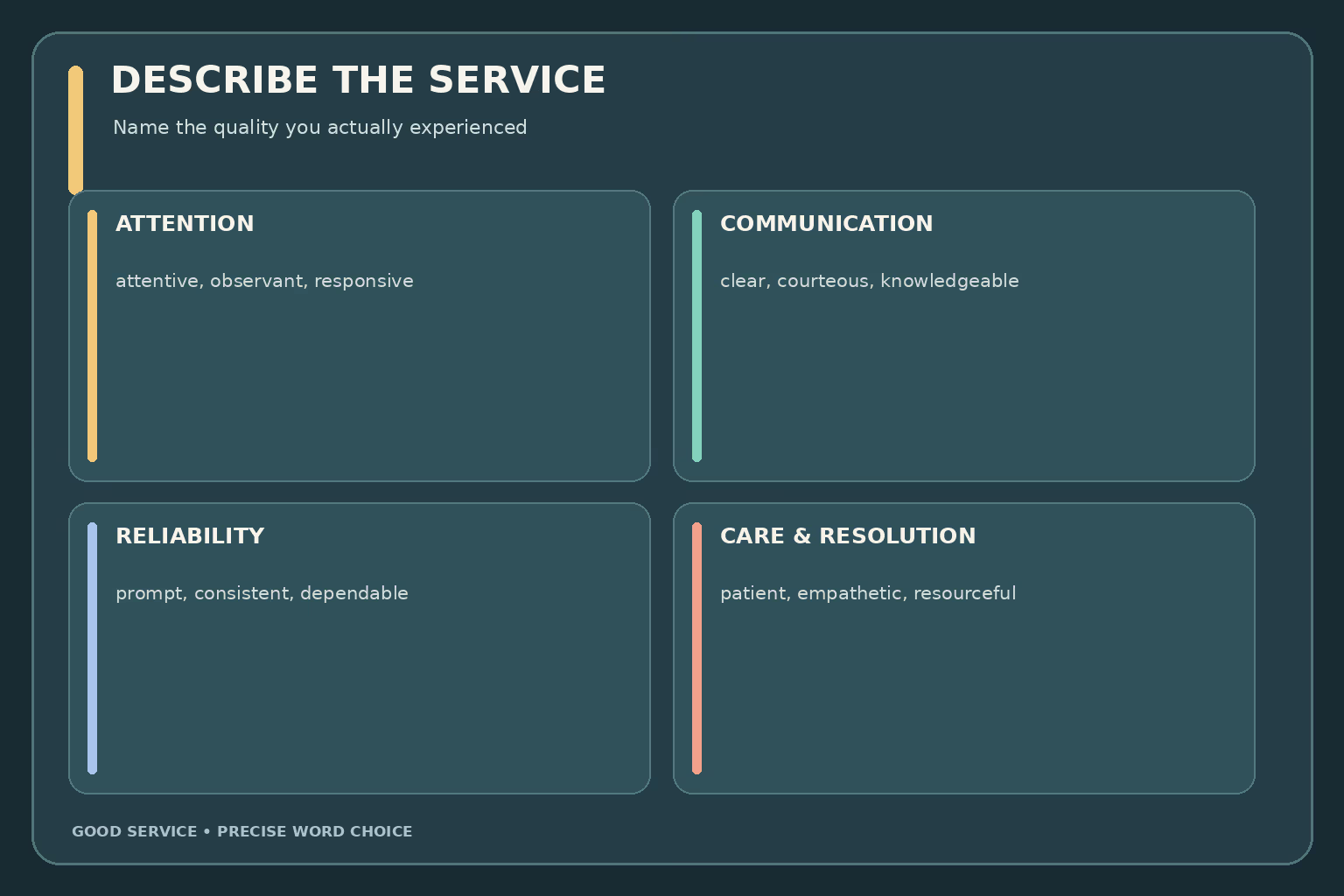
Good service can mean quick help, a clear explanation, careful listening, or a problem solved without needless effort. Choose an adjective that points to the part you experienced. Prompt describes timing; attentive describes noticing and responding to needs; knowledgeable describes command of relevant information. A specific detail makes any of these words more convincing.
For example, “The support agent was helpful” gives a positive impression. “The support agent was patient and explained each return option clearly” tells the reader what made the interaction helpful. If you are writing a review or workplace note, stick to what you saw, heard, or experienced rather than guessing about someone’s intentions.
Adjectives for Different Qualities of Service
Service has several dimensions. One interaction may be friendly but slow, or efficient but impersonal. Separating the qualities helps you give balanced praise and useful feedback.
- Attentive: notices requests or details and responds appropriately. “The attendant was attentive, bringing the requested menu before we had to ask again.”
- Responsive: reacts in a timely way to a question or need. “The repair desk was responsive and confirmed an appointment the same afternoon.”
- Knowledgeable: understands the service or product well enough to give relevant information. “The technician was knowledgeable about the two compatible parts.”
- Clear: explains information so it is easy to follow. “Her clear instructions helped me finish the form without another call.”
- Courteous: communicates with respect and consideration. “The representative remained courteous while checking the billing details.”
- Patient: gives someone time to explain or understand without showing irritation. “The librarian was patient as my child described what kind of book he wanted.”
- Empathetic: recognizes and responds with care to another person’s difficulty. “The agent was empathetic when I explained why the missed delivery mattered.”
- Efficient: handles a task with little wasted time or effort. “The clinic’s efficient check-in took only a few minutes.”
- Reliable: can be depended on to do what was agreed. “The contractor was reliable, arriving at the confirmed time on both visits.”
- Thorough: covers the necessary details carefully. “The mechanic gave a thorough explanation of the inspection.”
- Resourceful: finds a practical way to address a difficulty. “The coordinator was resourceful and found an accessible alternative room.”
- Accommodating: willing and able to adjust when a reasonable need or request arises. “The hotel staff was accommodating about storing our bags before check-in.”
Choosing the Right Word for the Situation
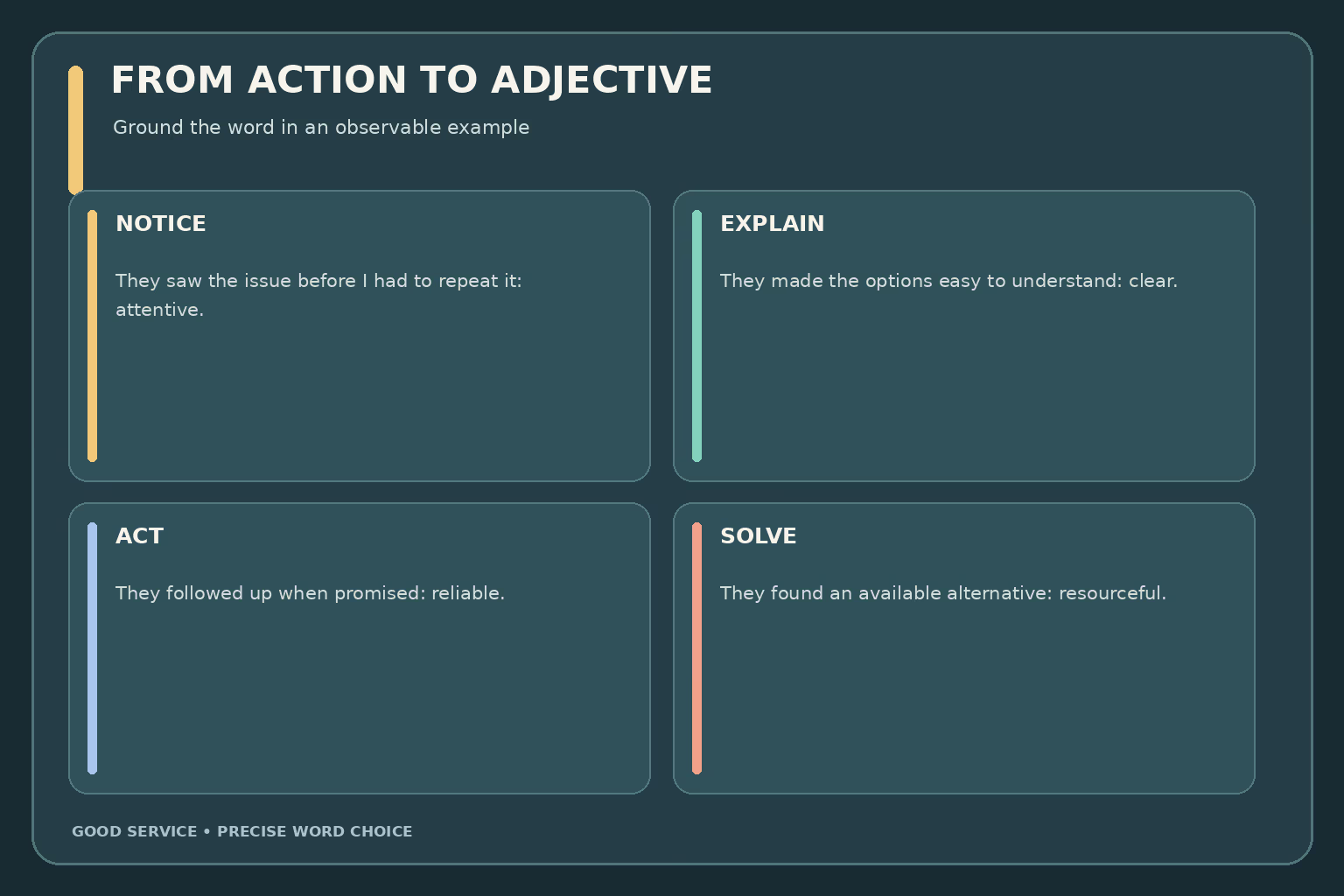
For speed: use prompt, timely, quick, or efficient when the response or process was fast. “Timely” is useful when help arrived when it was needed, even if it was not immediate. Speed alone does not prove the work was complete or accurate.
For dependability: use reliable, consistent, dependable, or punctual when someone followed through, delivered as promised, or arrived on time. One good experience may support “prompt”; a pattern across several visits better supports “consistent.”
For communication: choose clear, informative, candid, tactful, or reassuring according to what was said and how. “Clear” means easy to understand; “informative” means it gave useful facts; “tactful” describes considerate wording. Use “reassuring” for the effect the communication had on you, not as proof that an uncertain outcome was guaranteed.
For personal care: words such as warm, friendly, thoughtful, welcoming, and considerate describe the interpersonal tone or gestures. They are related but not identical: a staff member can be friendly without anticipating a need, and a reserved professional can still be highly considerate.
For problem-solving: capable, resourceful, practical, thorough, and effective describe different parts of resolving an issue. “Effective” fits when the solution worked; “thorough” fits when relevant details were checked; “resourceful” fits when the person found a workable path despite a constraint.
Good Service Adjectives by Industry
The best word depends on what matters in that setting. Use these suggestions as starting points, then support the description with an example.
- Restaurants: attentive, welcoming, knowledgeable, accommodating, efficient. “Our server was knowledgeable about the ingredients and checked whether the substitution worked.”
- Retail: helpful, patient, informative, low-pressure, responsive. “The associate was helpful without rushing me while I compared the two sizes.”
- Hotels and hospitality: welcoming, thoughtful, flexible, prompt, considerate. “The front desk was flexible and showed us where to wait while our room was prepared.”
- Customer support: empathetic, clear, responsive, resourceful, thorough. “The support team was thorough, confirmed the account details, and explained the next step.”
- Healthcare administration: respectful, clear, organized, attentive, compassionate. Describe the communication or coordination you experienced; do not use a service adjective as a claim about a clinical outcome.
- Home or repair services: punctual, careful, transparent, reliable, tidy. “The electrician was punctual, explained the estimate, and cleaned the work area.”
- Education and advising: supportive, encouraging, patient, informative, responsive. “The advisor was patient and helped me compare the course requirements.”
- Delivery and transportation: timely, courteous, dependable, communicative, careful. “The driver was courteous and sent a clear update when traffic changed the arrival time.”
Examples for Reviews, Thank-You Notes, and Feedback
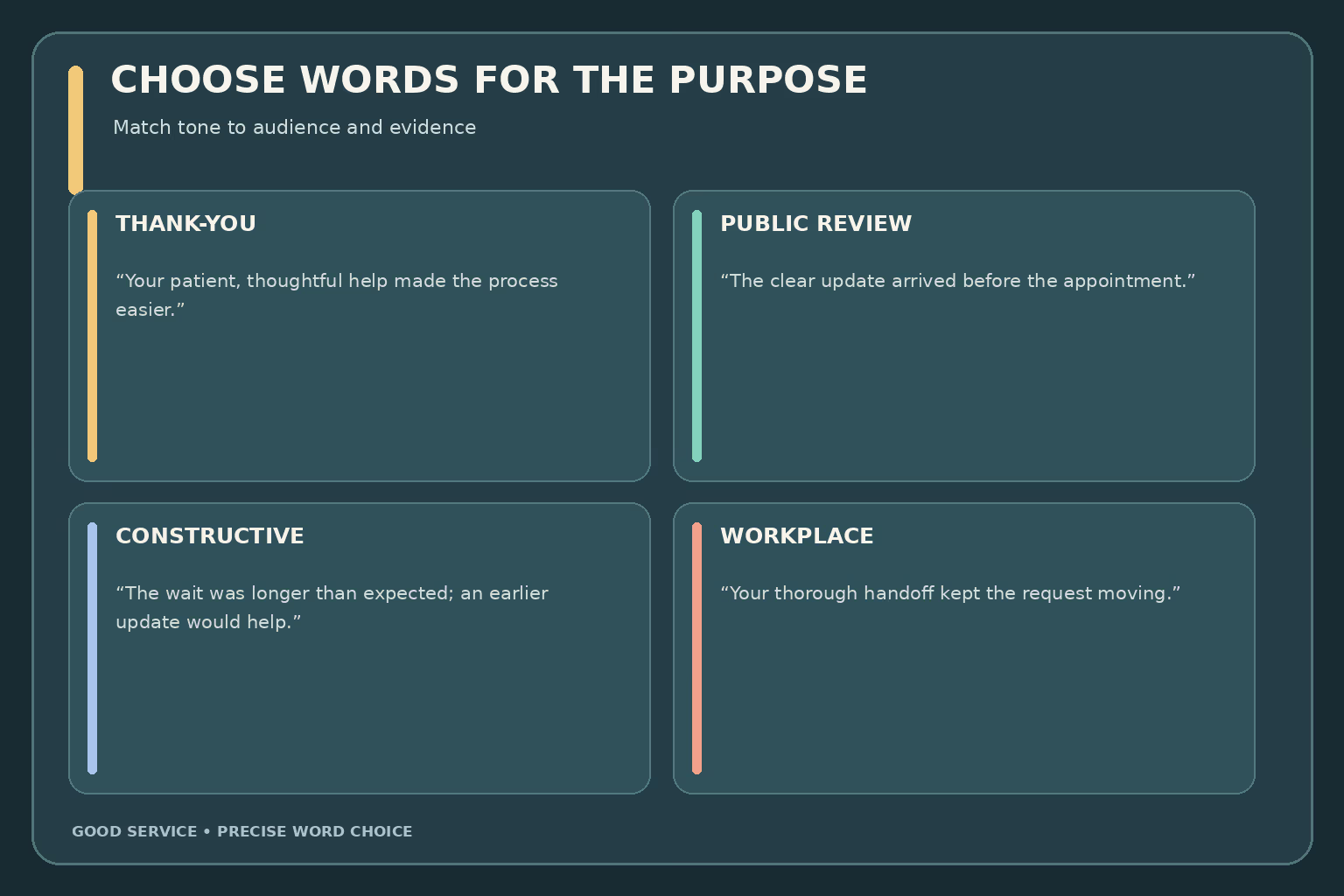
Short public review: “The staff was welcoming and efficient. I was checked in promptly, and the receptionist clearly explained where to go next.”
Detailed review: “When my order arrived with one missing item, the representative was responsive and courteous. They confirmed the details, arranged a replacement, and sent a follow-up message with the tracking information.”
Thank-you note: “Thank you for your thoughtful and patient help. Your clear explanation made a confusing process much easier for me.”
Workplace recognition: “Jordan’s thorough handoff and reliable follow-through kept the customer request moving while the account team was away.”
Constructive feedback: “The technician was knowledgeable and courteous. The appointment began 40 minutes late, and I did not receive an update; a message about the delay would have made the visit easier to plan.”
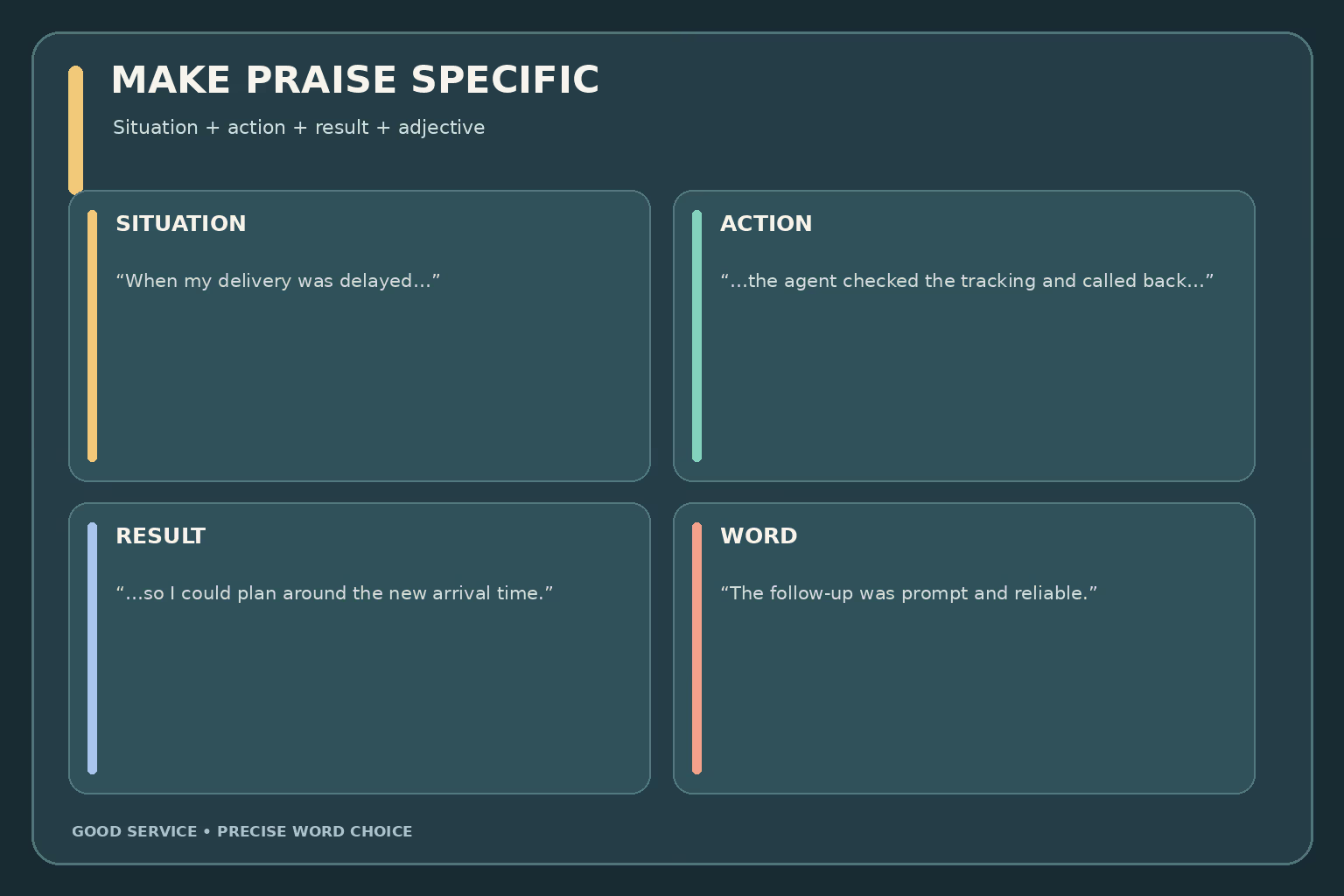
A useful pattern is situation + action + result + adjective: explain what happened, what the person did, how it affected the outcome, and then name the quality. “When the booking changed, the coordinator called promptly and arranged an alternative; the response was considerate and resourceful.” This structure works for praise as well as criticism.
How to Describe Poor or Mixed Service Fairly
Sometimes an interaction has both strengths and problems. Words such as delayed, confusing, inconsistent, inattentive, unhelpful, or impersonal can describe a concern, but pair them with a concrete example. “The response was delayed by two days” is more informative than “The service was terrible.” Explain the effect if it matters: “Because I did not receive an update, I could not confirm the delivery window.”
Keep the scope accurate. If one call went poorly, describe that call rather than labeling every employee or the entire business. If the issue was fixed later, mention the resolution too. Balanced wording helps the reader understand what happened and gives the organization a clearer opportunity to respond.
Make Praise Specific and Honest
Before publishing feedback, check that the adjectives match your firsthand experience. The U.S. Federal Trade Commission explains that consumer reviews express an evaluator’s experience with a service or business, and its guidance emphasizes that reviews should reflect real experiences. Do not invent details, imply that you used a service you did not use, or repeat a claim as fact when you cannot verify it. The FTC’s materials describe U.S. consumer-review rules; they are not a substitute for legal advice.
For a quick check, ask: What did the person do? Which adjective describes that action? What changed because of it? If you cannot answer those questions, choose a more modest word or add a concrete detail. The Cambridge English Dictionary defines responsive in terms of reacting quickly or positively; in a service review, you can make that idea specific by saying what request received a response and when.
Frequently Asked Questions
What is the best adjective for excellent customer service?
There is no single best word for every interaction. Responsive, attentive, knowledgeable, courteous, reliable, and helpful are useful when they accurately describe what happened. Add a specific example to show why the word fits.
What is another word for good service?
Depending on the quality, try excellent, attentive, efficient, dependable, courteous, thoughtful, or professional. These words describe different things, so choose the one that best matches the experience.
How do you compliment someone’s service?
Name the helpful action and its effect: “Your clear explanation and patient answers helped me make a confident choice.” Specific praise feels more personal than a general “Great service.”
How can I describe service that was fast but not helpful?
Separate the qualities: “The reply was prompt, but it did not answer my question.” This is clearer and fairer than treating speed as the same thing as a successful resolution.
Which adjectives work in a professional review?
Reliable, responsive, thorough, courteous, knowledgeable, and efficient often suit a professional tone. Support them with a work-related action or outcome, and avoid claims you cannot substantiate.
Sources
- Cambridge Dictionary: responsive (meaning and usage).
- Federal Trade Commission: How To Evaluate Online Reviews (considering the source and honesty of reviews).
- Federal Trade Commission: Consumer Reviews and Testimonials Rule — Questions and Answers (scope and distinctions among reviews and testimonials).
- Federal Trade Commission: Featuring Online Customer Reviews (principles for truthful review practices).

When it comes to receiving excellent service, we all want to be able to express our satisfaction and appreciation. That’s where adjectives come in handy. Adjectives are powerful words that allow us to paint a vivid picture of the quality of service we have received. In this article, I’ll be sharing a comprehensive list of adjectives that can be used to describe good service, along with examples to help you better understand their usage. Whether you’re writing a review, giving feedback, or simply want to express your gratitude, these adjectives will help you convey your experience in the most impactful way possible.
Good service is more than just efficient or polite; it goes above and beyond to make us feel valued and taken care of. That’s why having a variety of adjectives at our disposal is so important. From “attentive” to “impeccable,” these adjectives allow us to capture the essence of exceptional service. In this article, I’ll be exploring a range of adjectives that can be used to describe good service, providing you with a valuable resource to enhance your ability to express your satisfaction. So, let’s dive in and discover the perfect words to describe the outstanding service you’ve received.
How to Describe good service? – Different Scenarios
When it comes to describing good service, it’s important to be specific and use adjectives that capture the essence of the service experience. In different scenarios, there are different aspects of service to consider. Here are a few examples of how to describe good service in various situations:
Restaurant Service:
- Attentive: Servers are present, anticipate needs, and respond promptly.
- Knowledgeable: Staff can answer questions about the menu and make recommendations.
- Friendly and welcoming: Creates a warm and inviting atmosphere.
- Efficient: Orders are delivered accurately and quickly, without unnecessary delays.
- Accommodating: Staff is willing to go the extra mile to personalize the experience.
- Memorable: Interactions leave a positive and lasting impression.
Retail Service:
- Helpful and informative: Staff is readily available to answer questions and offer assistance.
- Patient and understanding: Takes time to listen to customer needs and concerns.
- Product knowledge: Staff has a good understanding of the products they sell.
- Non-pushy: Offers help without being overly sales-oriented.
- Efficient checkout process: Lines move quickly, and transactions are handled smoothly.
- Returns and exchanges handled easily: Creates a hassle-free experience.
Hospitality Service:
- Warm and welcoming: Creates a sense of arrival and comfort.
- Anticipatory service: Staff seems to know your needs before you even ask.
- Going above and beyond: Small touches that personalize the experience.
- Attentive to detail: Everything is clean, well-maintained, and presented beautifully.
- Flexible and accommodating: Staff readily adapts to requests and changes.
- Memorable experiences: Creates a positive and lasting impression of the location.
Customer Support:
- Empathetic and understanding: Listens actively and acknowledges the customer’s frustration.
- Knowledgeable and resourceful: Has the answers to questions or finds solutions quickly.
- Efficient and timely: Resolves issues promptly and minimizes wait times.
- Clear and concise communication: Explains information in a way that is easy to understand.
- Patient and polite: Remains professional and courteous even in challenging situations.
- Goes the extra mile: Offers additional support or resources to ensure customer satisfaction.
Remember, good service is not just about being efficient or polite. It’s about creating a positive experience for customers and making them feel valued. By using the right adjectives, you can accurately convey the level of service received in different situations.
In the table below, I’ve compiled a list of additional adjectives that can be used to describe good service in various industries:
| Industry | Adjectives |
|---|---|
| Healthcare | Compassionate, attentive, thorough |
| Banking | Reliable, trustworthy, responsive |
| Automotive | Knowledgeable, efficient, friendly |
| Education | Supportive, encouraging, informative |
Describing Words for good service in English
As a seasoned blogger with years of experience, I know the importance of using the right adjectives to describe the quality of service. When it comes to good service, there are a plethora of words that can accurately capture the experience. In this section, I’ll provide you with a selection of describing words that you can use when talking about good service in English.
Efficient: When a service is efficient, it means that it is quick and gets the job done smoothly. Efficiency is key in many industries, such as retail and customer support, where customers value their time.
Attentive: A good service is one where the staff is attentive, paying close attention to the needs and preferences of the customers. This level of attentiveness creates a personalized experience, making customers feel valued and heard.
Knowledgeable: Being knowledgeable is an important aspect of good service, especially in industries that require expertise and guidance, such as hospitality and specialized retail. Customers appreciate receiving accurate information and recommendations from staff who are well-informed.
Polite: Politeness goes a long way in delivering good service. When the staff is polite, it creates a friendly and welcoming atmosphere for customers. Simple acts of courtesy, such as greeting customers with a smile and using polite language, can greatly enhance the overall service experience.
Responsive: Good service is responsive service. When customers reach out for assistance or have a concern, a responsive staff will promptly address their needs. This shows customers that their concerns are being taken seriously and that their satisfaction is a top priority.
Flexible: In certain situations, flexibility is required to provide exceptional service. Whether it’s accommodating special requests, adjusting schedules, or finding creative solutions, a service that is flexible and adaptable is highly valued by customers.
Now that you have a handful of adjectives to describe good service in English, you can effectively convey the level of service received in different situations. Remember, providing good service goes beyond just being efficient or polite. It’s about creating a positive experience for customers and leaving them satisfied.
With that in mind, let’s move on to the next section where we’ll further explore adjectives for good service in specific industries.
Adjectives for good service
When it comes to describing good service, using the right adjectives is key. These words help us convey the level of service we have received and can make all the difference in creating a positive customer experience. In this section, I’ll explore some positive and negative adjectives that can be used to describe good service. Let’s dive in!
Positive Adjectives for Good Service with Examples
Positive adjectives can help us express the exceptional qualities we appreciate in good service. Here are twelve adjectives along with example sentences to illustrate their usage:
- Efficient: The waiter at the restaurant was efficient and brought out our food in no time.
- Attentive: The hotel staff was very attentive, making sure all our needs were met during our stay.
- Knowledgeable: The customer support representative was highly knowledgeable and answered all my questions promptly.
- Polite: The retail associate was incredibly polite, greeting each customer with a friendly smile.
- Responsive: The IT support team was quick and responsive in solving my computer issues.
- Flexible: The tour guide was flexible and accommodated our requests for sightseeing stops.
- Friendly: The staff at the theme park was exceptionally friendly, creating a welcoming atmosphere for visitors.
- Courteous: The airline attendant was very courteous and made our flight experience pleasant.
- Professional: The lawyer demonstrated a high level of professionalism in handling our case.
- Prompt: The delivery service was prompt in delivering our package right to our doorstep.
- Reliable: The car rental company was known for its reliable service, always having vehicles available when needed.
- Accommodating: The restaurant staff was incredibly accommodating, adapting the menu to meet our dietary needs.
Negative Adjectives for Good Service with Examples
While we strive for positive experiences, it’s important to acknowledge that sometimes we might encounter less-than-ideal service. Here are five negative adjectives that describe poor service, along with example sentences:
- Inattentive: The waitress seemed inattentive, rarely checking on our table throughout the meal.
- Unhelpful: The customer service representative was unhelpful, refusing to assist with my issue.
- Slow: The service at the coffee shop was slow, with long wait times to get our orders.
- Rude: The receptionist was incredibly rude, speaking to customers in a disrespectful manner.
- Inefficient: The transportation service was highly inefficient, causing delays and inconveniences for passengers.
Remember, it’s important to effectively communicate the level of service we receive. By using descriptive adjectives, we can provide others with a clear understanding of our experiences. In the next section, we will explore adjectives for good service in specific industries.
Synonyms and Antonyms with Example Sentences
Synonyms for good service
When it comes to describing good service, there are a variety of words that can be used to effectively convey the level of satisfaction. Here are some synonyms for “good service” that you can use:
- Excellent
- Outstanding
- Exceptional
- Superb
- Impeccable
These synonyms can help you elevate your descriptions of good service, allowing you to provide more detailed and engaging feedback. For example:
- “I received excellent service at the restaurant. The staff was attentive and friendly.”
- “The hotel provided an outstanding level of service. The room was clean and the staff went above and beyond to meet our needs.”
- “I had an exceptional experience at the spa. The therapists were skilled and the atmosphere was relaxing.”
Using these synonyms will not only enrich your vocabulary but also enhance the impact of your statements, making them more impactful and memorable.
Antonyms for good service
In contrast to the positive adjectives used to describe good service, there are also antonyms that can be used to portray a less satisfactory experience. Here are some antonyms for “good service” that you can use to express disappointment or dissatisfaction:
- Poor
- Terrible
- Unacceptable
- Subpar
- Disappointing
By using these antonyms, you can effectively communicate when your expectations have not been met. For example:
- “I received poor service at the store. The staff was unhelpful and rude.”
- “The airline provided a terrible level of service. The flight was delayed and the staff was unprofessional.”
- “I had an unacceptable experience at the hotel. The room was dirty and the staff was indifferent to my concerns.”
By employing these antonyms, you can provide a balanced assessment of the service received and help others make informed decisions.
Remember, using adjectives to describe good service is key in effectively communicating your experiences. By selecting the right words and synonyms, you can enhance the impact of your feedback and make it more memorable to others.
Conclusion
Describing good service is essential in effectively communicating our experiences. In this article, I have discussed the significance of using adjectives to describe the level of service received. By utilizing positive adjectives, such as “excellent,” “outstanding,” and “exceptional,” we can convey the exceptional quality of service we have encountered.
Conversely, negative adjectives like “poor,” “terrible,” and “unacceptable” can accurately depict instances of poor service. These words enable us to provide a balanced assessment and help others make informed decisions.
Using synonyms and antonyms for “good service” allows us to express our experiences more precisely. By incorporating these descriptive words into our conversations and reviews, we can effectively convey the level of service received and help others gauge the quality of a particular establishment.
By utilizing adjectives to describe good service, we can effectively communicate our experiences and assist others in making informed decisions. So, let’s make use of these powerful words to accurately depict the service we receive and contribute to a more transparent and reliable service industry.


