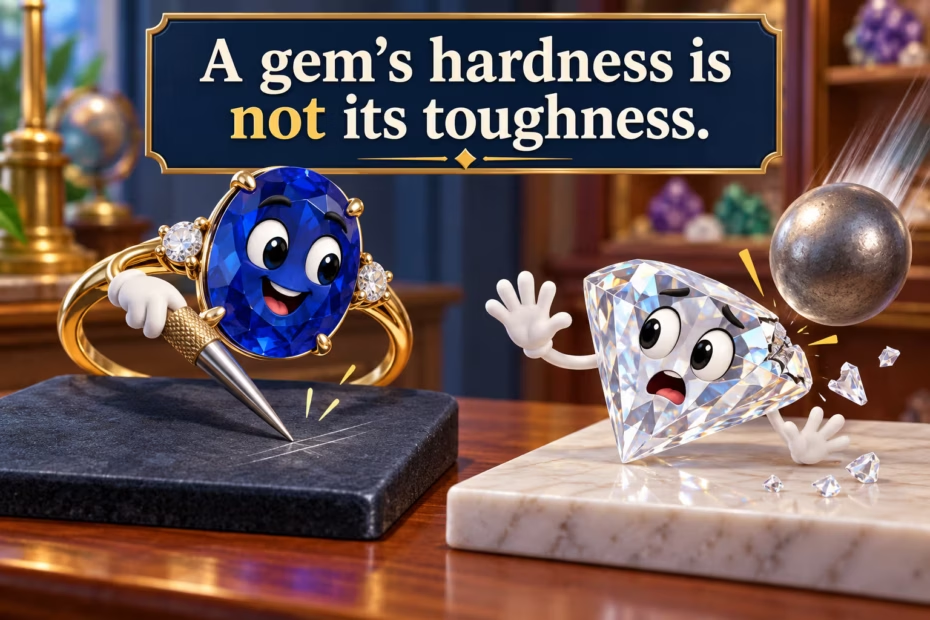
Adjectives for jewelry describe its style, shape, material, surface, condition, or the impression it creates. Words such as delicate, geometric, gold-plated, polished, tarnished, and ornate make different claims. Choose a term that matches what you can see or verify: a gemstone’s hardness alone does not establish its toughness, and “waterproof” or “nickel-free” should not be guessed from appearance.
At a glance
- Describe visible features such as shape, color, finish, setting, and scale separately from material claims.
- Use terms such as gold-plated, sterling silver, or 14-karat gold only when the item’s composition or marking supports them.
- Gem durability includes resistance to scratching, breaking, and environmental effects; hardness covers scratching alone.
- Cleaning advice depends on the gem, treatment, setting, and finish; pearls and some other materials should not go in ultrasonic cleaners.
- Words such as beautiful, luxurious, and valuable express a perspective or claim; they are not objective measurements by themselves.
How Do You Choose a Precise Adjective for Jewelry?
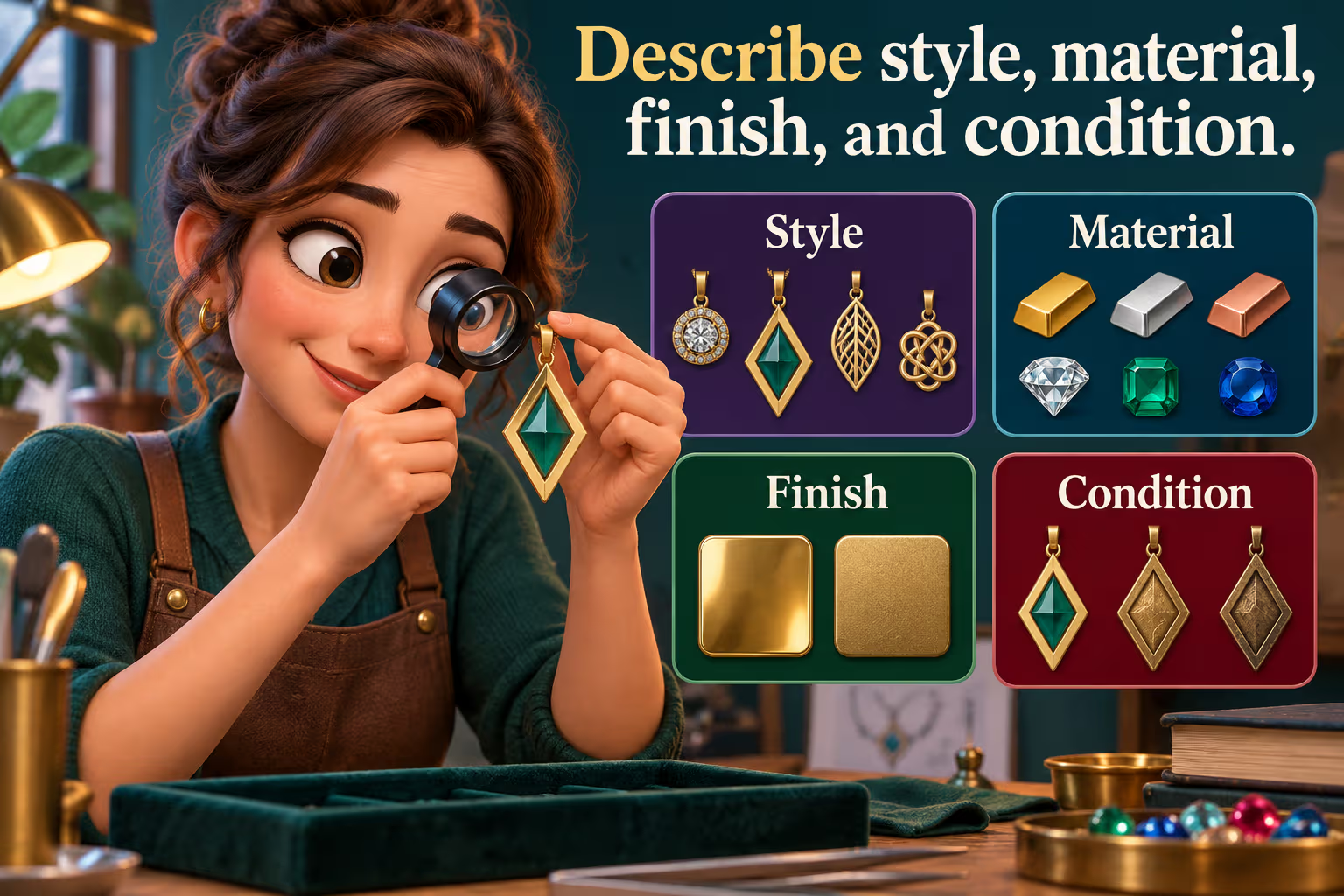
Start with the feature you want a reader to picture, then select a word for that feature. A ring can be oval-cut in shape, polished in finish, yellow-gold in color, and delicate in appearance at the same time. Keeping those dimensions distinct makes a description more useful than stacking broad praise words.
| What you are describing | Possible adjectives | Example | What to check |
|---|---|---|---|
| Shape and design | Geometric, sculptural, asymmetrical, floral, minimalist | “The pendant has an asymmetrical, sculptural shape.” | Describe the visible design rather than implying a maker or period. |
| Scale and visual weight | Delicate, dainty, chunky, oversized, petite | “A delicate chain holds a small oval pendant.” | These are relative impressions; add a measurement when size matters. |
| Surface and finish | Polished, matte, brushed, hammered, textured, faceted | “The brushed band has a low-shine finish.” | Distinguish the metal’s finish from a gemstone’s cut or facets. |
| Color and light | Colorless, vivid, iridescent, translucent, reflective | “The opal shows iridescent flashes against a dark setting.” | Lighting changes appearance; do not infer origin or treatment from color alone. |
| Composition | Gold, silver, platinum, pearl-set, gemstone-set | “The pendant is marked 14K gold.” | Use material names only when labels, records, or testing support them. |
| Condition | Tarnished, scratched, chipped, intact, worn | “The clasp is intact, but the silver surface is tarnished.” | Describe the observed area and avoid implying the whole piece is damaged. |
For a clear listing or gift note, combine one or two visual details with a verifiable material detail: “a polished silver-tone necklace with a teardrop-shaped blue glass pendant.” “Silver-tone” describes appearance; it does not promise that the necklace is made of sterling silver.
Which Jewelry Material and Quality Terms Need Evidence?
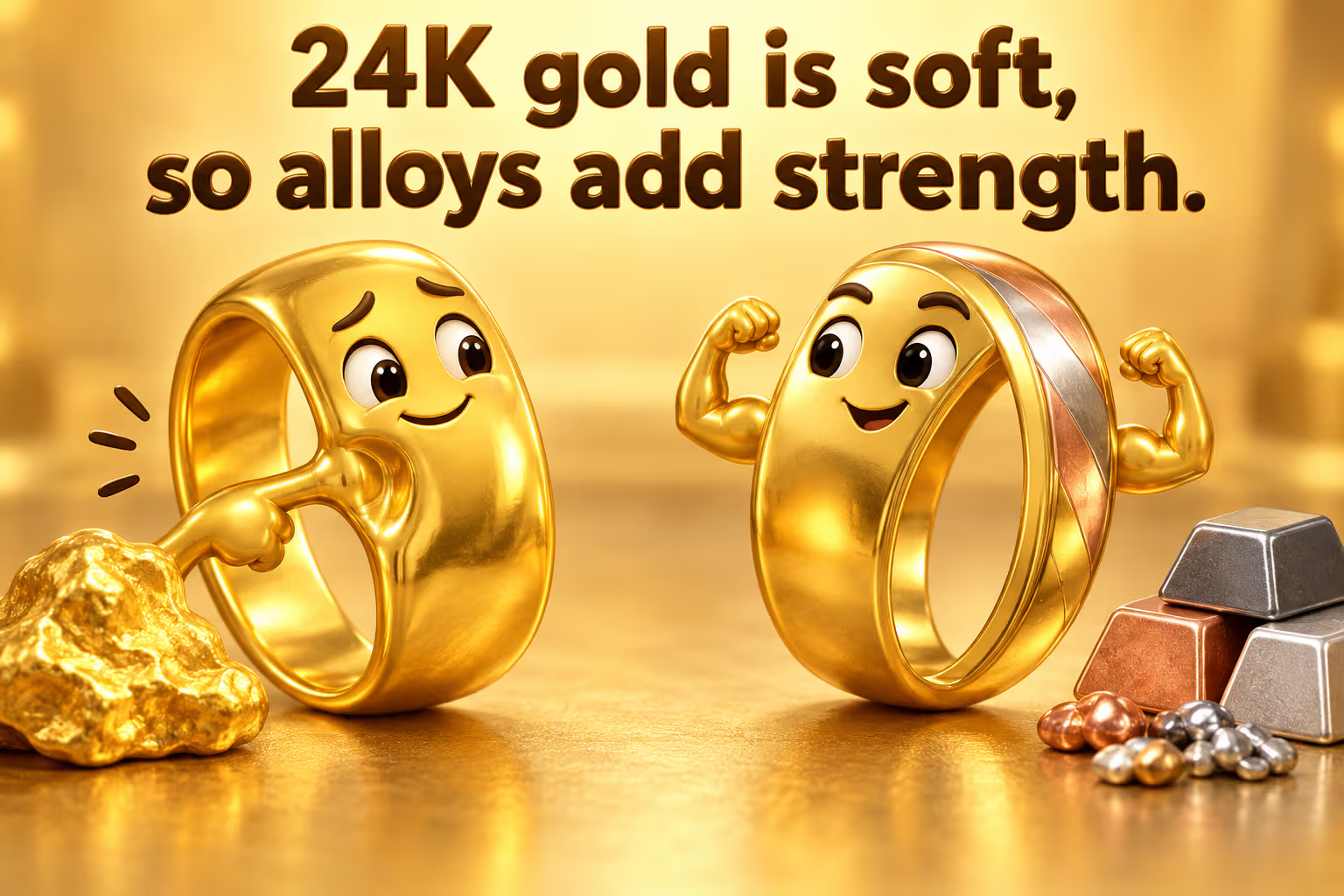
Material and quality adjectives should match reliable product information, not visual impression alone. A gold-colored piece may be gold alloy, gold-plated, gold-filled, or another material with a similar appearance. The U.S. Federal Trade Commission explains that karat marks describe gold content: 18K means 18 parts gold out of 24, while 14K means 14 parts gold out of 24. Pure 24K gold is soft, so it is often alloyed for jewelry.
The FTC also distinguishes “solid gold” from hollow construction and describes different gold-layer processes and markings. When you do not know the composition, choose a visual phrase such as gold-tone or silver-colored rather than asserting solid, genuine, nickel-free, or waterproof. Those words can imply a testable property. A product label, maker’s specification, reliable assay, or other evidence should support it.
The FTC consumer guide to platinum, gold, and silver jewelry offers practical information about karat marks, plating, and metal descriptions. Its scope is U.S. consumer guidance; requirements and hallmarking systems differ across jurisdictions.
Does “Hard” Mean a Gemstone Is Durable?
No. In gemology, hardness concerns resistance to scratching, while toughness concerns resistance to breaking, chipping, or cleaving. Stability describes how a gem responds to factors such as heat, light, chemicals, or humidity. A gemstone may resist scratches yet still chip if struck in a vulnerable direction, so hard and durable are not interchangeable.
The Gemological Institute of America explains durability through these separate properties and cautions that setting, repair, and cleaning decisions depend on the gem and its condition. For jewelry copy, use a specific verified fact—such as a documented gemstone name or cut—instead of promising that a piece is “indestructible,” “scratch-proof,” or suitable for every activity.
GIA’s overview of gemstone durability discusses hardness, toughness, and stability. GIA’s Mohs scale guide also notes that the scale ranks scratch resistance and that its intervals are not equal steps in absolute hardness.
Which Adjectives Describe Jewelry Condition and Care?
Condition words should name the observed change and, when useful, its location: “the clasp is scratched,” “the silver is tarnished,” or “one prong looks loose.” These statements are clearer than broad labels such as old, damaged, or poor. A jeweler can assess whether a setting is secure or a surface treatment needs specialist care.
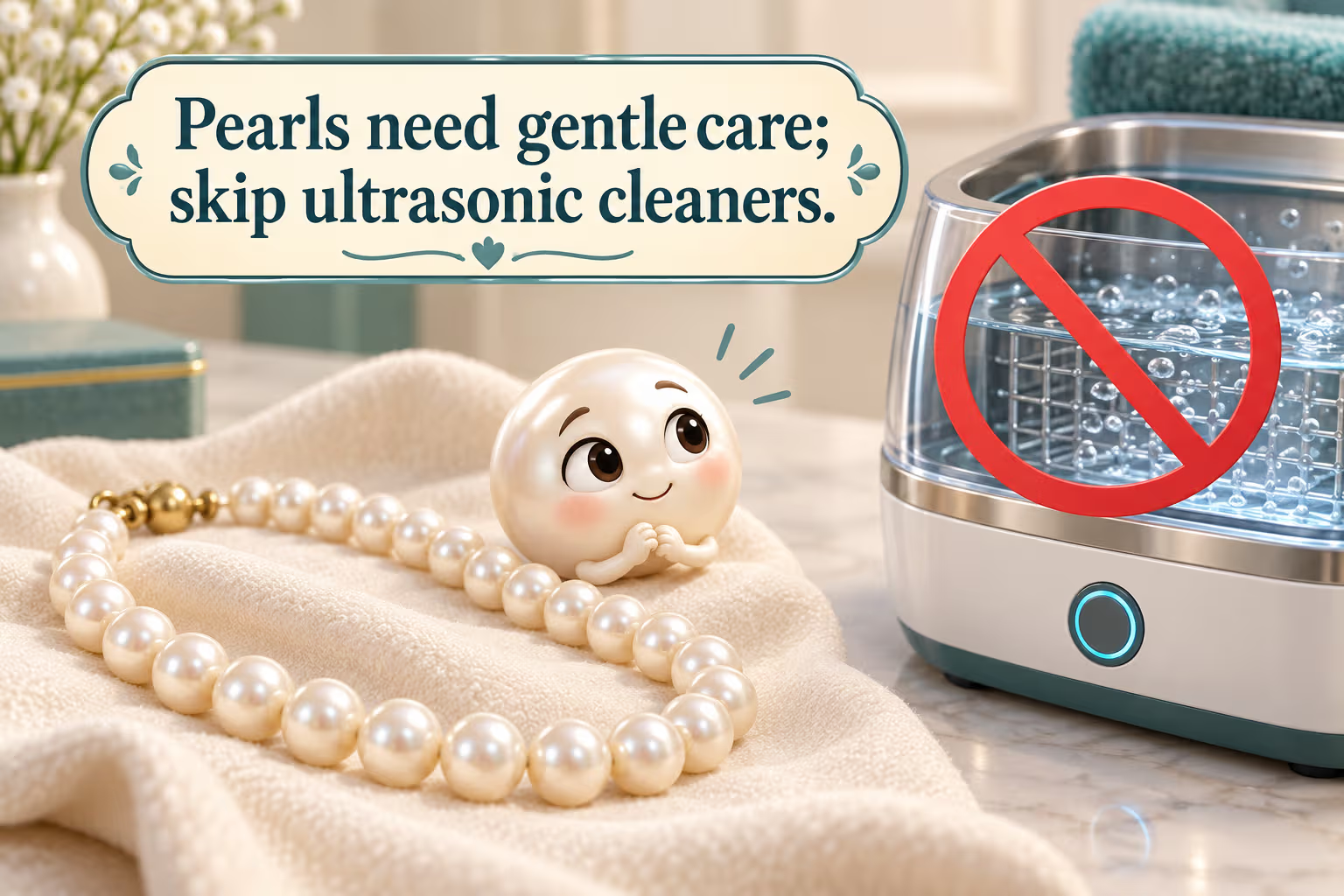
Do not treat water-resistant, waterproof, or easy-to-maintain as universal properties of a piece. Water exposure can affect different metals, finishes, adhesives, and gemstones in different ways. GIA warns that ultrasonic cleaning is unsuitable for pearls and several other organic gem materials, and that some treated, fractured, coated, or heat-sensitive gems can also be damaged. When the gem or treatment is unknown, ask a qualified jeweler and follow care information for the specific piece.
GIA’s ultrasonic-cleaner guidance recommends checking the gem and treatment first; it identifies pearls, coral, amber, and other materials that should not be placed in an ultrasonic machine. Avoid describing a piece as carefree or maintenance-free unless its maker provides a suitably specific basis.
Are “Beautiful,” “Luxurious,” and “Valuable” Objective Descriptions?
Not by themselves. Beautiful and elegant express a person’s aesthetic judgment; they can work well in a review or gift message when presented as a viewpoint. Luxurious may signal style or positioning, but it does not prove price, rarity, or craftsmanship. Valuable is especially context-dependent: resale value depends on factors such as material, condition, provenance, market, and documentation.
For product descriptions, pair a subjective word with a concrete reason: “I find the minimal pendant elegant because its smooth outline has no additional ornament.” If the writing makes a commercial claim about metal content, gemstone quality, treatment, or value, state the documented basis and avoid implying more than the evidence supports. The FTC’s Jewelry Guides say marketers should truthfully represent product attributes, including metallic content, quality, treatment, durability, and value.
How Can You Describe Jewelry in One Sentence?
- Name the item: identify the ring, bracelet, necklace, earring, or other piece.
- Choose visible details: mention shape, scale, color, finish, setting, or texture.
- Add verified composition: use a material adjective only when a label or other reliable source supports it.
- Keep opinion clear: signal personal impressions with phrases such as “to me” or “the reviewer describes it as.”
- Describe condition specifically: identify the affected part and avoid unsupported care or durability promises.
For example: “The vintage-style pendant has a polished oval setting and a vivid green stone; the seller identifies the metal as 14K gold.” This sentence separates visible design from information attributed to the seller. “Vintage-style” describes the look, while “vintage” alone can imply age or provenance.
The original alphabetized word lists and examples below are retained in full. Their categories are a starting point: a word may fit more than one feature, and a label such as “positive,” “synonym,” or “antonym” does not make every term interchangeable. Check a word’s meaning and word class before using it as a substitute.
When it comes to jewelry, there are many different adjectives that can be used to describe it. For example, jewelry can be delicate or chunky, understated or ostentatious. It can be made from a variety of materials, including gold, silver, platinum, and diamonds.
And it can be set with a wide range of gemstones, from the classic ruby or sapphire to more unusual stones such as amethyst or opal. Whether you’re looking for the perfect adjective to describe your own jewelry collection or you’re searching for the perfect gift for a special someone, this list of adjectives for jewelry will help you find the perfect word.
Adjective For Jewelry
It’s not uncommon to have a hard time adjectives for jewelry. adjectives, especially adjectives for describing people, can be difficult to remember. But with this list of adjectives for jewelry, you’ll never be at a loss for words again. From simple adjectives like “sparkly” and “shiny” to more complex ones like “majestic” and “opulent,” this list has everything you need to describe any piece of jewelry.
Whether you’re trying to capture the beauty of a diamond necklace or the grandeur of a royal tiara, you’ll find the perfect adjective on this list. So next time you’re at a loss for words, refer to this list of adjectives for jewelry. You’re sure to find the perfect way to describe any piece of jewelry.
A
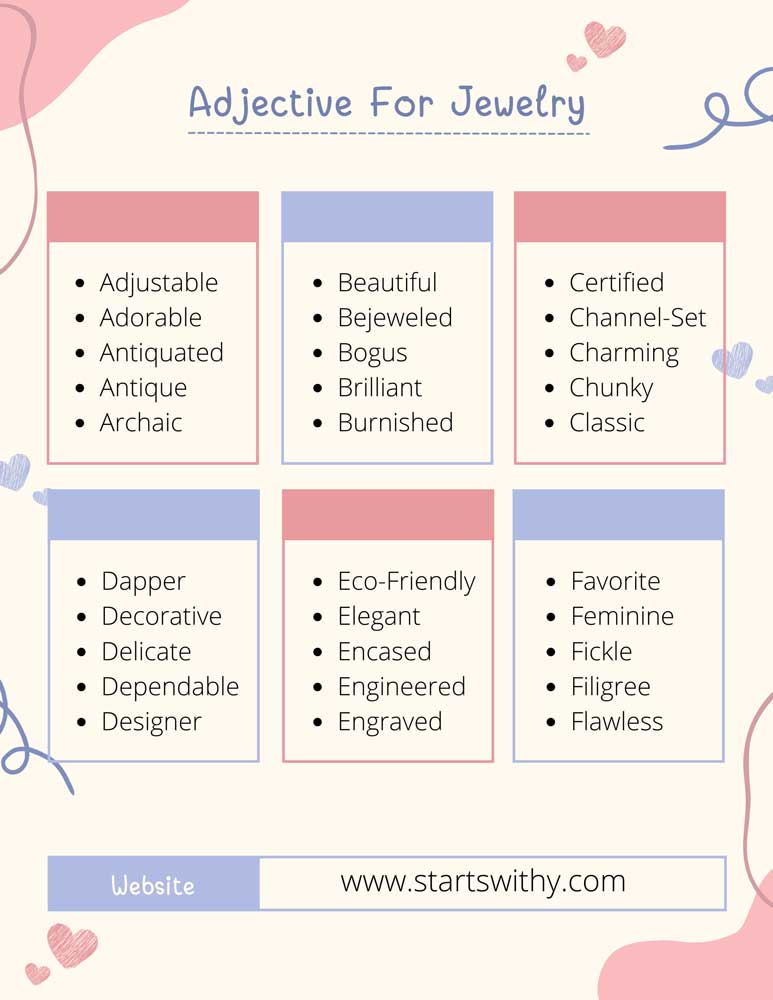
| Adjustable | Adorable | Antiquated |
| Antique | Archaic | Artisan |
| Artisanal | Attention-Getting | Authentic |
B
| Bangle-Style | Beaded | Beautiful |
| Bejeweled | Black | Bogus |
| Bold | Brilliant | Burnished |
C
| Carved | Casual | Certain |
| Certified | Channel-Set | Charming |
| Cheap | Chic | Chunky |
| Classic | Clustered | Colorful |
| Comfortable | Comfy | Complex |
| Contemporary | Cool | Coordinating |
| Coral | Corrosion-Resistant | Cosmic |
| Costly | Costume | Coveted |
| Crackled | Cut-Out | Cute |
| Cutting-Edge |
D
| Dainty | Dangling | Dangly |
| Dapper | Deadly | Decorative |
| Delicate | Dependable | Designer |
| Detailed | Discounted | Distinctive |
| Dramatic | Durable |
E
| Easy-To-Maintain | Eco-Friendly | Edgy |
| Elegant | Encased | Engineered |
| Engraved | Erotic | Etched |
| Everyday | Exceptional | Exciting |
| Exotic | Expensive-Looking | Exquisite |
| Eye-Catching |
F
| Faceted | Fancy | Fashion-Forward |
| Fashionable | Fashioned | Favorite |
| Female | Feminine | Fickle |
| Filigree | Fine | Finely Detailed |
| Finished With | Flattering | Flawless |
| Flexible | Flirty | Floral |
| Functional | Funky |
G
| Genuine | Glamorous | Glittering |
| Glitzy | Gold | Gold-Filled |
| Gold-Plated | Gold-Toned | Golden |
| Gorgeous | Graceful | Gunmetal |
H
| Half-Priced | Hammered | Hand-Carved |
| Hand-Crafted | Hand-Finished | Hand-Hammered |
| Hand-Wrapped | Handcrafted | Handmade |
| Hassle-Free | Heavy | High-Class |
| High-Performance | Hinged | Hot |
| Hypoallergenic |

I | J | L
| Inexpensive | Inlaid | Innovative |
| Interesting | Intricate | Iridescent |
| Jewel-Tone | Jobher | Keepsake |
| Kiln-Fired |
L
| Large | Laser-Cut | Latest |
| Lead-Free | Lightweight | Long-Lasting |
| Lovely |
M
| Marbled | Marketable | Marquise-Cut |
| Masculine | Massive | Men’S |
| Mens | Metallic | Minimal |
| Minimalist | Modern | Mosaic |
| Multi-Faceted | Multistrand |
N | O
| Nice | Nickel-Free | Norwegian |
| One-Of-A-Kind | Opaque | Open-Worked |
| Original | Ornamental | Ornate |
P
| Period | Pierced | Pink |
| Plated | Platinum | Polished |
| Portable | Pre-Formed | Precious |
| Precise | Premium-Grade | Preppy |
| Priceless | Princess-Cut | Prismatic |
| Professional | Purposed |
R
| Radiant | Reflective | Reliable |
| Rich | Rocker-Style | Roman |
| Rough-Cut | Round-Cut | Rugged |
| Rust-Resistant |

S
| Sale-Priced | Sassy | Scratch-Resistant |
| Sculptural | Semi-Translucent | Set |
| Sexy | Sham | Shimmering |
| Shoppable | Silver | Silver-Tone |
| Simple | Sleek | Slender |
| Slip-On | Small | Smoky |
| Smooth | Snag-Free | Solid |
| Sophisticated | Sparkling | Sparkly |
| Sporty | Streamlined | Striking |
| Structural | Studded | Stunning |
| Stylish | Subtle | Subtlest |
| Superior | Supportive | Suspended |
T
| Tapered | Tarnished | Teardrop |
| Textured | Themed | Timeless |
| Tiny | Top-Of-The-Line | Trendsetting |
| Tribal | Two-Tone |
U | V
| Ukrainian | Unique | Valuable |
| Versatile | Victorian | Vintage |
| Visible |
W
| Wardrobe-Friendly | Water-Resistant | Waterproof |
| Wear-Anywhere | Whimsical | Women’S |
| Wooden | Wrapped | Wrought |
When it comes to jewelry, finding the right words to describe its beauty and allure can sometimes be a challenge. Whether you’re a jewelry lover or a writer in need of inspiration, this article is here to help. In this guide, I’ll be sharing a collection of adjectives that will elevate your descriptions of jewelry to a whole new level. From sparkling diamonds to delicate pearls, get ready to discover the perfect words to capture the essence of these exquisite adornments.
Have you ever been captivated by the brilliance of a diamond or the intricate details of a vintage necklace? Jewelry has a way of evoking emotions and making a statement. That’s why it’s essential to have a repertoire of adjectives at your disposal to truly bring these pieces to life. In this article, I’ll be showcasing a wide range of descriptive words that will enable you to paint a vivid picture of any piece of jewelry. So, whether you’re writing a product description or simply want to express your admiration, get ready to explore the world of adjectives for jewelry.
How to Describe jewelry? – Different Scenarios
- Product Descriptions: When writing product descriptions for jewelry, it’s essential to highlight its unique features, materials, and craftsmanship. Use adjectives that evoke a sense of luxury, such as “elegant,” “sophisticated,” or “exquisite.” You can also describe the design elements, such as “intricate filigree,” “sparkling gemstones,” or “dainty pendant.” Here are some examples:
| Description | Adjectives |
|---|---|
| This necklace features an elegant pendant. | elegant |
| The ring showcases intricate filigree details. | intricate, delicate, ornate |
| These earrings are adorned with sparkling diamonds. | sparkling, dazzling |
- Admiration and Emotion: Jewelry has the power to evoke strong emotions and make a statement. To express admiration, use adjectives like “stunning,” “awe-inspiring,” or “breathtaking.” If you want to convey a sense of sentimentality, consider words like “timeless,” “cherished,” or “sentimental.” Here are some examples:
| Sentence | Adjectives |
|---|---|
| I’m in awe of the stunning necklace she’s wearing. | stunning, mesmerizing |
| This bracelet is a cherished family heirloom. | cherished, sentimental |
| The jewelry collection is a testament to her timeless style. | timeless, elegant |
- Fashion and Style: Jewelry is often used as a fashion accessory to enhance an outfit. Use descriptive words that complement the wearer’s style, such as “trendy,” “elegant,” or “minimalist.” Consider the occasion and the overall aesthetic when choosing adjectives. Here are some examples:
Read: Describing Canada: Adjectives and Examples
| Sentence | Adjectives |
|---|---|
| She paired her trendy dress with delicate gold earrings. | trendy, delicate |
| The necklace adds an elegant touch to her evening gown. | elegant, sophisticated |
| His minimalist style is accentuated by the sleek silver ring. | minimalist, |
Describing Words for jewelry in English
When it comes to describing jewelry, it’s important to use adjectives that capture its unique qualities and appeal. Whether you’re writing a product description or simply discussing jewelry in general, using the right words can make all the difference. Here are some adjectives that can help you effectively describe jewelry:
- Elegant: This is perfect for describing jewelry that exudes sophistication and refinement. Use it to highlight pieces that are tastefully designed and have a classic appeal.
- Sparkling: Use this word to describe jewelry that shines and catches the light, creating a dazzling effect. It’s great for highlighting the brilliance of gemstones or the glitter of diamonds.
- Exquisite: This word is ideal for describing jewelry that is intricately crafted and displays exceptional attention to detail. It conveys a sense of beauty and craftsmanship.
- Unique: Use this adjective to describe jewelry that is one-of-a-kind or stands out from the rest. It emphasizes the individuality and specialness of a piece.
- Delicate: When describing jewelry with a delicate appearance or design, this word is a perfect choice. It evokes a sense of fragility and elegance.
- Statement: This adjective is used when describing bold and eye-catching jewelry that makes a strong visual impact. It’s great for pieces that are meant to be noticed and start conversations.
- Timeless: Use this word to describe jewelry that has a classic and enduring appeal. It suggests that a piece will remain stylish and relevant for years to come.
Remember, the key is to use descriptive words that accurately capture the essence of the jewelry. By using appropriate adjectives, you can paint a vivid picture in the reader’s mind and help them appreciate the beauty and uniqueness of each piece.
| Adjective | Example Sentence |
|---|---|
| Elegant | This necklace features an elegant design with pearls cascading down the chain. |
| Sparkling | The ring is adorned with a sparkling diamond at its center, catching the light from every angle. |
| Exquisite | The bracelet showcases an exquisite combination of intricate filigree work and vibrant gemstones. |
| Unique | This pendant is truly unique, featuring a rare gemstone that is unlike anything you’ve seen before. |
Read: Describing Words for Job Skills: Examples & Adjectives
Adjectives for Jewelry
Adjectives for jewelry
When it comes to describing jewelry, using the right adjectives can make all the difference in capturing its beauty and allure. The right words can paint a vivid picture and help the reader truly appreciate the unique qualities of each piece. In this section, I’ll explore both positive and negative adjectives that can be used to describe jewelry, along with example sentences to illustrate their usage.
Positive Adjectives for Jewelry
- Elegant: The necklace was adorned with elegant diamonds, sparkling in the light.
- Sparkling: The earrings were encrusted with sparkling gemstones that caught everyone’s attention.
- Exquisite: The exquisite craftsmanship of the ring was evident in its intricate details.
- Unique: She wore a unique pendant that showcased her individuality and style.
- Delicate: The bracelet was made of delicate filigree, adding a touch of femininity.
- Statement: The oversized, bold design of the necklace made it a true statement piece.
- Timeless: The vintage brooch had a timeless charm that transcended trends.
- Tarnished: The old silver ring had become tarnished over time, but it added to its vintage appeal.
- Dull: The gemstones on the bracelet looked dull and lacked the usual brilliance.
- Tacky: The plastic beads on the necklace gave it a tacky and cheap appearance.
- Bulky: The bulky size of the earrings made them uncomfortable to wear for long periods.
- Gaudy: The necklace was adorned with gaudy and flashy rhinestones that overwhelmed the design.
Remember, the right choice of adjectives can elevate your descriptions and make the jewelry come alive in the minds of your readers. Whether you want to highlight its elegance, uniqueness, or timelessness, the right words can truly make a difference.
Synonyms and Antonyms with Example Sentences
Synonyms and Antonyms with Example Sentences
Synonyms for Jewelry
When it comes to describing jewelry, having a variety of synonyms at your disposal can help you create engaging and vivid descriptions. Here are some synonyms for jewelry that can enhance your writing:
| Synonym | Definition | Example Sentence |
|---|---|---|
| Accessory | An item worn or used to complement an outfit or enhance appearance | The pearl necklace is the perfect accessory for her evening gown |
| Trinket | A small decorative item, often of little value | She adorned her wrist with a delicate silver trinket bracelet |
| Bauble | A small, showy piece of jewelry | The festival dancers wore colorful baubles on their costumes |
Read: Discover Adjectives for Volcano – With Examples
Using these synonyms for jewelry can add depth and variety to your descriptions, allowing readers to envision the pieces in a more captivating way.
Antonyms for Jewelry
While positive adjectives can enhance the appeal of jewelry, it’s also important to consider using antonyms to describe pieces that may not be as desirable. Here are some antonyms for jewelry that can help you create a more comprehensive range of descriptions:
| Antonym | Definition | Example Sentence |
|---|---|---|
| Tarnished | Dull or discolored due to age or exposure | The once-shiny silver ring now appeared tarnished and worn |
| Dull | Lacking shine or brightness | The lackluster gemstone failed to capture the light’s sparkle |
| Tacky | Cheap, gaudy, or in poor taste | The oversized, brightly colored earrings were considered tacky |
| Bulky | Large and heavy | The chunky bracelet felt bulky on her delicate wrist |
| Gaudy | Flashy, showy, and lacking sophistication | She chose not to wear the gaudy rhinestone necklace |
By incorporating both synonyms and antonyms when describing jewelry, you can create a more nuanced and comprehensive portrayal of each piece. This allows readers to have a better understanding of its appeal or lack thereof.
Remember, the right choice of adjectives can bring your descriptions to life and captivate your readers’ imagination. Use these synonyms and antonyms as tools to refine your writing and make your descriptions more engaging and accurate.
Describing jewelry with the right adjectives is essential in capturing its true essence. Throughout this article, we have explored the significance of using descriptive words to enhance our understanding and appreciation of jewelry. From synonyms like accessory, trinket, and bauble to antonyms such as tarnished, dull, tacky, bulky, and gaudy, we have discovered a range of adjectives that can be used to portray jewelry in different ways.
By incorporating both synonyms and antonyms, we can create a more nuanced and comprehensive portrayal of each piece of jewelry. This allows us to convey its unique qualities, beauty, and style accurately. Whether we are describing a delicate necklace, a sparkling ring, or an elegant bracelet, the right adjectives help us paint a vivid picture in the minds of our readers.
Remember, when it comes to describing jewelry, the words we choose matter. So, let’s continue to explore the vast array of adjectives available to us and use them to bring the brilliance and allure of jewelry to life.
Final verdict
As you can see, there are many adjectives that can be used to describe jewelry. Whether you’re looking for a word to describe a piece of antique jewelry or a simple necklace, there’s an adjective that will fit the bill.
In addition to being beautiful, jewelry can also be sentimental, valuable, or simply fun. No matter what adjectives you choose to describe your jewelry, one thing is for sure: it’s always an important part of your personal style.
Frequently Asked Questions About Adjectives for Jewelry
What are good adjectives to describe jewelry?
Useful adjectives depend on the feature: delicate or chunky for visual scale, geometric or floral for design, polished or matte for finish, and vivid or iridescent for color and light. Use material terms such as gold or sterling silver only when reliable product information supports them. Combine distinct features rather than several broad praise words.
What is the difference between gold-tone and gold-plated?
“Gold-tone” describes a gold-like appearance and does not identify the metal. “Gold-plated” describes a layer of gold applied to another material, though the exact process and amount need more product information. The FTC distinguishes gold plating, gold-filled or overlay terms, and karat descriptions. Check the maker’s label or documentation before using a composition claim.
Does a hard gemstone resist breaking?
Not necessarily. Gem hardness measures resistance to scratching, while toughness concerns resistance to breaking, chipping, or cleaving. Stability describes response to heat, light, chemicals, or humidity. GIA treats these as separate parts of gemstone durability, so “hard” alone does not show that a gem is suitable for every setting, activity, or cleaning method.
Can I call jewelry waterproof or nickel-free?
Use those terms only when the specific piece has reliable evidence to support them. Jewelry may combine metals, coatings, stones, adhesives, and finishes that respond differently to water or skin contact. Appearance cannot establish that an item is nickel-free or waterproof. Refer to the maker’s specifications or testing, and qualify the claim to match its scope.
Can pearls go in an ultrasonic jewelry cleaner?
No. GIA advises against placing pearls in ultrasonic cleaners because vibration, heat, and cleaning solutions can harm delicate organic gem materials. The same article names coral, amber, and several other materials that should also be kept out. When a piece includes an unknown gem, treatment, or setting, use its care instructions or consult a qualified jeweler before cleaning.


