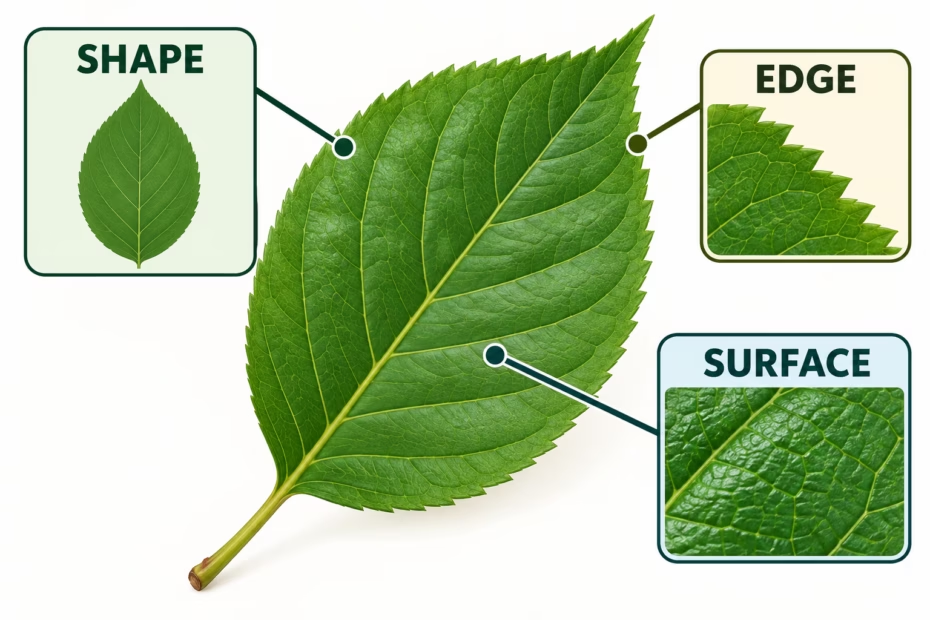
Leaf adjectives are most useful when they name a visible feature: the blade’s shape, its margin (edge), its surface, its veins, or its condition. A glossy, lance-shaped leaf with a toothed edge gives a reader more to picture than “a pretty leaf.” Botanical terms can be precise, but pair an unfamiliar term with a plain-language explanation.

Describe leaf shape and structure
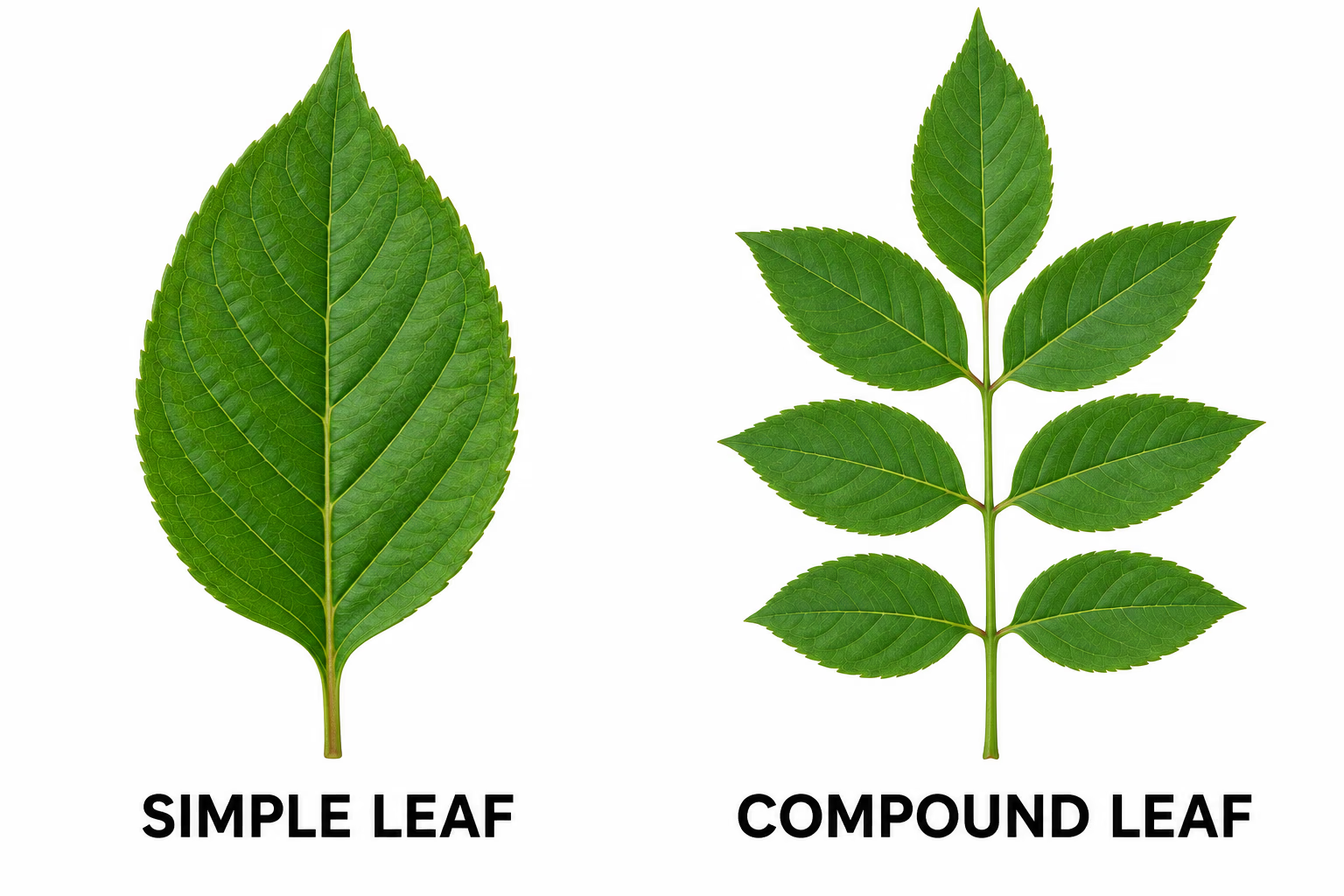
Start by asking whether you are looking at one leaf or one leaflet. A simple leaf has one undivided blade, even when the blade has lobes. A compound leaf is divided into separate leaflets. The leaf stalk, or petiole, joins the leaf to the stem; a leaflet is attached to the compound leaf’s central axis, not directly to the branch. Penn State Extension explains these differences and notes that the bud at the base of a leaf stalk helps distinguish a leaf from a leaflet (From the Woods: Ten Important Hardwoods).
| Feature | Useful adjective or term | What it describes | Example |
|---|---|---|---|
| Overall shape | oval, round, lanceolate, heart-shaped | The outline of the blade; lanceolate means lance-shaped and tapered | “The plant has narrow, lanceolate leaves.” |
| Divisions | simple, compound, lobed | Whether the blade is undivided, split into leaflets, or cut into lobes | “The simple leaf is deeply lobed but not divided into leaflets.” |
| Edge or margin | entire, toothed, serrated, wavy | The outline along the blade’s edge | “The oval blade has a finely toothed margin.” |
| Veins | parallel, pinnate, palmate, reticulate | The arrangement of veins; terms describe patterns, not general beauty | “Several prominent veins radiate from the base in a palmate pattern.” |
| Surface | smooth, hairy, wrinkled, waxy | What can be observed or gently felt on the upper or lower surface | “The underside feels slightly hairy along the veins.” |
| Color and pattern | variegated, mottled, purple, yellow-green | Color or markings on a particular specimen | “The variegated blade has cream patches along its green edge.” |
| Condition | fresh, wilted, withered, brittle | Temporary state, age, weather, or damage—not necessarily a species trait | “The dry, brittle leaves crumbled after the frost.” |
Use accurate words for leaf edges
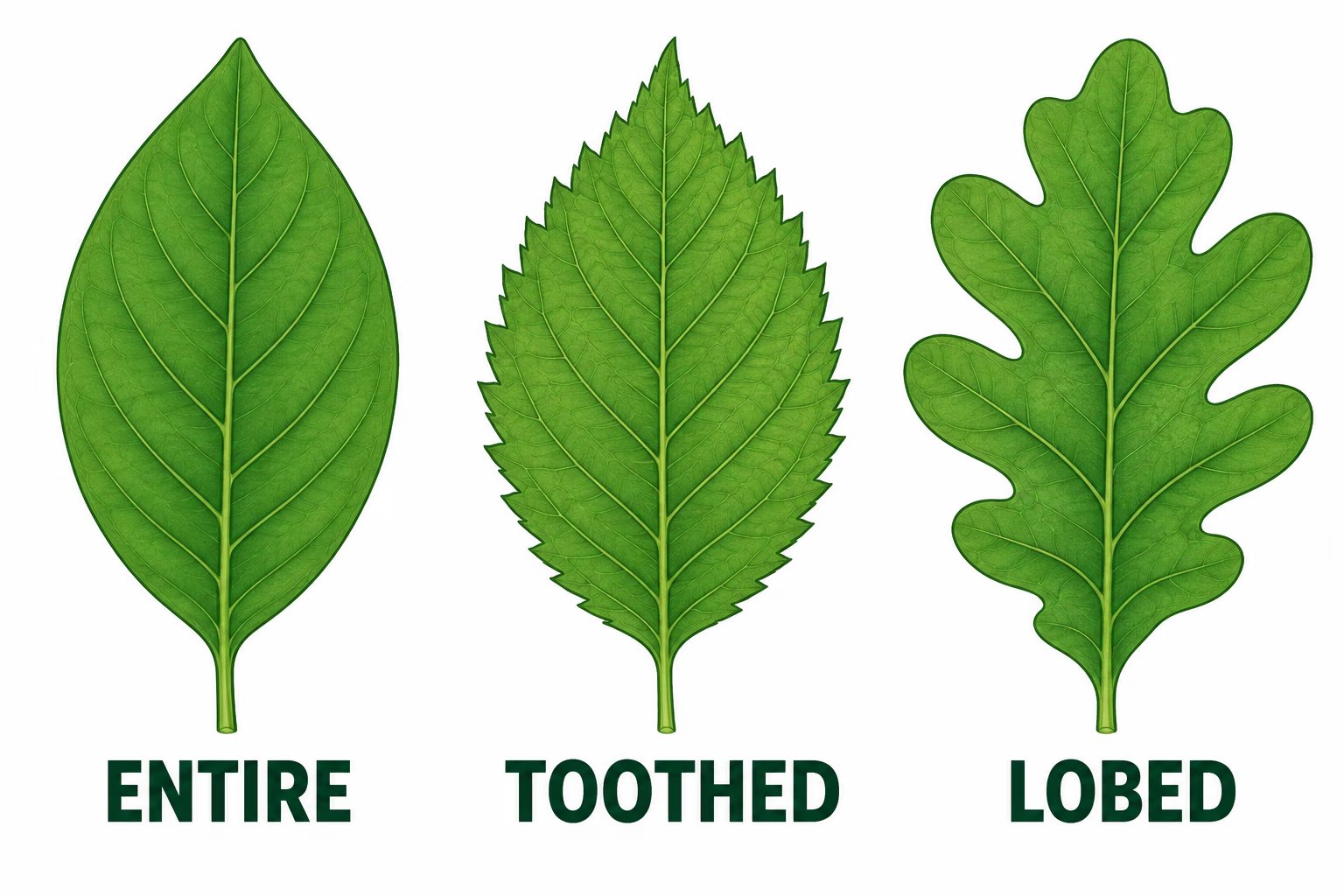
A margin described as entire is smooth rather than toothed. A toothed or serrated margin has projections; lobed describes broad indentations that do not divide the blade into separate leaflets. Sinuate can describe a margin with a wavy outline. These words are not interchangeable, so point to the edge pattern you actually see. Penn State Extension’s leaf-printing guide gives accessible examples of simple and compound leaves, lobes, toothed margins, veins, and surface texture (Growing Gardeners: Leaf Printing).
Leaf, leaflet, petiole, frond, and foliage
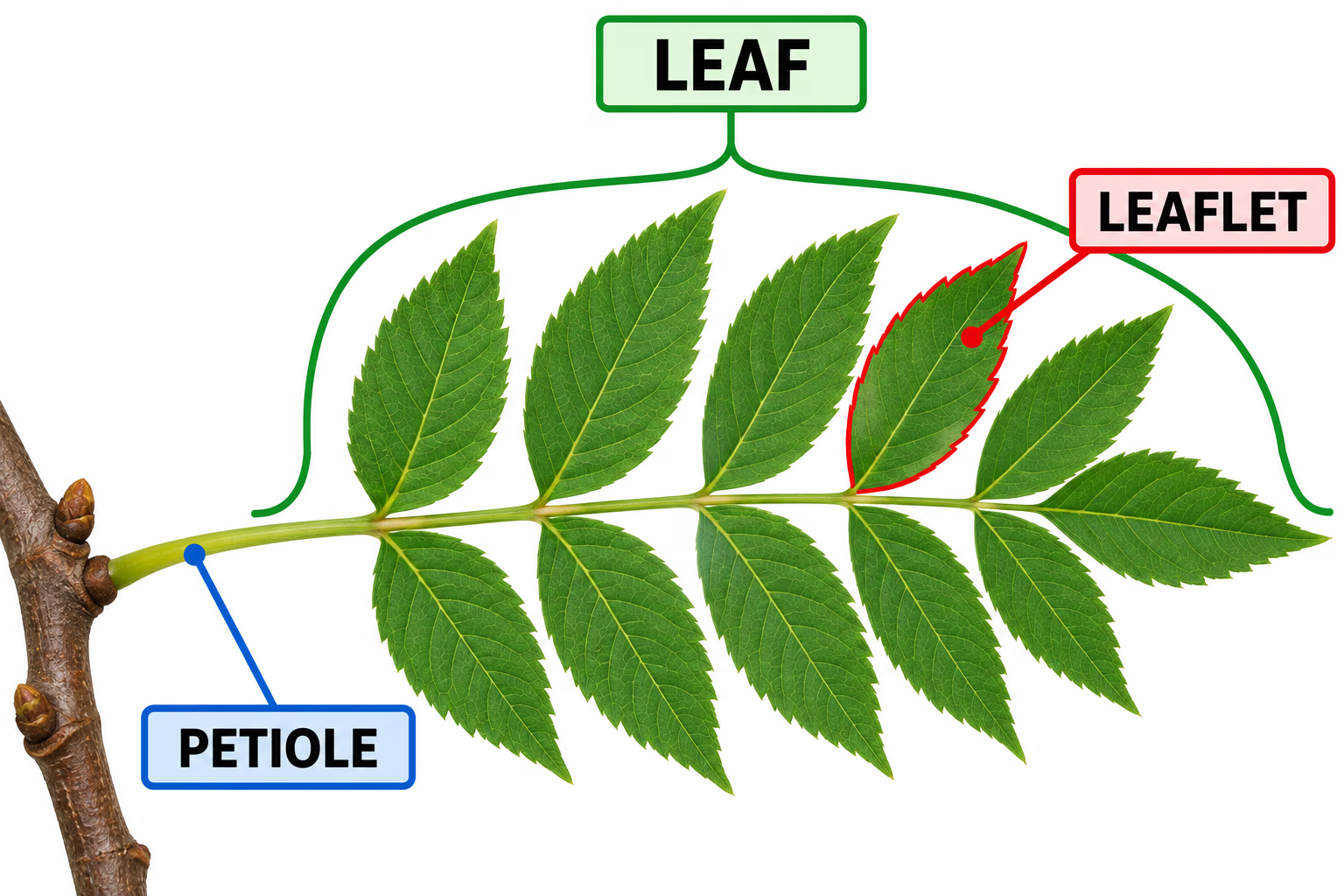
Related plant words have distinct meanings. A leaflet is one division of a compound leaf; a petiole is the stalk that attaches a leaf blade to a stem. A frond is a large, divided leaf, especially of a fern or palm, so it is not a general synonym for every leaf. The U.S. Forest Service glossary defines a frond as a large divided leaf characteristic of palms or ferns (Forest Service FEIS glossary).
Foliage and greenery usually refer collectively to leaves or leafy growth; verdure suggests green vegetation. Flora means the plant life of a place or period, not one leaf. These related words may enrich a description, but they do not all substitute for the singular noun leaf. Nor is there a direct botanical antonym for leaf. A branch, stem, trunk, twig, and petiole are different plant structures, not opposites of a leaf.
Choose leaf adjectives in context
Some adjectives describe a specimen, while others express a reaction. Green, toothed, and waxy point to features; beautiful and elegant report a viewer’s response. Both kinds can work, but specific observations make the description easier to understand. Instead of “a beautiful leaf,” try “a small, glossy leaf with a pale midrib.”
Color also depends on species and season: a leaf may be fresh green in spring and golden or rust-red later in the year. Words such as fragrant and aromatic fit only when there is a noticeable scent, sometimes after the leaf is crushed or rubbed. Avoid presenting a temporary state—such as withered after drought—as a defining feature of the whole plant.
Describe unfamiliar leaves without handling them
Do not touch a leaf simply to test whether it is fuzzy, fragrant, or poisonous. Poison ivy can have leaflets in groups of three, but identification from a single feature can be uncertain; Poison Control notes that its rash is caused by urushiol oil found throughout the plant, especially in leaves and stems (Poison ivy, poison oak, and poison sumac). If you suspect poison ivy or another irritant plant, leave it undisturbed and consult reliable local identification guidance. A word such as poisonous should not be used as a casual synonym for bitter, unpleasant, or unattractive.
Frequently asked questions
What adjectives describe the shape of a leaf?
Common choices include oval, round, lanceolate, heart-shaped, lobed, and narrow. For botanical writing, name the visible outline and explain a technical term if your audience may not know it.
Is a leaflet the same as a leaf?
Not always. A leaflet is an individual division of a compound leaf. Looking for the bud at the base of the leaf stalk can help distinguish the whole leaf from one leaflet.
What is a good adjective for leaf texture?
Depending on what you observe, you might use smooth, rough, hairy, waxy, leathery, or wrinkled. The upper and lower surfaces can differ, so describe which side you mean.
About the original examples below: They are preserved unchanged as language examples, not as a botanical identification guide. The original “synonyms” include broader collective words, and its “antonyms” are different plant parts rather than opposites of leaf. Do not handle an unfamiliar plant to test a descriptive word; poison ivy can cause a rash even when its leaves or stems are dead.
When it comes to describing the beauty and diversity of nature, one cannot overlook the humble leaf. Leaves come in a myriad of shapes, sizes, and colors, each with its own unique characteristics. In this article, I’ll be sharing a collection of descriptive adjectives that can be used to paint a vivid picture of the different types of leaves you may encounter. From vibrant and lush to delicate and intricate, these adjectives will help you capture the essence of leaves in all their glory.
As we delve into the world of leaf adjectives, it’s important to note that these words are not just limited to botanists or nature enthusiasts. Whether you’re a writer, a photographer, or simply someone who appreciates the wonders of the natural world, these adjectives will add depth and richness to your descriptions. So, without further ado, let’s explore the fascinating world of leaf adjectives and discover how they can bring your words to life.
How to Describe leaf? – Different Scenarios
When it comes to describing leaves, there are various scenarios to consider. Whether you’re a botanist studying plant species or a writer seeking to convey the beauty of nature in your prose, understanding how to describe leaves effectively can greatly enhance your work. Let’s explore some different scenarios and the adjectives that can be used to describe leaves in each.
1. Shape and Size:
In this scenario, we focus on the physical characteristics of leaves. Leaves come in a wide variety of shapes and sizes, from the long and slender needles of pine trees to the heart-shaped leaves of an oak tree. Here are some adjectives that can be used to describe shape and size:
- Narrow
- Broad
- Oval
- Lanceolate
- Lobed
2. Texture and Surface:
When describing the texture and surface of leaves, we consider their tactile qualities and appearance. Leaves can be smooth or rough, glossy or matte. Here are some adjectives to help you describe the texture and surface of leaves:
- Smooth
- Rough
- Velvety
- Waxy
- Hairy
3. Color and Pattern:
The color and pattern of leaves can vary greatly, adding to the visual appeal of plants. Leaves may be green, but they can also be tinged with other colors or display intricate patterns. Here are some adjectives to describe the color and pattern of leaves:
- Vibrant
- Variegated
- Mottled
- Striped
- Speckled
4. Veins and Margins:
The veins and margins of leaves can provide interesting details for description. Veins can be prominent, creating a striking pattern, while the leaf margins can be smooth or serrated. Here are some adjectives to describe the veins and margins of leaves:
- Reticulated
- Palmate
- Toothed
- Sinuate
- Entire
5. Scent and Sound:
Not all leaves have a strong scent or produce sound, but if you encounter leaves that do, it can add another dimension to your description. Some leaves may have a pleasant aroma, while others may rustle in the breeze. Here are some adjectives to describe the scent and sound of leaves:
- Fragrant
- Aromatic
- Rustling
- Whistling
- Whispering
Leaves come in a variety of shapes, sizes, textures, colors, patterns, and scents. As a writer or a botanist, being able to effectively describe leaves can greatly enhance your work. In this section, I will provide you with a list of adjectives to help you describe leaves in English.
Describing Words for leaf in English
When describing the shape and size of leaves, consider using these adjectives:
- Broad: Leaves that are wide and expansive, such as those of a maple tree.
- Narrow: Leaves that are slim and slender, like those of a pine tree.
- Oval: Leaves that are shaped like an elongated circle, like those of a magnolia tree.
- Serrated: Leaves that have sharp, jagged edges, like those of a saw.
- Heart-shaped: Leaves that resemble the shape of a heart, like those of a bleeding heart plant.
Texture and Surface
To describe the texture and surface of leaves, you can use these adjectives:
- Smooth: Leaves that have a sleek and even surface, like those of a jade plant.
- Fuzzy: Leaves that are covered in a soft, hair-like texture, like those of a lambs ear plant.
- Waxy: Leaves that have a shiny, glossy appearance, like those of a succulent plant.
- Leathery: Leaves that are thick and tough, like those of a holly tree.
Color and Pattern
When it comes to describing the color and pattern of leaves, consider using these adjectives:
- Green: Leaves that have a vibrant, verdant color, like those of a grass.
- Variegated: Leaves that have multiple colors or patterns, like those of a calathea plant.
- Mottled: Leaves that have irregular spots or blotches, like those of a snake plant.
- Burgundy: Leaves that have a deep red or purple color, like those of a Japanese maple tree.
Veins and Margins
- Palmate: Leaves that have veins radiating from a central point, like those of a hand.
- Parallel: Leaves that have veins running parallel to each other, like those of a corn plant.
- Toothed: Leaves that have small, sharp teeth along the margins
Adjectives for leaf
Positive Adjectives for Leaf with 12 Example Sentences
When describing leaves, there are a variety of positive adjectives that can help capture their beauty and characteristics. Here are 12 examples of positive adjectives that can be used to describe leaves:
- Vibrant: The leaves of the maple tree turned vibrant shades of red and orange in the fall.
- Lush: The rainforest was filled with lush, green leaves that created a dense canopy overhead.
- Glossy: The leaves of the holly plant were shiny and glossy, reflecting the sunlight.
- Elegant: The long, slender leaves of the palm tree swayed gently in the breeze, creating an elegant display.
- Graceful: The weeping willow’s leaves cascaded down in graceful, drooping strands.
- Delicate: The delicate leaves of the cherry blossom tree fluttered in the spring breeze.
- Fragrant: Crushed mint leaves released a fragrant scent that filled the air.
- Majestic: The giant sequoia trees stood tall with their majestic, needle-like leaves.
- Wholesome: Fresh basil leaves added a wholesome aroma and flavor to the dish.
- Shimmering: The sunlight reflected off the shimmering leaves of the silver birch tree.
- Prickly: Avoid touching the prickly leaves of the cactus to prevent getting pricked.
- Rejuvenating: Walking through the forest, the scent of pine needles and the rejuvenating air from the leaves was refreshing.
Negative Adjectives for Leaf with 5 Example Sentences
While most leaves are beautiful and pleasant, there are also negative adjectives that can be used to describe certain characteristics of leaves. Here are 5 examples of negative adjectives for leaves:
- Withered: The drought caused the leaves on the plants to become withered and brown.
- Brittle: The leaves of the old oak tree were dry and brittle, crumbling at the touch.
- Decaying: The decaying leaves on the forest floor emitted a pungent odor.
- Invasive: The ivy plant had invasive leaves that quickly covered the nearby trees.
- Poisonous: Be cautious of the poisonous leaves on the poison ivy plant, as they can cause a rash.
Remember, the proper use of adjectives is essential in effectively describing leaves and capturing their unique qualities.
Synonyms and Antonyms with Example Sentences
Synonyms for leaf
When it comes to describing leaves, there are several synonyms that can help us capture their unique characteristics. Here are some synonyms for “leaf” and examples of how they can be used:
| Synonym | Example Sentence |
|---|---|
| Frond | The fern’s fronds sway gently in the breeze. |
| Foliage | The foliage of the tree turned a vibrant red in autumn. |
| Verdure | The verdure of the forest was breathtakingly beautiful. |
| Greenery | The lush greenery in the park provided a peaceful retreat. |
| Flora | The flora in this garden represents a wide variety of plant species. |
Antonyms for leaf
Just like there are synonyms, there are also antonyms – words that have the opposite meaning. Here are some antonyms for “leaf” and examples of how they can be used:
| Antonym | Example Sentence |
|---|---|
| Branch | The bird perched on a branch of the tree. |
| Stem | The delicate flower bloomed from the stem. |
| Trunk | The elephant used its trunk to pick up leaves. |
| Twig | The squirrel jumped from twig to twig in the tree. |
| Petiole | The petiole connects the leaf to the stem of the plant. |
Remember, using synonyms and antonyms in your descriptions can add variety and depth to your language.
Conclusion
Describing leaves is an art that allows us to appreciate their beauty and diversity. Throughout this article, we have explored various aspects of leaves that can be described, such as their shape, size, texture, color, and veins. By using adjectives effectively, we can capture the unique qualities of leaves and bring them to life in our descriptions.
From broad and narrow to serrated and smooth, there are countless adjectives to choose from when describing leaf shapes. Texture and surface can be described using adjectives like fuzzy, waxy, and leathery. The color and pattern of leaves offer a wide range of descriptive possibilities, from vibrant and variegated to mottled and burgundy.
Positive adjectives like lush, glossy, and elegant can help us convey the beauty and grace of leaves. On the other hand, negative adjectives like withered and brittle can be used to describe leaves that have lost their vitality.
By using synonyms and antonyms for the word “leaf,” we can add variety and depth to our descriptions. This allows us to paint a more vivid picture and engage our readers on a deeper level.
The art of describing leaves is a powerful tool that allows us to appreciate their intricacies and convey their essence to others. So, next time you encounter a leaf, take a moment to observe its unique qualities and let your words bring it to life.


