Adjectives for Lips: Shape, Texture, and Expression
Adjectives for lips describe shape, texture, color, or expression: full, thin, smooth, dry, rosy, pursed, and smiling are useful examples. Choose the feature you actually want readers to picture. A precise phrase such as “slightly parted lips” usually communicates more than a string of vague compliments or dramatic descriptions.
Lip adjectives at a glance
Full and thin usually describe lip shape or volume.
Smooth, dry, and chapped describe surface texture or condition.
Rosy, pale, and red describe visible color in a particular scene.
Pursed, parted, and smiling describe position or expression.
Lip descriptions cannot reliably prove a person’s feelings or character.
Choose natural wording that fits the viewpoint and context.
Which adjectives for lips describe each feature?
Group lip adjectives by the attribute they describe rather than treating them as interchangeable synonyms. Shape, surface, color, and movement create different pictures. A character can have full lips that are dry, pale, and slightly parted at the same moment; each word contributes a different detail.
Feature
Adjectives or phrases
Example
Shape or volume
full, thin, rounded, narrow
Her full lips curved into a smile.
Contour
defined, uneven, softly curved
The portrait showed softly curved lips.
Texture
smooth, soft, dry, chapped
His dry lips felt rough after the long walk.
Color
rosy, pink, pale, red
Red lipstick made her lips vivid under the stage lights.
Position
parted, closed, pursed, compressed
He waited with his lips slightly parted.
Movement
trembling, quivering, smiling
Her trembling lips made the reply difficult.
Surface finish
glossy, matte, bare
The photograph emphasized matte lips and soft lighting.
Smiling, pursed, and parted describe different lip expressions.
How do you describe lip shape clearly?
Use full, thin, rounded, or narrow when shape matters to the description. These words describe an appearance, not a ranking of attractiveness. The Cambridge lip entry identifies lips as the soft upper and lower edges of the mouth; specify upper or lower when the distinction matters.
“A full lower lip” is more exact than “full lips” if only the lower lip has that appearance. “A sharply defined upper lip” describes contour rather than size. Avoid assuming every face is symmetrical; “an uneven smile” may describe temporary expression, whereas “uneven lips” suggests shape.
Use size words with care in character writing. Large, small, broad, and narrow can describe different dimensions, and readers may picture different features unless you add context. A short physical observation usually serves a scene better than comparing every character with one idealized appearance.
Which words describe texture and surface?
Smooth, soft, dry, and chapped describe texture or condition. Glossy and matte describe how a surface reflects light, often in a makeup context. Do not substitute a surface finish for a tactile quality: glossy lips can appear shiny without telling readers how they feel.
“Her smooth lips caught the light” combines surface and lighting. “His chapped lips tightened as he spoke” adds an action to a texture detail. These are descriptive examples, not medical assessments; a vocabulary list cannot establish the cause of a visible change or recommend a treatment.
A word such as cracked is stronger and more specific than dry. Use it only when visible cracks are part of the intended scene. Luscious, velvety, and silky are more figurative or sensuous; they suit some literary voices but can sound excessive in neutral description.
What is the difference between pursed and parted lips?
Pursed lips are drawn together tightly, commonly into a small rounded shape; parted lips are separated rather than fully closed. The Cambridge pursed entry helps distinguish the first expression. If you mean lips pressed into a flat line, compressed may be clearer.
Compare “She listened with pursed lips” with “She listened with slightly parted lips.” The first suggests a tightened position; the second suggests a small opening. Neither description alone proves anger, surprise, desire, or any other particular feeling. Let the surrounding action establish the emotional interpretation.
Tight-lipped can describe a visibly closed mouth or, figuratively, reluctance to speak. “The official remained tight-lipped about the decision” concerns information withheld, not necessarily a detailed facial shape. Distinguish a physical description from an idiom when teaching vocabulary.
How can color words remain precise?
Color words describe what is visible in the scene, which may reflect lighting, makeup, or the viewpoint. Pink, rosy, pale, red, and dark are descriptive choices, but their effect depends on the person and setting. A color adjective does not explain why that color is present.
“Her lips looked pale under the cool stage lights” anchors the appearance to lighting. “He wore deep-red lipstick” names the cosmetic source directly. Avoid assigning personality traits, heritage, or health conclusions to lip color; those inferences add claims the observation cannot support.
Which phrases sound natural in different writing contexts?
Neutral descriptions favor observable phrases such as slightly parted, dry, or softly curved. Fiction can use more figurative language when it matches the narrator’s voice. Product descriptions need concrete details about finish or shade instead of unsupported promises about beauty or wellbeing.
Portrait description: softly curved lips, a defined upper lip, a relaxed mouth.
Action in fiction: pursed lips, trembling lips, tightly compressed lips.
Makeup description: glossy lips, matte red lips, bare lips.
“Smiling lips” is a natural descriptive phrase, but “she smiled” may be simpler when the action matters more than appearance. Likewise, “his lips trembled” often reads more directly than “his trembling lips were noticeable.” Choose an adjective when it adds an attribute, and a verb when movement drives the sentence.
How do you avoid overloaded descriptions?
Choose one or two details that matter to the scene. “Her pale lips were slightly parted” gives color and position without competing images. “Her full, luscious, silky, perfect, inviting lips” mostly repeats an impression and makes the narrator’s judgment more prominent than the observable detail.
Choose the attribute: shape, texture, color, position, or movement.
Select a concrete word from that category.
Add context if the adjective could be figurative or ambiguous.
Read the sentence aloud and remove words that repeat the same impression.
Adjectives for lips work best when they help the reader see an expression or understand a scene. A physical feature does not need a value judgment, and a mouth position does not need an unsupported psychological explanation. Let precise observation carry the description.
Texture words such as dry and smooth describe a different attribute from shape.
Frequently asked questions about lip adjectives
Is soft an adjective for lips?
Yes. Soft can describe the perceived texture of lips, and “soft lips” is a natural phrase. It does not tell readers the lips’ size, color, or expression. If one of those features matters, choose an additional specific detail, such as “soft, slightly parted lips,” rather than several words for softness.
Is beautiful a useful lip adjective?
Beautiful is grammatically possible, but it expresses a subjective judgment rather than a precise physical attribute. In fiction, that judgment may reveal the narrator’s feelings. In a neutral description, full, softly curved, or rosy gives readers more concrete information. Choose the word according to what the sentence needs to communicate.
Can lips be described as silent?
Silent lips is a figurative expression that suggests someone is not speaking. Lips themselves do not produce silence as a measurable surface feature. If clarity is the priority, write “She remained silent” or “Her lips stayed closed.” Use the figurative phrase when its tone suits the surrounding prose.
What is a clear sentence using pursed lips?
“He paused with pursed lips before answering” gives a visible position and an action without declaring a specific emotion. To describe doubt or disapproval, supply supporting context in the next sentence. Pursed lips can occur in different situations, so the physical detail alone should not be treated as proof of intent.
Your lips are one of the most defining features of your face. They can be full and sensual or thin and delicate. They can be the perfect shade of pink or red, or they can be the palest of nudes. No matter what your lips look like, there are a few adjective words that can describe them perfectly.
Here are some of the best adjective words to describe lips:
Luscious – This word is perfect to describe lips that are full and sensual. If your lips are luscious, they are probably the envy of everyone around you.
Kissable – Kissable lips are soft and inviting. They are the kind of lips that you just want to kiss over and over again.
Delicious – Delicious lips are lips that make you want to eat them. They are lips that are so tempting and irresistible.
Lovely – Lovely lips are delicate and beautiful. They are the kind of lips that you can’t help but stare at.
Perfect – Perfect lips are just that, perfect. They are the kind of lips that you can’t find anything wrong with.
Adjective For Lips
Lips are often referred to as being sensual, soft, and sexy. Here are some other adjective words that can be used to describe lips:
Alluring: Having an appealing or attractive quality.
Angelic: Having a divine or heavenly quality.
Appealing: Inviting or tempting.
Attractive: Possessing physical features that are pleasing to look at.
BEAUTIFUL: Aesthetically pleasing.
Captivating: Holding someone’s attention or interest.
Charming: Possessing qualities that attract or please others.
Delicate: Fine or fragile in nature.
Divine: Of heavenly or godlike quality.
Elegant: possessing beauty that is refined and tasteful.
Exquisite: Possessing a perfection that is rare or outstanding.
Fascinating: holding someone’s interest or attention in a compelling way.
Fine: Of high quality or excellent in nature.
Glamorous: Possessing an air of allure or charm.
Good-looking: Possessing physical features that are pleasing to look at.
Handsome: Possessing physical features that are pleasing to look at, typically referring to men.
Heavenly: Of divine or heavenly quality.
Hot: sexually attractive or appealing.
Inviting: Tempting or appealing.
Irresistible: So appealing that one cannot resist.
Lovely: Possessing beauty that delights the senses.
Magnetic: Possessing an attractive or compelling quality.
Mesmerizing: Having a captivating or hypnotic effect.
Mysterious: Possessing an enigmatic quality.
Nurturing: Possessing qualities that care for and support others.
Pleasing: Aesthetically or otherwise satisfying.
Prepossessing: Having qualities that attract or please others.
Pretty: Possessing beauty that is delicate or pleasing.
Radiant: Possessing a bright or glowing quality.
Ravishing: Having a stunning or beautiful quality.
Refined: Possessing beauty that is tasteful and sophisticated.
Romantic: Possessing qualities that are associated with love or romance.
Seductive: Possessing qualities that are alluring or tempting.
Sexy: Possessing qualities that are sexually appealing.
Soft: Having a gentle or smooth quality.
Sophisticated: Possessing a refined or elegant quality.
Stunning: Possessing a quality that amazes.
Sweet: Having a pleasant or endearing quality.
Sympathetic: Possessing qualities that care for and support others.
Tender: Having a gentle or soft quality.
Transcendent: Possessing a quality that is beyond the physical world.
Unique: Possessing qualities that are one of a kind.
Warm: Possessing qualities that are comforting or inviting.
Wonderful: Possessing a quality that delights or amazes.
A
Absent
Accustomed
Adamantine
Adverse
Affectionate
Aforementioned
Afric
Againher
Aged
Aghast
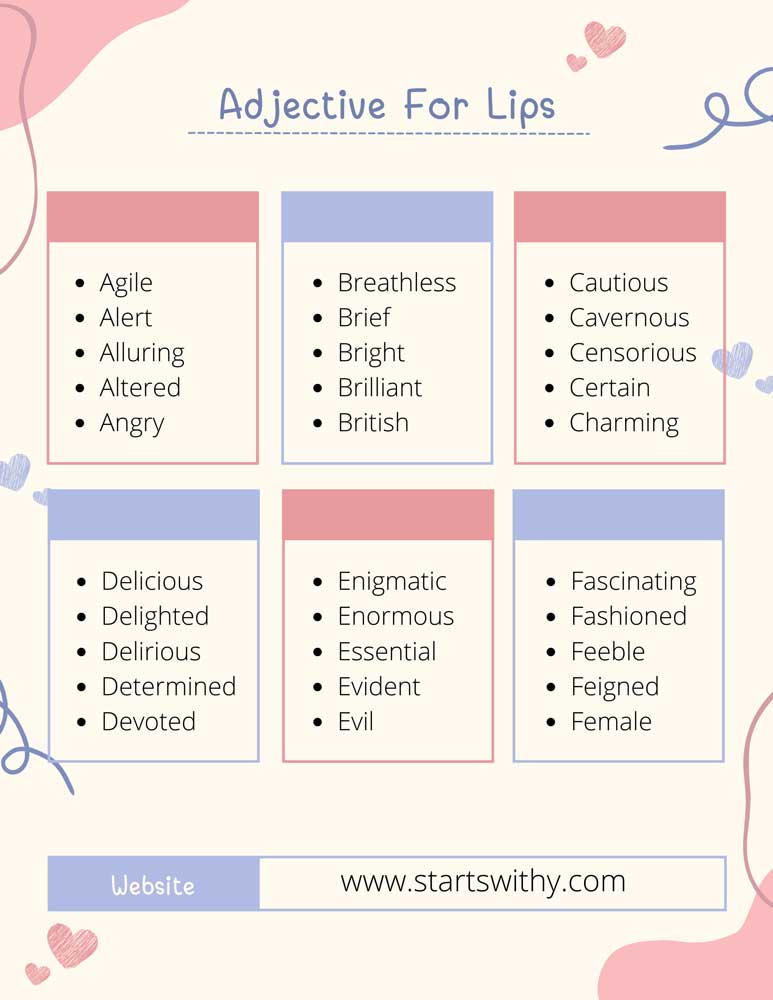
Agile
Agitated
Alert
Alien
Alluring
Altered
Amorous
Angry
Appalled
Appealing
Arched
Ardent
Aristocratic
Arrogant
Ashen
Ashy
Astonished
Attic
Attractive
Austere
Austrian
Avid
Awful
B
Balmy
Bearded
Beautiful
Bedi
Beloved
Bitter
Black
Blanched
Blind
Bloated
Bloodless
Bloody
Blue
Bluish
Blushing
Bold
Boyish
Brave
Breathless
Brief
Bright
Brilliant
British
Broad
Broken
Brown
Brutal
Bulging
Burnmy
C
Cadaverous
Calm
Carven
Cautious
Cavernous
Censorious
Certain
Characteristic
Charming
Chaste
Childish
Childlike
Chilly
Christian
Circular
Clammy
Classic
Clean
Cleft
Close
Closed
Closedthe
Coarse
Cold
Colorful
Colorless
Colourless
Columellar
Compressed
Conical
Convulsed
Convulsive
Cool
Coral
Corrupted
Counter
Countless
Crimson
Crisp
Cross
Cruel
Curved
Cut
Cynical
D
Dainty
Dark
Dead
Deadly
Dear
Decent
Deep
Delicate
Delicious
Delighted
Delirious
Determined
Devoted
Devouring
Discoloured
Disdainful
Disgusting
Dissembling
Distorted
Downy
Drunken
Dry
Dull
Dumb
Dusty
E
Eager
Earthly
Easier
Electric
Eloquent
English
Enigmatic
Enormous
Essential
Evident
Evil
Excited
Expressive
Exquisite
Exultant
F
Faceagainst
Facehis
Faded
Fair
Famished
Fascinating
Fashioned
Fat
Feeble
Feigned
Female
Feverish
Fierce
Fine
Firm
Flaccid
Flat
Flattened
Fleshy
Flexible
Flushed
Foodless
Foolish
Forwardhis
Fragrant
French
Fresh
Friendly
Frightful
Fromfrommy
Frozen
Furious
G
Gargantuan
Gay
Gentle
German
Ghastly
Ghostly
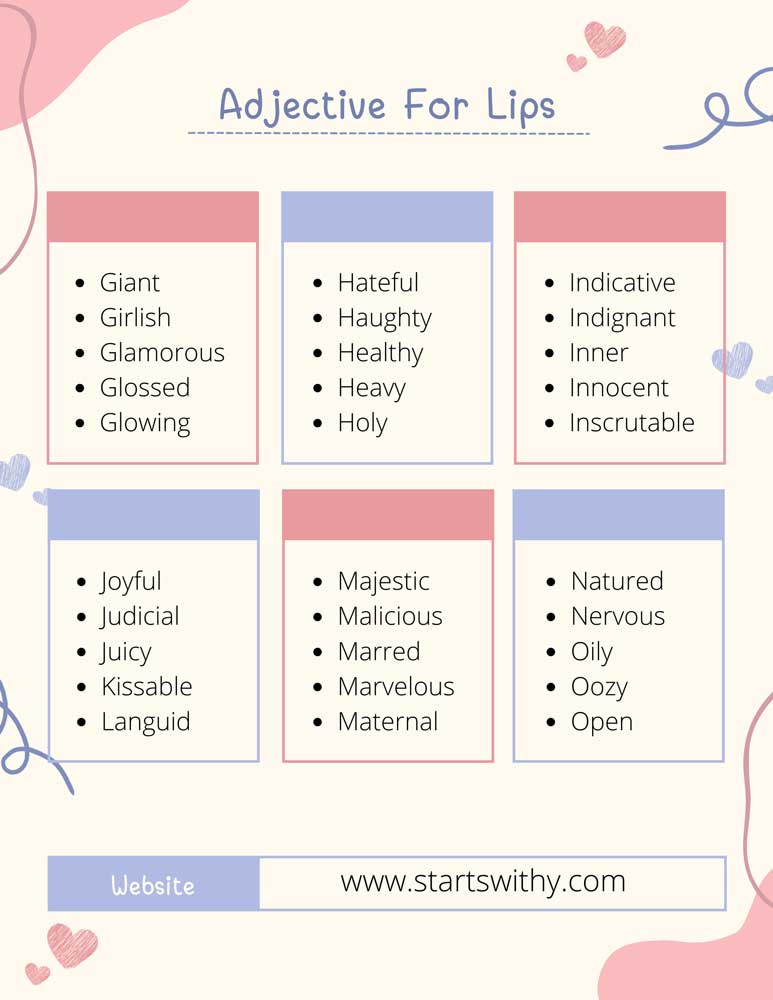
Giant
Girlish
Glamorous
Gloomy
Glossed
Glossy
Glowing
Golden
Gracious
Grateful
Gratified
Grave
Greedy
Grim
Gross
Guilty
H
Hallowed
Halting
Handsome
Hanging
Happy
Hard
Harsh
Hatched
Hateful
Haughty
Healthy
Heavy
Herher
Holy
Honest
Honeyed
Honored
Horrible
Hot
Human
Hungry
I
Icy
Idle
Illustrious
Imaginable
Immaculate
Immobile
Imperious
Indeterminate
Indicative
Indignant
Inner
Innocent
Innumerable
Inscrutable
Inspired
J | K | L
Joyful
Judicial
Juicy
Kindly
Kissable
Languid
Large
Leafy
Lifeless
Lighthis
Live
Locked
Lonely
Loose
Lovely
Loving
Luscious
Lustful
M
Mad
Magical
Maiden
Majestic
Malicious
Marred
Marvelous
Maternal
Meaty
Merrier
Metallic
Mighty
Mischievous
Mobile
Modern
Moist
Momenthis
Mortal
Motherly
Motherthe
Motionless
Mournful
Moustachioed
Mouththe
Mumbling
Muslim
Mustacheless
Mute
Mutinous
Mutual
Myriad
N | O
Narrow
Nasty
Natured
Nervous
Nude
Numb
Oily
Oozy
Open
Outer
Ox
P
Painful
Pale
Palethy
Pallid
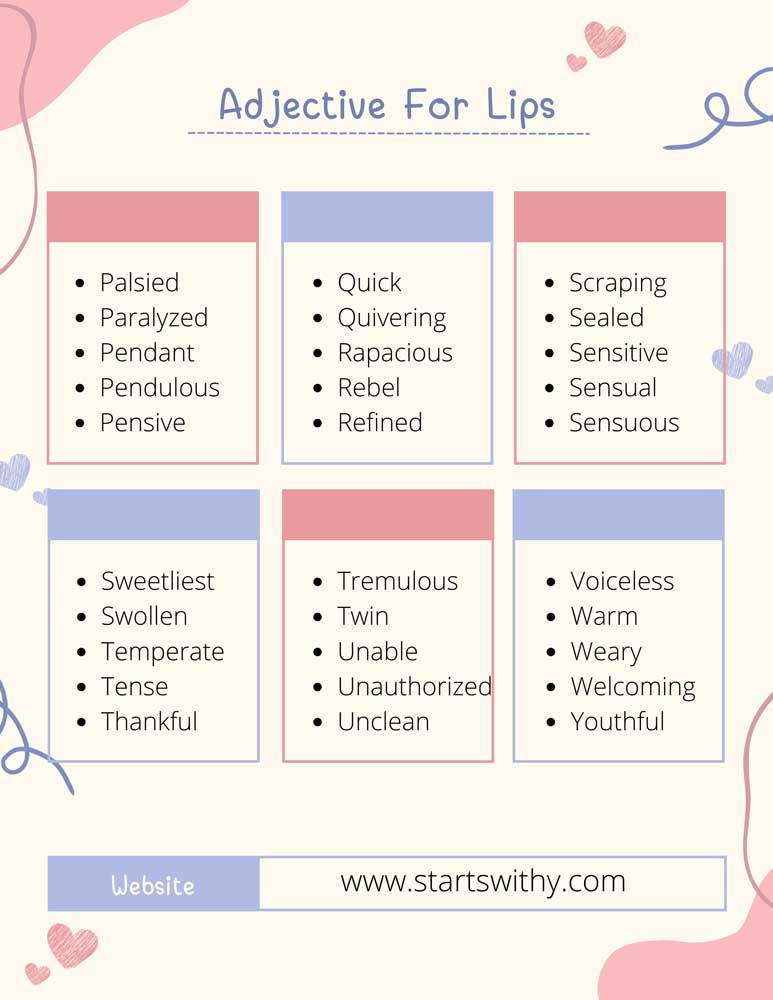
Palsied
Paralyzed
Parted
Passionate
Peachy
Pendant
Pendulous
Pensive
Perfect
Persian
Persuasive
Petulant
Philanthropic
Pillowy
Pink
Pious
Piteous
Playful
Plump
Poetic
Pointed
Polluted
Pomegranate
Poor
Posterior
Pouting
Practiced
Precious
Precise
Prehensile
Preposterous
Prim
Princely
Profane
Prominent
Prophetic
Prophetical
Proud
Provincial
Prudent
Puffy
Pure
Purple
Purplish
Pursed
Q | R
Queenly
Queer
Quick
Quivering
Rapacious
Rebel
Red
Refined
Relentless
Reluctant
Resolute
Respective
Responsive
Rich
Rigid
Ripe
Roguish
Rose
Rosy
Round
Rounded
Royal
S
Sad
Said
Sanctimonious
Sardonic
Scarlet
Scarred
Scornful
Scraping
Sealed
Sensitive
Sensual
Sensuous
Sere
Set
Sexy
Shapeless
Sharp
Shaven
Shiny
Short
Shut
Sick
Silent
Silvery
Singingthose
Skinny
Slavish
Sleeping
Smoky
Smooth
Sneering
Sodden
Soft
Solemn
Sore
Sorrowher
Spanish
Speechless
Spicy
Spiteful
Steady
Stedfast
Stern
Stiff
Stoopedher
Straight
Straightened
Stubbled
Sugary
Sunken
Supercilious
Sweet
Sweetliest
Swelledher
Swollen
T
Temperate
Tempting
Tense
Thankful
Thick
Thin
Thirsty
Tight
Tightened
Timid
Tinctured
Tired
Treacherous
Tremulous
Twin
Twisted
U
Ulcerated
Unable
Unauthorized
Unclean
Unconscious
Unforbidden
Unformed
Unpersuasive
Unrazored
Unresponding
Unsteady
Untaught
Unused
Unwilling
Unworthy
Upper
Upturned
V | W | Y
Vague
Vast
Vestal
Vile
Voiceless
Wan
Warm
Weak
Weary
Welcoming
Whiskered
Whitened
Wide
Willing
Winsome
Wise
Wistful
Withered
Womanly
Wooden
Wordless
Working
Wrinkled
Writhen
Yellow
Yore
Youthful
Final verdict
The lips are one of the most important features on the face. They are often the first thing that people notice about someone. The right adjective can make them look even more beautiful. Here are some of the best adjectives for lips: Full, Plump , Kissable , Soft, Supple, Smooth, Delicious, tantalizing
Robin founded StartsWithy in 2022 to make English words easier to understand and use. Robin oversees our 30,000+ guides, checks meanings and grammar against trusted dictionaries such as Cambridge, Oxford Learner’s and Collins, and is accountable for every correction we make.