Choose adjectives for the Moon by naming what you actually observe: its phase, brightness, surface pattern, apparent color, position, or the mood it creates. A crescent Moon can look silver and delicate; a full Moon can appear bright, round, and luminous. Words such as eerie or majestic describe a viewer’s impression, not a measurable lunar property.
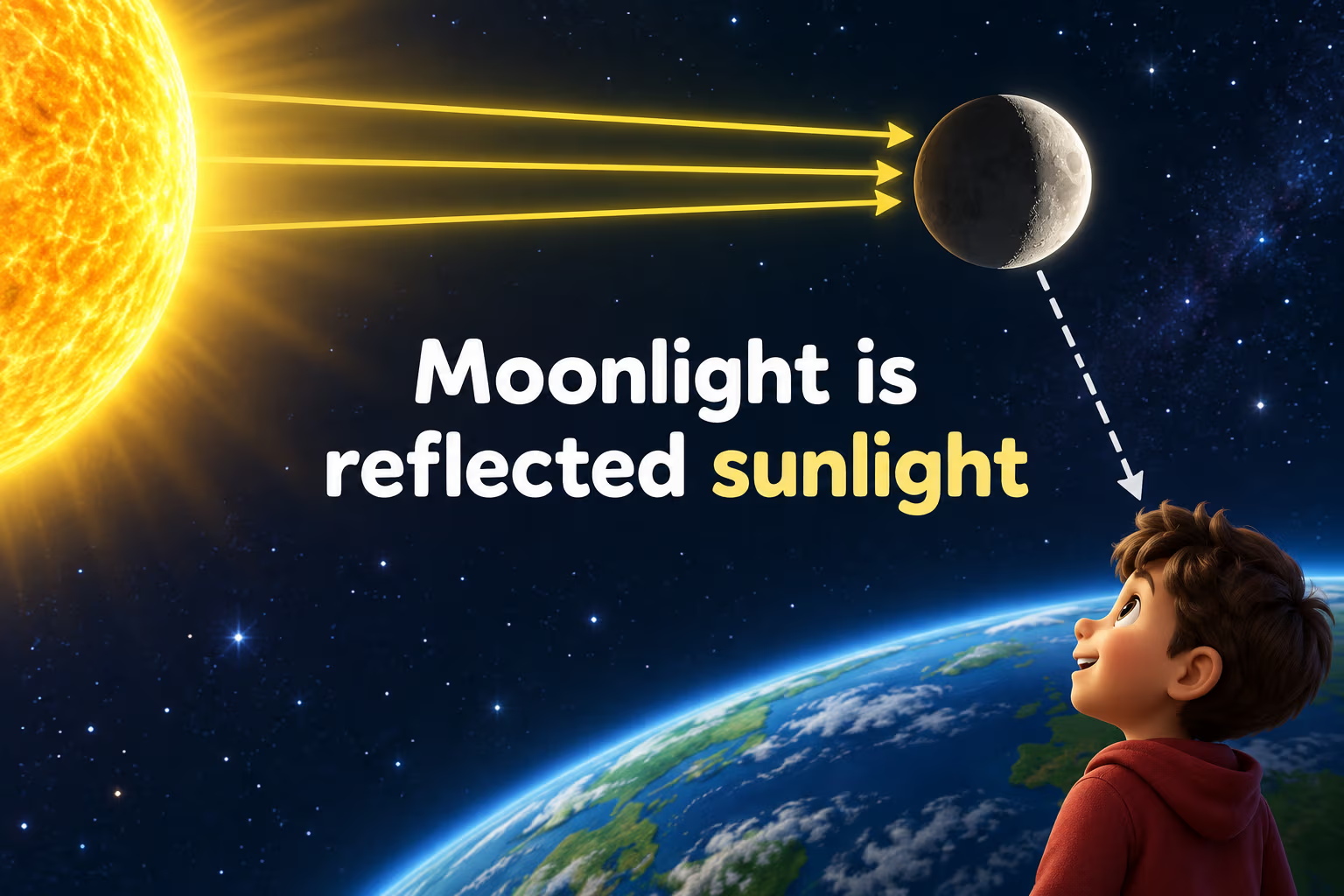
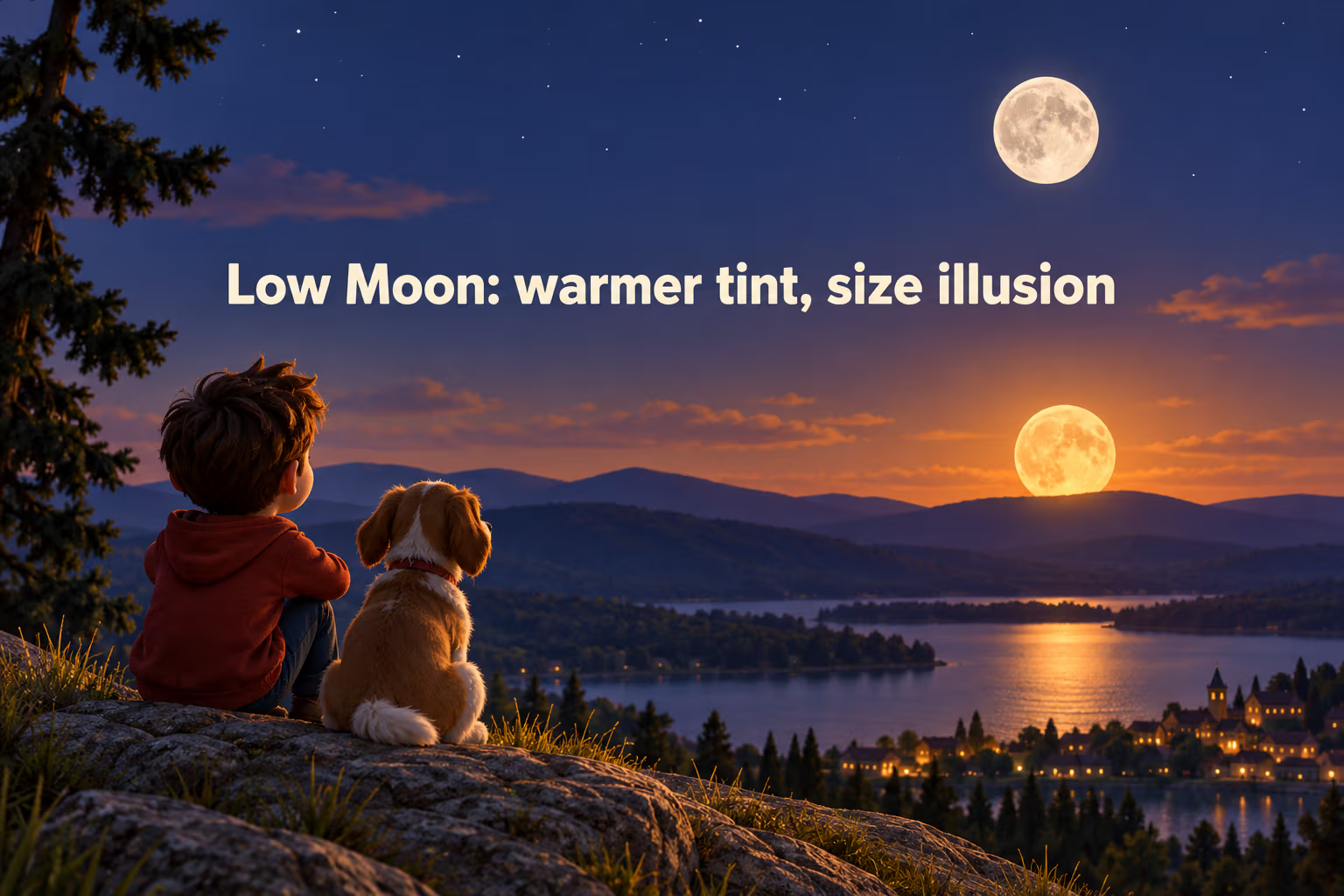
Quick guide: The Moon does not make its own light; moonlight is sunlight reflected from its surface. The Moon is always half illuminated by the Sun, while its phase describes how much of that sunlit half we see from Earth. A low Moon can look more yellow or orange through Earth’s atmosphere, and it can seem larger near the horizon because of a perceptual illusion.
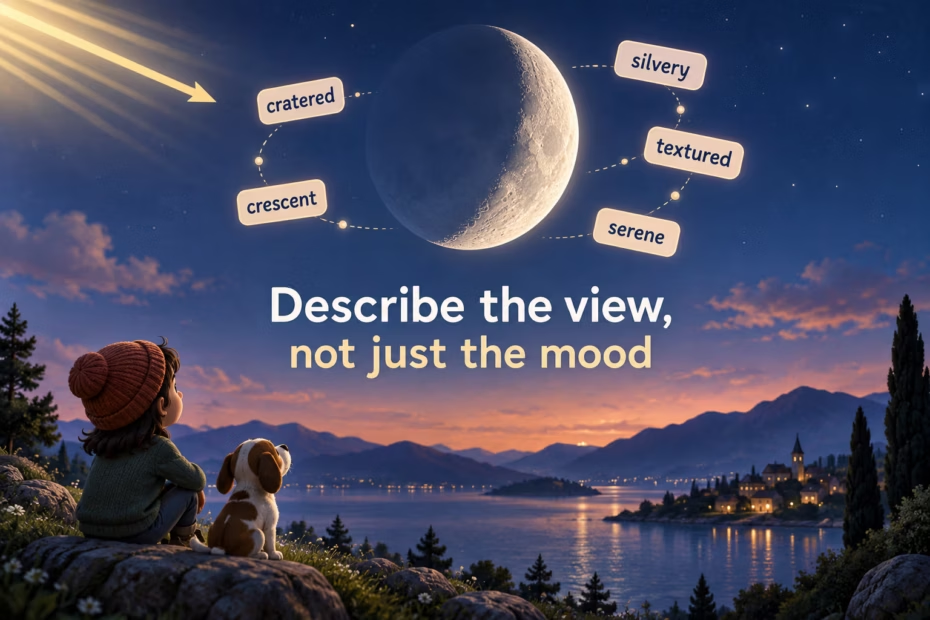
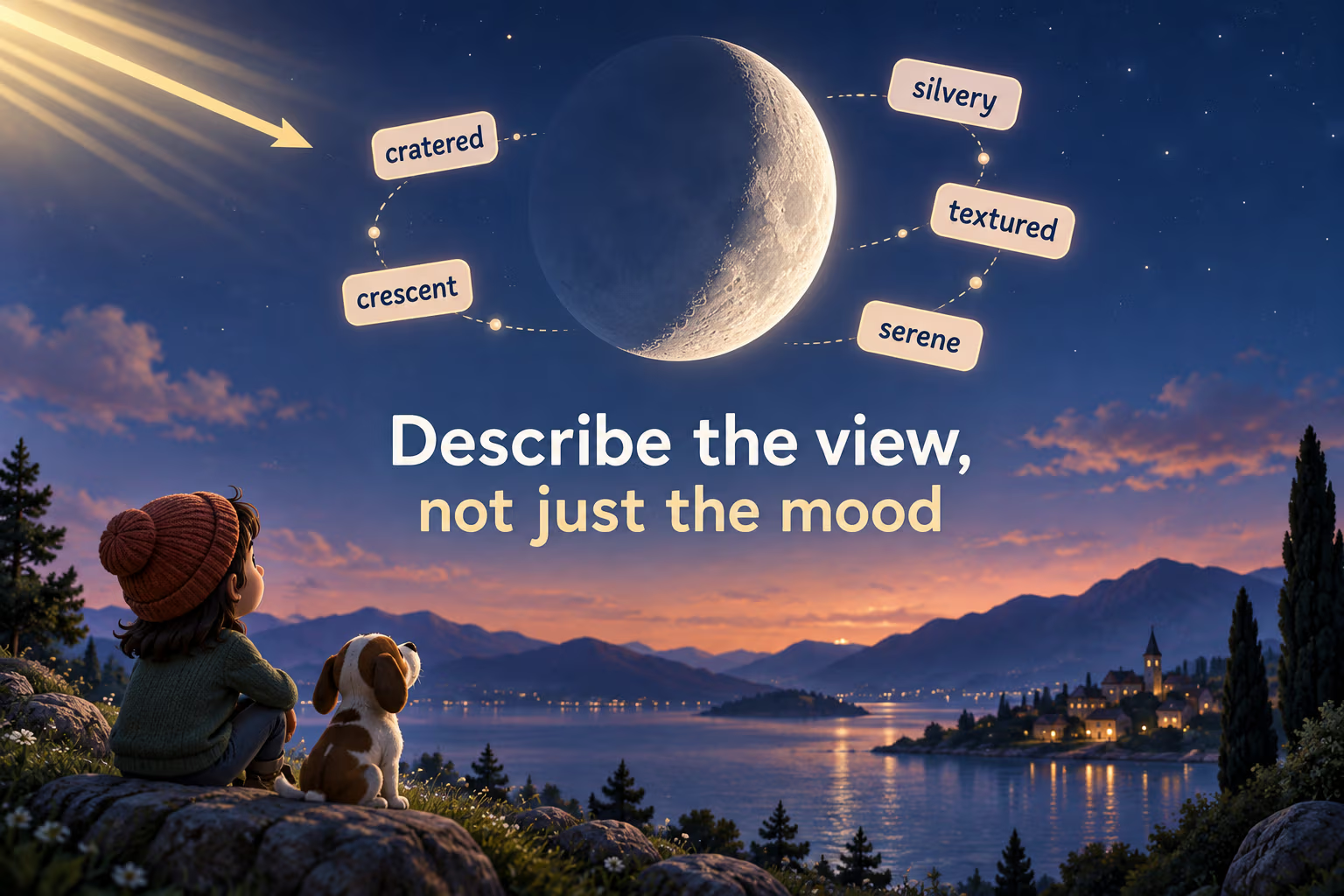
Describe visible features as well as the mood a view creates.
Start with a visible feature, then add an interpretation only when it suits your purpose. This simple distinction keeps a science description precise while leaving room for expressive writing. NASA explains that the Moon’s bright appearance is reflected sunlight; the surface itself contains darker gray volcanic plains and brighter highlands.
Moonlight is sunlight reflected from the Moon’s surface.
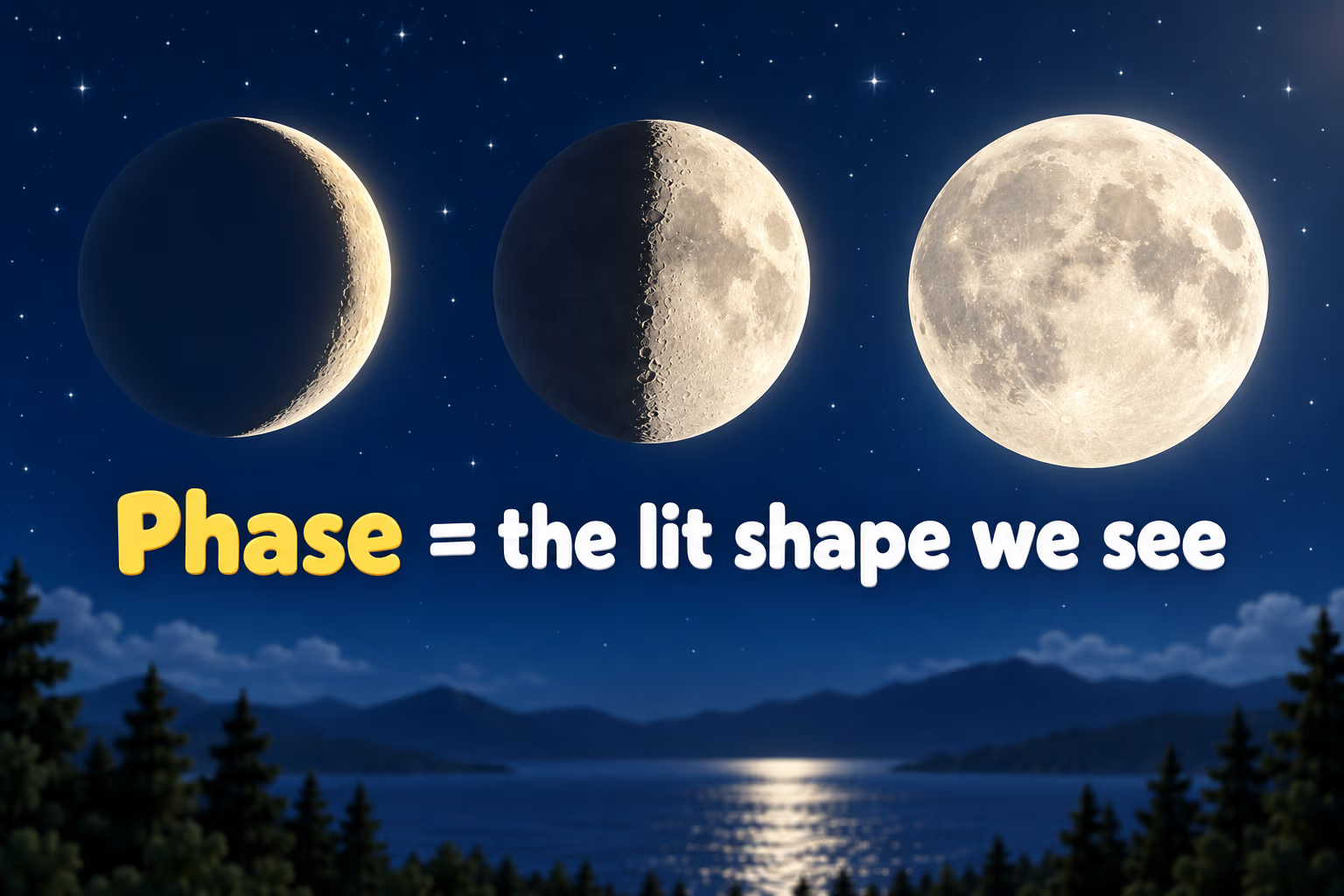
Phase and illumination: crescent, gibbous, full
Crescent, half-lit, gibbous, and full describe the apparent shape of the illuminated portion. Waxing means that the visible sunlit portion is growing; waning means it is shrinking. “Half Moon” is common everyday language, though “first quarter” or “third quarter” names the lunar phase more precisely. These terms describe our changing view, not a shadow cast by Earth; Earth’s shadow falls on the Moon during a lunar eclipse. See NASA’s Moon phases guide.
A phase describes the lit shape we see from Earth.
Brightness, surface, and color: luminous, cratered, gray
Bright, luminous, and radiant describe how the Moon appears from Earth; they do not mean it produces light. For a closer look at lunar terrain, cratered, rocky, and rugged are more concrete. The Moon’s surface is mostly dark gray, although it often looks nearly white to the unaided eye because its reflected sunlight is bright against the night sky. A low Moon often looks warmer in color because its light travels through more of Earth’s atmosphere, which scatters more blue wavelengths; dust or pollution can deepen the tint.
A low Moon may look warmer and seem larger; the apparent size is an illusion.
Apparent size and position: looming, distant, high
High, low, rising, and setting locate the Moon in the sky. Looming can capture how a horizon Moon seems to dominate a landscape, but it is a perceptual description: photographs made with the same zoom show the Moon nearly the same width at the horizon and overhead. Do not claim that the atmosphere magnifies it. NASA notes that the exact explanation for the Moon illusion remains unsettled.
Observational Words and Poetic Impressions
Use observational adjectives when readers need to picture a specific sky. Use mood words when the goal is atmosphere, voice, or symbolism. The same Moon can be “serene” to one observer and “eerie” to another, so these words communicate a response rather than a fact about the Moon.
What you mean
Useful adjectives
What the words tell the reader
Visible phase
crescent, gibbous, full, waxing
Shape or change in the sunlit portion
Light and tone
bright, luminous, pale, silvery
How the Moon looks from your viewpoint
Position or apparent scale
low, rising, distant, looming
Where it appears, or how it seems in context
Surface or visual texture
cratered, mottled, rocky, rugged
Visible terrain, especially through magnification
Mood or literary effect
serene, eerie, majestic, mysterious
The observer’s feeling or the writer’s tone
Quick Rules for Describing a Moon Scene
Name the phase or outline: “a thin waxing crescent.”
Add a visible quality: “a pale crescent above the rooftops.”
Place it in the scene: “low over the eastern horizon.”
Add mood only if it helps: “an eerie, pale crescent.”
A practical rule is to attach mood words to the observer or scene when literal accuracy matters: “the eerie Moonlight made the empty road feel unfamiliar” is clearer than implying the Moon itself is eerie. Likewise, reserve orange or golden for a warm-looking horizon view or an eclipse, rather than treating those colors as the Moon’s permanent surface color. For a short poem, by contrast, “silver,” “lonely,” or “watchful” can work as deliberate personification.
Frequently Asked Questions About Moon Descriptions
Is the Moon bright or luminous?
Both are natural descriptions of how the Moon looks from Earth. Scientifically, its visible light is reflected sunlight, so “bright” or “luminous” describes its appearance rather than an ability to produce light.
What color is the Moon?
Much of the lunar surface is dark gray, but the Moon often looks nearly white to us. Near the horizon, it can appear yellow or orange as its light passes through more atmosphere; color also varies with viewing conditions and image processing.
Does the Moon really look bigger at the horizon?
It often seems bigger, but the effect is an illusion of perception rather than atmospheric magnification. A photo taken with unchanged zoom can show that the Moon’s width is nearly the same low in the sky and overhead.
Which adjectives work best in a poem?
Choose words for the poem’s image and tone: “silver” suggests a cool sheen, “watchful” personifies the Moon, and “serene” creates calm. These are creative impressions, so they need not function as scientific descriptions.
When it comes to describing the moon, there are a wide variety of adjectives that can be used. For example, the moon can be described as being bright, round, and full. Additionally, the moon can also be described as being pale, eerie, and mystical. Ultimately, the adjectives that are used to describe the moon will depend on the individual’s personal experiences and feelings.
However, there are a few adjectives that are commonly used to describe the moon, such as these: beautiful, serene, majestic, and stunning. No matter what adjectives are used to describe the moon, it remains one of the most fascinating and enigmatic objects in our night sky.
Adjective For Moon
The moon is a beautiful sight in the night sky, and it has long been a source of inspiration for artists and poets. In fact, there are many adjectives that can be used to describe the moon. For example, the moon can be described as “luminous,” “serene,” or “ethereal.”
It can also be described as “magical,” “mysterious,” or “enchanting.” The adjectives that are used to describe the moon often reflect its beauty and mystery. The next time you see the moon, take a moment to appreciate its wonder, and try to come up with your own adjectives for this fascinating celestial body.
A
Ablaze
Abstract
Aesthetic
Ageless
Alien
Alkaline
Amazing
American
Ancient
Angelic
Asteroid
Astronomical
Astrophysical
Autumnal
Barometric
Barren
Battered
Beautiful
Beloved
Black
Blind
Blond
Blue
Bluish
Bold
Bow
Bright
Brilliant
Broad
C
Calm
Captive
Celestial
Certain
Chaste
Clean
Clear
Closer
Clouded
Cloudeda
Cloudless
Cold
Comforting
Conflate
Conscienceless
Conscious
Constant
Contrary
Controlling
Cool
Cosy
Coyote
Crescent
Crimson
Crownèd
Cruel
D
Damp
Dark
Dead
Deadly
Deceptive
Deep
Descending
Detestable
Devoid
Dim
Diminished
Distant
Distinct
Distorted
Dual
E
Early
Eleventh
Elfin
Eloquent
Enchanting
Enough
Enthralling
Entire
Envious
Estuary
Ethereal
Evanescent
Expansive
Experienced
Exquisite
Extra
Exultant
Eyed
F
Faced
Faded
Faint
Fairer
Fairy-Tail
Famous
Farther
Feeble
Fickle
Fifth
Final
Fine
Fitful
Floating
Flooded
Flying
Following
Footed
Forgotten
Freedom
Friendly
Frosty
Full
Future
G
Gaelic
Galilean
Gateway
Gentle
Ghastly
Ghostly
Giant
Gibbous
Gigantic
Gilt
Glisten
Gloomy
Glorious
Glowing
Godly
Gold
Golden
Gravitational
Green
Guardian
H
Hallowed
Hard
Harvest
Haunted
Heavenly
Heaventhe
Heraldic
Hidden
Holy
Howling
Huge
Human
Hung
Hungry
I
Iconic
Icy
Impossible
Incomprehensible
Indian
Indulgent
Infinite
Inner
Insightful
Invisible
Irregular
J | K | L
Japanese
Jovian
Joyous
Keen
Languid
Large
Legendary
Lifeless
Light
Lily
Little
Lonely
Looming
Lost
Loveliest
Lovely
Lovelya
Luminous
M
Mad
Magical
Magnificent
Maiden
Major
Mammy
Marked
Martial
Massive
Melancholy
Mellow
Middle
Midnight
Midsummer
Mighty
Mild
Milky
Mini
Misty
Mock
Moonthe
Mountainous
Mournful
Mummied
Mysterious
Mystic
N
Naked
Natal
Near
Nearby
Neath
Neptunian
Ninth
Normal
O
Obliging
Obscure
Oceanic
Official
Old
Olden
Ominous
Opaque
Orange
Orbed
Orbèd
Original
Otherworldly
Outer
Overcast
P
Pale
Pallid
Paradise
Past
Pasty
Peaceful
Pearlescent
Pendant
Pensive
Penumbra
Perpetual
Persistent
Placid
Pleasant
Pointed
Potent
Prakritic
Present
Pulling
Pure
Purple
Q | R
Quiet
Radiant
Rayed
Rechargeable
Red
Reflected
Regular
Remote
Resplendent
Revolving
Rich
Ripe
Rocky
Roguish
Round
Rounded
Royal
Ruinous
S
Sacred
Sad
Scary
Secret
Sensitive
Serene
Shadowy
Shimmer
Shy
Sick
Sickle
Sickly
Silent
Silhouette
Silly
Silver
Silvery
Single
Sixth
Sized
Slender
Slenderest
Slim
Slow
Sober
Soft
Solitary
South
Southern
Soviet
Spectacular
Spherical
Spinning
Splendid
Stable
Still
Storied
Stormy
Strange
Strollfull
Strong
Sunny
Super
Supercilious
Sweet
Swift
Swung
Syrian
T
Tenth
Terrible
Terrifying
Thin
Thinnest
Thou
Tidal
Time-Worn
Timorous
Tired
Tranquil
Tropical
Twelfth
Twinkling
U
Unborn
Uncertain
Unclouded
Unconquered
Unearthly
Uneasy
Unpolluted
Untouchable
Upthe
Uranian
V | W | Y
Vertuous
Victory
Visible
Walked
Wan
Wandering
Warm
Watcher
Watery
Weary
Weird
Westering
Wet
White
Wicked
Wild
Wispy
Wonderful
Yellow
Final verdict
To conclude, the moon is a remarkable natural satellite that has inspired adjectives like “pale,” “silent,” and “eternal.” It has also been the subject of many stories, songs, and poems over the centuries. While we may never know the moon’s true origins, its beauty and mystery continue to captivate our imaginations.
Robin founded StartsWithy in 2022 to make English words easier to understand and use. Robin oversees our 30,000+ guides, checks meanings and grammar against trusted dictionaries such as Cambridge, Oxford Learner’s and Collins, and is accountable for every correction we make.