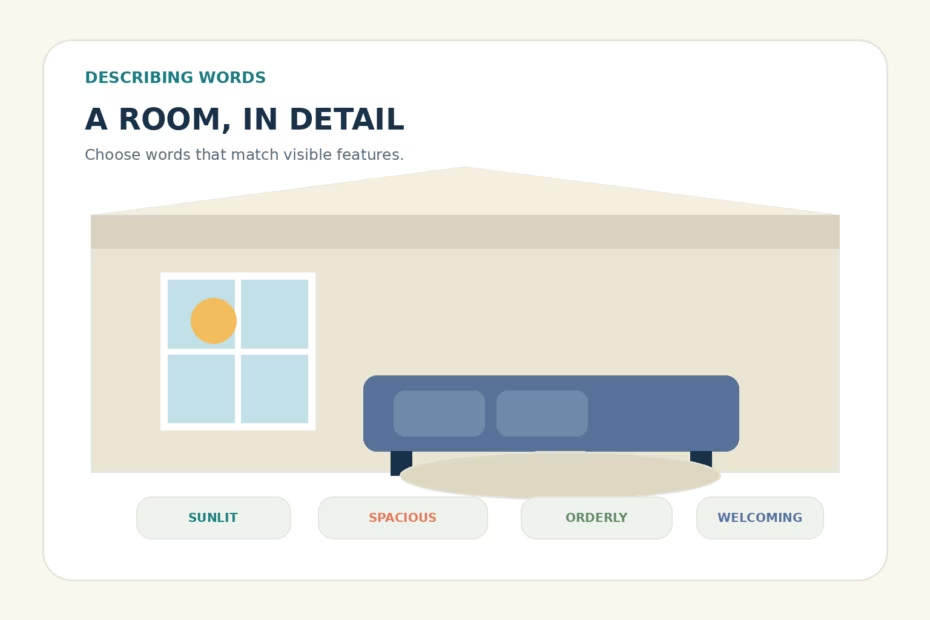
A room description becomes clearer when it names details a reader can picture: how much space there is, where the light falls, how objects are arranged, and what the room feels like to use. The word beautiful gives an opinion; words such as sunlit, narrow, or cluttered give the reader more specific clues. This guide groups adjectives for a room by the feature they describe and shows how to use them in sentences.
Quick list: adjectives to describe a room
Use this list to find a word that matches the feature you want to emphasize. Some adjectives can fit more than one category, depending on context.
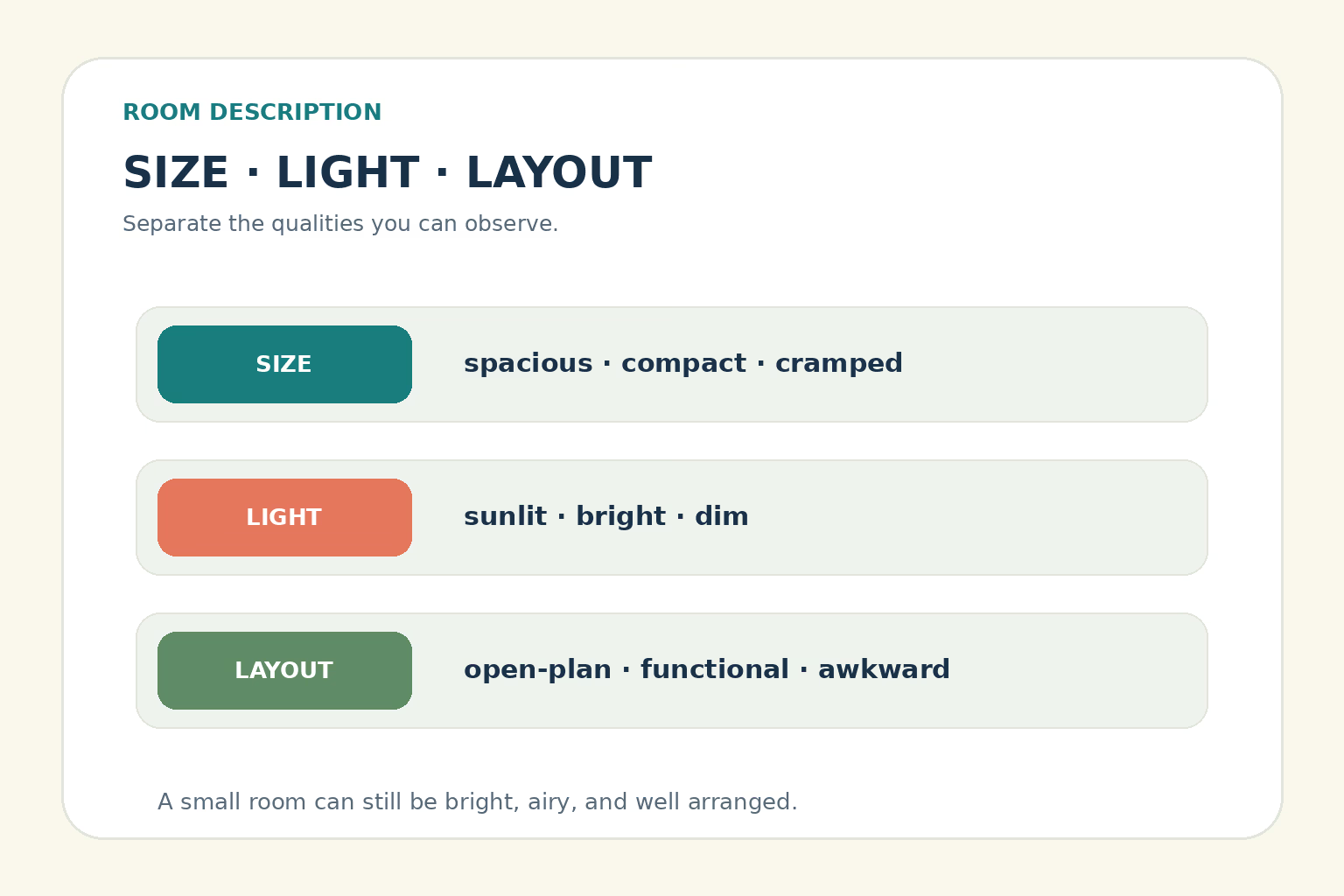
- Size and space: spacious, roomy, expansive, compact, small, narrow, cramped, open
- Light and air: bright, sunlit, dim, shadowy, airy, stuffy, ventilated, windowless
- Layout and order: open-plan, organized, uncluttered, cluttered, crowded, functional, awkward, well-arranged
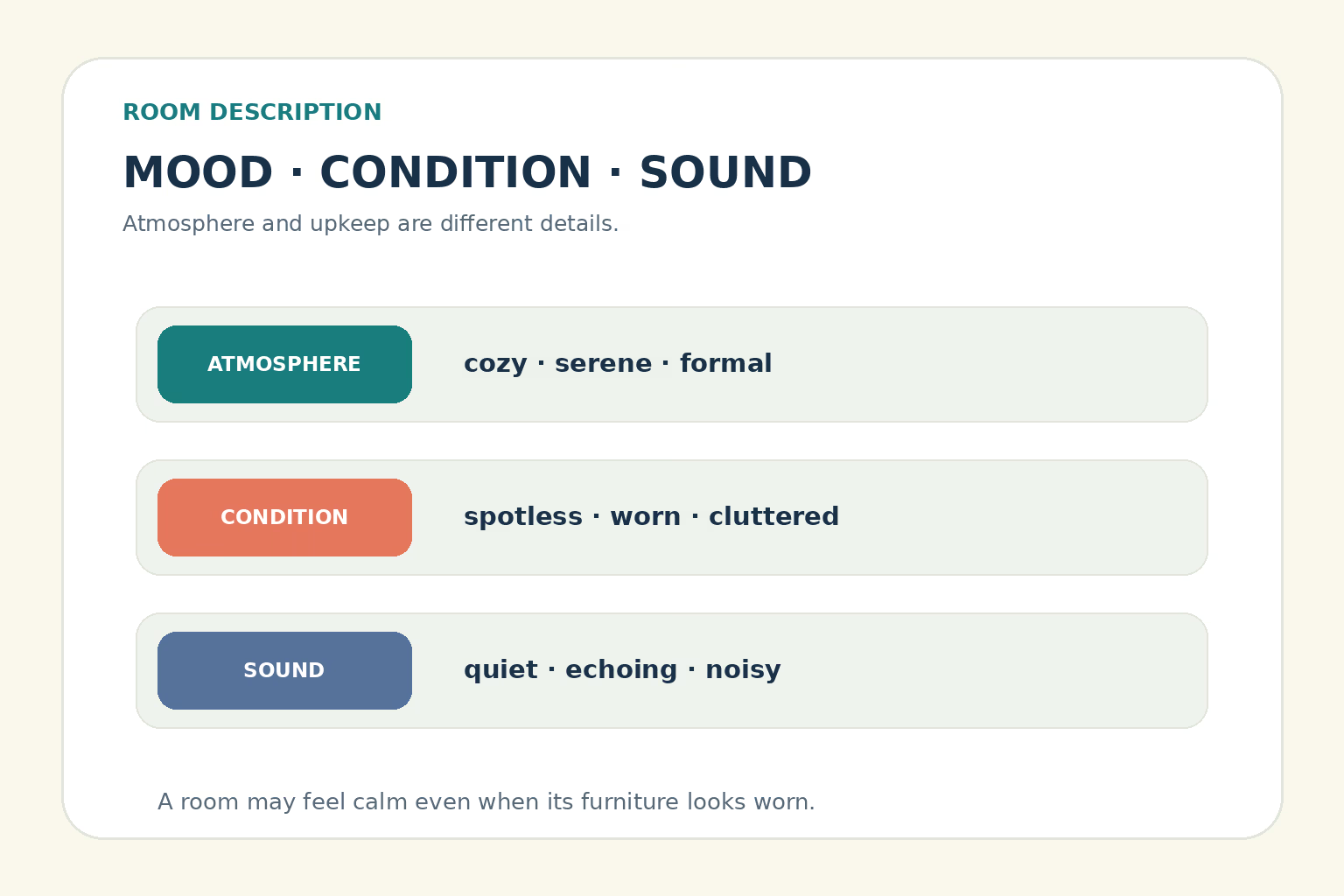
- Comfort and atmosphere: cozy, welcoming, serene, lively, formal, intimate, relaxing, imposing
- Appearance and condition: elegant, modern, rustic, polished, worn, dingy, spotless, neglected
- Sound and privacy: quiet, noisy, echoing, hushed, private, exposed, soundproof
Before choosing a word, ask what you can actually observe. A room can be small but comfortable, bright but noisy, or spacious yet cluttered. Pairing two accurate details often creates a stronger description than piling on several near-synonyms.
Adjectives for a room’s size, light, and layout
Spatial words tell a reader how the room is arranged and how it might feel to move through it. Light and ventilation add separate information, so avoid treating airy as if it always means large: a compact room with an open window can still feel airy.
| Adjective | What it suggests | Example |
|---|---|---|
| Spacious | There is plenty of room to move or arrange furniture. | The spacious studio has room for a desk and a reading chair. |
| Compact | The room is small but arranged efficiently; the word need not sound negative. | A compact study fits a desk, shelves, and a task lamp. |
| Cramped | There is too little space for comfortable movement or the things inside it. Cambridge defines the adjective in terms of not having enough space or time. | The cramped entryway made it difficult for everyone to take off their coats. |
| Open-plan | The layout combines spaces without full-height dividing walls. | The open-plan kitchen and dining area makes conversation easy. |
| Sunlit | Direct sunlight reaches the room. | A sunlit corner brightened the breakfast nook each morning. |
| Dim | The light level is low. | The dim hallway needed a brighter ceiling fixture. |
| Airy | The room feels open and fresh, often because of space, windows, or air movement. | High ceilings and open windows gave the room an airy feel. |
| Stuffy | The air feels warm or stale, often because little fresh air is moving. | The meeting room grew stuffy after the windows were closed. |
For precise writing, distinguish bright from sunlit: a room can be bright because of lamps, while sunlit specifically points to sunlight. Likewise, spacious describes available room, while airy describes an impression of openness or freshness. If fresh air is the main point, well-ventilated is more exact; Cambridge Dictionary defines ventilated for a space as having fresh air entering and moving around it.
Adjectives for a room’s mood and condition
Atmosphere words describe the impression a room creates. Condition words describe its upkeep. Keeping those ideas separate helps avoid confusing an emotional response with a visible fact: a room might be serene but worn, or elegant but cluttered.
| Adjective | What it suggests | Example |
|---|---|---|
| Cozy | Comfortable and pleasantly warm or intimate. | The cozy den had a soft rug and a reading lamp. |
| Serene | Calm and peaceful. | Muted colors made the waiting room feel serene. |
| Welcoming | Inviting and comfortable for visitors. | A bench by the door made the entry feel welcoming. |
| Formal | Arranged for a more traditional or official occasion. | The formal dining room was set for a family celebration. |
| Cluttered | Messy, disorganized, or covered with too many things; this matches Cambridge Dictionary’s definition. | The cluttered workroom had papers stacked across the table. |
| Uncluttered | Free of unnecessary objects and visual mess. | The uncluttered desk left space to spread out the plans. |
| Spotless | Extremely clean. | The spotless kitchen was ready for the cooking class. |
| Worn | Showing signs of use over time. | The worn armchair gave the reading room a lived-in look. |
| Dingy | Dark, dull, or unclean in appearance. | Fresh paint and better lighting changed the dingy basement room. |
| Echoing | Sound reverberates around the room. | The empty gym was echoing during the early morning practice. |
Some words make a factual claim as well as create a mood. Spotless suggests a high degree of cleanliness; private suggests limited access or visibility; soundproof suggests that sound is blocked. Use them only when the details support the claim. If you mean that a space is suitable to live in, habitable is more specific than comfortable: Cambridge Dictionary describes it as providing conditions good enough to live in.
How to choose the right adjective for a room
- Name the feature first. Decide whether you are describing size, lighting, layout, cleanliness, sound, or mood.
- Use observable evidence. Instead of “a lovely room,” try “a bright room with tall windows and pale wood floors.”
- Match the strength of the word. A little untidy room may be messy; chaotic suggests a much stronger lack of order.
- Balance positive and negative details. “The narrow office is quiet and well organized” gives a more useful picture than calling it simply “good” or “bad.”
- Vary sentence structure. Place one adjective before the noun (“a sunlit room”) or use a linking verb (“the room felt calm”).
For example, “The room was nice” could become “The compact guest room felt welcoming, with a bright window and neatly made bed.” The revision gives specific visual details and an atmosphere word. In a story, you might instead choose details that support the scene: “The dim, echoing corridor seemed empty.”
Room adjectives by type of space
- Bedroom: restful, cozy, private, sunlit, cramped, cluttered. “The restful bedroom had blackout curtains and a tidy bedside table.”
- Living room: spacious, welcoming, lively, elegant, open-plan. “The open-plan living room connected the seating area to the kitchen.”
- Kitchen: functional, bright, spotless, cramped, well-equipped. “The functional kitchen kept everyday dishes within easy reach.”
- Bathroom: clean, compact, airy, tiled, luxurious. “The compact bathroom used a wall-mounted sink to free up floor space.”
- Office or study: quiet, organized, focused, windowless, noisy. “The quiet study offered a focused place to work.”
- Classroom: cheerful, orderly, crowded, flexible, well-lit. “The flexible classroom could be rearranged for group activities.”
These are starting points, not fixed labels. A classroom can be quiet during reading time and lively during a group project. Describe the particular room and moment rather than assuming every room of one type has the same qualities.
Common mistakes when describing rooms
- Using several synonyms together: “spacious, roomy, expansive” repeats a similar idea. Choose the word that best fits the scene.
- Mixing up size and comfort: Small is neutral; cramped says the lack of space is uncomfortable or restrictive.
- Calling every tidy room “minimalist”: Minimalist describes a deliberately simple style, not merely a room with few objects.
- Using a mood word without context: Add the details that make a room feel serene, gloomy, or welcoming.
- Making a claim the description cannot support: A room with a window is not automatically well-ventilated; a room that looks clean is not necessarily spotless.
Frequently asked questions
What are positive adjectives for a room?
Useful positive adjectives include welcoming, bright, spacious, cozy, serene, organized, functional, and elegant. Pick one based on whether you mean the room’s size, atmosphere, appearance, or use.
What are negative adjectives for a room?
Depending on the detail, you might use cramped, cluttered, dim, noisy, stuffy, dingy, or neglected. These words do not all mean the same thing: cluttered describes disorder, while cramped describes a shortage of space.
What is another word for a small room?
Compact is a neutral or positive choice when a small room is arranged efficiently. Use cramped when the limited space makes movement or use difficult, and cozy when the small size feels comfortable.
How can I describe a room in one sentence?
Combine a concrete detail with one or two adjectives: “The bright, compact studio has built-in shelves and a clear path from the door to the window.” This gives readers a more precise picture than a string of general praise.
Sources for word meanings
For meaning checks, see the Cambridge Dictionary entry for “cluttered”, its entry for “cramped”, its entry for “ventilated”, and its entry for “habitable.” The example sentences in this guide are original illustrations of the words in room-related contexts.

Welcome to my article on adjectives for rooms! If you’re looking to add some descriptive flair to your writing or simply want to enhance your vocabulary, you’ve come to the right place. In this article, I’ll be sharing a variety of adjectives that you can use to vividly describe different types of rooms. Whether you’re describing a cozy bedroom, a spacious living room, or a luxurious bathroom, these adjectives will help you paint a detailed picture in the minds of your readers. So, let’s dive in and explore the world of descriptive words for rooms!
How to Describe room? – Different Scenarios
When it comes to describing a room, there are various scenarios that require different adjectives to accurately portray the space. Whether you are writing a story, describing a real place, or teaching children about different types of rooms, selecting the right adjectives is crucial. Let’s explore different scenarios where room descriptions are useful and the corresponding adjectives.
Scenario 1: Describing a Cozy Bedroom
In a cozy bedroom, you want to convey a sense of comfort and warmth. Here are some adjectives that can help you create that atmosphere:
| Adjective | Definition |
|---|---|
| Inviting | Making you feel welcome and at ease |
| Snug | Small, warm, and comfortable |
| Comfy | Providing a pleasant and cozy feeling |
Scenario 2: Depicting a Spacious Living Room
When describing a spacious living room, you want to emphasize the size, openness, and functionality of the space. Consider using these adjectives:
| Adjective | Definition |
|---|---|
| Generous | Having more than enough space |
| Airy | Full of light and well-ventilated |
| Versatile | Able to be adapted or used for different purposes |
Scenario 3: Portraying a Luxurious Bathroom
A luxurious bathroom is all about indulgence, sophistication, and relaxation. Use these adjectives to capture the essence:
| Adjective | Definition |
|---|---|
| Opulent | Demonstrating wealth and luxury |
| Elegant | Stylish and tasteful |
| Pampering | Making someone feel special and well taken care of |
Scenario 4: Teaching Adjectives to Kids
For educators teaching adjectives to children, it’s important to focus on easy, age-appropriate words. Here are some examples of simple adjectives for different rooms:
- Bedroom: cozy, colorful, messy
- Living room: big, bright, comfy
- Bathroom: clean, shiny, small
Remember, the key is to choose adjectives that accurately describe the room and evoke the desired emotions in your readers or listeners. By using vivid and appropriate adjectives, you can paint a detailed picture in their minds and make your writing more engaging and effective.
Describing Words for room in English
When it comes to describing rooms, choosing the right adjectives is essential. These words help us paint a vivid picture and communicate the characteristics of a room effectively. In this section, I will provide you with a list of adjectives that can be used to describe different rooms, along with examples to illustrate their usage.
Cozy Words for Bedrooms
- Intimate: A small and comfortable bedroom can be described as intimate. It creates a warm and personal atmosphere.
- Serene: A calm and peaceful bedroom can be referred to as serene. This adjective evokes a sense of tranquility.
- Inviting: A bedroom that welcomes you in is inviting. This adjective implies comfort and hospitality.
Bright and Spacious Words for Living Rooms
- Airy: A living room with plenty of natural light and open space can be described as airy. It feels fresh and expansive.
- Generous: A living room that offers ample space to move around and accommodate guests is generous. This adjective suggests openness and hospitality.
- Welcoming: A cozy and warm living room that makes you feel at home is welcoming. It creates an inviting and friendly atmosphere.
- Opulent: A bathroom adorned with luxurious fixtures and finishes can be referred to as opulent. It exudes extravagance and elegance.
- Lavish: A bathroom with high-end features and indulgent comforts can be described as lavish. This adjective suggests luxury and indulgence.
- Spa-like: A bathroom that resembles a spa in terms of design and amenities is spa-like. It evokes a sense of relaxation and pampering.
Remember, when teaching children about different rooms, it is important to use age-appropriate adjectives that they can understand and relate to. Use words that accurately describe the room and evoke the desired emotions in young learners.
I hope this list of adjectives for rooms will help you effectively describe and teach about different living spaces. The key is to choose words that vividly depict the characteristics of the room and engage your readers or listeners.
Stay tuned for the next section where we explore how colors can enhance the ambiance of a room.
Adjectives for room
Positive Adjectives for Room
When it comes to describing rooms, choosing the right adjectives is essential. Positive adjectives can help create a welcoming and inviting atmosphere. Here are some examples of positive adjectives that you can use to describe rooms:
| Adjective | Definition | Example Sentence |
|---|---|---|
| Cozy | Warm and comfortable | The bedroom has a cozy atmosphere. |
| Spacious | Large and roomy | The living room is spacious and airy. |
| Bright | Well-lit and full of light | The kitchen has bright, natural lighting. |
| Serene | Calm and peaceful | The meditation room has a serene ambiance. |
| Inviting | Welcoming and friendly | The guest room is inviting and comfortable. |
| Elegant | Stylish and sophisticated | The dining room has an elegant design. |
| Tranquil | Quiet and peaceful | The study room provides a tranquil environment. |
| Harmonious | Balanced and pleasing | The music room has a harmonious color scheme. |
| Organized | Neat and well-arranged | The office is organized and clutter-free. |
| Lively | Energetic and vibrant | The playroom is filled with lively colors. |
| Luxurious | Sumptuous and indulgent | The master bathroom is luxurious and elegant. |
| Delightful | Charming and pleasant | The garden room is a delightful space. |
Negative Adjectives for Room
Not all rooms have positive qualities, and sometimes it is necessary to describe their negative aspects. Here are some negative adjectives that can be used to describe rooms:
| Adjective | Definition | Example Sentence |
|---|---|---|
| Cluttered | Messy and disorganized | The storage room is cluttered with old items. |
| Gloomy | Dark and depressing | The basement has a gloomy atmosphere. |
| Cramped | Small and confining | The bathroom feels cramped and tight. |
| Dingy | Dark, dull, and dirty | The attic has a dingy and neglected appearance. |
| Drab | Dull and lacking in color or excitement | The waiting room has a drab and uninviting look. |
Remember, choosing the appropriate adjectives will help create a vivid and engaging description of a room. Incorporate these adjectives into your teaching materials to enhance children’s vocabulary and understanding of different room types.
Synonyms and Antonyms with Example Sentences
Synonyms for room:
- Chamber
- Space
- Area
- Place
- Dwelling
Example Sentences:
- The cozy chamber provided a peaceful retreat.
- There was not enough space to fit all the furniture.
- She rearranged the area to create a better flow.
Antonyms for room:
- Cramped
- Confining
- Crowded
- Small
- Claustrophobic
Example Sentences:
- The cramped room felt suffocating.
- The confining space made it difficult to move around.
- The crowded conditions were overwhelming.
Remember, when teaching adjectives to children, it’s important to provide context and examples that they can relate to. Consider using visual aids, such as pictures of different rooms, to help them understand the meaning of these adjectives.
Conclusion
Choosing the right adjectives when describing rooms is essential in painting a vivid picture for the reader. Throughout this article, I have provided a range of synonyms and antonyms for the word “room,” along with example sentences to demonstrate their usage.
One key takeaway from this discussion is the importance of providing context and relatable examples when teaching adjectives to children. By using visual aids, such as pictures of different rooms, we can help children better understand the meaning of these adjectives and how they can be applied.
In the next section, we will delve deeper into other aspects of room descriptions, exploring topics such as color, size, and atmosphere. By expanding our vocabulary and understanding of adjectives, we can create more engaging and descriptive room descriptions that captivate our readers.
Remember, the words we choose have the power to transform a simple room into a vibrant and inviting space. So, let’s continue to explore the world of adjectives and enhance our ability to describe rooms with precision and creativity.


