How to Choose Adjectives for Sharks
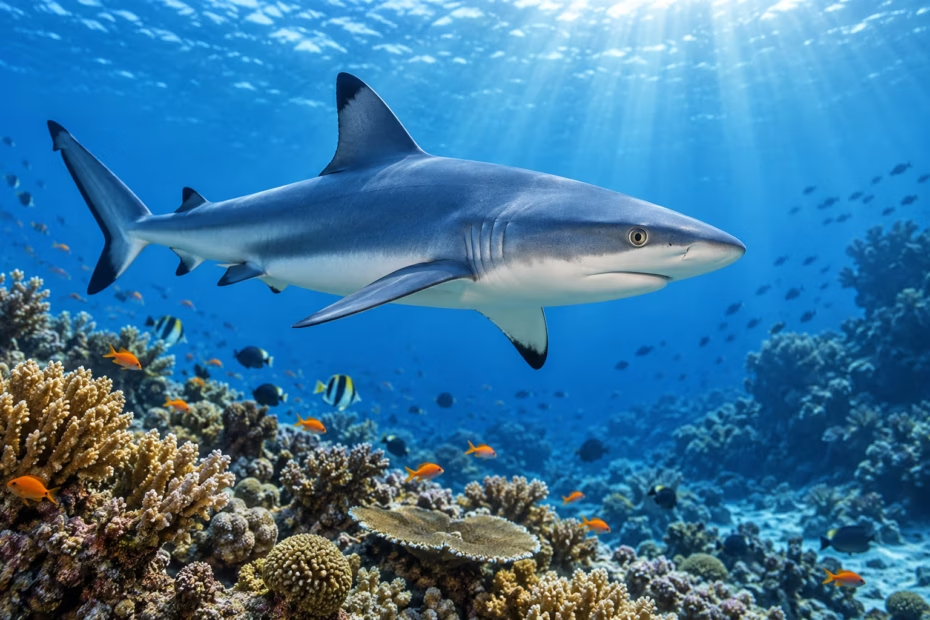
A useful shark adjective gives readers a concrete detail about a particular animal, scene, or scientific observation. Sharks are a diverse group, so words such as “massive,” “dangerous,” or “aggressive” should not be treated as true of every species. Match the adjective to what can actually be seen or supported, and name the species when the detail is species-specific.
For creative writing, you might describe a shark as sleek, shadowy, or formidable to set a mood. In a school report or nature caption, favor observable wording such as “gray above and pale below,” “slow-moving near the seafloor,” or “large-bodied.” A practical pattern is adjective + visible or sourced detail: “The whale shark’s broad, spotted back moved beneath the boat.”
What Adjectives Describe a Shark’s Appearance?
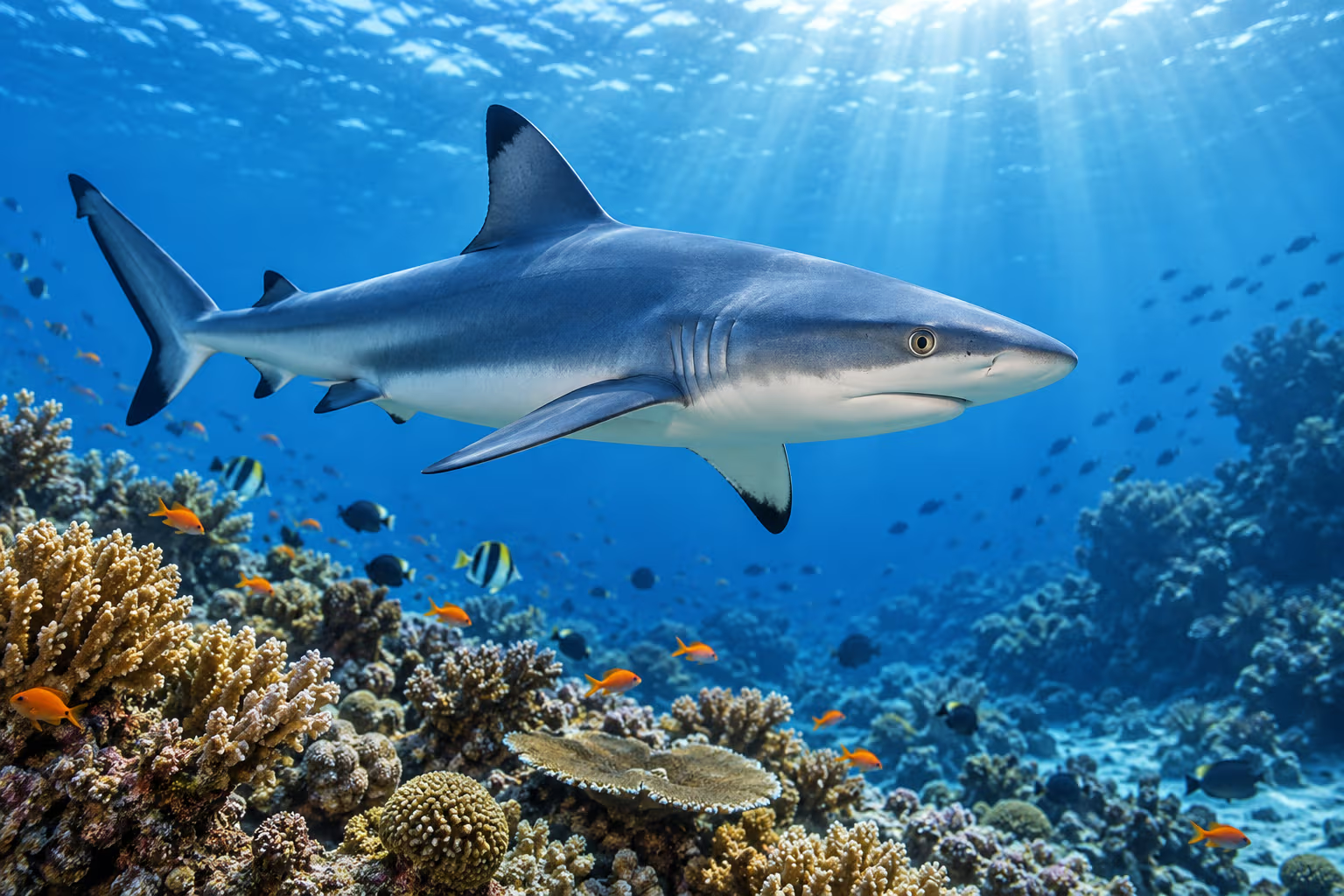
Appearance words help readers picture body shape, coloring, skin, fins, and teeth. Sharks vary widely in size and form, so choose a term that fits the species instead of relying on a single movie-style image.
| Adjective | What it describes | Example sentence |
|---|---|---|
| Streamlined | A tapered body shape suited to moving through water | The streamlined blue shark crossed the open water with steady strokes. |
| Spotted | Distinct marks on the skin | The whale shark’s spotted pattern made the broad animal easy to recognize. |
| Pale | A light underside or coloration | A pale underside contrasted with the darker back. |
| Broad-headed | A wide head shape, especially noticeable in hammerheads | The broad-headed hammerhead swept its head from side to side as it searched. |
| Rough-textured | Skin that feels coarse because of tiny tooth-like scales | The rough-textured skin is made of dermal denticles, not ordinary fish scales. |
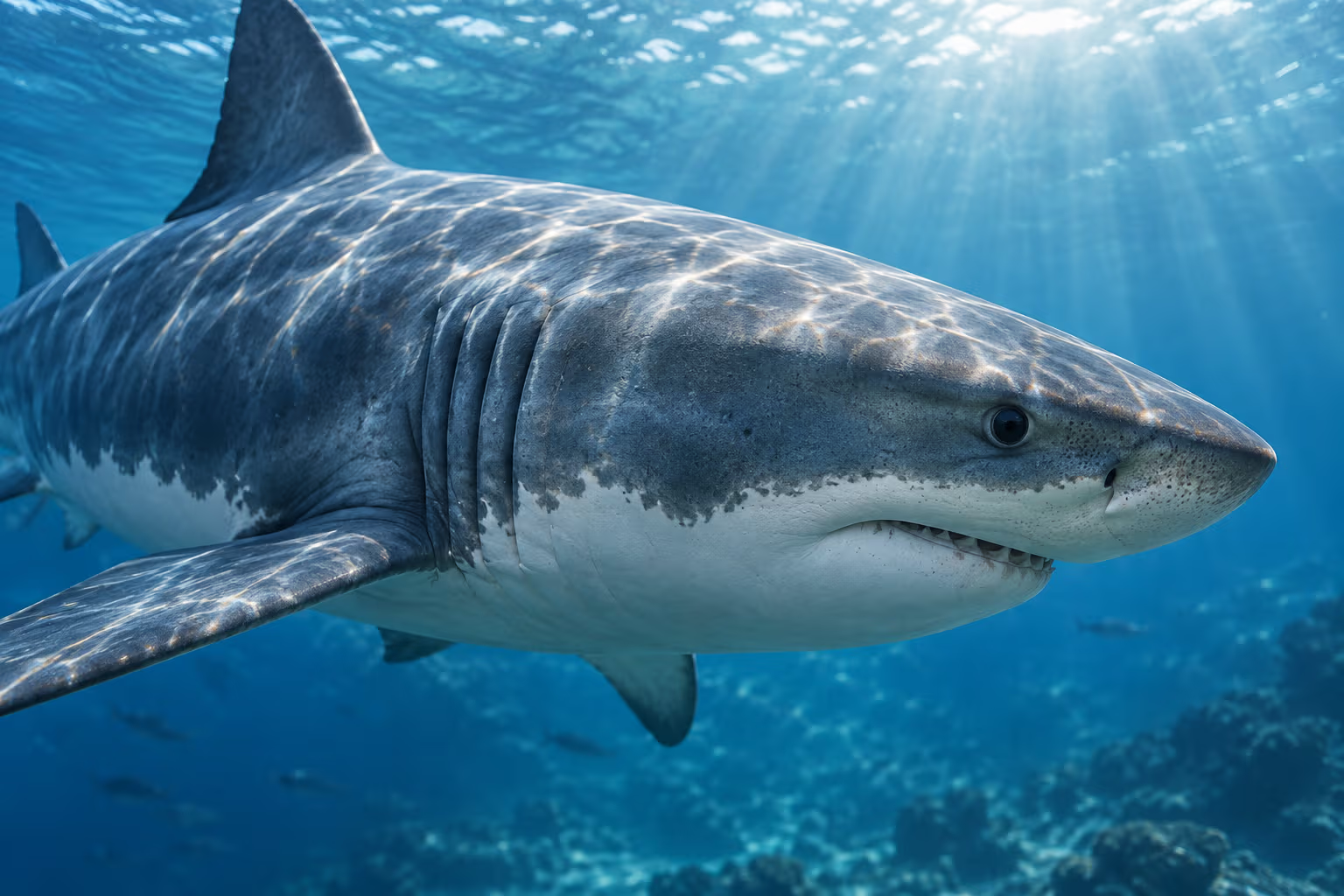
| Serrated | Teeth with small saw-like edges | In the illustration, serrated teeth give the great white shark a recognizable profile. |
| Slender | A narrow body or build | The slender shape of this reef shark is easy to distinguish from a whale shark. |
| Powerful-looking | A visual impression, not a scientific measurement | The powerful-looking tail filled the frame as the shark turned. |
“Sleek,” “glossy,” and “silvery” can work in a vivid passage, but check the animal or image first: a shark’s skin may look matte, patterned, sandy, or dark rather than shiny. “Sharp-toothed” is more general than “serrated,” since tooth shape differs among species and can vary between jaws.

Which Words Describe Shark Movement and Behavior?
Movement adjectives are strongest when they describe an action observed in a particular moment. Avoid turning a brief behavior into a broad personality judgment: “a shark circled the bait” reports an action, while “the shark is vicious” assigns a human-like trait and implies more than the observation shows.
| Word | Use it when… | Example |
|---|---|---|
| Gliding | Movement appears smooth and continuous | A reef shark glided past the coral before changing direction. |
| Winding | The path curves or changes course | The small shark took a winding path through the kelp. |
| Resting | The animal is still or inactive in the observed scene | A nurse shark rested on the sandy bottom, away from the current. |
| Migratory | A species or individual makes seasonal or long-distance movements | The report describes a migratory species tracked between feeding areas. |
| Solitary | An animal is alone in the scene or is generally described that way with a source | A solitary shark appeared near the reef at dusk. |
| Social | Observed individuals associate or interact | The researchers recorded social behavior among the sharks they studied. |
| Ambush-hunting | A hunting method involves waiting before a rapid strike | The flattened angel shark is adapted to an ambush-hunting style. |
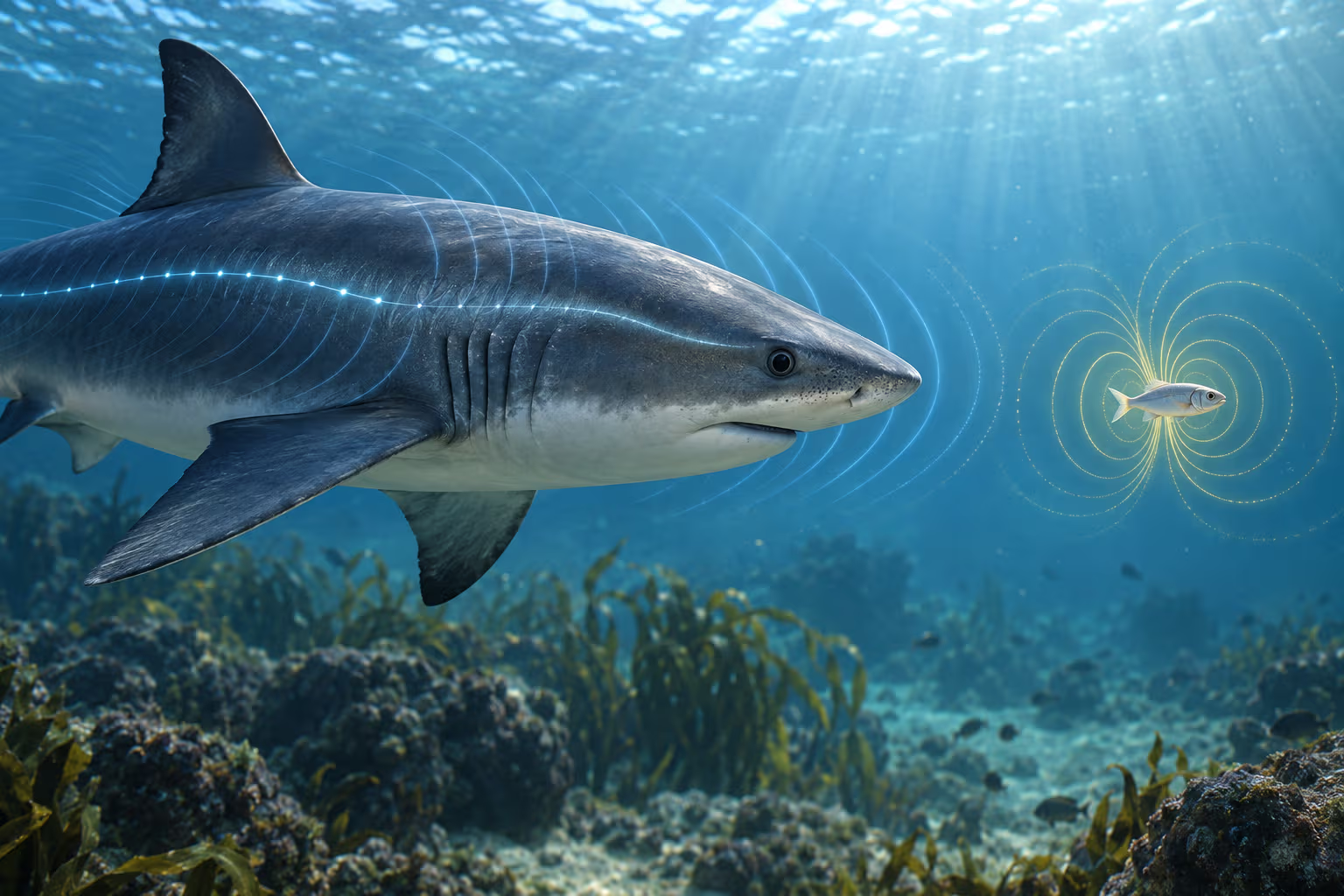
The sensory picture is also more complex than a single “keen sense of smell.” Smithsonian Ocean describes shark vision, smell, hearing, taste, touch, and electroreception; the lateral-line system responds to water movement, while ampullae of Lorenzini detect weak electrical fields. These are distinct sensory systems, and their roles vary with species and context.
How Can You Describe Shark Size and Habitat?
Size adjectives should be relative or tied to a known measurement. “Small-bodied” and “large” are useful when a comparison is clear; use an actual length from a reliable species source when precision matters. The whale shark is the largest living fish, while the dwarf lanternshark is tiny by comparison, illustrating why one adjective cannot stand for all sharks.
Habitat terms can make a description more informative: coastal, reef-dwelling, deep-sea, pelagic (open-water), bottom-dwelling, or temperate-water. A location word should identify where the scene or species belongs, not imply every individual stays in one place. For example: “The bottom-dwelling angel shark lay partly covered by sand” is more specific than “The shark was mysterious.”
| Useful habitat adjective | Meaning in a description | Example sentence |
|---|---|---|
| Coastal | Near a shore | The coastal nursery gives young sharks a sheltered place to grow. |
| Pelagic | Living in the open-water zone | The pelagic shark followed prey far from the reef. |
| Deep-sea | Associated with deep ocean conditions | The deep-sea species has adaptations suited to low-light conditions. |
| Reef-associated | Using reef habitat for some part of its life | A reef-associated shark moved among coral outcrops. |
| Bottom-dwelling | Spending much of its time near the seafloor | The bottom-dwelling shark rested on the sand. |
Are Sharks “Fierce” or “Dangerous”? Use Those Words Carefully
“Fierce,” “menacing,” and “terrifying” can be appropriate for a fictional scene or a narrator’s reaction, but they are subjective mood words. “Dangerous” should identify a specific risk and context instead of labeling all sharks. NOAA Fisheries cautions against sensational descriptions that make shark encounters seem more common than they are; risk depends on location, activity, species, and circumstances. A measured nature description can acknowledge that some sharks can injure people while also avoiding the claim that sharks generally hunt humans.
For factual writing, replace a broad label with evidence: “The shark approached the baited camera,” “The tagged animal entered the swimming area,” or “The species has sharp teeth and should be observed from a safe distance.” If your source uses a category such as “aggressive,” say who applied it and why; do not use it as a catch-all synonym for predatory.
45 Adjectives for Sharks by Writing Purpose
Use this list as a vocabulary menu, not as a checklist that fits every shark. Some terms describe visible form, some describe movement, and some express the writer’s tone.
- Appearance: streamlined, spotted, pale, dark-backed, broad-headed, slender, rough-textured, serrated, pointed, robust, graceful, mottled.
- Movement: gliding, winding, darting, circling, cruising, steady, swift, slow-moving, turning, hovering.
- Senses and hunting context: perceptive, vibration-sensitive, electroreceptive, alert, ambush-hunting, opportunistic, predatory.
- Habitat and scale: coastal, pelagic, deep-sea, reef-associated, bottom-dwelling, migratory, small-bodied, large, juvenile, mature.
- Creative mood: mysterious, imposing, formidable, striking, shadowy, awe-inspiring.
A few terms above belong mainly in sourced or imaginative contexts. “Electroreceptive” and “vibration-sensitive” refer to sensory abilities; “opportunistic” and “predatory” describe feeding ecology, not personality. “Juvenile” and “mature” describe life stage rather than appearance. “Fearsome” and “terrifying” tell readers how a scene feels, not how every shark behaves.
Example Sentences with Shark Adjectives
- The streamlined shark moved through the current with a quiet, even rhythm.
- A spotted whale shark appeared beneath the boat, its pattern visible in the clear water.
- The bottom-dwelling angel shark blended into the sand until it began to move.
- A migratory shark traveled between feeding grounds, according to the tracking study.
- The mysterious silhouette gave the fictional scene an uneasy mood.
- A large-bodied shark passed the reef camera; the researcher recorded its estimated length rather than calling it “huge.”
- The electroreceptive shark can detect weak electrical cues, a detail that is more precise than simply calling it “clever.”
- The graceful shark turned in a wide arc, a writer’s visual description of its movement.
Frequently Asked Questions About Shark Adjectives
What are five positive adjectives for a shark?
Streamlined, graceful, striking, adaptable, and remarkable can suit a descriptive passage. In factual writing, support each term with a visible feature, behavior, or sourced fact. “Positive” describes the writer’s tone; it does not mean the trait applies to every species.
What are good words to describe a shark’s appearance?
Try spotted, pale, dark-backed, broad-headed, slender, or rough-textured when those details match the shark you are describing. Species names and photographs help readers understand which features are actually present.
Is “aggressive” a good adjective for sharks?
Use “aggressive” only when a reliable source defines or documents that behavior in a specific context. It is often an imprecise blanket label. Describe the observed action—such as approaching, circling, or biting—and explain the circumstances.
What is a strong adjective for shark movement?
Gliding works for smooth, continuous movement; darting suggests a quick burst; cruising describes steady travel. Choose the word that fits the observed speed and motion.
How can I describe a shark without making it sound frightening?
Focus on form, color, movement, sensory abilities, and habitat. For instance, “a spotted whale shark drifted beneath the boat” gives a clear image without assigning a threatening motive.
Sources and Further Reading
- Smithsonian Ocean, Sharks — shark senses, lateral-line detection, electroreception, and species diversity.
- NOAA Fisheries, Debunking Common Shark Myths — context on sensational language and human-shark encounters.
- NOAA Fisheries, Shark Conservation — fisheries, ecological roles, and conservation challenges.
- NOAA Fisheries, Sharks in Atlantic, Gulf, and Caribbean Coastal Waters — regional species and encounter context.

How to Describe sharks? – Different Scenarios
When it comes to describing sharks, there are a variety of words and phrases that can be used to paint a vivid picture. Whether you are teaching young children about these fascinating creatures or simply looking to expand your vocabulary, here are some ways to describe sharks in different scenarios:
- Appearance
- Behavior
- Characteristics
- Size
Remember, these descriptions can be used to engage young learners or anyone who is captivated by the world of sharks. By using descriptive words, we can bring these incredible creatures to life in our imaginations.
Let’s dive deeper into the diverse species of sharks and explore their unique features and habitats.
Describing Words for sharks in English

Sharks are fascinating creatures that captivate our imagination with their unique appearance and powerful presence. Describing sharks using the right words can paint a vivid picture and engage young learners. Let’s explore some descriptive words that will help bring these magnificent creatures to life.
- Sleek: Sharks are known for their smooth and streamlined bodies that allow them to move effortlessly through the water.
- Majestic: With their powerful fins and sharp teeth, sharks exude a sense of grandeur and awe.
- Terrifying: Sharks’ reputation as fierce predators adds an element of fear and excitement to their description.
- Elegant: The way sharks glide through the water with their graceful movements can be described as elegant.
- Mysterious: Sharks inhabit the depths of the ocean, and their elusive nature adds an air of mystery to their description.
- Formidable: Sharks possess incredible strength and agility, making them formidable hunters in their underwater domain.
- Serrated: Describing a shark’s teeth as serrated highlights their sharpness and efficiency when it comes to capturing prey.
- Sleek: Sharks’ sleek skin, often covered in scales, helps reduce friction as they navigate through the water.
- Fierce: Sharks’ determined and powerful nature makes them appear fierce and intimidating.
- Stealthy: Sharks are known for their stealthy approach, quietly stalking their prey before launching into a swift attack.
It’s important to choose the right words when describing sharks to engage young learners and foster their fascination with these incredible creatures. Whether it’s their smooth bodies, powerful presence, or mysterious nature, descriptive words play a crucial role in bringing sharks to life.
| Word | Definition |
|---|---|
| Sleek | Smooth and streamlined |
| Majestic | Grand and impressive |
| Terrifying | Frightening and intimidating |
| Elegant | Graceful and refined |
| Mysterious | Enigmatic and secretive |
| Formidable | Powerful and strong |
| Serrated | Having a saw-like edge |
| Sleek | Smooth and glossy |
| Fierce | Ferocious and aggressive |
| Stealthy | Quiet and unobtrusive |
Adjectives for sharks

Positive Adjectives for Sharks with 12 Example Sentences
When describing sharks, there are many positive adjectives that can help paint a vivid picture of these fascinating creatures. Here are some examples of positive adjectives to describe sharks and how they can be used in sentences:
- Sleek: Sharks have a sleek body that allows them to glide effortlessly through the water.
- Majestic: The sight of a shark swimming gracefully in the ocean is truly majestic.
- Terrifying: Sharks have a terrifying reputation, but they play an important role in the ecosystem.
- Elegant: The movements of a shark are elegant and fluid, showcasing their strength and agility.
- Mysterious: Sharks remain a mysterious species, with much still to be discovered about their behavior and habitats.
- Formidable: With their sharp teeth and powerful bodies, sharks are formidable predators.
- Serrated: The teeth of a shark are serrated, allowing them to tear through their prey.
- Fierce: When a shark is hunting, it can unleash a fierce and determined attack.
- Stealthy: Sharks are known for their stealthy approach, gliding silently through the water to catch their prey.
- Powerful: Sharks possess a powerful bite force, making them one of the top predators in the ocean.
- Graceful: Despite their size, sharks exhibit a graceful movement as they navigate the depths of the sea.
- Adaptable: Sharks are highly adaptable creatures, able to thrive in a variety of marine environments.
Using these positive adjectives, we can help children develop a deeper understanding and appreciation for these incredible creatures. Now, let’s explore some negative adjectives that are often associated with sharks.
Negative Adjectives for Sharks with 5 Example Sentences
While sharks are powerful and awe-inspiring creatures, it’s important to note that there are negative adjectives often associated with them. Here are some examples of negative adjectives that describe sharks:
- Aggressive: Sharks are often labeled as aggressive due to their hunting behavior, but they are just following their instinct to survive.
- Dangerous: Sharks can be dangerous in specific situations, and it’s important to respect their space in their natural habitat.
- Predatory: Sharks are natural predators, and their hunting skills are finely tuned to ensure their survival in the wild.
- Intimidating: The size and presence of a shark can be intimidating to humans, but it’s crucial to understand their role in the ecosystem.
- Misunderstood: Sharks are often misunderstood due to their portrayal in media, leading to unnecessary fear and misconceptions.
By acknowledging these negative adjectives and providing the correct context, we can help children develop a balanced understanding of sharks. This will encourage them to appreciate these incredible creatures and their important role in maintaining a healthy marine ecosystem.
Synonyms and Antonyms with Example Sentences

Synonyms for sharks
When it comes to describing sharks, there are several synonyms that can be used to paint a vivid picture of these fascinating creatures. Here are some synonyms for sharks that you can use to captivate young learners:
- Sleek: Sharks are known for their sleek bodies that allow them to glide effortlessly through the water.
- Majestic: With their powerful presence and graceful movements, sharks are often considered to be majestic creatures.
- Terrifying: Sharks’ sharp teeth and powerful jaws can be quite terrifying to anyone who encounters them.
- Elegant: The way sharks move through the water with their smooth, flowing motions can be described as elegant.
- Mysterious: Sharks have an air of mystery surrounding them, as they often lurk beneath the surface, out of sight.
- Formidable: Sharks are formidable predators, equipped with a strong sense of smell and incredible speed.
- Serrated: Sharks’ teeth are serrated, which helps them tear through their prey efficiently.
- Fierce: Sharks are known for their fierce hunting abilities and their place at the top of the ocean’s food chain.
- Stealthy: Sharks have a knack for being stealthy and silently approaching their prey without being detected.
- Powerful: Sharks possess incredible strength, allowing them to swim swiftly and capture their prey with precision.
- Graceful: Despite their size and power, sharks can also be described as graceful, especially when they swim with elegance and ease.
- Adaptable: Sharks are highly adaptable creatures, able to thrive in various marine environments.
Remember, these synonyms can be used to engage young learners and foster their fascination with sharks.
Antonyms for sharks
While it’s important to highlight the positive aspects of sharks, it’s also crucial to provide a balanced view. Here are some antonyms or contrasting words for sharks, which can help children develop a more comprehensive understanding:
- Safe: Sharks can be seen as dangerous, but there are also safe areas in the ocean where they pose no threat.
- Friendly: Although sharks may have a fearsome reputation, they don’t typically interact with humans in a friendly manner.
- Gentle: Sharks are powerful creatures and their interactions with prey can be anything but gentle.
- Passive: Sharks are active predators who actively hunt for their food, rather than waiting passively for it to come to them.
- Harmless: While some shark species may be less aggressive than others, it is important to remember that they are not harmless.
By presenting these contrasting words, children can develop a balanced understanding of sharks and appreciate their important role in maintaining a healthy marine ecosystem.
Remember, it’s essential to provide the correct context when teaching children about sharks. Using a range of synonyms and antonyms can help them build a comprehensive vocabulary while fostering a respect for these incredible creatures.
Conclusion
In this article, I have explored various adjectives that can be used to describe sharks. By choosing the right words, we can captivate young learners and nurture their fascination with these incredible creatures. From positive adjectives like sleek, majestic, and elegant to negative ones like aggressive and dangerous, we can paint a vivid picture of sharks’ appearance, behavior, and characteristics.
It is important to provide the correct context when discussing sharks with children. By emphasizing their important role in maintaining a healthy marine ecosystem, we can help them develop a balanced understanding and appreciate these misunderstood creatures.
Furthermore, I have introduced synonyms and antonyms for sharks, accompanied by example sentences. This not only expands their vocabulary but also encourages a respect for these powerful and adaptable beings.
By using descriptive words effectively, we can bring sharks to life and highlight their unique features and abilities. Whether it’s in the classroom or during casual conversations, these adjectives help spark curiosity and foster a deeper appreciation for the wonders of the underwater world.


