How to Choose an Adjective for a Smile
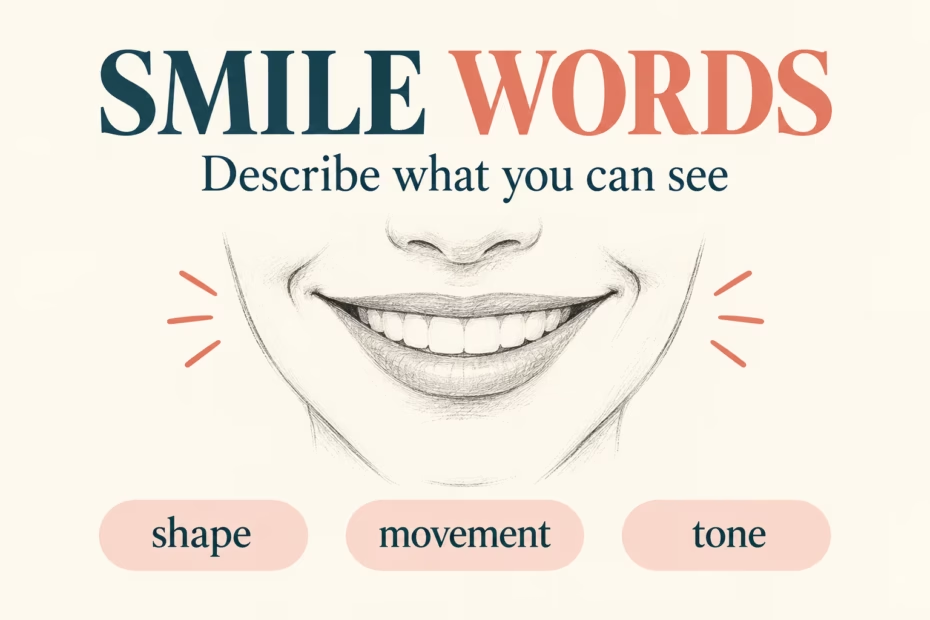
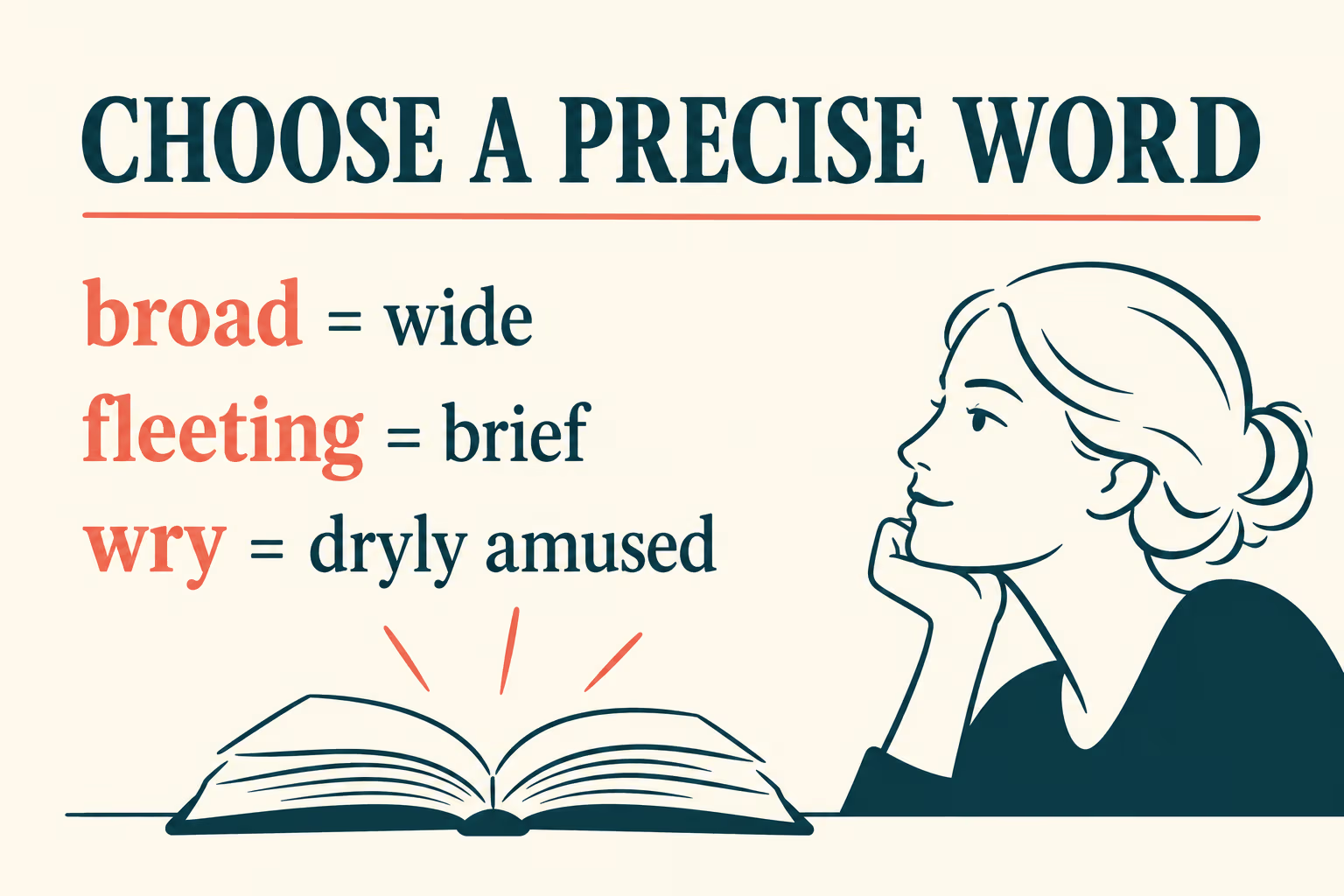
The clearest adjective tells readers what the smile looks or sounds like, or what tone it gives a particular scene. A broad smile describes shape; a fleeting smile describes duration; a wry smile suggests dry amusement. These words are not interchangeable: choosing the observable detail often makes a sentence more precise than calling every smile “beautiful,” “genuine,” or “infectious.”
A smile can be described in several useful ways:
- Shape or size: broad, slight, crooked, toothy, lopsided.
- Movement or duration: fleeting, widening, hesitant, fixed, sudden.
- Tone or effect in context: warm, wry, rueful, playful, reassuring.
These are writing choices, not a reliable way to diagnose how a person feels. A smile may be posed, polite, nervous, or part of a complicated moment. Describe the visible expression and surrounding action before assigning a motive.
Smile Adjectives by Shape and Appearance
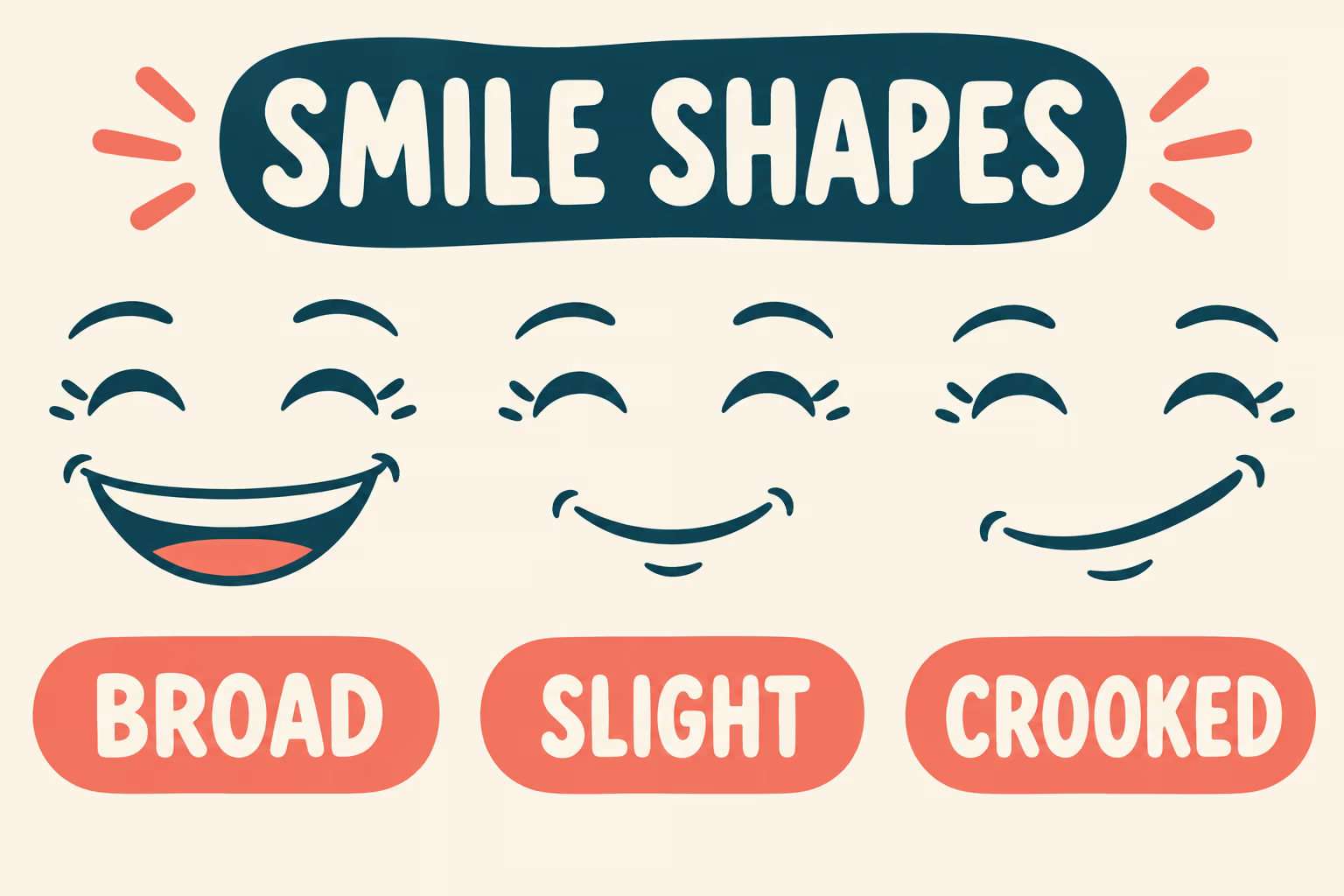
Use these words when a reader needs to picture the smile itself. “Broad” and “wide” describe a smile that stretches across the face. “Slight,” “faint,” and “subtle” suggest a small or restrained expression. “Toothy” tells readers that teeth show; it does not say whether the smile is joyful or comfortable. “Crooked” and “lopsided” describe uneven sides, while “tight” suggests that the lips are held together or the expression looks constrained.
- Broad: wide and easy to notice — A broad smile appeared when the curtain rose.
- Faint: slight or difficult to see — A faint smile crossed her face.
- Toothy: showing the teeth — He offered a toothy grin for the photograph.
- Crooked: uneven or tilted — A crooked smile tugged at one corner of his mouth.
- Quick: brief and sudden — A quick smile passed between the teammates.
“Gleaming,” “sparkling,” and “bright” are common in descriptions of smiles, but they can refer to teeth, light, or a cheerful impression. If literal brightness matters, explain what is shining; if you mean mood, an adjective such as cheerful may be clearer. Likewise, gummy and gap-toothed describe particular visible features and may sound teasing unless the context is affectionate or neutral.
Words for a Smile’s Tone
Some adjectives describe the impression a smile creates within a story or conversation. Because these judgments depend on context, use them with evidence: a line of dialogue, a gesture, or what happens next can show why the narrator calls a smile playful or rueful.
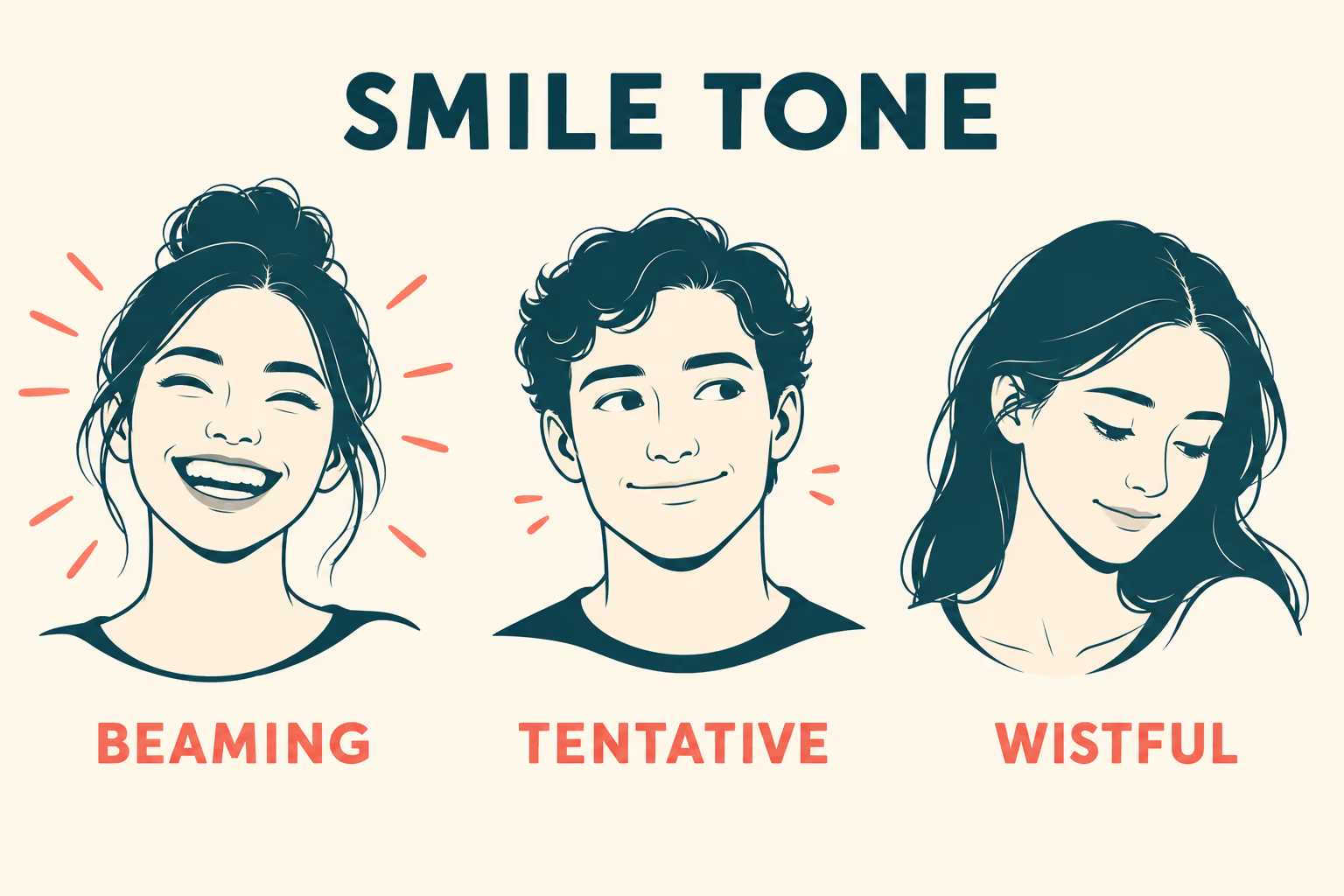
- Beaming: openly bright and cheerful — She gave a beaming welcome to the returning hikers.
- Warm: friendly and welcoming — He answered with a warm smile.
- Wry: dryly amused or ironic — A wry smile followed the familiar excuse.
- Rueful: showing regret or mild sadness — He gave a rueful smile at the missed train.
- Tentative: hesitant or uncertain — A tentative smile appeared as she entered the room.
- Playful: lighthearted and teasing — The child flashed a playful smile before hiding the card.
- Reassuring: intended to comfort or encourage — The guide offered a reassuring smile before the climb.
“Infectious” is figurative: it suggests that another person’s smile or cheerfulness spreads to people nearby. “Radiant” and “glowing” create a vivid, often lyrical impression, while “endearing” means that the smile makes the subject appealing or fondly regarded. These words work well when that effect is the point; they are less precise when the sentence only needs to describe the mouth’s shape.
Positive, Neutral, and Critical Descriptions
A useful vocabulary list includes words with different connotations. Affable, amiable, friendly, gentle, sunny, winsome, and welcoming are generally favorable. Plain, slight, quiet, fixed, and strained can be more neutral, depending on context. Smug, mocking, scornful, condescending, and malicious are critical or strongly interpretive. A writer should choose such words deliberately because they express a point of view, not just an outline of the lips.
Compare the difference: He had a crooked smile reports an uneven shape; He gave a smug smile interprets the expression as self-satisfied. The latter may be exactly right in a scene, but it tells the reader how to judge the character. If that is not intended, describe the action: One corner of his mouth lifted as he glanced at the spilled paint.
Adjectives such as evil, innocent, genuine, and fake can imply motive or character from a fleeting expression. Prefer concrete details unless the narrator has reliable context. Research on smiling also cautions against treating a single facial movement as conclusive proof of a person’s inner emotional state; the scene and the person’s own account matter.
Smile, Grin, Beam, Smirk, or Simper?
These related words overlap, but they give different pictures. A grin is usually a wide smile, often with visible teeth. To beam is to smile brightly or radiantly. A smirk commonly carries a self-satisfied or knowing implication, and can sound disapproving. A simper is a silly or affected smile and is usually critical. For neutral narration, smile is often the most flexible choice; choose the more specific word only when its added meaning fits.
Words that look similar may also describe different things: smiling can describe a face, smilingly is an adverb, and smile itself is usually a noun or verb. Some items in broad adjective lists—such as joyful, malice-related labels, or grinning—may describe a person, feeling, or action more naturally than the smile itself. Check how the word works in your sentence instead of assuming every list entry has the same grammar.
How to Compliment Someone’s Smile Respectfully
A sincere compliment is specific, brief, and appropriate to the relationship. You might say, “Your smile is so warm,” or “I love how your grin lights up when you talk about your garden.” Avoid making assumptions about someone’s health, character, or feelings based on their appearance. In professional settings or with strangers, keep the remark comfortable and relevant to the conversation; people do not owe anyone a smile.
For fiction, essays, or profiles, decide whether the sentence should describe appearance, mood, or the narrator’s reaction. “A slight smile softened the pause” gives a measured visual cue. “Her smile made the room feel less tense” states an effect in the scene. “She smiled because she was relieved” gives a reason, which should be supported by the story rather than inferred from the facial expression alone.
Examples of Adjectives for a Smile in Sentences
- A broad, toothy smile greeted the class at the door. — size and visible teeth.
- His faint smile disappeared when the phone rang. — a small expression and its movement.
- She answered with a wry smile at the obvious pun. — dry amusement supported by context.
- A tentative smile crossed his face as he waited for a reply. — hesitation, not a definite diagnosis of anxiety.
- The photograph caught their beaming smiles after the finish. — visibly bright expressions in a celebratory scene.
For stronger prose, avoid stacking several near-synonyms: a bright, radiant, glowing, sparkling smile repeats a similar impression. Pick one word that contributes the exact detail you want, or replace the adjective with an action that lets readers see the moment.
Frequently Asked Questions
What is a good adjective for a beautiful smile?
Warm, radiant, bright, beaming, and charming are common positive choices. For a more precise description, choose a visible feature such as broad, slight, or toothy, or use a tone word that the surrounding scene supports.
What adjective describes a small smile?
Faint, slight, subtle, and restrained can describe a small or understated smile. Fleeting describes a smile that lasts only briefly, so it refers to duration rather than size.
What is the difference between a wry smile and a smirk?
A wry smile suggests dry amusement or irony, often with a self-aware tone. A smirk more often suggests smug or knowing satisfaction and is frequently disapproving. Context can soften either word, but they are not exact synonyms.
Can a smile be described as genuine?
Yes, when the writer has enough context to support that judgment, such as a character’s own words or a well-established scene. Appearance alone does not always establish how someone feels, so avoid presenting genuine or fake as an objective visual fact.
Is “smiling” an adjective?
It can function as a participial adjective in phrases such as a smiling child, though it is also the present participle of the verb smile. Check what role it plays in the sentence rather than treating every word in a descriptive list as the same part of speech.
Sources and Further Reading
- Cambridge Dictionary, “smile.”
- Cambridge Dictionary, “grin.”
- Cambridge Dictionary, “smirk.”
- Cambridge Dictionary, “simper.”
- Reconsidering the Duchenne Smile: Indicator of Positive Emotion or Artifact of Smile Intensity? Journal of Nonverbal Behavior.

A beautiful smile is often said to be the window to the soul. It can tell you a lot about a person, whether they are happy, sad, nervous, or in pain. A beautiful smile is also said to be contagious, putting those around us at ease and making them feel good too. So what exactly makes a smile beautiful?
Here are some adjectives that might help to describe it: radiant, beaming, glowing, infectious, endearing. A beautiful smile is also often said to be genuine and warm. It’s the kind of smile that makes you feel like you’re being enveloped in a hug.
So next time you see someone with a gorgeous smile, take a moment to appreciate it. And if you’re lucky enough to have a beautiful smile yourself, don’t be afraid to share it with the world!
Adjectives that can be used to describe a beautiful smile may include “beaming,” “radiant,” “gleaming,” “sparkling,” and “bright.” A beautiful smile is often associated with happiness, confidence, and good health.
Adjectives For a Beautiful Smile

Ways to Describe A Smile With Adjectives Starting With A | B
| Affable | Auspicious | Blithe |
| Affectionate | Balmy | Bright |
| Amiable | Beaming | Brilliant |
| Amused | Beautiful | Brilliant |
| Animated | Beneficent | Brittle |
| Approving | Benevolent | Broad |
Ways to Describe A Smile With Adjectives Starting With B | C
| Broad | Charming | Clear |
| Buoyant | Cheerful | Clement |
| Calm | Cheery | Cold |
| Chapped | Cheesy | Compassionate |
| Charitable | Chirpy | Complaisant |
| Charming | Clarion | Condescending |
Adjectives for Smile That Starts With C | D | E | F
| Confident | Dazzling | Encouraging |
| Congenial | Dazzling | Enigmatic |
| Cracked | Devilish | Enthusiastic |
| Crooked | Dexter | Evil |
| Cruel | Dry | Favorable |
| Dazed | Easy | Feeble |
Adjectives for Smile That Starts With F | G
| Fine | Genial | Good-Natured |
| Fixed | Gentle | Good-Tempered |
| Forced | Gentle | Grave |
| Fortunate | Genuine | Grim |
| Friendly | Genuine | Grinning |
| Furtive | Good | Gummy |
Adjectives for Smile That Starts With H | I | J | K | L | M
| Haughty | Insolent | Lenient |
| Helpless | Ironic | Lighthearted |
| Humorless | Irresistible | Lightsome |
| Infectious | Joyful | Lovely |
| Ingratiating | Knowing | Lucky |
| Innocent | Lazy | Malicious |
Smile Adjectives That Starts With M | O | P
| Malignant | Mirthless | Obliging |
| Meek | Mischievous | Oily |
| Melancholy | Mocking | Optimistic |
| Merciful | Moist | Placid |
| Merry | Mournful | Playful |
| Mild | Mysterious | Pleasant |
Adjectives for Smile That Starts With P | Q | R | S
| Pleasant | Quiet | Rueful |
| Pleased | Radiant | Rusty |
| Plump | Radiant | Salutary |
| Pretty | Rainless | Sarcastic |
| Propitious | Reassuring | Sardonic |
| Quick | Reluctant | Sardonic |
S
| Scornful | Smug | Strained |
| Shining | Sober | Strange |
| Shy | Soft | Strange |
| Slight | Soft | Sudden |
| Sly | Sparkling | Sunbeamy |
| Smiling | Stony | Sunny |
S | T | U | V
| Sunshiny | Tight | Triumphant |
| Sweet | Timid | Ugly |
| Sweet | Tiny | Unclouded |
| Tender | Tranquil | Undarkened |
| Thin | Tremulous | Unthreatening |
| Thin | Tremulous | Vacant |
V | W
| Vague | Welcoming | Wistful |
| Warm | Wicked | Wonderful |
| Weak | Winsome | Wry |
| Weird | Wistful |
There’s nothing like a beautiful smile to brighten up someone’s day. If you know someone with a particularly lovely smile, why not tell them? A few words of genuine praise can mean a lot, and may even make the recipient smile even more!

To compliment someone for their smile, try saying something like: “Your smile is absolutely radiant!” or “I can’t help but be drawn to your gorgeous smile!” If you want to be more specific, you could also say: “Your teeth are so white and perfect!” or “You have such full, lovely lips!” Ultimately, just let the person know that you appreciate their beautiful smile – it’ll mean the world to them.
How to describe a beautiful smile with adjectives?
A beautiful smile can be described with many different adjective words. Some of these words may include: lovely, endearing, sweet, radiant, and captivating. Each person’s smile is unique and special, so there are many different ways to describe them. Ultimately, it is up to the individual to decide which adjectives best describe their smile.
It’s always nice to compliment someone for their beautiful smile. Here are a few tips on how to do it:
- Make sure you sound sincere and genuine. A forced compliment will come across as insincere and can even make the other person feel uncomfortable.
- Be specific about what you like about their smile. Do you love the way their teeth look? Is it the way they laugh that makes their smile so special? Mentioning something specific will make your compliment more meaningful.
- Avoid making the compliment sound like an insult. For example, don’t say “Your teeth are so white, they must be fake!” or “You must have had a lot of work done on your teeth!” This will only make the other person feel self-conscious and will ruin the effect of the compliment.
- Keep it short and sweet. A simple “Your smile is beautiful!” or “You have a gorgeous smile!” will do the trick. No need to go overboard with your words.
- Tell them that their smile is beautiful/gorgeous/stunning.
- Mention how their smile lights up the room.
- Say that their smile is contagious.
- Compliment their teeth – say they have a great set of pearly whites!
- Tell them that they have a very friendly/approachable smile.
By following these tips, you can give someone a compliment that will truly make them feel good about themselves. So next time you see someone with a beautiful smile, don’t hesitate to let them know how you feel!
Here’s some other useful adjectives for describing a smile.
- Lovely: A lovely smile is one that is warm and genuine. It lights up a person’s face and makes them look approachable and friendly.
- Endearing: An endearing smile is one that is full of warmth and sincerity. It’s the kind of smile that makes you feel like you’re the only person in the world that matters.
- Sweet: A sweet smile is one that is gentle and sincere. It is a smile that lights up a person’s face and makes them look truly happy.
- Radiant: A radiant smile is one that is full of life and happiness. It’s a smile that lights up a room and makes everyone feel welcome. A radiant smile is the kind of smile that makes you feel like anything is possible.
- Captivating: A captivating smile is one that is absolutely mesmerizing. It’s the kind of smile that makes you weak in the knees and completely melts your heart. It’s a smile that is so beautiful, you can’t help but stare.
- Endearing: An endearing smile is one that is full of warmth and sincerity. It’s the kind of smile that makes you feel like you’re the only person in the world and that you are loved unconditionally.
how to describe a smile romantically
A smile description in a romantic context goes beyond mere words; it’s an art form. To capture the allure of a beloved’s smile, one must weave a tapestry of vivid imagery and tender sentiment. Consider a smile as the dawn’s first light, gently breaking the horizon. It’s the soft curvature, reminiscent of a crescent moon, caressed by night’s last whisper. When love’s passion meets the simplicity of a grin, it becomes an ethereal dance of emotion and grace. Such a smile isn’t merely an upward tug of lips, but a profound gesture echoing the symphonies of amorous hearts. Through this lens, even the most fleeting smile is painted with strokes of romantic poetry.
Describing a smile romantically, especially when it comes to one’s wife, calls for adjectives that not only capture the beauty of the gesture but also convey the depth of emotion and connection you feel. Here are some adjectives to consider:
- Enchanting: Captivating in a magical way.
- Luminous: Bright and radiant.
- Breathtaking: So beautiful it almost takes your breath away.
- Heartwarming: Eliciting feelings of warmth and affection.
- Irresistible: Impossible to resist or ignore.
- Mesmeric: Hypnotically attractive.
- Ethereal: Extremely delicate and light, almost heavenly.
- Ravishing: Delightfully attractive.
- Intoxicating: Enthralling or exhilarating.
- Cherished: Deeply valued and loved.
- Bewitching: Powerfully or seductively captivating.
- Tender: Gentle and soft, expressing love.
- Euphoric: Conveying great happiness.
- Soulful: Deeply expressive and emotional.
- Ephemeral: Lasting for a very short time, making it even more special.
- Captivating: Holding one’s attention through beauty or charm.
Using such adjectives can add a touch of romance and appreciation when you’re expressing your feelings about your wife’s smile.
Describing the smile of a girl requires more than commonplace terms; it’s about capturing the essence, the vivacity, and the nuances of that particular moment. Using positive adjectives for smile not only accentuates its beauty but also communicates the observer’s admiration. Think of a smile as the canvas of a girl’s emotions, with each nuance painted in radiant colors of joy, shyness, mischief, or warmth.
When looking for the right words to describe the smile of a girl, one might say it’s like the first gleam of sunlight after a stormy night, both brilliant and reassuring. It could be as ethereal as the gentle flutter of a butterfly’s wing or as captivating as the twinkling of stars in a clear night sky. The sheer spontaneity of her grin might remind one of a fresh bloom in spring, effervescent and untamed.
To compliment a girl’s smile, it’s essential to be genuine and specific. Instead of a simple “you have a lovely smile,” you could say, “Your smile lights up the room like the morning sun,” or “Every time you smile, it feels like the world just got a little brighter.” By selecting the right descriptors, one can convey appreciation more profoundly, celebrating the uniqueness of each smile.
Final words
A smile is a universal welcome, and adjectives are some of the building blocks of language. If you want to describe someone’s smile, you might choose adjectives like beaming, broad, cheerful, contagious, engaging, or radiant. If you want to capture the way a smile makes you feel, you might go for terms like elated, relieved, or tickled pink. And if you want to get more specific, there are hundreds of adjectives to choose from, ranging from amusing to wry. So whatever mood you’re trying to convey, there’s an adjective out there to help you do it. Thanks for reading!


