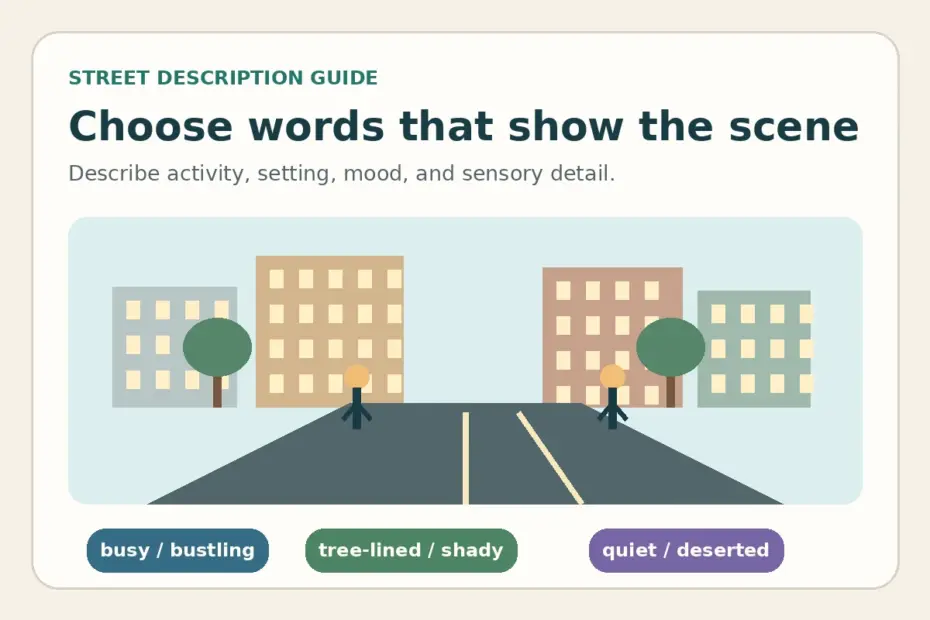
What Are Good Adjectives for a Street?
Good adjectives for a street name a detail readers can picture: bustling for heavy activity, tree-lined for its setting, rain-slick for its surface, or welcoming for its inviting atmosphere. To make a description precise, decide whether you want to show movement, appearance, sound, condition, or mood, then pair the adjective with evidence from the scene.
A street can be busy and beautiful, or quiet and unsettling, so one broad label rarely tells the whole story. The choices below help you select words for a particular purpose rather than stack several near-synonyms.

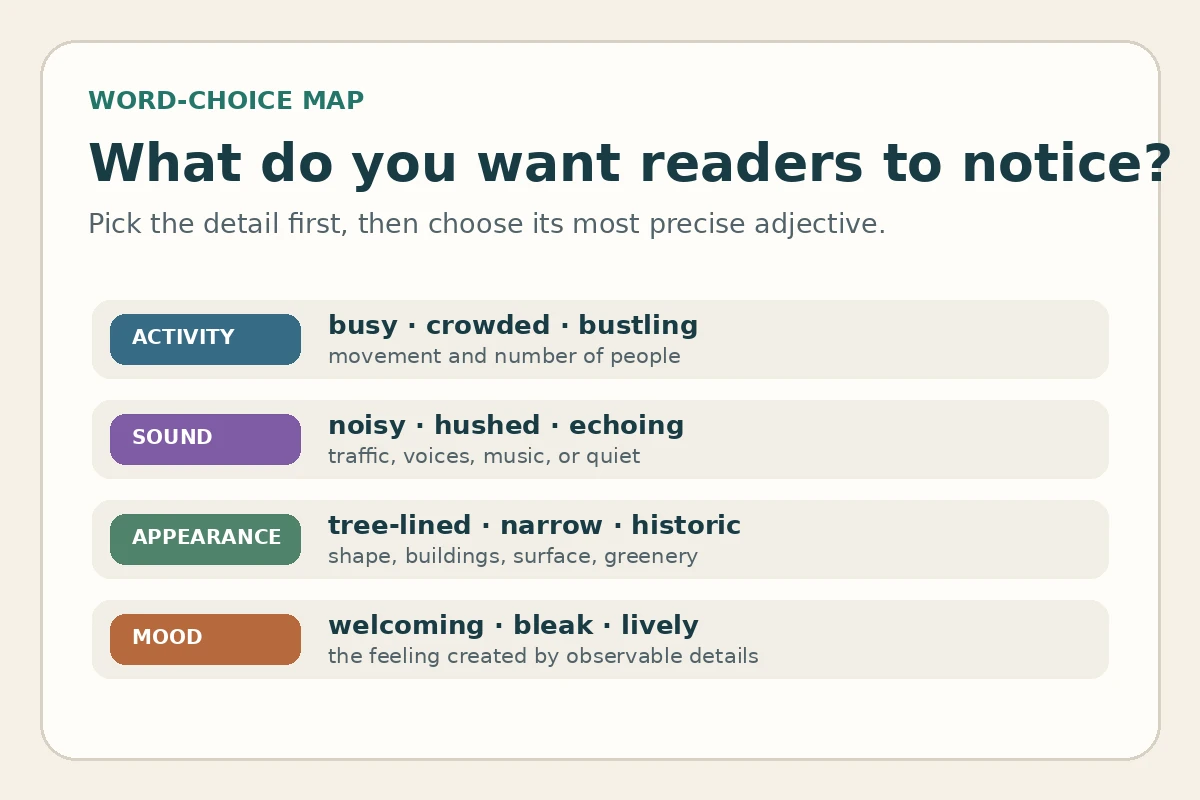
Choose Street Adjectives by the Detail You Notice
Start with something observable. A useful adjective points toward a feature of the street instead of asking the reader to accept a general judgment.
| Detail | Adjectives | What they suggest |
|---|---|---|
| People and movement | busy, bustling, crowded, deserted | How many people are present and how quickly they move |
| Sound | noisy, hushed, echoing, lively | Traffic, conversation, music, or an unusual quiet |
| Shape and layout | narrow, winding, broad, steep | The route’s scale, direction, or slope |
| Buildings and history | historic, modern, weathered, elegant | Visible architecture and the impression it creates |
| Nature and weather | leafy, tree-lined, sunlit, rain-slick | Plant life, light, or the condition of the surface |
| Feeling | welcoming, lively, bleak, unsettling | A response supported by details in the scene |
How to Pick a More Precise Adjective
Separate activity from mood
Busy describes activity; it does not automatically mean a place is enjoyable or stressful. Lively usually suggests energetic activity with a positive or engaging feel. Crowded emphasizes how closely people or vehicles are packed together and may imply discomfort. Bustling evokes brisk, ongoing movement, often around shops or a market. Choose the word that fits what is actually happening.
Use setting words for visible features
Tree-lined tells readers what borders the street; cobblestoned describes its paving; narrow gives a sense of width. Historic signals age or historical significance, but a street is not necessarily historic simply because its buildings look old. When you know the evidence, make it explicit: “a street lined with nineteenth-century brick storefronts” is clearer than “an ancient street.”
Let sensory details support the mood
Words such as serene, bleak, and welcoming describe an impression. Ground that impression in a sound, sight, or action: a shaded lane with birdsong may feel peaceful; shuttered shops and windblown litter may make a block seem desolate. The same street can feel different at rush hour, after rain, or late at night, so add a time or weather detail when it changes the scene.
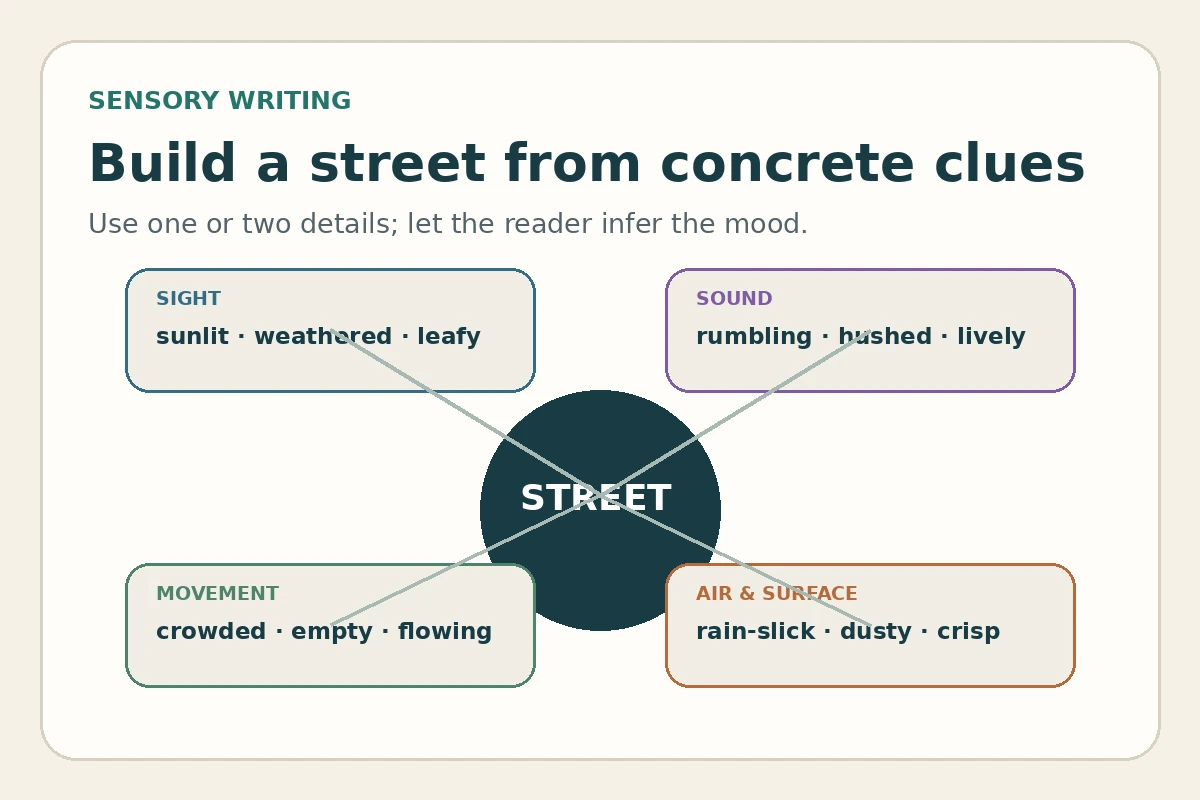
Street Description Examples
Neighborhood scene: The tree-lined residential street curved past low porches, and its leafy sidewalks felt calm in the late-afternoon shade. Tree-lined and leafy establish the setting; calm names the mood.
Market scene: On Saturday morning, the crowded market street smelled of warm bread as vendors called to passing shoppers. Crowded is supported by the shoppers, while smell and sound bring the scene into focus.
After a storm: Rain-slick pavement reflected the shop lights along the otherwise empty street. The detail creates a vivid image without relying on several vague mood words.
Street design guides also describe streets as places that serve people and community life as well as movement. That broader view is a useful reminder for writers: a street may be a route, a gathering place, a row of storefronts, or all three at once. See the National Association of City Transportation Officials’ Urban Street Design Guide.
Revise a Vague Street Description
Try replacing a general adjective with one concrete feature and one supporting detail:
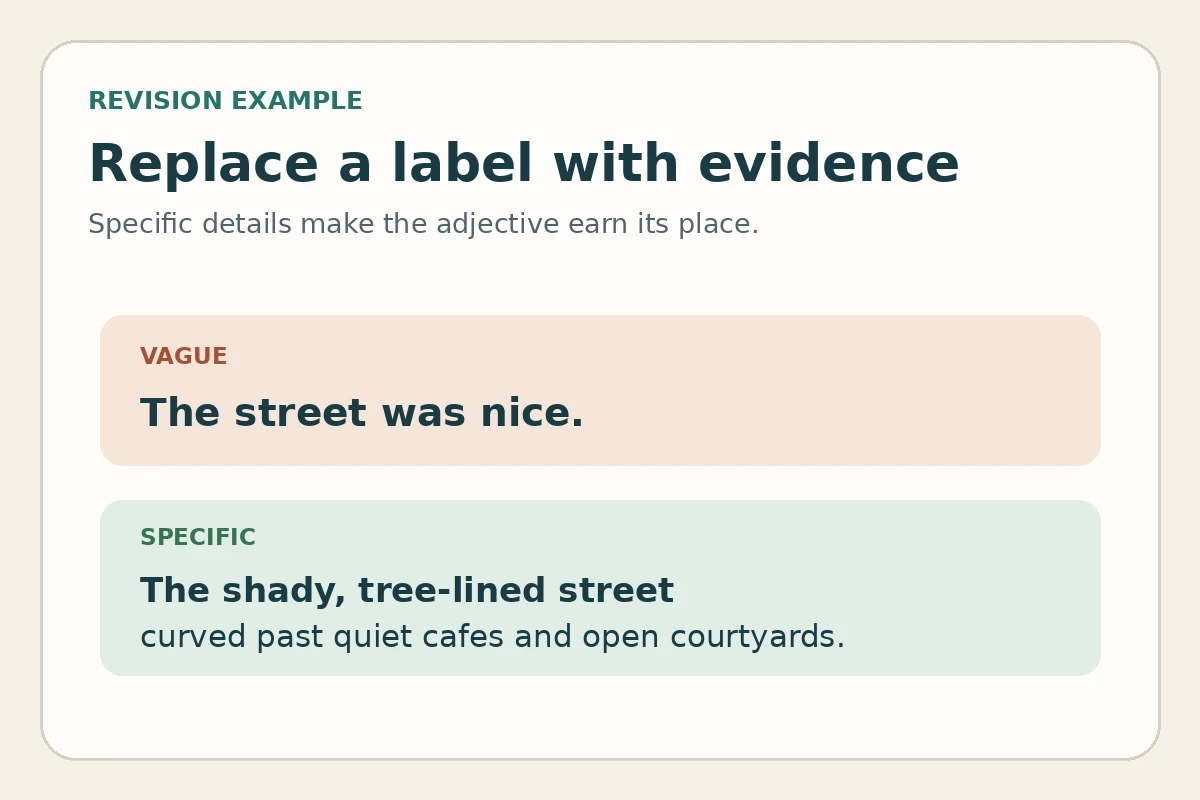
Before keeping an adjective, ask: Can a reader see or hear the feature? Does the word describe the street, or only my reaction to it? Would a more exact noun or verb do the job better? A sentence such as “The avenue hummed with buses and conversation” may be more vivid than “The avenue was noisy.”
Is “Street” an Adjective?
In a phrase such as street market or street musician, street modifies the noun that follows and is often described as an attributive noun. It can also function as an adjective meaning connected with ordinary city life, as in street culture. Oxford Learner’s Dictionaries records this adjective use. That is different from the usual goal on this page: choosing an adjective that describes a street, as in narrow street or lively street.
Frequently Asked Questions
What is a positive adjective for a street?
Welcoming, picturesque, lively, and charming can describe a street positively. Pick one that matches the scene: welcoming suggests an inviting feel, while picturesque focuses on visual appeal.
What adjectives describe a quiet street?
Quiet, hushed, peaceful, and serene are options. Use deserted when few or no people are there; it can suggest emptiness rather than comfort.
What is the difference between “busy,” “crowded,” and “bustling”?
Busy means active; crowded stresses that people or vehicles fill the space; bustling suggests energetic, continuous movement. A street can be busy without being crowded.
How can I describe a street at night?
Choose details that fit the scene: lamplit, rain-slick, hushed, neon-lit, or deserted. A short supporting image—such as shop signs glowing on wet pavement—makes the adjective more convincing.
Street has other grammatical uses too: Oxford Learner’s Dictionaries describes its adjective sense as something connected with daily city life, as in street musicians and street culture. For the distinction, see the Oxford entry for street as an adjective.
Walking down the street, we are surrounded by a vibrant tapestry of sights, sounds, and experiences. But have you ever stopped to think about the words we use to describe these bustling thoroughfares? In this article, I’ll be exploring a range of adjectives that can be used to paint a vivid picture of the streets we traverse every day. From bustling and chaotic to serene and picturesque, these adjectives will help you bring your descriptions to life and capture the essence of any street you encounter.
When it comes to describing streets, one adjective that often comes to mind is “busy.” Whether it’s the hustle and bustle of a city street or the lively energy of a neighborhood thoroughfare, the adjective “busy” encapsulates the constant movement and activity that characterizes these bustling urban landscapes. However, there’s more to streets than just being busy. They can be narrow or wide, lined with towering skyscrapers or quaint buildings, and filled with a cacophony of sounds or a peaceful silence. In this article, I’ll be delving into a variety of adjectives that will help you capture the unique atmosphere and personality of any street.
As we navigate the streets, we encounter a multitude of sensory experiences that shape our perception of them. The adjective “vibrant” comes to mind when we think of streets filled with colorful storefronts, lively street performers, and a constant buzz of activity. On the other hand, some streets exude a sense of tranquility and charm, with their cobblestone paths, quaint cafes, and the gentle rustling of leaves in the wind. By using the right adjectives, we can paint a vivid picture of these diverse streetscapes and transport our readers to the heart of the scene. So, let’s dive in and explore the descriptive words that will help you bring your street descriptions to life.
How to Describe street? – Different Scenarios

When it comes to describing streets, there are countless scenarios that can be encountered. Let’s explore some of these scenarios and the adjectives that can be used to vividly describe them:
1. Busy Streets
Busy streets are a common sight in bustling cities. The constant movement and activity create a vibrant atmosphere. To describe busy streets, you can use adjectives such as:
- Hectic: The streets are buzzing with people rushing to their destinations.
- Crowded: People fill every corner of the street, making it hard to navigate.
- Bustling: The street is alive with energy, and there’s always something happening.
- Thronged: The street is packed with a large number of people, making it feel lively.
2. Lively Streets
Lively streets are full of life and entertainment. They are often found in popular tourist destinations or vibrant neighborhoods. To bring these streets to life, you can use adjectives such as:
- Vibrant: The street is bursting with colorful storefronts and lively street performers.
- Cheerful: People on the street are happy and enjoying themselves, creating a joyful ambiance.
- Animated: The street is animated with street musicians, artists, and performers.
- Enthusiastic: The street is filled with a contagious energy, making it impossible to resist the excitement.
3. Peaceful Streets
Not all streets are bustling with activity. Some streets offer tranquility and serenity. To describe peaceful streets, consider using adjectives such as:
- Calming: The quietness and absence of noise offer a relaxing and calming experience.
- Idyllic: The street exudes a picturesque charm, with beautiful gardens and quaint houses.
- Serene: Walking down this street feels peaceful and uninterrupted, away from the chaos of the city.
- Tranquil: The street is so quiet that you can hear the gentle rustling of leaves and chirping of birds.
No matter the scenario, using the right adjectives can transport readers to the heart of the street and create a vivid mental image. It is important to choose words that accurately capture the atmosphere and characteristics of the street being described.
Describing Words for street in English

When it comes to describing streets, the right choice of adjectives can bring them to life and paint a vivid picture in the reader’s mind. Adjectives are powerful tools that allow us to capture the atmosphere and characteristics of a street. Let’s explore some descriptive words for streets in English:
- Busy: A busy street is full of energy and activity. It’s bustling with people, vehicles, and noise.
- Lively: A lively street is vibrant and animated. It exudes a sense of vitality and excitement.
- Peaceful: On the other end of the spectrum, a peaceful street is calm and serene. It invites a sense of tranquility and relaxation.
- Colorful: A colorful street is visually captivating, with a vibrant mix of colors, patterns, and designs. It’s a feast for the eyes.
- Historic: A historic street holds a significant place in history and is often lined with buildings or landmarks of historical importance.
Remember, the key to effective description lies in selecting adjectives that accurately capture the essence of the street you are describing. Choose words that paint a clear and compelling picture for your readers.
So whether you’re trying to portray a busy, lively, peaceful, colorful, or historic street, be sure to use appropriate adjectives to bring your descriptions to life. Happy writing!
| Busy | Lively | Peaceful | Colorful | Historic |
|---|---|---|---|---|
| Crowded | Energetic | Serene | Vibrant | Timeless |
| Hectic | Bustling | Quiet | Multicolored | Storied |
| Vibrant | Animated |
Adjectives for street
As a writer, I understand the importance of choosing the right adjectives to vividly describe streets. Adjectives help bring a street to life, capturing its atmosphere, characteristics, and mood. Whether you’re describing a busy street, a peaceful street, or a colorful street, using the appropriate adjectives can make your descriptions more engaging and accurate.

Positive Adjectives for Street
When describing streets in a positive light, there are several adjectives that can paint a vibrant picture in the reader’s mind. Here are twelve examples of positive adjectives you can use to bring your descriptions to life:
| Adjective | Definition | Example Sentence |
|---|---|---|
| Lively | Full of energy and activity | The street was lively with street performers and bustling shops. |
| Charming | Delightful and attractive | The charming street was lined with quaint cafes and colorful buildings. |
| Picturesque | Visually pleasing, like a picture | I walked down the picturesque street admiring the beautiful architecture. |
| Vibrant | Full of life and color | The vibrant street was adorned with colorful murals and bright flower stalls. |
| Bustling | Full of activity and noise | The bustling street was crowded with people and bustling market stalls. |
| Quaint | Charmingly old-fashioned | The quaint street had cobblestones and charming antique shops. |
| Welcoming | Inviting and friendly | The street was lined with welcoming cafes and smiling faces. |
| Enchanting | Captivating and magical | I found myself wandering down the enchanting street, lost in its charm. |
| Dynamic | Energetic and constantly changing | The dynamic street was always evolving with new businesses and trends. |
| Cosmopolitan | Diverse and multicultural | The cosmopolitan street had a variety of international shops and restaurants. |
| Invigorating | Refreshing and uplifting | I took a walk along the invigorating street, feeling renewed and inspired. |
| Chilled | Relaxed and laid-back | The chilled street had a calm and relaxed atmosphere, perfect for strolling. |
Negative Adjectives for Street
Sometimes, you may want to describe a street in a negative light to convey a certain mood or atmosphere. Here are five examples of negative adjectives you can use:
| Adjective | Definition | Example Sentence |
|---|---|---|
| Dingy | Dirty, dim, or in poor condition | The dingy street had cracked sidewalks and flickering streetlights. |
| Desolate | Empty, abandoned, and lonely | I walked down the desolate street, feeling a sense of sadness and isolation. |
| Grimy | Dirty, covered in grime or filth | The grimy street was littered with trash and had a musty smell. |
| Dreary | Dull and depressing | The dreary street had gray, peeling buildings and a sense of gloom. |
| Chaotic | Disordered, noisy, and confusing | The chaotic street was filled with honking cars and shouting pedestrians. |
Remember, when using adjectives to describe streets, it’s important to choose words that accurately capture the atmosphere and characteristics you are trying to convey. These descriptive words will help make your writing more engaging and bring your descriptions to life.
Synonyms and Antonyms with Example Sentences

Synonyms for street
When it comes to describing streets, there are many synonyms that can help bring your writing to life. Here are some common synonyms for the word “street” and example sentences to illustrate their usage:
| Synonym | Example Sentence |
|---|---|
| Road | I walked down the road lined with colorful houses. |
| Avenue | The bustling avenue was filled with shops and cafes. |
| Lane | The quiet lane was surrounded by tall trees. |
| Boulevard | We strolled along the tree-lined boulevard in the evening. |
| Thoroughfare | The busy thoroughfare was packed with cars and pedestrians. |
Using these synonyms can add variety and depth to your descriptions of streets.
Antonyms for street
On the other hand, if you want to convey a different atmosphere or mood, you may consider using antonyms of the word “street.” Here are some antonyms for “street” and example sentences to help you understand their usage:
| Antonym | Example Sentence |
|---|---|
| Alley | The narrow alley was dimly lit and filled with shadows. |
| Cul-de-sac | The quiet cul-de-sac was tucked away at the end of the neighborhood. |
| Dead-end | We found ourselves at a dead-end with no way to continue. |
| Sidewalk | The children played on the sidewalk while their parents watched. |
| Pathway | The winding pathway led us through the park to a hidden garden. |
Using these antonyms can create a contrasting and unique depiction of a street.
Remember, choosing the right adjectives, synonyms, and antonyms is crucial to accurately capturing the atmosphere and characteristics of the street you are describing. So, take your time and select words that resonate with your desired imagery.
By using a variety of descriptive words and techniques, you can make your writing more engaging and captivating for your readers. So go ahead and experiment with different adjectives, synonyms, and antonyms to create vivid and compelling descriptions of streets.
Conclusion
In this article, I have highlighted the significance of carefully selecting adjectives to vividly describe streets. By providing examples of synonyms and antonyms for the word “street” and offering example sentences, I have demonstrated how these words can enhance descriptions and create a contrasting and unique portrayal. It is essential to remember that the right choice of adjectives, synonyms, and antonyms is crucial in accurately capturing the atmosphere and characteristics of the street being described.
I encourage you to experiment with different words and techniques to make your writing more engaging and captivating. By incorporating a variety of descriptive words, you can bring your descriptions to life and immerse your readers in the streets you are describing.
So, next time you find yourself writing about a street, remember to choose your adjectives wisely. With the right words, you can paint a vivid picture that will captivate your readers and make your writing truly memorable. Happy writing!


