
Choose sunset adjectives by what you can see
A sunset description becomes clearer when you separate color, light, sky conditions, and mood. “Beautiful” expresses appreciation, but “golden light beneath pink clouds” gives the reader something to picture. Begin with one visible detail, then add an action or a second detail that explains the scene.
Not every sunset is fiery or dramatic. A pale, hazy sunset can be just as useful in a description as a brilliant red one. Choose words that match your observation or the scene you are creating. If the sky is muted, a collection of intensely bright adjectives will make the description feel inconsistent.
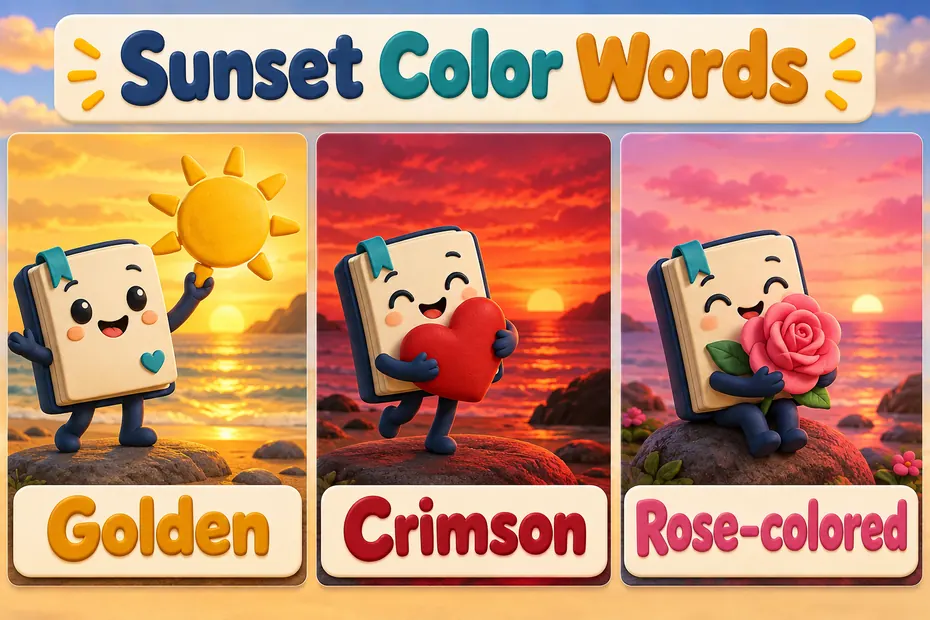
Color words for the sky and clouds
| Adjective | What it suggests | Example |
|---|---|---|
| golden | A yellow-gold appearance | Golden light touched the rooftops. |
| crimson | A rich red color | Crimson clouds stretched above the hills. |
| rose-colored | A pink or rosy appearance | A rose-colored band lingered along the horizon. |
| amber | A yellow-orange tone | Amber light filled the windows. |
| violet | A purple tone | Violet shadows gathered beneath the clouds. |
| pale | A light, less intense color | The pale pink sky faded slowly. |
Attach the adjective to the right part of the scene. “A crimson sunset” describes an overall impression; “crimson edges on the clouds” identifies a smaller detail. The second wording can be more accurate when most of the sky remains blue. Likewise, golden light does not require every cloud to look golden.
Oxford’s vivid entry distinguishes strong, bright color from other senses of the word. In “vivid orange clouds,” vivid strengthens the color description. In “a vivid description of the sunset,” it describes how clearly the writing creates a picture. Keep track of the noun the adjective modifies.

Light and sky conditions
Glowing, radiant, brilliant, and soft help describe the impression of light. “Soft evening light” suggests gentleness; “brilliant light” suggests greater intensity. Fading emphasizes change as the scene grows darker. These words work best with something concrete: a fading glow, radiant clouds, or soft reflections on water.
Hazy can describe conditions that make distant details less clear. Use it for an indistinct horizon or a softened view, rather than as a synonym for every peaceful scene. A clear sunset may also be peaceful. Cloud-streaked, overcast, misty, and clear describe different appearances; choose one that fits what the reader should visualize.
- Soft light settled over the garden.
- The hazy horizon blurred the outline of the hills.
- Cloud-streaked skies reflected in the river.
- A fading glow remained behind the buildings.
- The clear western sky turned pale orange.
Make comparisons carefully. A sky can look fiery because its colors resemble flames, but that metaphor does not mean there is a literal fire. “Fiery red clouds” gives the reader a recognizable image. Adding burning, blazing, flaming, and fiery together usually repeats the same idea.

Add mood through the observer or setting
Serene, tranquil, dramatic, and melancholy describe the feeling a scene creates. They are interpretations rather than measurements of the sky. A sunset may seem serene to someone sitting beside a still lake and lonely to someone leaving home. Put that feeling in context through the setting, the character’s response, or a surrounding action.
Compare “The sunset was beautiful and peaceful” with “Golden light spread across the calm lake as the boats stopped moving.” The second sentence gives the reader reasons to sense stillness. You can add “The scene felt serene” if the emotional impression matters, but the physical details already do some of that work.
A practical three-step method is to select one color, choose one feature, and add one verb. Pink + clouds + drifted becomes “Pink clouds drifted above the darkening town.” Then add a useful detail: “Pink clouds drifted above the darkening town, their edges bright against the blue.” This creates a scene without demanding an adjective for every noun.
Frequently asked questions
What can I use instead of “beautiful sunset”?
Try golden sunset, dramatic sunset, or soft, rose-colored sunset if those words fit the scene. For more precision, describe a feature: “a golden band beneath violet clouds.”
Can a sunset be both hazy and vivid?
Yes. Haze concerns the clarity of a view, while vivid concerns strong color. A distant horizon may be indistinct even when the nearby clouds look intensely orange. Explain which part of the view each adjective describes.
How do I avoid an overcomplicated description?
Keep the strongest observed detail and one clear action. Read the sentence aloud, remove repeated color or light words, and check that the reader can identify where each feature belongs in the scene.
With the advent of social media, people have taken to sharing photos of sunsets in an attempt to capture the beauty of the natural world. While a picture may be worth a thousand words, sometimes it can be difficult to find the right adjectives to describe a sunset.
In this article, we will explore some of the most popular adjectives used to describe sunsets. From romantic to peaceful, there is sure to be an adjective that accurately captures your experience. So next time you find yourself at sunset, take a moment to appreciate the beauty and choose your adjectives carefully.
Adjective For Sunset Scene
As the sun sets, the sky is filled with a beautiful range of colors. The adjectives that are typically used to describe a sunset can vary from person to person, but there are some that are used more commonly than others.
Some of the most popular adjectives for sunset include “golden,” “gorgeous,” “breathtaking,” and “spectacular.” While each person may have their own unique way of describing a sunset, one thing is for sure: sunsets are definitely an unforgettable experience.
A
| Abstract | African | Air |
| Ancient | Angry | Arms |
| Artificial | Autumnal |

B
| Barred | Beach | Beautiful |
| Benevolent | Better | Bird |
| Blessed | Blood-Red | Bloody |
| Boats | Boulevard | Breathtaking |
| Bright | Brilliant | Burning |
C
| Calm | Camp | Campagnian |
| Canadian | Central | Chapter |
| Cities | Clear | Cloud |
| Cloudless | Clouds | Cloudy |
| Cloudy Winter | Cold | Colored |
| Colorful | Colours | Crater |
| Crimson |
D
| Day | Days | Dazzling |
| Dim | Distant | Dramatic |
| Dull | Dusty |
E
| Early | Earth | Earthly |
| Eastern | Effect | Effects |
| Endless | English | Equatorial |
| Ere | Eternal | Evening |
| Exquisite | Eyes | Eyetalian |
F
| Fabulous | Fading | Faint |
| Fiery | Fine | Fire |
| Flame | Flaming | Flush |
| Forlorn |
G
| Gleam | Glorious | Glow |
| Glowing | Gold | Golden |
| Gorgeous | Gracious | Grand |
| Great | Greek | Gulf |
| Gun |
H | I
| Hawaiian | Haze | Heart |
| Horizon | Hot | Hour |
| Hours | Immaculate | Imperial |
| Incredible | Italian |

J | L
| Johnson | Land | Last |
| Late | Laws | Light |
| Line | Lingering | Lodge |
| Longitude | Lost | Loveliest |
| Lovely | Low | Lurid |
M
| Magazine | Magnificent | Marine |
| Marvellous | Mellow | Men |
| Midway | Miles | Mountains |
N | O
| Near | Nice | Night |
| Northern | Nothing | Olden |
| Onwards | Opaque | Opulent |
| Orange | Orders | Own |
P
| Pale | Park | Pass |
| Past | Peaceful | Pensive |
| Perfect | Perpetual | Pink |
| Pleasant | Portentous | Prayer |
| Pretty | Prolonged | Provisions |
| Purple |
Q | R
| Quiet | Radiant | Rain |
| Rainy | Rays | Red |
| Remarkable | Rich | Rock |
| Romantic | Rosa | Rosy |
| Ruddy |
S
| Sad | Scarlet | Scene |
| Seacoast | Serene | Shadows |
| Shine | Shows | Skies |
| Sky | Slow | Smile |
| Smoky | Soft | Solemn |
| Sombre | Song | Southern |
| Spacious | Spectacular | Splendid |
| Spot | Stormy | Strange |
| Stunning | Sullen | Sunrise |
| Superb | Swift |

T
| Tables | The | Tide |
| Time | Torrid | Touch |
| Towards | Tranquil | Tropical |
| Twilight Gently |
V
| Venetian | View | Viewing |
| Views | Virtual | Vivid |
W | Y
| Warm | Watching | Weird |
| Western | Wild | Windless |
| Windy | Wintry | Wonderful |
| Worldfine | Yellow |
Sunsets are one of nature’s most breathtaking spectacles. The vibrant colors, the gentle fading of light, and the sense of tranquility they evoke make them a favorite subject for poets, artists, and dreamers alike. In this article, I’ll be exploring a variety of adjectives that can be used to describe the beauty and majesty of a sunset. From fiery and radiant to serene and ethereal, these words will help you capture the essence of this awe-inspiring phenomenon.
When we think of sunsets, words like “beautiful” and “stunning” often come to mind. While these adjectives certainly do justice to the splendor of a sunset, there are countless other words that can add depth and nuance to your descriptions. Picture a sunset that is “dazzling,” with hues of gold, pink, and purple streaking across the sky. Or imagine a sunset that is “melancholic,” casting long shadows and creating a sense of nostalgia. In this article, I’ll be providing examples of these adjectives and more, to help you paint a vivid picture of a sunset in your writing.
Sunsets have a way of captivating our hearts and stirring our emotions. Whether you’re a writer looking to add descriptive flair to your prose, or simply someone who appreciates the beauty of nature, this article will equip you with a range of adjectives to elevate your descriptions of sunsets. So, let’s dive in and explore the kaleidoscope of words that can be used to capture the magic of a sunset.
How to Describe sunset? – Different Scenarios
When it comes to describing a sunset, there are many different scenarios to consider. Each scenario brings its own unique perspective and emotions, allowing you to use a variety of adjectives to capture its essence. Here are some examples of how to describe a sunset in different scenarios:
1. A Peaceful Evening at the Beach
- The sky is painted in vibrant hues of orange, pink, and purple, creating a serene atmosphere.
- The setting sun casts a warm glow, making the waves glisten and dance.
- As the sun dips below the horizon, the colors meld together, creating a breathtaking display of beauty.
2. A Rural Landscape
- The golden orb of the sun slowly sinks behind the rolling hills, casting long shadows.
- The fields are bathed in a soft, warm light, creating a sense of tranquility.
- The sky ignites with shades of crimson and amber, filling the air with a sense of awe and wonder.
3. An Urban Skyline
- The cityscape becomes a canvas as the sun starts its descent, casting an ethereal glow on towering buildings.
- Reflected in the glass facades, the colors of the sunset create a dazzling spectacle.
- The juxtaposition of nature’s beauty against the man-made structures evokes a sense of harmony and grandeur.
Read: 350+ Adjective Words to Describe Sun and Sunlight
4. A Mountainous Horizon
- The jagged peaks are silhouetted against the fiery sky, creating a dramatic and awe-inspiring sight.
- The colors intensify as the sun draws closer to the mountains, casting a warm glow on the rugged terrain.
- The beauty of the sunset against the majestic mountains leaves me feeling humbled and small in comparison.
- The sunflowers turn their faces towards the setting sun, basking in its warm embrace.
- The sky transforms into a tapestry of colors, illuminating the vast expanse of the open field.
- The tranquil beauty of the sunset fills me with a sense of gratitude and peace.
| Scenario | Adjectives |
|---|---|
| Beach | Serene, vibrant, breathtaking |
| Rural Landscape | Tranquil, soft, awe-inspiring |
| Urban Skyline | Ethereal, dazzling, grandeur |
| Mountainous Horizon | Dramatic, majestic, humbling |
| Open Field |
Describing Words for sunset in English
When it comes to capturing the beauty of a sunset, finding the right words to describe it can be a delightful challenge. Below, I’ve compiled a list of adjectives that can help you paint a vivid picture of a sunset in English. Whether you’re a teacher looking to teach easy words to young kids or simply want to enhance your own vocabulary, these words will surely come in handy.
Colors
- Fiery: The sky is ablaze with vibrant shades of red, orange, and yellow.
- Golden: The sun casts a warm golden hue across the horizon.
- Dusky: The fading light creates a dusky, purplish glow.
- Pastel: Soft hues of pink, lavender, and baby blue gently color the sky.
- Mellow: The sunset bathes everything in a mellow, serene light.
Shapes and Patterns
- Streaked: The sky is streaked with rays of light as the sun sets.
- Swirling: Clouds swirl and dance across the sky, creating a captivating display.
- Radiant: The sun radiates its light, casting a heavenly glow on the world.
- Ethereal: The sunset creates an ethereal, dream-like atmosphere.
- Painted: The sky seems like a beautifully painted canvas, with its vivid colors and delicate brushstrokes.
- Breathtaking: The sight of the sunset leaves you breathless with its awe-inspiring beauty.
- Tranquil: The peacefulness of the sunset brings a sense of calm and tranquility.
- Majestic: The grandeur of the sunset commands attention and admiration.
- Magical: There’s a sense of magic and enchantment in the air as the sun paints the sky.
- Serene: The stillness of the moment washes over you, leaving you feeling serene and content.
As you explore these different adjectives for describing sunsets, feel free to mix and match them to create your own unique descriptions. Remember, the beauty of a sunset is subjective, and your feelings and experiences may inspire new words to describe this natural phenomenon.
Read: Lemon Adjectives: Describing Words & Examples
So go ahead, find a serene spot, and let the setting sun be your muse as you practice using these adjectives.
Adjectives for sunset
Positive Adjectives for Sunset with Example Sentences
When it comes to describing sunsets, there are a plethora of positive adjectives that can capture the breathtaking beauty of the scene. Here are some examples with sentences to illustrate their usage:
| Adjective | Example Sentence |
|---|---|
| Radiant | The radiant sunset filled the sky with vibrant colors. |
| Majestic | The majestic sunset painted a stunning picture on the horizon. |
| Serene | The serene sunset brought a sense of peace and tranquility. |
| Mesmerizing | The mesmerizing sunset held us captivated until darkness fell. |
| Enchanting | The enchanting sunset painted the clouds with shades of gold and pink. |
| Vibrant | The vibrant sunset cast a warm glow over the landscape. |
| Breathtaking | The breathtaking sunset took my breath away with its stunning colors. |
| Magical | The magical sunset looked like a scene out of a fairytale. |
| Blissful | The blissful sunset filled me with a sense of contentment. |
| Captivating | The captivating sunset made it impossible to look away. |
| Idyllic | The idyllic sunset created a picturesque backdrop for our evening. |
| Exquisite | The exquisite sunset seemed like a masterpiece painted in the sky. |
Negative Adjectives for Sunset with Example Sentences
While sunsets are often associated with beauty and positivity, there are also negative adjectives that can be used to describe them. Here are a few examples:
| Adjective | Example Sentence |
|---|---|
| Dreary | The dreary sunset was overshadowed by dark clouds. |
| Dull | The dull sunset lacked the usual vibrant colors. |
| Uninspiring | The uninspiring sunset failed to capture my attention. |
| Disappointing | The disappointing sunset didn’t live up to my expectations. |
| Lackluster | The lackluster sunset paled in comparison to the previous evening’s display. |
Remember, while negative adjectives may not be as commonly used to describe sunsets, they can still add depth and contrast to your descriptions. Mixing positive and negative adjectives can create a more diverse and realistic portrayal of the sunset.
Now that we’ve explored both positive and negative adjectives for sunsets, it’s your turn to let your imagination roam free. Mix and match these adjectives to create your own unique descriptions of sunsets and capture their true beauty.
Synonyms and Antonyms with Example Sentences
Synonyms for Sunset
When describing a beautiful sunset, we can use a variety of synonyms to create vivid and engaging descriptions. Here are some alternative words that you can use to add depth and creativity to your writing:
- Dusk: As the day comes to an end, the sky is painted with hues of orange and purple during dusk.
- Twilight: The enchanting twilight sky slowly transitions from vibrant pinks to peaceful blues.
- Glowing: The sun sets in a glowing display of warm colors, casting a mesmerizing glow across the horizon.
- Radiant: As the sun sinks below the horizon, it leaves behind a radiant sky filled with brilliant shades of gold and red.
- Magical: The magical sunset casts a dreamy atmosphere, with the vibrant colors stretching across the entire sky.
Read: 450+ Adjective Words To Describe Doctor
Antonyms for Sunset
Sometimes, we want to describe a sunset in a different light. Antonyms can help us portray a contrasting mood or atmosphere. Here are a few antonyms for sunset:
- Sunrise: As the world awakens, the sunrise paints the sky with a gentle palette of pastels, signaling the start of a brand new day.
- Dawn: In the early hours of dawn, the darkness gradually fades away, replaced by soft, muted colors that gradually illuminate the sky.
- Sunless: On a cloudy day, the sun hides behind thick clouds, resulting in a sunless sunset that lacks the warm, vibrant hues typically associated with sunsets.
- Nightfall: As the sun disappears from the sky, nightfall takes over, enveloping everything in darkness and ushering in a tranquil atmosphere.
Remember, when using these synonyms and antonyms, don’t be afraid to mix and match them to create your own unique descriptions of sunsets. Let your imagination run wild and paint a picture with words that captures the essence of this breathtaking natural phenomenon.
Describing sunsets is an art that allows us to capture the beauty and magic of this natural phenomenon. In this article, I have provided a comprehensive list of adjectives that can be used to create vivid and engaging descriptions of sunsets. By using these descriptive words, you can paint a picture with your words and transport your readers to the breathtaking scene of a sunset.
Remember, the key to creating captivating descriptions is to mix and match these adjectives to create your own unique combinations. This will help you to capture the essence and mood of the sunset in a way that is both captivating and memorable.
Additionally, I have highlighted the importance of using antonyms to create contrasting moods or atmospheres when describing sunsets. This technique can add depth and complexity to your descriptions, allowing you to convey the full range of emotions that a sunset can evoke.
So, let your imagination run wild and experiment with these adjectives. Take inspiration from nature’s masterpiece and craft descriptions that transport your readers to the magical world of sunsets.
Final verdict
In conclusion, there are many different adjectives that can be used to describe a sunset. Each person may have their own unique way of describing the colors, light, and overall beauty of a sunset.
However, some common adjectives that are often used to describe sunsets include stunning, breathtaking, gorgeous, and majestic. No matter what adjectives you use to describe a sunset, there is no denying that they are truly one of nature’s most incredible sights.


