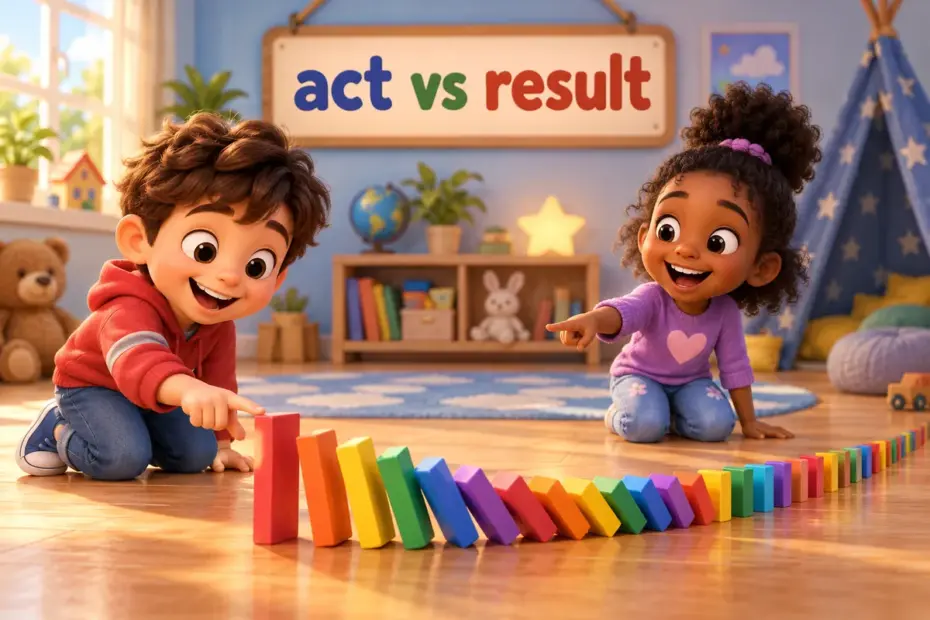
Affect vs effect causes more everyday errors than almost any other pair, because the two words differ by one letter and point in different directions. Affect is the verb meaning to influence something; effect is the noun meaning the result of that influence. “Rain affects the harvest” acts; “the effect was small” names the outcome.
Affect vs Effect at a glance
- Affect is usually a verb, and effect is usually a noun.
- Affect means to influence or change something.
- Effect means the result or outcome of a change.
- The pair A for action and E for end result keeps the two apart.
- The commonest error is writing effect where the sentence needs the verb affect.
What does affect mean and what does effect mean?
Affect is a verb meaning to influence something or to move someone emotionally; effect is a noun meaning the result or outcome of a cause. The Cambridge entry for affect and the Cambridge entry for effect mark this split, and one line shows it: “the news affected him” describes a change in action, while “the effect of the news” names the result.
| Sense | Word | Plain meaning | Example |
|---|---|---|---|
| Influence something | affect | Make a difference to | Rain affects the harvest. |
| Move emotionally | affect | Touch someone’s feelings | The story affected her deeply. |
| A result | effect | The outcome of a cause | The effect was immediate. |
| A special look | effect | An impression or appearance | The lighting gave a warm effect. |
| Bring about | effect | Cause to happen, in formal use | The law effected real change. |
What is the difference between affect and effect?
The difference is mainly grammatical: affect is the verb that does the influencing, and effect is the noun that names the result. A familiar single-letter pair such as abel vs able works the same way, where one letter signals a change of role.
| Test | Affect | Effect |
|---|---|---|
| Usual part of speech | verb | noun |
| Core meaning | to influence | a result |
| Typical pattern | affect plus an object | the effect on something |
| Memory hook | A for action | E for end result |
| Rare other role | noun in psychology | verb meaning to bring about |
| Quick test | if you mean influence, use affect | if you mean result, use effect |
Choose affect when you could replace the word with influence, and effect when you could replace it with result.
How do you use affect and effect in a sentence?
Each word follows fixed patterns, and the pattern is a faster test than the meaning; to watch the verb take an object, read sentences using affect.
| Pattern | Example | What it signals |
|---|---|---|
| affect + object | The delay affected everyone. | influence on a group |
| be affected by + noun | Crops were affected by frost. | something acted on them |
| the effect of + noun | The effect of the medicine wore off. | a named result |
| have an effect on + noun | Noise has an effect on sleep. | a measurable impact |
| take effect | The new rule takes effect in May. | a change begins |
| effect + object | The manager effected a quick change. | the verb meaning bring about |

Affect and effect in a sentence: examples across contexts
Reading the pair in different registers makes the choice automatic, and more frames for the noun sit in examples with effect.
| Context | Example sentence | Why this works |
|---|---|---|
| Classroom | Missing breakfast can affect concentration in class. | affect takes an object |
| Workplace email | The change will affect all three departments. | affect names the impacted group |
| News report | The storm had a lasting effect on coastal towns. | effect names the result |
| Health writing | Sleep affects how the body repairs itself. | affect as a process |
| Everyday speech | The new tax takes effect next month. | take effect is a fixed phrase |
| Academic writing | Researchers measured the effect of light on mood. | effect of names the cause |
| Legal writing | The clause was effected without delay. | effect as a verb means carry out |
| Business | Poor reviews affected sales sharply. | affect shows influence |
| Environment | Warmer seas affect fish migration. | affect links cause to change |
| Narration | The speech affected the crowd deeply. | affect can mean move emotionally |
Which should you use?
Match the word to its job: if the sentence names an action on something, use affect; if it names a result, use effect.
| Situation | Use | Example |
|---|---|---|
| Something changes another | affect | Heat affects the paint. |
| Naming an outcome | effect | The effect lasted for days. |
| Something moves a person | affect | Music affects mood. |
| Bringing change about | effect | She effected a rapid recovery plan. |
Register is the second test. Affect stays in the middle of a sentence as the engine of a clause, while effect fills a noun slot and often follows an article or the word the. Neither word replaces the other, so the honest limit is this: a sentence that needs a verb cannot take effect, and a sentence that names a result cannot take affect.
Word forms and grammar of affect and effect
The two families grow in different directions, and another one-letter mix-up, addition vs edition, is fixed the same way once the job of each word is clear.
| Form | Part of speech | Example |
|---|---|---|
| affect | verb | Fog affects the flight schedule. |
| affects | verb, third person | Stress affects sleep. |
| affected | verb, past | The region was affected badly. |
| affecting | verb, -ing | Rain is affecting the match. |
| effect | noun | The effect was clear at once. |
| effects | noun, plural | The side effects faded. |
| effective | adjective | The remedy was effective. |
| effectiveness | noun | They tested the drug’s effectiveness. |
Common mistakes with affect and effect
Mistake 1: effect as the verb. Incorrect: The rain effected our plans. Correct: The rain affected our plans. Rule: influencing something takes the verb affect.
Mistake 2: affect as the noun. Incorrect: The affect of the storm was severe. Correct: The effect of the storm was severe. Rule: a named result takes the noun effect.
Mistake 3: dropping the object of affect. Incorrect: The change will affect. Correct: The change will affect us all. Rule: affect is transitive and needs something to influence.
Mistake 4: losing the fixed phrase. Incorrect: The rule takes affect in May. Correct: The rule takes effect in May. Rule: the phrase meaning a change begins is take effect.
Mistake 5: confusing the verb effect. Incorrect: They effected the deadline by two days. Correct: They effected a new rota after review. Rule: the verb effect means bring about, not alter or move.
Practice using affect and effect
- Fill in the blank: Cold weather can ___ the engine in winter.
- Choose the better word: The new speed limit had a surprising (affect / effect) on traffic.
- Correct the error: The strike effected thousands of commuters.
- Build a sentence: use take effect about a rule starting in June.
- Spot the register: which line suits a science report, (a) The drug changed things, or (b) The drug had a measurable effect?
- Fill in the blank: Poor lighting ___ how fast we read.
Answers
- affect, because it is the verb meaning influence.
- effect, because it names a result.
- The strike affected thousands of commuters; influence takes the verb affect.
- The new parking rule takes effect in June.
- (b), because the phrase measurable effect suits formal reporting.
- affects, because it is the verb taking the object how fast we read.

The bottom line
The affect vs effect choice comes down to grammar: affect is the verb that influences, and effect is the noun that names the result. Use A for action and E for end result whenever the two look alike on the page. Remember that affect needs something to influence, and that the fixed phrases take effect and in effect always keep the noun.
Frequently asked questions about affect and effect
Is affect a verb and effect a noun?
That is the usual split, and it explains most everyday use. Affect is the verb meaning to influence, and effect is the noun meaning a result. Each word has a rare other role, but in ordinary writing the verb-and-noun pattern holds almost every time.
What is a fast way to remember affect and effect?
Link the first letters to their jobs. A stands for action, so affect is the verb that acts on something. E stands for end result, so effect is the noun that names what is left at the end. Say the two hooks together until the choice is instant.
Can effect ever be a verb?
Yes, effect works as a formal verb meaning to bring about, as in the committee effected a change. That sense is rare and appears mainly in official writing. In everyday sentences, the verb is affect and the noun is effect, so the formal verb rarely causes trouble.
Why is affect sometimes a noun?
In psychology, affect is a technical noun meaning observable emotion or mood. Outside that field it almost never appears as a noun, so learners can treat affect as a verb. If a sentence needs a result, the word is effect.